
What AI Photo Scoring Actually Measures
AI photo scoring sounds like a single feature, but it is really a small stack of separate measurements bundled into one number or one sort order. Understanding what is being measured, and what is not, is the difference between using a quality score as a genuinely useful shortcut and using it as a crutch that quietly throws away good frames. This guide breaks down how the scoring actually works, where it fails, and how to fold it into a culling workflow without losing editorial control (part of imagic's broader AI and technology coverage for photographers).
Most scoring systems, including the one built into imagic, evaluate a handful of distinct signals per photo rather than one mysterious "quality" score:
- Sharpness and focus accuracy. The system analyzes edge contrast and detail resolution, typically weighted toward the region where a face or the main subject sits, to estimate whether the intended subject is actually in focus.
- Eye state on faces. For portraits, weddings, events, and anything with people in frame, closed-eye and mid-blink detection flags frames where the subject blinked at the wrong moment.
- Composition signals. Basic framing checks (centering, horizon tilt, awkward crops at the edge of frame) contribute to a composition component.
- Exposure balance. Clipped highlights, blocked shadows, and overall histogram shape feed into whether a frame is usably exposed straight out of the camera.
- Duplicate and burst grouping. Near-identical frames from a burst or a bracketed sequence get clustered together so the software can point at the strongest frame in the group rather than presenting fifteen nearly identical shots.
Each of these is a distinct model or heuristic under the hood, not one black box. That matters for accuracy: a photo can score high on sharpness and low on composition, or vice versa, and the breakdown is usually more useful than the combined number.
How the Scoring Pipeline Works
The general approach for AI quality scoring in desktop culling tools follows a fairly consistent pattern across products, imagic included:
- The RAW or JPEG file is decoded and a working preview is generated, since running full-resolution analysis on every frame in a 40-gigapixel wedding take would be wasteful.
- Face and eye detection runs first where applicable, since it changes how the sharpness check is weighted (a photo can be tack sharp on the background and still fail on subject sharpness if the face region is soft).
- Sharpness is measured using edge-detection and local contrast analysis, looking for the frequency signature of in-focus detail versus motion blur or misfocus.
- Exposure and histogram analysis run in parallel, checking for clipped channels and overall tonal distribution.
- A perceptual hash or similar fingerprint is generated so visually similar frames can be grouped for duplicate and burst detection, independent of the quality scoring itself.
- The individual signals are combined into a score or rank that the software surfaces in the culling interface, usually alongside the individual components rather than hiding them.
None of this is a single neural network guessing "good photo" versus "bad photo" from scratch. It is closer to a set of purpose-built checks, each of which is reasonably well understood and independently testable, chained together. That is worth knowing because it explains both the strengths and the failure modes below.
Where Scoring Gets It Wrong
No automated scoring system understands photographic intent. It measures technical properties, and technical properties are not the same thing as a good photograph. The gap between the two is where most of the frustration with AI culling tools comes from, and it is worth being specific about where that gap actually shows up.
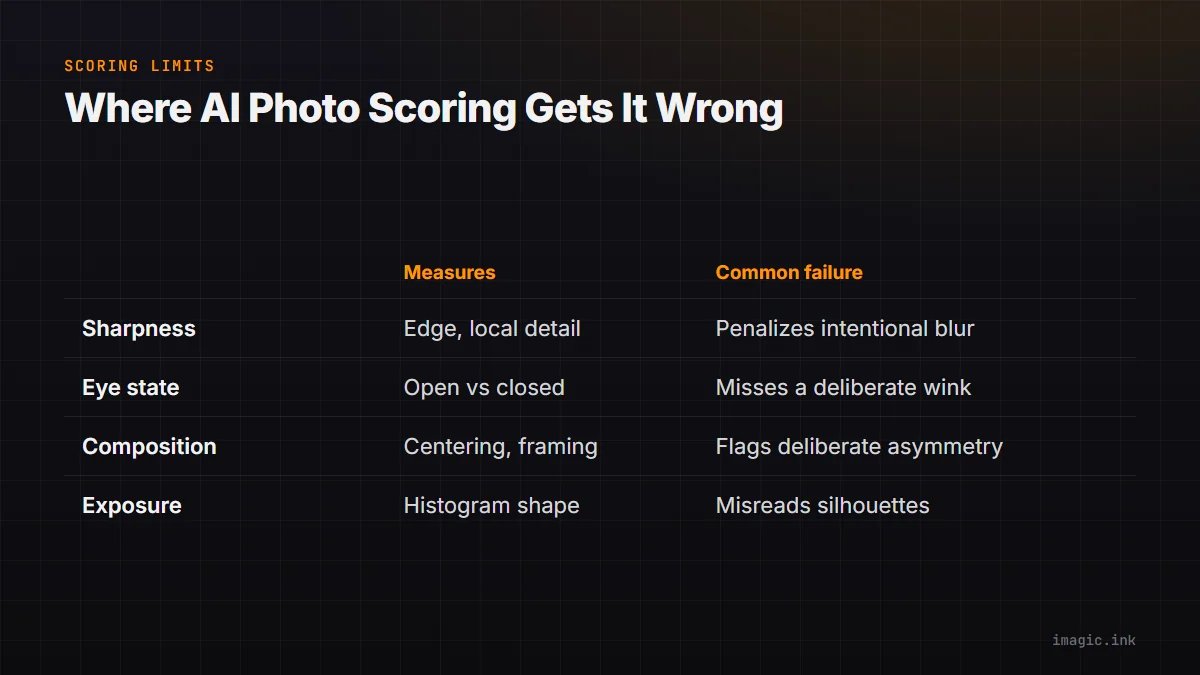
| Signal | What it measures | Common failure mode |
|---|---|---|
| Sharpness | Edge contrast and local detail | Penalizes intentional motion blur, shallow depth of field, or soft focal points that are creatively correct |
| Eye state | Open versus closed or mid-blink | Cannot tell a genuine blink from a deliberate slow blink, a wink, or eyes closed in laughter |
| Composition | Centering, horizon, basic framing | Flags off-center or asymmetric compositions that are deliberate artistic choices, not mistakes |
| Exposure | Histogram shape and clipping | Penalizes intentionally high-key, low-key, or silhouette images that are correctly exposed for the effect |
A few specific scenarios are worth calling out because they trip up almost every scoring system, not just one product's implementation:
- Creative or environmental blur. Panning shots, long-exposure water or light trails, and intentional camera movement will often score as "unsharp" even though the blur is the entire point of the image.
- Backlit and silhouette work. A subject shot against a bright window or sunset, correctly exposed for the highlights, will have a shadow-heavy histogram that a naive exposure check can misread as underexposed.
- Off-center and negative-space compositions. Editorial and fine-art work frequently places the subject at the edge of the frame on purpose. A composition score built around centering will not understand that.
- Low light and high ISO grain. Grain and noise can be misread as softness by sharpness detectors, especially in dim venues like receptions or dance floors.
- Group shots with many faces. When ten people are in frame, "did anyone blink" becomes a much harder problem than single-subject portraits, and the odds that at least one face fails the eye check rise fast, even though the overall photo may be perfectly usable.
None of this means the scoring is broken. It means the scoring is doing exactly what it was built to do: flag technical properties. Whether those properties matter for a given frame is a judgment call that still belongs to the photographer.
How Accurate Is It, Really
Accuracy is a slippery word here because it depends entirely on what you are asking the system to be accurate about. Sharpness and eye-closure detection on a well-lit, front-facing subject are technically well-defined problems, and modern implementations handle the common case reliably. Composition and "is this a keeper" style judgments are not well-defined problems at all, since they depend on context the software cannot see: the client's brief, the story the sequence is telling, the mood of the shoot.
A useful way to think about it: treat the score as a fast, tireless first pass that is very good at catching the objectively bad frames (genuinely misfocused, genuinely blinked, genuinely blown out) and mediocre at ranking the genuinely good ones against each other. That asymmetry is actually the useful part. Culling a 3,000-frame take down to the 200 that are technically sound is the tedious, low-judgment work AI scoring is well suited to accelerate. Deciding which 80 of those 200 tell the best story is still a human editorial call.
It also helps to understand that scoring is comparative within a set more than it is absolute. A "7 out of 10" sharpness score on one shoot and a "7 out of 10" on a completely different shoot, different lens, different light, are not directly comparable numbers. Within a single burst or a single session, though, relative ranking tends to be far more reliable, which is exactly the use case (find the sharpest frame in this burst of twelve) that culling tools are built around.
Reading the Histogram Alongside the Score
Quality scores compress a lot of information into one number or one star rating, which is convenient but lossy. For exposure specifically, looking at the underlying histogram gives a far more precise read than trusting an exposure score in isolation, especially for scenes with intentionally uneven lighting. A histogram shows exactly where the tonal information sits and whether clipping is happening in the highlights, the shadows, or both, which is the kind of detail a single aggregate score has to throw away to stay simple.
The same logic applies to the other signals. A composition flag is a prompt to look at the frame again, not a verdict. A sharpness score attached to a burst is most useful as a way to jump straight to the sharpest candidate in that burst rather than scrubbing through all twelve frames manually. Used that way, the score saves the tedious part of the work and leaves the judgment calls to the person who actually understands the assignment.
Building AI Scoring Into a Real Culling Workflow
The practical way to use AI photo scoring well is to treat it as a sorting and flagging layer, not a final decision-maker. A workflow that holds up across genres tends to look something like this:
- Let the software group bursts and duplicates first. This is the least judgment-dependent step and the one where automation earns the most trust: near-identical frames genuinely are near-identical, and grouping them saves real scrolling time.
- Sort within each group by score, not across the whole shoot. Ranking within a burst of near-duplicates is where scoring is most reliable, since the frames share the same light, subject, and framing.
- Review anything flagged for closed eyes or low sharpness before rejecting it. A quick visual check catches the deliberate blinks, the intentional blur, and the backlit frames that a pure numeric threshold would wrongly discard.
- Use exposure and composition flags as prompts, not automatic deletions. Set the software to surface low scores for review rather than auto-rejecting anything below a threshold, particularly for genres with more creative latitude like documentary, street, or fine-art work.
- Keep the final pass human. Even after AI-assisted culling narrows a shoot down substantially, a quick pass through the surviving set is worth the time before batch editing and export.
In imagic specifically, this maps to the way the culling screen is built: quality scores and duplicate groups populate a filterable grid, but nothing gets deleted automatically. The photographer sees the flags, sees the underlying frames, and decides. Combined with scene detection that groups shots by setting and subject, the scoring layer turns a multi-thousand-frame take into something that can be reviewed in a fraction of the clicks, without pretending the software understands the story being told.
What This Means for Different Genres
Accuracy expectations should shift with the type of work. Wedding and event photography, where the goal is largely technical (in focus, eyes open, correctly exposed), is where AI scoring earns its keep the fastest, since most of the take is genuinely disposable near-duplicates and a smaller set of technically clean keepers. Portrait and headshot work benefits similarly, since eye state and sharpness on a single dominant subject are exactly the well-defined problems scoring handles best.
Landscape, architectural, and fine-art work is where scoring needs the most skepticism. Long exposures, deliberate blur, unconventional framing, and extreme dynamic range scenes are common in these genres and are also the scenarios most likely to be misread by a general-purpose quality model. In practice this means leaning harder on the software's grouping and organizational features (getting bracketed exposures and near-duplicate compositions clustered together) and less on the raw quality score as a keep-or-reject signal.
Sports and wildlife sit somewhere in between: sharpness and subject-in-focus detection are genuinely useful given the sheer volume of near-identical burst frames a long lens produces, but composition scoring struggles with off-center action and unconventional crops that are often the most compelling frames in the set. The underlying exposure scoring component follows the same logic across genres: reliable at flagging clipped or blocked frames, less reliable at judging whether a deliberately dramatic exposure choice was the right call.
Frequently asked questions
Can AI photo scoring replace manual culling entirely?
No. It is reliable at grouping duplicates and flagging objectively soft or blinked frames, which removes most of the repetitive work, but it cannot judge story, emotion, or creative intent. A human pass on the surviving set is still the right final step for client-facing work.
Why did a sharp, well-composed photo get a low score?
Scoring measures technical signals like edge contrast, histogram shape, and face-region focus in isolation from context. Intentional blur, silhouettes, off-center framing, and unconventional exposure choices commonly trigger low scores even when the photo is correctly executed for its creative intent.
Does AI scoring work the same way across all software?
The general approach (sharpness detection, eye-state checks, exposure analysis, duplicate grouping) is broadly similar across culling tools, but the specific models, thresholds, and how much control photographers get over the process vary considerably between products. It is worth checking whether a given tool lets you review flagged frames before anything is deleted or rejected automatically.