
Generative AI changes professional photography less by eliminating the camera than by changing what clients consider necessary, editable, and provable. Some visual concepts can begin as synthetic exploration. Some production problems can be solved after capture. Some low-risk assets may never require a shoot. At the same time, photographed evidence, access to real people and places, product truth, live events, and accountable authorship become more valuable when an image's origin cannot be assumed.
No credible article can assign one market-share or job-loss number to this transition without a defined dataset and date. The impact varies by genre, client, jurisdiction, budget, distribution, and tolerance for synthetic content. A useful response is operational: specify what must be captured, what may be generated, who approves changes, how rights are cleared, and how the final asset communicates its history.
The brief now needs an origin requirement
Traditional briefs specify subject, message, location, format, usage, and delivery. A modern brief should also state origin constraints. Must the scene, person, product, and event have existed as depicted? Are generated backgrounds allowed? Can objects be removed or added? May a person's likeness be synthesized or substantially altered? Does the client need capture evidence or Content Credentials?
These questions are not only ethical. They affect casting, releases, location access, insurance, product claims, schedule, retouching, and legal review. A campaign selling the appearance of a real product may have stricter truth requirements than a clearly fantastical editorial illustration. A news image, scientific record, or documentary archive has different boundaries again.
Put the answers in the statement of work. Define "retouching," "composite," and "generated" for that project. Specify who can request an exception and who approves it. Ambiguity discovered after delivery is more expensive than a direct conversation before production.
Preproduction becomes faster and more complicated
Generated images can help explore lighting, wardrobe, set geometry, color, and framing before a shoot. Used as rough visual discussion, they can reveal disagreements early. They can also create impossible expectations: physically inconsistent reflections, unavailable architecture, unbuildable props, or a model pose that cannot be reproduced safely.
Label concept images as concepts. A treatment should distinguish mood reference from promised final composition. The producer, photographer, stylist, retoucher, and client should identify which features are practical targets and which are only atmospheric. If a synthetic reference includes a recognizable person, protected design, brand element, or private property, rights questions may arise even before publication.
Use previsualization to ask better production questions rather than to hide uncertainty. Where must a reflection be created on set? Which shadow establishes scale? Is the proposed camera position possible? Which material cannot be simulated convincingly under the approved alteration policy? The camera plan becomes more precise when the concept is interrogated.
Capture gains value where reality is the product
Events, sport, journalism, documentary work, live performance, evidence, and access-driven portraiture derive value from being present. Generative systems can imitate visual conventions, but they cannot retroactively witness a particular moment. The photographer's access, timing, consent process, caption accuracy, and preservation of originals become part of the deliverable.
Commercial work also retains reality requirements. A customer may need to see the exact product, texture, fit, location, or person. Regulated categories can restrict misleading depiction. Even when a generated variation is allowed, a verified capture can anchor geometry, color, branding, and claims.
This does not make capture immune to change. Clients may request fewer physical variations and more post-production versions. Photographers may need cleaner plates, lighting references, wider safety frames, material detail, depth information, or locked camera views to support approved downstream work. The capture list should reflect the intended transformation.
Retouching shifts from correction to asset construction
Traditional retouching already includes compositing, cleanup, reshaping, and color work. Generative tools can accelerate some selections, extensions, removals, and ideation, but they also make large semantic changes easier to request. The relevant boundary is not whether AI touched the file; it is whether the image still makes the claims the client and audience are entitled to infer.
Maintain layers or equivalent editable history where the production tool supports them, plus the original capture, approved intermediate, and final master. Record which regions were generated or materially reconstructed. Review hands, text, logos, reflections, repeated structure, product geometry, and background continuity. Plausible output can still be wrong.
Do not treat speed of generation as permission to expand scope without agreement. Every variation still needs art direction, rights review, quality control, color management, and delivery naming. Define how many concepts and revision rounds are included.
Rights and licensing move closer to the camera team
Contracts should identify who supplies the generative tool, who accepts its terms, what inputs may be uploaded, and who carries risk for the output. Training-data disputes, likeness rights, trademarks, design rights, confidentiality, and model releases can intersect. Rules vary by jurisdiction and continue to develop, so qualified legal advice may be necessary.
A photographer should not upload confidential client frames, unreleased products, or restricted likenesses to a service merely because a feature is convenient. Review current provider terms for input use, retention, training, subprocessors, and deletion. Consumer and enterprise terms may differ.
License language also needs to cover derivatives. If the client can generate unlimited variants from delivered photographs, that may exceed the original usage bargain. Conversely, if the photographer uses a client's protected assets to generate additions, approval and ownership must be explicit. Existing boilerplate may not answer either question.
Disclosure should follow context and consequence
A whimsical composite in an openly fictional campaign needs a different disclosure practice from an image presented as documentary evidence. Platforms, publishers, contests, clients, and regulators may set their own rules. The production should identify every applicable policy before delivery, not after an asset is challenged.
Disclosure can occur in captions, credits, metadata, Content Credentials, asset-management fields, or contractual records. No single label communicates every detail. Use plain language that distinguishes captured subject, conventional adjustment, composite construction, and generated material when that distinction affects interpretation.
Do not use disclosure as a substitute for consent. A label saying a person's body or voice was synthesized does not make unauthorized use acceptable. Likewise, an undisclosed minor cleanup is not automatically deceptive in every commercial context. The approved truth claim governs.
Provenance helps establish history, not truth
Content provenance systems can bind signed information about origin and edits to an asset. They can help a recipient inspect which organization or device made a claim and whether the bound content has changed. They do not prove that a caption is true, that a staged scene was candid, or that an unsigned image is false.
Preserve camera originals, sidecars, exports, release records, and a clear custody path. When a client requests Content Credentials, confirm which camera and software stages preserve or add them, and test the exact delivery transformations. Screenshots, social recompression, and unsupported applications can affect what remains available.
Provenance is strongest when paired with accountable practice. Accurate captions, secure storage, controlled access, and documented edits give the signed claims substance. A badge without a trustworthy workflow is only a technical signal.
Differentiate through production reliability
Style alone is easier to imitate than access, trust, direction, subject rapport, location knowledge, lighting control, and consistent delivery. Professional value increasingly includes the ability to decide which parts of a brief should be photographed, generated, licensed, or rejected. That advisory role can prevent expensive or reputational mistakes.
Build portfolios that show complete assignments, not only isolated visual effects. Explain the constraint solved: real product color, live timing, a difficult location, sensitive access, repeatable lighting, or a defensible documentary process. Keep captions factual and avoid unsupported claims about automation or turnaround.
Develop adjacent fluency without pretending every role is the same. A photographer can understand prompting, compositing, provenance, and data policy while collaborating with specialist retouchers, producers, and counsel. The goal is an accountable production chain, not one person claiming mastery of every tool.
Keep non-generative automation in perspective
Not all AI-assisted photography creates synthetic pixels. Technical scoring, duplicate grouping, metadata search, masking, and style starting points can support work on captured files. Their risks center on selection bias, privacy, opacity, and overreliance rather than invented scene content. Governance should match the operation.
imagic's documented local workflow analyzes sharpness, exposure, closed eyes, composition, and near-duplicate or burst groups, with culling represented as reversible status. It can apply a user's learned style and export non-destructive edits. Those functions should not be described as generative scene creation. The desktop workflow provides product scope, and the Industry Insights section places technical change in professional context.
A clear vocabulary prevents category errors. State whether a tool selects, adjusts, composites, or generates. Clients can then approve the actual action instead of agreeing to a vague statement that "AI was used."
Adopt a project-level policy
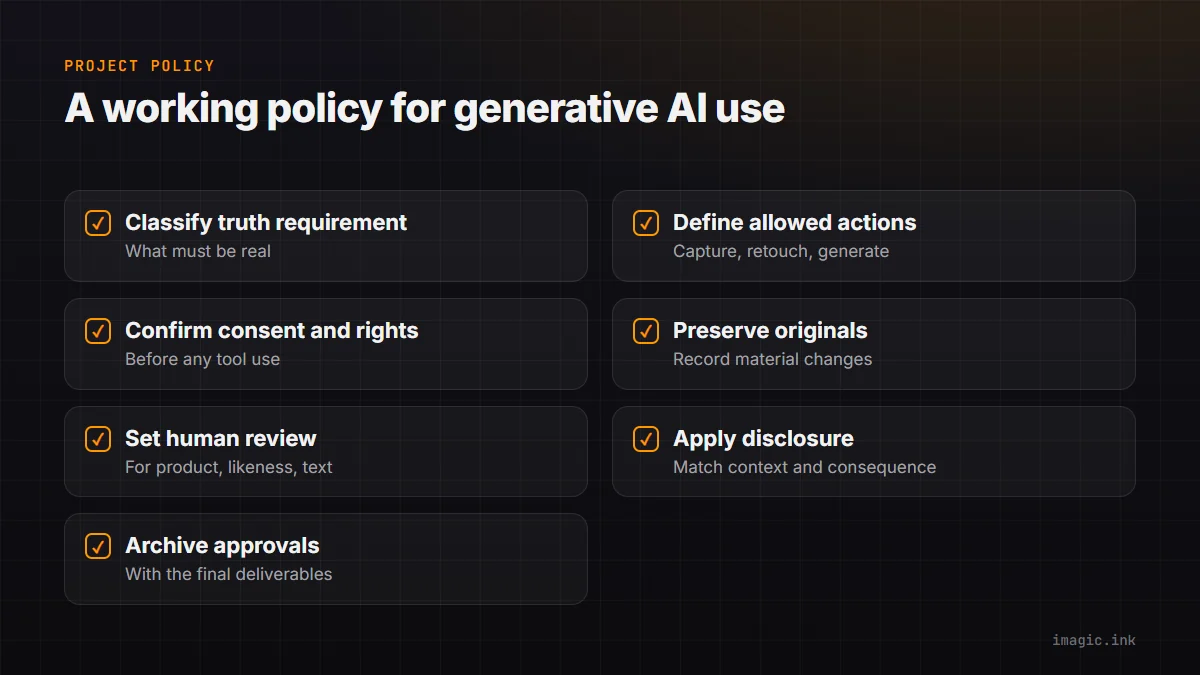
- Classify the image's truth and provenance requirement.
- Define allowed capture, retouching, compositing, and generation.
- Confirm consent, confidentiality, service terms, and rights.
- Preserve originals and record material transformations.
- Set human review for product, likeness, text, and context.
- Apply the required disclosure and provenance method.
- Archive approvals with final deliverables.
Generative AI does not create one inevitable future for professional photography. It creates a larger set of production choices. Professionals remain valuable when they make those choices visible, lawful, visually coherent, and aligned with what the image is supposed to mean.
Archive assets for future revisions and disputes
A campaign may return months later for a new crop, language, product color, or platform format. Archive the camera originals, approved generated ingredients, prompts where policy permits, model and application information exposed by the tool, edit history, releases, licenses, approvals, and final masters. Store enough context to explain the result without assuming that the same proprietary service will remain available.
Separate source, working, and delivery assets. A generated concept that was never cleared should not sit beside approved production elements with an ambiguous filename. Record which files may be reused, which are licensed only for the original campaign, and which contain a person's likeness or confidential product. Future convenience must not erase original restrictions.
Define the dispute path before publication. If a subject, rights holder, or audience challenges an asset, the producer should be able to preserve evidence, stop distribution where authorized, identify the approved transformation, and contact the responsible reviewer. A defensible archive supports correction without pretending that provenance records settle every legal or ethical question.
Frequently asked questions
Will generative AI eliminate professional photography?
No universal forecast is defensible. Synthetic assets can replace some assignments or variations, while real events, products, people, access, accountability, and verified capture continue to create distinct needs.
Should every AI-assisted photograph be labeled?
Disclosure depends on context, policy, and the materiality of the change. Define requirements before production and use plain language when origin or alteration affects interpretation.
Are Content Credentials proof that an image is true?
No. They can carry signed provenance claims and reveal certain changes, but they do not validate every caption, scene, or intention. Trust still depends on the claimant and workflow.