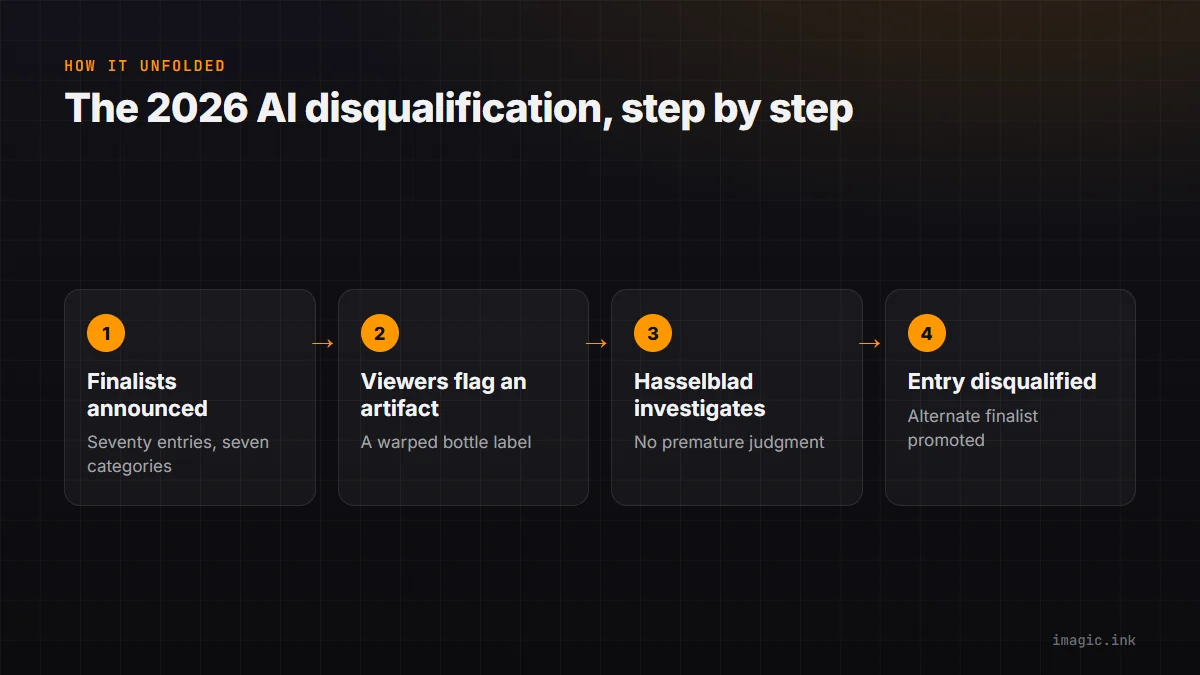
Hasselblad Masters is one of photography's higher-profile brand-run competitions, and its 2026 edition became a case study in a different kind of story. In late April 2026, the company published its shortlist of 70 finalists across seven categories. Within a day, photographers on forums and social media flagged one of the Street category finalists as apparently synthetic, pointing to a close-up of a Coca-Cola bottle with warped label text and inconsistent reflections, the kind of small detail that generative image tools still get wrong. Checked 15 August 2026: Hasselblad confirmed on 18 May 2026 that the entry violated the contest's ban on AI-synthesized images and disqualified it, replacing the finalist with an alternate chosen through the contest's internal voting process, according to PetaPixel's reporting on the disqualification.
The episode is worth walking through carefully, because it is less a story about one dishonest entrant and more a demonstration of how photo competitions currently detect synthetic images: crowd pattern-matching after publication, not verification before it. That gap is the actual subject of this article, along with what a documented alternative already exists to close it.
What Happened at Hasselblad Masters 2026
Hasselblad announced its 2026 finalists on 28 April 2026. By the next day, online commenters were pointing to one Street category entry as having the visual hallmarks of AI generation, most visibly in a Coca-Cola bottle rendered with distorted lettering and reflections that did not track with the rest of the frame. Hasselblad did not rule immediately. Asked about the accusations, the company said: "Pending the completion of the verification, we will not make any premature judgment on the compliance of individual entries. Should any violation be confirmed, the shortlisted qualification of the offending work will be revoked immediately," per the account in PetaPixel's coverage. Three weeks later, on 18 May, Hasselblad confirmed the violation and pulled the entry, promoting an alternate finalist in its place.
Entrants in Hasselblad Masters remain anonymous to the public through the finalist and judging stages, so the disqualified photographer's identity was not published in the reporting reviewed for this article, and nothing found as of the 15 August 2026 check date has changed that. What is on record is the category (Street), the tell that triggered scrutiny (the bottle close-up), and the outcome (disqualification plus replacement).
The stakes explain some of why the story traveled. Hasselblad Masters runs across seven categories (Landscape, Architecture, Portrait, Street, Art, Wildlife, and a Project//21 category for photographers 21 and younger), judged by a panel the company describes as nine photography professionals drawn from institutions including National Geographic and Getty Images. Winners receive a Hasselblad X2D II 100C medium-format body, two XCD-series lenses, a EUR 5,000 creative fund, and publication in the Hasselblad Masters book, according to the competition's own 2026 rules and prizes page. A finalist slot in a contest with that kind of prize package and brand visibility is worth enough that a synthetic entry getting through, even briefly, was always going to draw scrutiny once it reached a public gallery.
How the AI-Generated Image Was Caught
Nobody at Hasselblad ran a scanner on the finalist set before publishing it. The image was caught the way most AI-generated entries in open competitions get caught in 2026: someone looked closely at a public gallery and recognized a rendering artifact. Warped or nonsensical text on labels, packaging, and signage remains one of the more persistent tells in generative imagery, and a beverage bottle in a street photograph is exactly the kind of incidental detail a photographer would frame around instinctively but a generative model can render inconsistently because it is not reasoning about real typography, just predicting plausible-looking shapes.
That detection path matters because it is fragile. It depends on the artifact being visible, on someone noticing it, on that person having enough of a public platform to be heard, and on the tell surviving whatever compression a competition applies to submitted JPEGs. A cleaner generation, a smaller or less legible piece of incidental text, or a category where viewers aren't primed to scrutinize logos and signage could plausibly have gone unflagged. None of that is confirmed about this specific case; it is a structural observation about why crowd-sourced detection is inherently inconsistent, not a claim that this particular image was a close call.
What Hasselblad's Contest Rules Actually Say About AI
Hasselblad's 2026 competition rules page states that entries must be genuine photographic work and explicitly prohibits AI-synthesized images, requiring participants to guarantee "the authenticity of their information and the originality of their entries." The rules describe violators as facing disqualification and legal responsibility, language that is the contest's own terms rather than a court finding, and it is worth reading as a strong deterrent clause rather than evidence that legal action has actually been taken against anyone.
The rest of the entry requirements give useful context for how a synthetic image could plausibly slip past an initial screen: submissions are grouped in threes per category, delivered as JPEG files under 10MB at 300 dpi or higher, with no watermarks or signatures, and images from any camera brand or film format are eligible except work shot on drones, smartphones, or tablets. There is no metadata-verification step described in the public rules, no mention of requiring original RAW files on submission, and no reference to Content Credentials or C2PA in the rules text reviewed for this piece. The screening that exists appears to happen at the human judging stage, and, as this incident shows, sometimes after finalists are already public.
The Verification Gap: Self-Attestation Versus Technical Proof
Strip away the specifics of one bottle in one street photograph and the mechanism underneath is a familiar one across creative competitions: entrants attest that their work follows the rules, judges evaluate on visual and creative merit, and the burden of proving a violation falls on whoever notices something wrong after the fact. That works reasonably well when the concern is plagiarism or a previously published image, because reverse image search and prior-publication checks are mature tools. It works far less well against generative synthesis, where the "evidence" is a rendering artifact that a good enough model simply will not produce.
This is an inference rather than a fact reported by Hasselblad or PetaPixel, but it follows directly from the timeline: roughly three weeks passed between the public accusation and the confirmed disqualification, and confirmation depended on a visible artifact existing in the first place. A structural fix would move verification earlier and make it less dependent on a viewer's eye for label typography, which is exactly the gap that cryptographically signed provenance metadata is designed to close.
Why Content Credentials Are the Structural Fix, and Their Limits
Content Credentials, built on the C2PA standard, work by attaching a cryptographically signed record to an image at capture or edit time, noting what device or software produced it and what changed at each step afterward. The Content Authenticity Initiative describes the goal as something closer to "a nutrition label for digital content" than a verdict: the credential documents origin and edit history and makes later tampering detectable, but it deliberately does not declare whether an image is "real," according to the CAI's explanation of how the technology works. Readers can check a credential themselves through the CAI's public verification tool. The imagic blog's cluster page on which cameras and apps currently support Content Credentials covers the growing list of hardware and software that attach these credentials, and is the deeper reference for how the standard actually gets applied in a real camera-to-export workflow, which is directly relevant background for a competition rules debate like this one.
Two limits matter here and are easy to overstate in either direction. First, absence of a credential is not proof an image is fake; most cameras and most editing software in active use still do not attach one, so an uncredentialed street photograph is normal, not suspicious. Second, a credential's presence is not an unbreakable guarantee either. In September 2025, a researcher demonstrated that Nikon's C2PA-enabled Z6III could be tricked into attaching a valid, signed credential to a doctored image by exploiting the camera's multiple-exposure blending feature to overlay outside content onto an in-camera frame, an attack path documented by Nikon Rumors and confirmed by Nikon, which suspended its Authenticity Service and revoked certificates issued during the affected window while it worked on a fix, per PetaPixel's follow-up reporting. That was a weakness in one camera's implementation of a specific in-camera feature, not proof that C2PA's underlying cryptography was broken, and it is covered in more depth on imagic's Nikon Z6III C2PA incident page. The honest summary for a competition context is that Content Credentials would give judges a documented signal to check before publishing finalists rather than nothing at all, not a system that makes disqualification cases like this one impossible.
What This Means If You Enter Photo Competitions in 2026
Read the specific rules of whatever competition is in front of you rather than assuming a general industry standard, because wording varies. Hasselblad's ban targets AI-synthesized images specifically, and the distinction most contests are drawing in 2026 is between generative synthesis, meaning content a model invented, and conventional editing, meaning tone, color, dodge-and-burn, or cropping work performed on a real capture. Heavy generative-fill sky replacements or object removal that fabricates detail can fall on the wrong side of that line even when the base frame was genuinely captured, so if a rule bans "AI-synthesized" or "AI-generated" images without further definition, treat any generative-fill step as a risk worth clarifying with the organizer before entering.
This is not a Hasselblad-specific problem. Any competition that accepts anonymous submissions, judges on visual merit, and relies on entrants to self-attest originality is exposed to the same detection lag, whether the prize is a medium-format camera or a smaller regional award. The specific tell in this case, a warped bottle label, will not be the tell that catches the next one; generative tools improve, and the categories most exposed are the ones, like street and travel photography, that are built around incidental real-world detail (signage, packaging, crowds, reflections) rather than a single controlled subject a model can render more convincingly. None of that is a claim about how common undetected synthetic entries are across the industry, since there is no reliable way to measure images nobody has flagged; it is a structural read on why this kind of incident is more likely a recurring category of story than a one-off.
Keeping an intact record of what a camera actually captured is useful independent of any one contest's rules, and that is a workflow question more than a legal one. A desktop tool that keeps original RAW files untouched while culling and grading a shoot, such as imagic's local batch editing on CR2, CR3, NEF, ARW, RAF, ORF, RW2, DNG, and PEF files on the desktop app, gives a photographer an unmodified original to point back to if a submission is ever questioned, because none of its culling or editing commands overwrite or delete the source file. That is a workflow safeguard, not an authenticity certificate: imagic does not attach Content Credentials or C2PA metadata to exports, and it has no feature that checks whether an image is AI-generated, so it is not a fit for anyone specifically looking for a provenance-verification tool rather than a culling and editing one. For that need, the camera and software support tracked on the Content Credentials cluster page above is the more relevant starting point.
Frequently Asked Questions
What exactly gave away the AI-generated Hasselblad Masters finalist?
Online commenters pointed to a close-up of a Coca-Cola bottle in the Street category entry, where the label text was warped and reflections did not match the rest of the frame, a rendering pattern commonly seen in generative image tools when they encounter real-world text and packaging, per PetaPixel's reporting.
Did Hasselblad name the disqualified photographer?
No. Hasselblad Masters keeps entrants anonymous to the public through the finalist stage, and the reporting reviewed for this piece did not identify the photographer. As of the 15 August 2026 check date, nothing found publicly changes that; the confirmed facts remain the category, the artifact that triggered scrutiny, and the disqualification-plus-replacement outcome.
Would a Content Credential have stopped this automatically?
Not automatically, and it is worth resisting that framing. A missing credential is not proof of AI generation, since most cameras in use do not attach one at all, and a present credential is not an unforgeable guarantee either, as the Nikon Z6III multiple-exposure exploit showed for one camera's implementation. What a credential does add is a documented, checkable record judges could inspect before finalists go public, shifting detection earlier than waiting for a viewer to spot warped label text after the fact.
Does Hasselblad allow any AI-assisted editing, or is it a total ban?
The 2026 rules published by Hasselblad prohibit AI-synthesized images and require entrants to guarantee the authenticity and originality of their work, but the public rules text reviewed for this piece does not spell out a line-by-line list of which conventional edits (exposure, color, cropping, spot removal) remain acceptable versus which AI-assisted tools would count as synthesis. Photographers entering should treat any generative-fill, sky-replacement, or object-fabrication step as a compliance question worth confirming directly with the organizer rather than assuming it is covered by a general editing allowance.