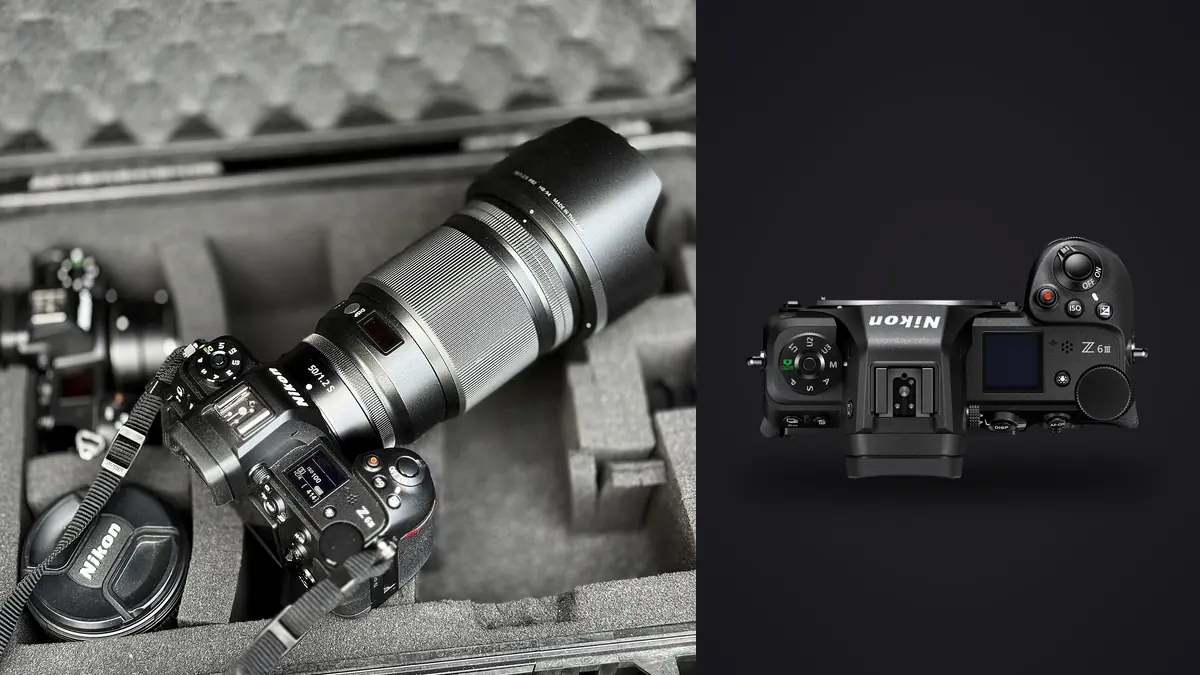
In September 2025, a reader-submitted proof of concept showed that Nikon's Content Credentials implementation on the Z6III could be tricked into signing a composite image as though it were an untouched original capture. Nikon confirmed the finding, suspended part of the authenticity service, and said it was working on a fix. Checked 15 August 2026, that suspension and remediation effort is still the reported status; Nikon has not announced that the signed-composite path is fully closed. This page separates what actually broke (a specific implementation and workflow gap in one camera's rollout of an authenticity feature) from what did not break (the C2PA cryptographic standard itself, which many other manufacturers and software vendors continue to ship against).
None of this is a reason to distrust Content Credentials as a concept, and none of it is a reason to treat the Z6III's badge as bulletproof either. The useful reading sits between those two extremes, and it matters for anyone deciding whether to buy into an authenticity workflow, whether to trust a credential they see on someone else's file, or whether to keep shooting exactly as before.
What the proof of concept actually demonstrated
Content Credentials, built on the C2PA (Coalition for Content Provenance and Authenticity) specification, work by attaching a signed manifest to an image file at the point of capture or edit. That manifest can record details such as the device used, a cryptographic hash of the pixel data, and a chain of any edits applied afterward, all signed with a certificate so a viewer can check whether the manifest still matches the file and whether it came from a trusted source. The full mechanics are documented in the C2PA specification index, and the Content Authenticity Initiative explains the consumer-facing version of the same idea on its how it works page.
Nikon built its version of this into the Z6III, described on Nikon's own Nikon Authenticity Service page and detailed in the camera's online manual entry on adding C2PA data. According to the write-up published by Nikon Rumors, citing a reader submission from September 2025, the demonstrated attack path involved constructing a composite image, in other words combining elements from more than one source, and getting the camera's signing process to attach a Content Credentials manifest to that composite as though it had come straight off the sensor with no compositing involved. If that description is accurate, the resulting file would carry a cryptographically valid Nikon signature while asserting something false about how the image was made. That is a serious problem for a feature whose entire purpose is asserting how an image was made.
PetaPixel's follow-up reporting from later that September describes Nikon confirming the issue and pausing part of the authenticity workflow rather than disputing the finding. That is the material fact worth sitting with: this was not a rumor Nikon brushed off, it was a vulnerability Nikon acknowledged.
An implementation incident, not a broken standard
It is tempting to read a headline like "Nikon's C2PA feature had a major vulnerability" and conclude that Content Credentials as a whole are untrustworthy. That conclusion does not follow, and conflating the two is the single most common mistake in coverage of this story.
C2PA is a specification. It defines a data format, a signing process, and a set of rules for how manifests should be constructed and verified. A specification can be implemented correctly or incorrectly by any given manufacturer, the same way a camera maker can implement the DNG raw format correctly or introduce a bug that corrupts metadata on write. The reported flaw was in how Nikon's Z6III firmware generated and attached a manifest during in-camera compositing-adjacent workflows, not in the C2PA signing algorithm, the certificate chain design, or the manifest schema defined by the coalition. Nothing in the reporting describes anyone forging a C2PA signature outright or breaking the underlying cryptography that C2PA relies on; the demonstrated path was getting a legitimate signer (the camera itself) to sign a claim that did not match reality.
That distinction matters practically. Other manufacturers with their own Content Credentials rollouts, including Leica's supported models listed on its Content Credentials support page and Sony's approach described in its June 2024 explainer on camera authenticity, are separate implementations of the same specification. A flaw in Nikon's signing workflow is not evidence that Leica's or Sony's implementations share the same gap, though it is a reasonable prompt to ask each vendor how their own workflow guards against the same class of problem. It is also a reminder that any C2PA implementation is only as trustworthy as the code and hardware attesting to the manifest, which is exactly the kind of thing a security researcher is supposed to go looking for.
What Nikon has said and where the fix stands
Per the PetaPixel reporting cited above, Nikon's public position after confirming the issue was that it could not fully resolve the C2PA problem on its own, a phrasing that points at the wider dependency web behind an authenticity feature: camera firmware, the C2PA specification and reference tooling, and the verification services that ultimately check a manifest are not all controlled by one company. Nikon suspended the affected part of its authenticity service rather than leaving it running with a known gap, which is the response you would want from a vendor treating this seriously rather than downplaying it.
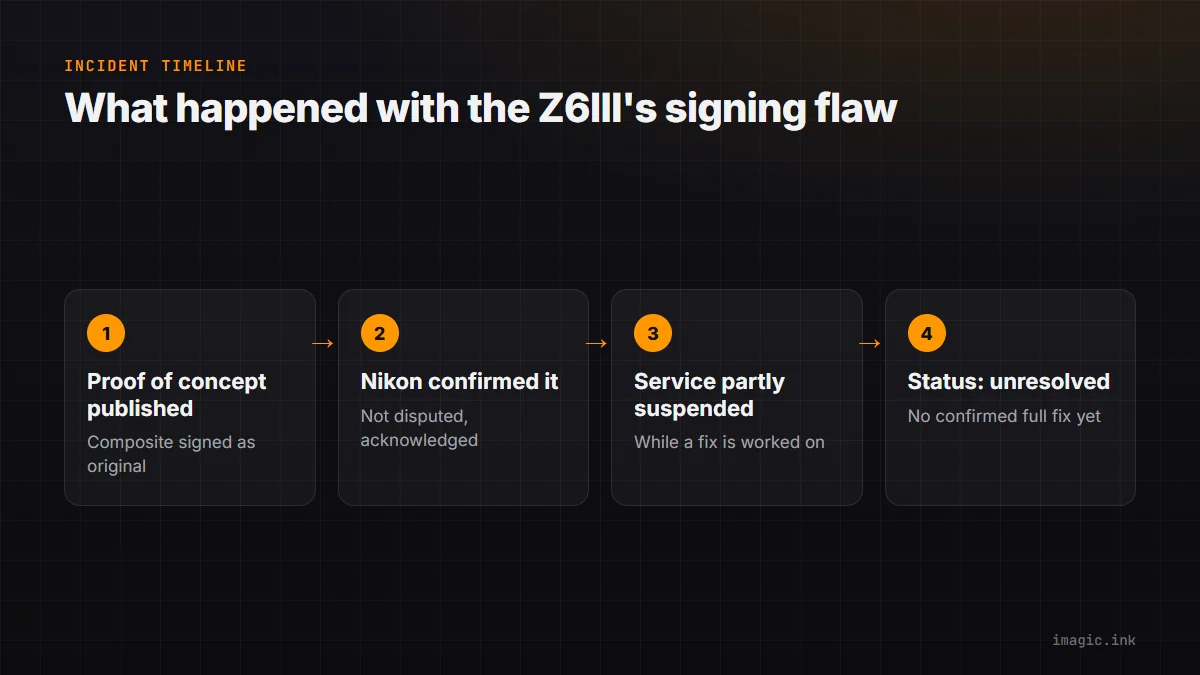
Checked 15 August 2026, no follow-up report in the sources reviewed for this page confirms that Nikon has shipped a complete fix and fully restored the affected signing path. Readers evaluating a Z6III purchase, or deciding whether to trust a Content Credentials badge on a Z6III file, should treat the feature's current status as unresolved rather than assume it has quietly been patched. If Nikon publishes a formal resolution, that would be worth checking directly on Nikon's authenticity service page before relying on the feature for anything where provenance actually matters, such as photojournalism submission requirements or contest rules that check for a Content Credentials manifest.
What a Content Credentials badge does and does not prove
The incident is also a useful prompt to be precise about what these credentials are for in the first place. A Content Credentials manifest is a provenance assertion: it states what a signer claims about an image's origin and edit history, and it lets a verifier check whether that claim's cryptographic signature is intact. It is not a general-purpose truth detector, and it was never designed to be one. The Content Authenticity Initiative's own verification tool reports what a manifest says and whether its signature validates, not whether the underlying scene actually happened the way the manifest describes.
Two consequences follow directly from that design, and both were true before the Nikon incident and remain true after it. First, a valid, unbroken signature chain tells you the manifest has not been tampered with in transit and that it came from the claimed signer, but if that signer's own capture-and-sign workflow can be fooled, as the Z6III case demonstrates, a technically valid signature can still carry a false claim. Second, and just as important for anyone building editorial or evidentiary workflows around this technology: the absence of a Content Credentials manifest is not proof that an image is false or manipulated. Most cameras in active use, most editing software, and most of the internet's existing photo archive were never going to carry a C2PA manifest in the first place, so missing metadata is the default state for the overwhelming majority of images, not a red flag on its own.
Why this matters beyond one camera model
Content Credentials adoption is expanding well past Nikon. The companion pillar on this site, which camera and app makers support Content Credentials in 2026, walks through the wider landscape of manufacturers and software vendors building against the C2PA specification, and it is worth reading alongside this page because the Nikon incident is one data point in a much larger rollout, not the whole story. The same pillar is also the right place to check whether a specific camera or app you use has published its own security track record for its C2PA implementation, since that detail changes vendor by vendor and update by update.
Authenticity infrastructure is also starting to matter for contest and publication rules, not just technical curiosity. The AI-generated finalist disqualified from the 2026 Hasselblad Masters competition, reported by PetaPixel in May 2026, is a separate incident covered in more depth on this site's page on the Hasselblad Masters AI disqualification, but it illustrates the same underlying tension: organizations are starting to lean on provenance signals to make eligibility decisions, which raises the stakes on those signals being implemented correctly. A signing bug in a camera used by contest entrants, or a verification tool that gets fooled by a composite claiming to be untouched, has consequences that go beyond an individual photographer's workflow.
What this means if you are choosing a camera or a workflow
For most working photographers, the Z6III incident changes very little about day-to-day shooting. Content Credentials is an opt-in feature layered on top of image capture, not a replacement for how a camera exposes and writes a raw file, and turning it on or off does not affect image quality or file compatibility. The practical decision points are narrower than the headlines suggest.
If your work depends on a verifiable chain of custody, for photojournalism, legal evidence, or contest submission where a missing or broken credential could disqualify a file, treat any single vendor's C2PA implementation as one input rather than the whole answer, and check that vendor's current security status before submission deadlines rather than assuming last year's announcement still holds. If you are buying a Z6III specifically for its authenticity feature, checking Nikon's own service page for a resolution notice before relying on the credential for anything high-stakes is a reasonable precaution given the unresolved status described above. If Content Credentials is not something your workflow currently uses at all, this incident is background context rather than something that requires a workflow change; the vast majority of raw processing, culling, and export work has nothing to do with C2PA signing.
It is also worth being honest about where local desktop tools like imagic sit relative to any of this. imagic is a local-first raw culling and batch-editing application for Windows and macOS; photos are processed on the machine they are opened on and are not uploaded anywhere as part of culling or editing. imagic does not attach, verify, or otherwise touch Content Credentials manifests, and it makes no claim about image authenticity or provenance. If a file arrives with a C2PA manifest attached by the camera that shot it, that manifest is metadata the camera wrote, not something imagic's culling or RAW processing pipeline creates, reads, or asserts anything about. Anyone evaluating culling software specifically for a Content Credentials-aware pipeline should check each vendor's documentation directly, since manifest handling during editing and export is a feature some tools may add and others, including imagic today, do not build around. imagic's own desktop application page describes what the software actually does with raw files locally, which is the more relevant question for most buyers than an authenticity feature it does not offer.
Reading vendor security disclosures without over- or under-reacting
The Z6III case is also a reasonably clean example of how to read a vendor security disclosure. A useful sequence is: identify who found the issue and whether the vendor confirmed it (in this case, a reader report picked up by Nikon Rumors, subsequently confirmed by Nikon per PetaPixel's reporting); identify exactly what capability was affected (the signing of composite images as unmodified originals, not the C2PA cryptography or certificate infrastructure generally); check the vendor's stated remediation status as of the date you are reading (suspended and in progress, as of the most recent reporting reviewed here); and avoid generalizing a single vendor's implementation bug into a judgment about an entire open specification used by multiple companies. Skipping any one of those steps is how a specific, fixable engineering incident turns into an inaccurate blanket claim that "Content Credentials don't work," which overstates the problem, or a false sense that the issue has quietly gone away, which understates it.
Frequently Asked Questions
Did the Nikon Z6III vulnerability break C2PA's cryptography?
No. Based on the Nikon Rumors report and Nikon's confirmation covered by PetaPixel, the demonstrated issue was in how the Z6III's implementation signed composite images, not in the C2PA specification's cryptographic signing or certificate model. The specification itself, documented at spec.c2pa.org, was not shown to be broken; a single manufacturer's implementation of it was.
Is the Nikon Z6III's Content Credentials feature safe to use now?
Checked 15 August 2026, the most recent reporting reviewed for this page describes the affected part of Nikon's authenticity service as suspended while Nikon works on a fix, with no confirmed full resolution found in the sources cited here. Anyone relying on the feature for something high-stakes should check Nikon's own authenticity service page directly for the current status before trusting it, rather than relying on this article's date.
If a photo has no Content Credentials manifest, does that mean it is fake?
No. A missing manifest is the default state for nearly every photo in existence, since most cameras, phones, and editing tools in active use were never going to attach C2PA data in the first place. Content Credentials is an opt-in provenance assertion, not a universal detector, and its absence proves nothing about whether an image was manipulated.
Does imagic add, remove, or verify Content Credentials data?
No. imagic is a local raw culling and batch-editing tool; it does not attach, edit, strip, or verify C2PA manifests, and it makes no authenticity claims about the files it processes. Any Content Credentials data a camera wrote to a file passes through imagic's local culling and export workflow unaffected, the same way other metadata a camera embeds is preserved rather than interpreted.
Do other camera makers have the same vulnerability as Nikon?
There is no evidence in the sources reviewed here that Leica's or Sony's separate Content Credentials implementations share the specific signed-composite issue reported against the Z6III. Each manufacturer builds its own signing workflow on top of the shared C2PA specification, so a flaw in one vendor's implementation is not proof of the same flaw elsewhere, though it is a fair reason to ask any vendor how their workflow guards against a similar attack path.