A growing number of camera bodies and photo-editing programs now attach a signed record to an image describing where the file came from and what happened to it before a viewer sees it. The industry term for that record is a Content Credential, built on a technical standard called C2PA, short for the Coalition for Content Provenance and Authenticity. Checked 15 August 2026, this page is a working directory of which cameras and applications actually ship the feature, what the credential can and cannot prove, and two recent, well-documented incidents that show the gap between how Content Credentials are supposed to work and how they have actually failed in practice.
The reason this list is worth maintaining rather than treating as settled is that AI image generation has gotten good enough that a viewer's eye increasingly fails to catch a synthetic frame on its own, which is exactly the gap the two incidents further down this page illustrate from two different directions: one where the signing camera itself could be fooled, and one where an organization with no credential check at all had to rely on someone noticing a warped bottle label after finalists were already public.
The short version is worth stating plainly before the detail. A Content Credential is a signed claim, not a verdict. It records what a named source, typically a camera or a piece of editing software, asserts happened to a file: who made it, what device or program touched it, and in what order. When every link in that chain cooperates and signs correctly, a credential is a genuinely useful audit trail. When one link is compromised, careless, or simply absent, as most cameras and most software in daily use still are, the credential either carries a false claim or never existed in the first place. Neither situation means an image is automatically suspect.
This page works as a reference and a primer at the same time. The sections below list which manufacturers have a confirmed Content Credentials rollout as of the check date, with a source for each claim, followed by an explanation of how to check a credential without taking a badge at face value. Two linked pages on this site go deeper on specific cases worth understanding before trusting, or dismissing, a Content Credential encountered in the wild: a signing flaw discovered in one camera's implementation, and a photography competition whose own verification process could not catch a synthetic entry before a public gallery did.
What a Content Credential Actually Records
Content Credentials are built on C2PA, a specification maintained by a coalition whose members include major camera manufacturers, software companies, and media organizations. The current version of the specification, covering the manifest data format, the signing process, and the rules a verifier applies when checking a file, is published at the C2PA specification index. Reading the specification directly is the most reliable way to confirm a technical claim about the standard, rather than relying on a manufacturer's marketing summary of it.
In practice, a manifest attached to a file can include the device or software that produced it, a cryptographic hash of the pixel data at each recorded step, and a list of actions, edits, crops, color adjustments, AI-assisted changes, applied afterward. Each entry is tied together and signed with a certificate, so a verifier can check two separate things: whether the manifest has been tampered with since it was signed, and whether the certificate belongs to a source the verifier has chosen to trust. The Content Authenticity Initiative, the industry group that runs public-facing tools and education around C2PA, describes this mechanism in plain language on its how it works page. The manifest functions like a chain-of-custody log attached to the file, not an inspection of whether the scene depicted is genuine.
That distinction is the one most coverage of Content Credentials glosses over. A credential does not analyze pixels for signs of manipulation the way a forensic tool might. It does not confirm that a photograph depicts a real event, a real place, or an unedited scene. It confirms, assuming the signing chain behaved correctly, that a named source made a named set of claims about the file. Whether those claims are honest depends entirely on whether the signer, camera firmware, editing software, or a person operating either, told the truth when it signed. That dependency is exactly what went wrong in the Nikon incident covered later on this page.
The reverse also holds, and it matters just as much for anyone reading credentials rather than shipping them. A file with no Content Credential attached is not evidence of anything by itself. Most cameras currently in service, most editing software in daily use, and effectively the entire existing photo archive built before this standard existed carry no C2PA manifest at all, so an uncredentialed image is the default state of nearly every photograph in circulation, not a red flag.
Cameras Shipping Content Credentials in 2026
Camera-level support for Content Credentials is still a minority feature, concentrated among a small number of manufacturers who have built signing directly into specific bodies. Coverage below reflects sources reviewed for this page as of the check date; a manufacturer's support can change with a firmware update, so confirming directly with the maker before a purchase decision is worth the extra step.
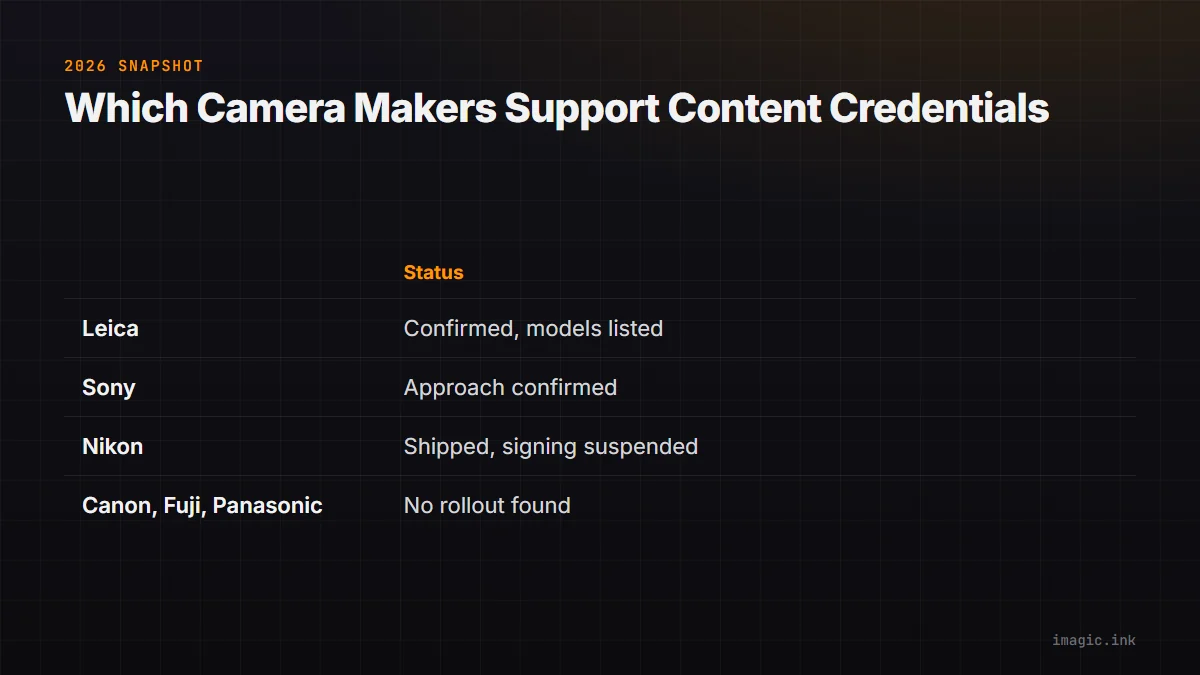
| Manufacturer | Content Credentials status (checked 15 August 2026) | Source |
|---|---|---|
| Leica | Confirmed, specific supported models listed directly by Leica | Leica Content Credentials page |
| Sony | Approach confirmed by Sony; check the current spec sheet for a given body | Sony camera-authenticity explainer |
| Nikon | Shipped on the Z6III; the affected signing path was suspended after a flaw, per Nikon's confirmation | Nikon Authenticity Service page |
| Canon, Fujifilm, Panasonic | No confirmed rollout found in sources reviewed for this page | Check each manufacturer's current support pages directly |
Leica publishes a supported-camera list on its own Content Credentials page, naming the specific bodies that ship the feature and describing how the credential is generated at capture. Because Leica maintains this as a dedicated, updated page rather than a single announcement, it is the more durable reference to check periodically as the supported list grows.
Sony has published its own explanation of a camera-level authenticity approach in a June 2024 post on the Sony company blog, describing the reasoning behind attaching signed provenance data at the point of capture, referenced here as Sony's camera-authenticity explainer. That post covers the company's intent and technical direction rather than a single model's specification sheet, so pairing it with a specific camera's current manual is the more reliable way to confirm whether a particular Sony body ships the feature today.
Nikon built Content Credentials into the Z6III, documented on Nikon's own Nikon Authenticity Service page and detailed step by step in the camera's online manual entry on adding C2PA data. Nikon's rollout is also the subject of a well-documented security incident, a signing flaw in the camera's implementation rather than a break in the underlying C2PA standard, examined in full further down this page and in a dedicated companion article linked from that section.
Sources reviewed for this page did not turn up a confirmed, currently shipping Content Credentials rollout from Canon, Fujifilm, or Panasonic as of the check date. That is a statement about what this review found, not a claim that no such feature exists or is planned; camera manufacturers announce authenticity features on their own schedules, and a body not listed here today can ship the feature in a future firmware update. Anyone choosing a camera specifically for this feature should check the maker's current product and support pages directly rather than relying on any single article's snapshot.
Camera-level support is also not always retroactive. A body that ships without Content Credentials at launch can gain the feature through a firmware update, and a body that ships with it can have that specific function suspended, as the Nikon case shows, without the camera itself being recalled or the rest of its functionality affected. Treat the table above as a snapshot rather than a permanent classification, and confirm directly with the manufacturer before a purchase decision that depends specifically on this feature.
Camera-level signing carries more weight than signing added later in an editing program, for a structural reason rather than a brand-preference one. A manifest created at the moment of capture can attest to something no later step can: that a specific device, not a person editing a file afterward, generated the very first recorded entry in the chain. A credential added downstream, in an editing application rather than in-camera, can only describe what happened from that point forward; it cannot speak to whether the file it received already contained edits made before the software ever opened it. That is one reason manufacturers building this feature into the camera body itself, rather than leaving it entirely to editing software, are treated as the more foundational layer of the ecosystem in most of the documentation cited on this page.
Where the Chain Breaks Down After the Camera
A Content Credential does not stop mattering once a file leaves the camera. Every step afterward, opening the RAW file in an editor, applying a batch preset, exporting a JPEG or TIFF, uploading to a platform, is a point where the credential either gets extended with a new signed entry, gets stripped out entirely, or survives untouched because the software handling the file has no idea the manifest is there. Which of those three happens depends entirely on whether the specific piece of software in that step is itself built to read and write C2PA data, and most photo software, culling and editing tools included, currently is not.
This matters practically because a broken chain does not announce itself. A file can arrive from the camera with a valid, signed manifest, pass through an editing step in software that silently discards metadata it does not recognize, and come out the other side with no credential at all, indistinguishable from a file that was never signed in the first place. Nothing about that process is malicious or even unusual; it is simply what happens by default when a tool was not built around this specification.
It helps to compare this to ordinary file metadata, which most photographers already work with daily. Standard EXIF and XMP fields, capture time, lens, aperture, copyright note, are easy to read and just as easy to edit or strip with common software, with no cryptographic signature protecting them from being changed after the fact. A C2PA manifest is built specifically to resist that kind of silent alteration: changing the pixel data or an entry in the manifest after signing breaks the cryptographic hash, which is what a verification tool flags as tampering. That protection only covers what happens after the manifest is signed, though. It cannot retroactively validate whether the signer's original claim, the thing being signed in the first place, was accurate.
Publishing platforms add another layer. A platform that displays a Content Credential badge to viewers has to independently support reading and rendering that data, and a screenshot of a credentialed image is a brand-new file with no relationship to the original manifest, since screenshotting recaptures pixels rather than preserving metadata. The Content Authenticity Initiative's explanation of the system covers this handoff problem directly: the standard only delivers value across a full pipeline that cooperates end to end, and any single uncooperative or unaware link resets the chain rather than partially preserving it.
How to Check a Content Credential Yourself
The Content Authenticity Initiative runs a free public tool at verify.contentauthenticity.org that reads a file's manifest and reports what it finds: the claimed device or software of origin, the recorded chain of edits, the identity behind the signing certificate, and whether the signature itself is intact. Uploading a file there, or checking a supported platform's built-in badge, is the most direct way to see what a specific image actually claims, rather than assuming a credential exists or trusting a camera's marketing description of the feature.
Reading the tool's output correctly means separating two different questions it can answer. The first is mechanical: does the signature validate, meaning has the manifest been altered since it was signed. The second is about trust: does the signing identity belong to a source worth believing. A tool can answer the first question with certainty and still leave the second one entirely up to the person checking, because a mathematically valid signature only proves the manifest has not been tampered with in transit. It says nothing about whether the original signer told the truth when it created that manifest in the first place.
The verification tool's second question, whether a signing identity is worth trusting, is usually handled through what the specification calls a trust list: a set of certificate issuers a verifier has chosen to treat as legitimate signers. A manifest signed by a certificate outside that trust list can still be technically well-formed and internally consistent, yet a verifier has no basis for treating its claims as credible. This is a design choice documented in the specification itself, and it means verification is never fully automatic in the sense of requiring no judgment at all. A verifier, whether that is a public tool, a publishing platform, or an individual checking a file, still has to decide which signers it is willing to trust before a valid signature translates into a credible claim.
A practical example makes the two-step check concrete. A file downloaded from a photographer's own portfolio site, run through the verification tool, might show a valid signature chain naming a specific camera model as the capture device and listing a single crop as the only recorded edit. The signature validating tells a reader the manifest was not altered after that camera signed it. Whether to believe the camera's claim that a crop was the only change made is a separate judgment call, resting on how much trust the reader places in that manufacturer's signing process, which is precisely the kind of judgment the Nikon case below shows can go wrong even when a certificate checks out cleanly.
That second question, whether the signer itself can be trusted to sign accurately, is exactly where the Nikon Z6III incident becomes relevant, and it is worth reading in full before assuming any single vendor's implementation is airtight simply because its signatures validate.
When the Signer Itself Is Wrong: the Nikon Z6III Incident
In September 2025, a reader submitted a proof of concept to Nikon Rumors showing that the Z6III's Content Credentials implementation could be made to sign a composite image, one built from more than one source, as though it were a single, untouched capture straight off the sensor. If that description holds up, the resulting file would carry a cryptographically valid Nikon signature attesting to something false about how the image was actually made, which is precisely the failure mode a provenance system exists to prevent.
Nikon did not dispute the finding. Per PetaPixel's follow-up reporting later that September, Nikon confirmed the issue and suspended part of its authenticity service while it worked on a fix. Checked 15 August 2026, no source reviewed for this page confirms that Nikon has shipped a complete resolution and fully restored the affected signing path. The most recent reporting available describes the feature's status as suspended and under active remediation, which is the status this page treats as current until Nikon states otherwise on its own authenticity service page.
The distinction worth holding onto is that this was an implementation incident inside one manufacturer's specific rollout, not evidence that the C2PA cryptographic standard itself is broken. The specification defines a data format, a signing process, and a verification method; nothing in the reporting describes anyone forging a C2PA signature outright or breaking the certificate chain the standard relies on. The reported flaw sat in how the Z6III's own workflow generated and attached a manifest during a specific in-camera process, which is the kind of implementation bug that can affect any single vendor's rollout of a shared specification without saying anything about the specification's soundness. Leica's and Sony's separate implementations are not shown to share this specific gap. A flaw in one manufacturer's signing workflow is not proof of the same flaw elsewhere, though it is a fair reason to ask any vendor how their own workflow guards against a similar attack path.
The full write-up, including exactly what the proof of concept demonstrated, how Nikon responded, and what to check before trusting the feature on a Z6III today, is covered in depth on this site's page on the Nikon Z6III C2PA security incident. That page is the more complete reference for anyone evaluating a Z6III purchase specifically for its authenticity feature, or trying to understand why a technically valid signature is not automatically a trustworthy one.
When an Institution Leans on Provenance and It Still Fails: Hasselblad Masters 2026
Content Credentials adoption is not only a camera-hardware story. It also shapes how institutions decide whether to trust an image at all, and a 2026 photography competition shows what happens when that decision-making process has no credential to lean on. Hasselblad published its Hasselblad Masters 2026 finalist list on 28 April 2026. Within a day, online commenters flagged one Street category entry as apparently synthetic, pointing to a close-up of a bottle with warped label text and reflections that did not track with the rest of the frame, a rendering pattern generative image tools still struggle with on incidental real-world text.
Hasselblad did not rule immediately. Per PetaPixel's reporting on the disqualification, the company said it would not make a premature judgment pending verification, and confirmed on 18 May 2026 that the entry violated the contest's ban on AI-synthesized images, disqualifying it and promoting an alternate finalist chosen through the contest's internal process.
What makes this relevant to a page about Content Credentials is what the contest's own rules do, and do not, check for. Hasselblad's published 2026 rules page requires entrants to guarantee the authenticity and originality of their work and bans AI-synthesized entries outright, but the rules text describes no metadata-verification step, no requirement to submit original RAW files, and no reference to Content Credentials or C2PA. The screening that exists happens at human judging, and in this case, detection ultimately depended on a public gallery going live and someone noticing an artifact in a beverage label after the fact, not on any credential check before finalists were published.
That sequence is a useful illustration of the gap Content Credentials are meant to close. A credential attached at the point of capture, checked before publication rather than after, would have given judges a documented signal to review instead of relying on whoever happened to be looking closely enough at a bottle in the background of a street photograph. It would not have been an infallible check, since a credential can carry a false claim if a signer is compromised, the Nikon case above is proof of that, but it would have moved the checkpoint earlier and made it less dependent on a viewer's eye for label typography.
The complete account, including what the published rules require, how the entry was actually caught, and what it means for anyone entering a photography competition in 2026, is covered on this site's page on the Hasselblad Masters AI disqualification.
What This Means for a Local, Non-Cloud Culling Workflow
Most of the culling and editing work behind a typical shoot, sorting thousands of frames, grouping bursts, grading a batch, exporting a delivery set, has nothing to do with Content Credentials at all, and turning the feature on or off at capture does not change image quality or file compatibility downstream. Still, anyone building a workflow around provenance, for photojournalism, legal evidence, or a competition with rules like Hasselblad's, needs to know where each tool in that pipeline stands.
imagic is a local raw culling and batch-editing application for Windows and macOS. Photos are processed on the machine they are opened on and are not uploaded anywhere as part of culling or editing, a distinction covered in more detail on this site's privacy checklist for culling software for anyone comparing tools specifically on that basis. imagic does not attach, strip, or verify C2PA manifests, and it makes no authenticity claim about the files it processes. Culling and grading commands are non-destructive, meaning nothing in the application deletes or overwrites an original file. That last point is a workflow safeguard rather than a substitute for a credential: keeping an intact, unmodified original to point back to is useful independent of whether that original also carries a signed manifest.
Exporting through any tool that is not itself a C2PA signer, imagic included, produces a new file, and whether an original manifest survives that step depends on how the specific software handles metadata it was not built to read. Photographers who need an unbroken credential chain end to end should confirm that behavior with each tool in their pipeline directly rather than assume any given culling or editing application preserves it by default. The camera and app coverage above is the starting point for that check; imagic's own desktop application page describes what the software does with raw files locally, which is the more relevant question for most buyers than an authenticity feature it does not currently offer.
For photographers evaluating a local culling tool for reasons unrelated to Content Credentials, such as keeping RAW files off a network entirely, imagic supports nine RAW formats (CR2, CR3, NEF, ARW, RAF, ORF, RW2, DNG, and PEF), offers AI-assisted quality scoring and duplicate grouping for large shoots, and is sold as a one-time license, Lite at EUR 19, Plus at EUR 49, Max at EUR 99, rather than a subscription, with a 500-export free trial that does not require a card. None of that is specific to authenticity or provenance, but it is the more common reason photographers choose a local-first tool in the first place, and it is worth stating plainly rather than implying imagic offers a Content Credentials feature it does not.
Frequently Asked Questions
What is the difference between C2PA and a Content Credential?
C2PA is the technical specification, maintained by an industry coalition and published at spec.c2pa.org, that defines the manifest format, signing process, and verification rules. A Content Credential is the actual signed record attached to a specific file that follows that specification. The relationship is similar to a file format and a file: JPEG is a specification, and a specific photo saved as a JPEG is the file that follows it.
Does a missing Content Credential mean a photo is fake?
No. Most cameras currently in service and most editing software in daily use do not attach a C2PA manifest at all, so an uncredentialed image is the default state of nearly every photograph in circulation, not evidence of manipulation. A missing credential simply means no signer in that file's history chose, or was able, to attach one.
Can a Content Credential be faked or bypassed?
The Nikon Z6III incident covered above shows that a signer's implementation can be tricked into attaching a technically valid, cryptographically signed credential to a claim that was not accurate, a composite image signed as an unmodified original. That was a flaw in one manufacturer's specific rollout rather than a break in C2PA's underlying cryptography, but it is a clear demonstration that a valid signature only proves the manifest was not altered after signing, not that the signer told the truth when it created that manifest.
What happens to a Content Credential when a photo passes through software that does not support C2PA?
The outcome depends on that specific piece of software, and there is no universal default. Some tools preserve metadata they do not recognize and pass a manifest through untouched; others strip unfamiliar metadata during processing or export, which silently breaks the credential chain with no warning to the person using the tool. Because the result varies by application, confirming behavior directly with each tool in a workflow, rather than assuming any single piece of software preserves a credential by default, is the only reliable way to know whether a chain survived end to end.
Does imagic support or verify Content Credentials?
No. imagic culls and batch-edits raw files locally on Windows and macOS without attaching, stripping, or verifying C2PA manifests, and it makes no authenticity claim about the images it processes. Any Content Credentials data a camera wrote into a file is metadata the camera created, not something imagic's culling or export pipeline reads or asserts anything about; photographers who need a verified provenance chain through export should confirm that specific behavior with each tool in their pipeline.