Adobe's Lightroom (1TB) plan price increase took effect on 20 March 2026. Six months on, the useful question is not a vague "did people leave," which nobody publishes reliable numbers on, but something more concrete: what actually changed, and how do you check for yourself whether staying, switching to another subscription, or moving to a one-time license makes sense for your own numbers.
This is deliberately not a survey piece. No first-party source publishes how many Lightroom subscribers switched to something else after the increase, and no independent, methodologically sound survey of that specific question turned up during research for this piece. Anything more specific than "search interest around Lightroom's price rose" would be a guess dressed up as data, so this piece sticks to what is actually checkable: what changed, what it costs in practice, and how to work out whether it matters for your own situation.
What actually changed on 20 March 2026
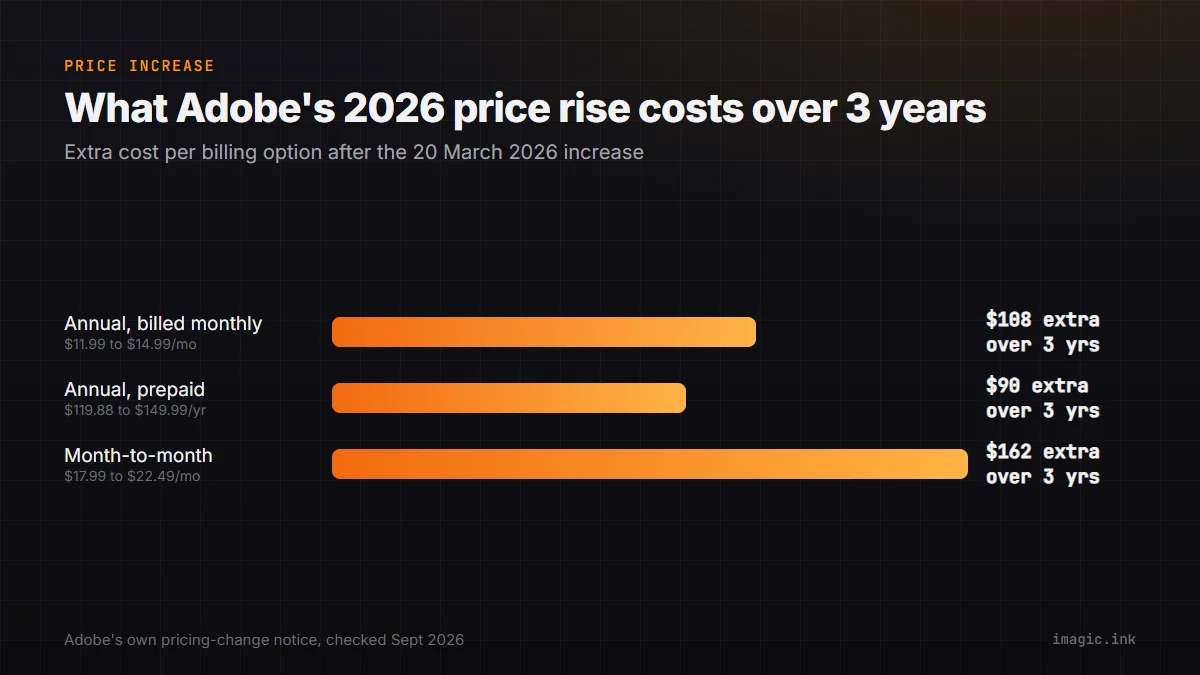
Adobe's own pricing-change notice for the Lightroom plan that includes 1TB of cloud storage documents three separate increases depending on billing option: the annual plan billed monthly rose from $11.99 to $14.99 a month, the annual plan prepaid rose from $119.88 to $149.99 a year, and the flexible month-to-month plan rose from $17.99 to $22.49 a month. Source: Adobe's Lightroom (1TB) plan pricing FAQ, cross-checked against independent pricing trackers in September 2026 that still report the same post-increase figures. Adobe's notice states the change applied both to new sign-ups from 20 March 2026 onward and to existing subscribers at their next renewal on or after that date.
One honest caveat worth stating plainly: Adobe's own live pricing page, checked directly on 16 September 2026, currently advertises the standalone Lightroom plan at $11.99 a month for new sign-ups, its pre-increase figure. Software pricing pages change without notice and sometimes show different numbers to different accounts, regions, or promotional windows at different times. The specific dollar figures in this piece are what each source stated on the date it was checked; before you make a decision based on any number here, including Adobe's own increase notice, confirm the live price on Adobe's own site the day you are ready to buy.
What the increase covered, and what it did not
Adobe's own notice was specific about scope, and the detail matters for anyone assuming it applied to their whole Creative Cloud bill. The increase applied to the Lightroom plan that bundles Lightroom, Lightroom Classic, and 1TB of cloud storage, along with the larger 3TB, 10TB, and 20TB storage tiers built on the same plan. It explicitly excluded the Lightroom Premium mobile-only plan, which kept its prior price under that specific notice. Adobe's rollout also was not limited to the United States: the notice listed dozens of affected countries, with figures adjusted for local currency and tax in each. If you are on a different Adobe plan entirely, the Photography plan that bundles Photoshop, for instance, this specific notice does not tell you what happened to your price; check your own plan's billing history directly rather than assuming the 1TB-plan figures above apply to it.
The math worth actually doing
Whatever the live sign-up price shows today, the documented increase is useful as a worked example of what a subscription price change compounds into over a few years, which is the number that actually matters for a switching decision.
| Billing option | Pre-increase price | Post-increase price | Extra cost over 3 years |
|---|---|---|---|
| Annual, billed monthly | $11.99/mo | $14.99/mo | $108.00 |
| Annual, prepaid | $119.88/yr | $149.99/yr | $90.33 |
| Month-to-month | $17.99/mo | $22.49/mo | $162.00 |
None of these totals include Adobe's occasional promotional pricing, which can temporarily lower any of these figures for a limited window, or any change in what is bundled with the plan. They are simple math on the figures Adobe's own notice documented, useful as a baseline rather than a guarantee of what any specific account pays.
What is notable about the three billing options is how evenly the increase lands as a percentage rather than a flat dollar figure: $11.99 to $14.99 is a 25.1 percent increase, $119.88 to $149.99 is 25.1 percent, and $17.99 to $22.49 is 25.0 percent. A near-identical percentage across three differently structured billing options suggests a deliberate, single across-the-board rate increase rather than three separately calculated adjustments, which is a useful thing to know if you are trying to predict what a future increase might look like rather than just react to this one.
How to check what your account is actually paying today
Given the gap between the increase Adobe documented and the headline price its own marketing page shows for new sign-ups, the only number that actually matters for your own decision is the one on your own account, not a figure from any article, this one included. Adobe's account management page shows your current plan, renewal date, and next billing amount directly, and your last few invoices show what you have actually been charged. That five-minute check is worth doing before assuming either the pre-increase or post-increase figures above describe your specific subscription, since Adobe's pricing pages, regional pricing, and promotional offers can all produce a number that differs from the general figures in any public pricing notice.
What a price increase like this does not automatically mean
It is tempting to assume a headline price increase triggers a mass exodus, but no first-party or independently audited source publishes actual switching numbers for Lightroom users, and inventing a percentage here would be exactly the kind of unsupported claim worth avoiding. What can be said honestly is narrower: the cost of staying on Lightroom went up by a specific, documented amount for a specific plan, and that is a legitimate trigger to re-run your own numbers, whether or not the market at large reacted the same way you might. A single documented increase, however real, is not by itself evidence that Lightroom became a worse deal than every specific alternative you might be weighing it against; that comparison depends on what each alternative actually costs today, not on Lightroom's price change in isolation. The honest framing is that the cost of staying put went up by a specific, checkable amount, not that staying put automatically became the wrong choice relative to whatever else you are considering.
A checklist for evaluating a switch, not a verdict
Rather than guessing at what "everyone else" did, work through what actually matters for your own files and workflow.
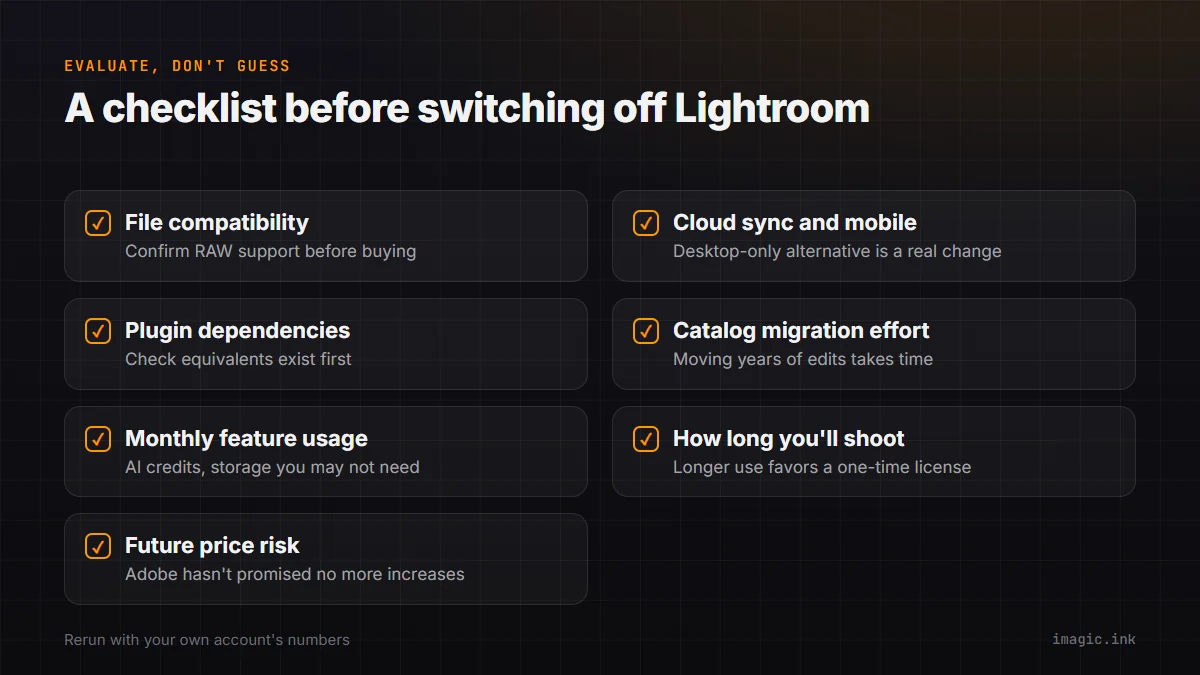
- File compatibility: confirm any alternative supports your camera's RAW format natively before committing, not after buying.
- Cloud sync and mobile editing: if you rely on Adobe's cross-device sync or the mobile app, a desktop-only alternative is a real workflow change, not just a cost change.
- Plugin and extension dependencies: if your export pipeline leans on third-party Lightroom plugins, check whether an equivalent exists before assuming you can fully replace the workflow.
- Catalog migration effort: moving years of edits, ratings, and keywords out of a Lightroom catalog takes real time; factor that one-time cost against the ongoing subscription savings.
- What you actually use monthly: generative AI credits, cloud storage, and the mobile app all cost Adobe money to run; if you do not use them, you may be paying for capacity a simpler tool does not need to replicate.
- How long you plan to keep shooting: a subscription's downside compounds with time, while a one-time license's upfront cost amortizes better the longer you use it; a six-month project and a ten-year practice should weigh this differently.
- Whether the price actually increases again: Adobe's own notice does not commit to a fixed pricing schedule going forward, and a past increase is not evidence there will not be another one; that uncertainty itself is worth weighing, not just the number that already happened.
What the search data actually shows, without overreading it
imagic's own keyword research, pulled from Google Trends related-query data around the seed term "lightroom alternative," shows both "adobe lightroom price" and "lightroom classic price" as rising search terms over the past year, alongside a broader climb across several other creative software price-related queries in the same period. That confirms people are actively searching about the cost of staying on Lightroom right now, more than they were a year ago. It does not, on its own, say anything about where those searches end up, whether that is renewing anyway, switching to a different subscription, or moving to a one-time license, and a Trends score is a measure of relative search interest, not a count of actual switches. Treat it as a sign the question is live for a lot of people right now, not as a verdict on the answer.
Where the different alternatives actually sit
"Switching off Lightroom" covers genuinely different destinations. Some photographers move to another subscription with a different price curve, covered in the existing Capture One pricing comparison. Others move to a free, open-source tool and accept a steeper learning curve, covered in the darktable comparison. And some move to a one-time-license product instead of another subscription entirely: imagic's Lite, Plus, and Max tiers are each a single purchase rather than a recurring charge, which removes the exact kind of renewal-date price change this piece is about, at the cost of imagic not offering cloud sync, a mobile app, or a plugin ecosystem the way Lightroom does. This earlier piece on leaving a Lightroom subscription walks through that tradeoff in more depth, and the Industry Insights category has more on pricing shifts like this one as they happen.
Frequently asked questions
Did the Lightroom price increase actually take effect?
Adobe's own pricing FAQ documents a price increase for the Lightroom (1TB) plan effective 20 March 2026, applying to new sign-ups from that date and to existing subscribers at their next renewal on or after it. Checked again in September 2026, Adobe's live pricing page showed its pre-increase figure for new sign-ups, so confirm the current price yourself before deciding.
How much more does the annual plan actually cost now?
Per Adobe's own documented figures, the annual-prepaid Lightroom (1TB) plan rose from $119.88 to $149.99 a year, an increase of $30.11 per year, or about $90 over three years.
Is switching to a one-time license actually cheaper?
It depends entirely on how long you plan to use the software and what features you actually rely on. A one-time purchase avoids future renewal increases entirely, but a fair comparison has to account for what a subscription includes that a one-time license typically does not, like cloud sync or a mobile app.