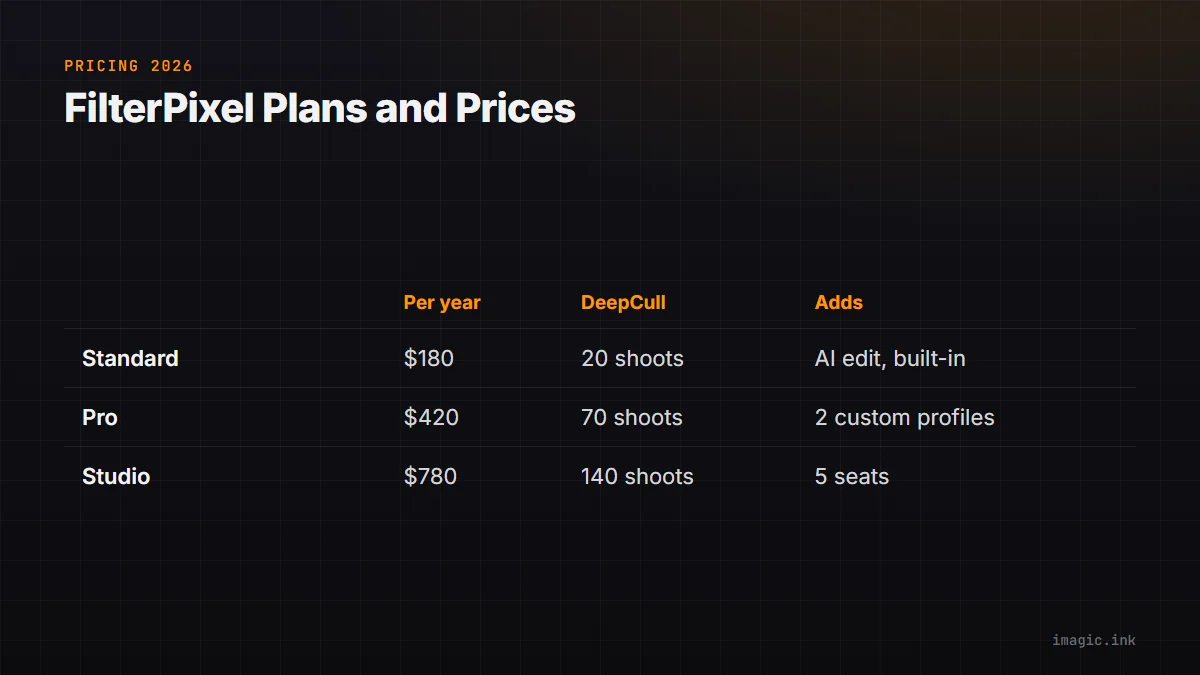
FilterPixel's pricing page is short, but two things on it decide what you will really pay: the plans are billed yearly, and the genre-aware DeepCull culling is counted in shoots rather than photos. This page lays out the three plans, how the shoot allowance works, what each tier adds, and the questions worth answering before you subscribe. Every figure comes from FilterPixel's own pricing page, checked on 26 October 2026, in USD before any sales tax or VAT.
The three plans at a glance
FilterPixel sells one app in three tiers. Each tier's monthly figure is labelled as billed annually, so the yearly total is what you actually pay up front.
| Plan | Per month, billed annually | Per year | DeepCull shoots a year | Seats |
|---|---|---|---|---|
| Standard | $14.99 | $180 | 20 | 1 |
| Pro | $34.99 | $420 | 70 | 1 |
| Studio | $64.99 | $780 | 140 | Up to 5 |
The page has an Annually / Monthly switch labelled "Save 25%", but when we checked it did not show a separate month-to-month price for any plan. If paying monthly matters to you, confirm the current monthly figure inside the app before you commit.
How DeepCull shoots are counted
FilterPixel has two kinds of culling. Basic Cull, the technical pass for blur, focus, expressions and composition with similar frames grouped, is unlimited on every paid plan. DeepCull, the genre-aware mode that gives every photo a score and a reason, is the part that is metered.
- One shoot covers up to 5,500 photos. A bigger project is split automatically, so a 10,000-photo wedding uses two shoots, and the app asks you to confirm before processing.
- Extra shoots cost $7.99 each as a one-time purchase that never expires, and they stack on top of your plan's allowance.
- Per the pricing FAQ, unused shoots from your plan do not roll over.
The practical test is to count your jobs. A photographer with 30 events a year who wants DeepCull on every one would use 30 shoots: Standard's 20 plus ten extra shoots comes to $180 plus $79.90, or about $260 a year, which is still well under Pro's $420. Pro starts to make sense when you also want its extra features, or when your shoot count is well above 30.
What each plan adds
Standard includes unlimited basic AI culling, 20 DeepCull shoots a year with all genre modes and a score and reason on every photo, AI editing with FilterPixel's built-in profiles, Lightroom and Capture One support, JPEG and RAW files, and in-app support.
Pro adds 70 shoots a year, Magic Number (the AI suggests how many frames to keep), JPEG export for same-night delivery, crop and straighten, two custom AI editing profiles trained on your own edits, and priority cloud processing. It is still one seat.
Studio adds 140 shoots a year, five custom profiles, up to five team seats with a usage dashboard, VIP support with an onboarding call, and early access to new features.
Editing has no per-photo fee on any plan. The pricing page says upgrades take effect immediately and downgrades at the end of your billing cycle.
What a year and three years cost
| Plan | One year | Three years |
|---|---|---|
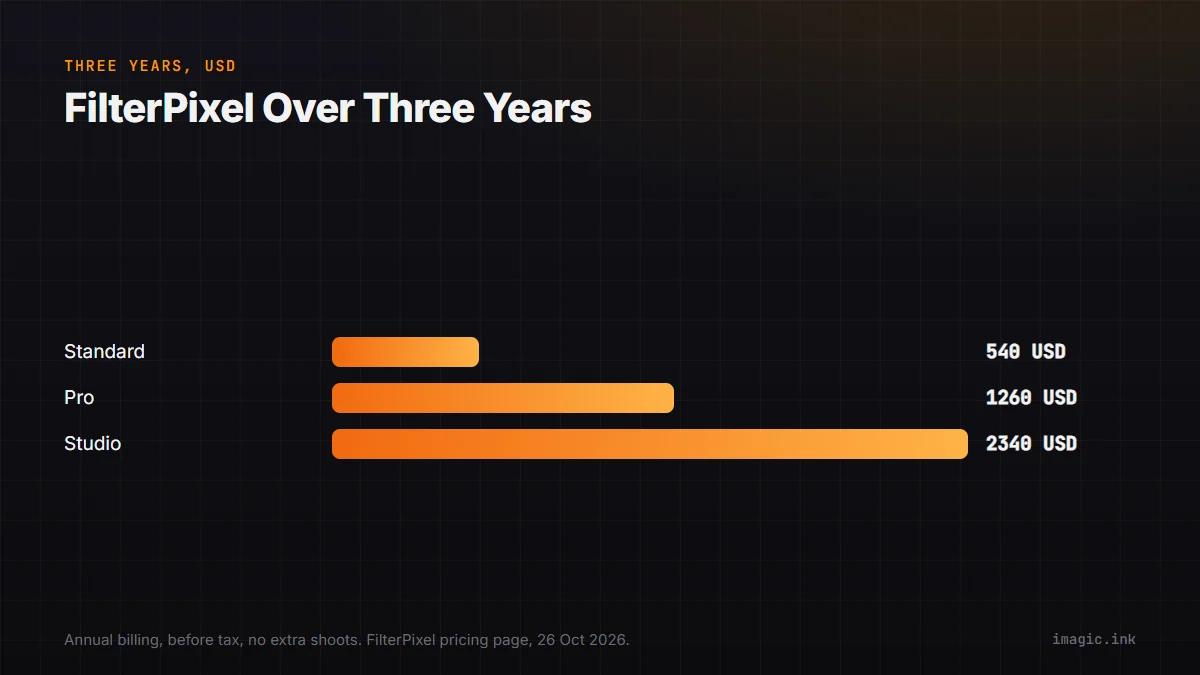
| Standard | $180 | $540 |
| Pro | $420 | $1,260 |
| Studio | $780 | $2,340 |
These assume prices stay where they are, which no subscription guarantees, and they leave out any extra shoots you buy.
The free trial
FilterPixel's home page offers four free projects with unlimited photos, and says no credit card is required. Use them on full shoots you have already culled by hand, then compare FilterPixel's picks with yours: that tells you more than any feature list.
Questions to ask before you subscribe
- How many shoots do you really do? Count last year's jobs. That number, not the feature list, usually decides between Standard and Pro.
- Are you comfortable with cloud analysis? FilterPixel says your original files never leave your computer, but DeepCull uploads each image's small embedded preview and analyses it in the cloud. Some client contracts care about that; many photographers do not.
- Do you need the editing? Every plan includes AI editing. If you only cull and already edit in Lightroom, part of the price pays for a feature you may not use.
- Does a yearly commitment fit? Billing is annual, so a quiet season does not lower the bill.
Alternatives priced differently
Aftershoot sells culling on its own, with Select from $10 a month on yearly billing, and runs its processing locally; our FilterPixel vs Aftershoot comparison sets the two price lists side by side. Narrative Select starts at $10 a month for its Lite plan, with its AI culling from the $20 Standard plan, as laid out in Narrative Select pricing.
And imagic is a one-time purchase: EUR 19, 49 or 99, with no subscription and no shoot meter. It scores sharpness, closed eyes and composition, groups bursts and duplicates, and then develops and exports the RAW files itself, all on your own machine, with nothing uploaded. It has no genre-trained mode like DeepCull and no team seats, so it is a different trade-off rather than a like-for-like swap. There is a free 500-export trial with no card; culling and editing during the trial do not count toward it. Our imagic vs FilterPixel comparison and the three-year cost of the main culling tools go further.
Frequently asked questions
How much does FilterPixel cost?
As of October 2026, Standard is $14.99 a month billed annually ($180 a year), Pro $34.99 ($420 a year) and Studio $64.99 ($780 a year), before tax.
Is there a free version of FilterPixel?
There is no permanent free plan on the pricing page. New users get four free projects with unlimited photos and no card required.
What happens if I run out of DeepCull shoots?
Basic Cull stays unlimited. For more DeepCull, you can buy extra shoots at $7.99 each, which never expire, or move up a plan. Unused shoots in your plan do not roll over.
Is FilterPixel a one-time purchase?
No. Every FilterPixel plan is a subscription billed annually. If you want AI culling with a one-time price, imagic sells licences from EUR 19 to 99.