A Subscription's Real Price Is a Three-Year Number, Not a Monthly One
A monthly figure on a pricing page is deliberately the smallest number a vendor can put in front of a reader. $20 a month reads a lot like $19 a month, right up until three years of renewals turn a six-dollar-a-month gap into more than two hundred dollars. This article does that multiplication out loud, using the vendor-published prices for the five products lined up in the AI photo culling software comparison: imagic, Aftershoot, FilterPixel, Imagen AI, and Narrative Select. That comparison covers feature depth, RAW format support, and platform availability side by side; this one takes a narrower slice, purely the arithmetic of what each option costs across three years of ownership, since three years is a reasonable span to judge a piece of studio software against before hardware or business needs shift enough to prompt a fresh decision anyway. Checked 15 August 2026: imagic's own pricing is a one-time license of 19, 49, or 99 euros for the Lite, Plus, and Max tiers, with no recurring charge after purchase; that single fact is the fixed point every subscription total below gets measured against.
None of the totals that follow are a verdict on which tool is best. A subscription that bundles cloud backup, team seats, or a client gallery is doing more than culling and editing, and paying more for it is a fair trade if those extras actually get used by the studio buying them. The point of laying the math out in the open is narrower than picking a winner: so the real three-year number is visible before a monthly price gets signed up for, rather than discovered gradually across thirty-six separate charges.
The Assumptions Behind Every Total Below
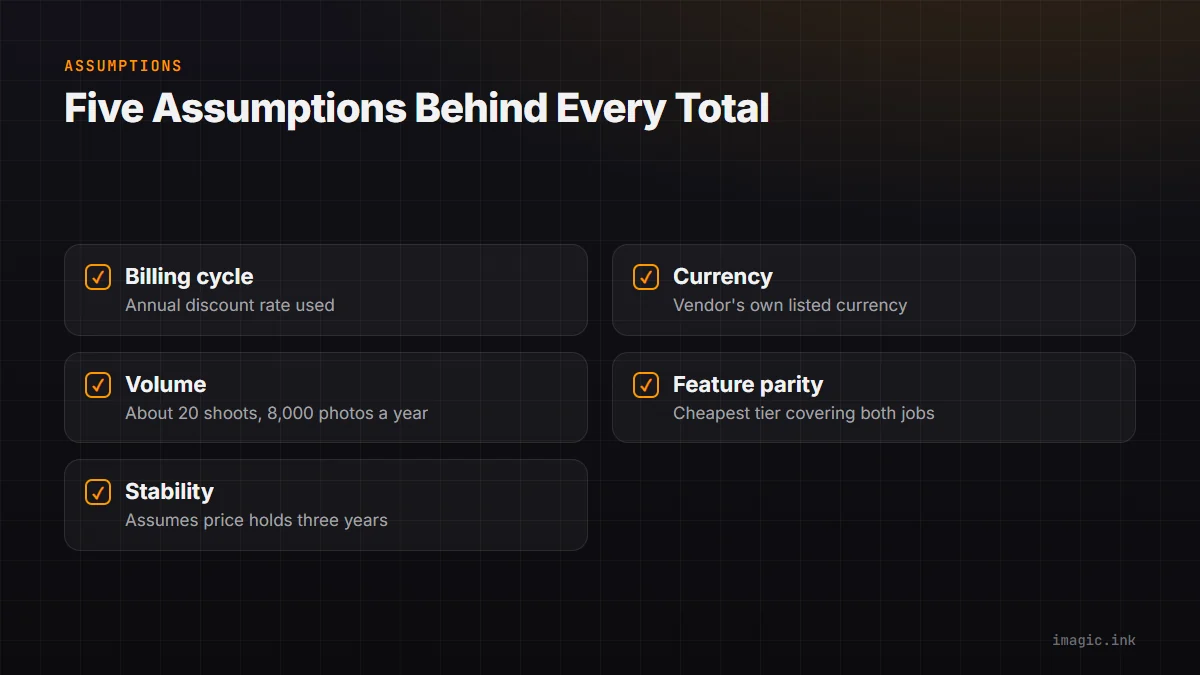
Five choices determine every dollar figure in this article, and changing any one of them changes the totals, which is exactly why they are stated up front rather than folded silently into a single number. First, billing cycle: annual billing is used wherever a vendor discounts for it, since that is the rate a subscriber actually pays after the first renewal decision, not the higher month-to-month rate advertised to a first-time visitor. Second, currency: each price is shown in the currency the vendor itself lists, euros for imagic and Imagen AI, US dollars for Aftershoot, FilterPixel, Narrative Select, and Adobe. Nothing here assumes euro-to-dollar parity; a reader comparing across currencies should apply a bank's own current exchange rate rather than treat the figures as directly interchangeable. The figures are also list prices before any local sales tax or VAT a vendor adds at checkout, which varies by billing country and is worth confirming during an actual purchase rather than assumed into a headline number. Third, volume: the main comparison table further down assumes a working middle ground of about 20 paid shoots and 8,000 photos a year, a photographer somewhere between occasional weekend work and a full booking calendar. A later section recalculates the same tools at a lighter and a heavier volume, because several of the vendors here price by shoot count or photo count rather than a single flat fee. Fourth, feature parity: the plan chosen for each vendor is the cheapest tier that plausibly covers both culling and enough editing to stand in fairly for what a single imagic purchase does, not necessarily each vendor's absolute cheapest tier. Fifth, stability: every subscription total assumes the currently published price holds for three straight years of renewals, an assumption rather than a guarantee, addressed directly in a later section about what a fixed monthly figure does not promise.
One more thing worth stating plainly: none of the figures below come from a test run, a client outcome, or a benchmark performed for this article. Every number is copied from a vendor's own current pricing page, cited at the point it gets used. A reader who wants to verify a total, or substitute a different shoot count, plan tier, or billing cycle, can follow the same links and redo the arithmetic in a few minutes. That is the actual purpose of showing the math instead of handing over a bare conclusion.
What Five Tools Cost, Straight From Their Own Pricing Pages
imagic's pricing is the simplest structure in this comparison because there is only one variable, which tier, and no second variable for billing cycle, region, or usage volume. The desktop app runs on Windows and macOS, processes photos entirely on the local machine, and covers AI quality scoring, duplicate and burst grouping, batch editing, one-click styles, and RAW processing across nine formats (CR2, CR3, NEF, ARW, RAF, ORF, RW2, DNG, and PEF) at every tier. Lite costs 19 euros once, Plus costs 49 euros once, and Max costs 99 euros once and additionally unlocks a local MCP server and command-line interface for scripting a culling or export pipeline, a detail relevant only to someone already running some form of local automation; it does not change what culling or editing costs on its own. A 500-export free trial requires no card. None of the three tiers renew, expire, or bill again after the purchase, so the three-year total is identical to the day-one total, which is the whole reason a one-time license is the anchor the rest of this article measures against.
Aftershoot separates its subscription into named add-ons rather than one all-in-one plan, and its own pricing page lists them individually: Select (culling only) at $120 a year, Edit at $360 a year, and Retouch at $240 a year, all billed annually, plus a Complete bundle covering all three at a discounted $540 a year rather than the $720 that buying Select, Edit, and Retouch as three separate charges would otherwise total. An AI Profile Bundle add-on, extra custom and instant AI training profiles, costs a further $10 a month on top of any plan, which works out to an additional $360 across three years for a studio that wants it layered onto Complete. A thirty-day free trial precedes any charge. Since imagic covers culling and editing in one purchase, Complete is the fairer comparison point rather than Select alone; at $540 a year, three years of Aftershoot Complete totals $1,620, assuming the currently advertised bundle rate is still on offer at each future renewal.
FilterPixel bundles culling and editing into every tier rather than splitting them, according to its own pricing page: Standard runs $14.99 a month billed annually ($180 a year) with an allowance of 20 DeepCull shoots a year, Pro runs $34.99 a month annually ($420 a year) with 70 shoots a year and adds same-night JPEG export plus two custom AI profiles, and Studio runs $64.99 a month annually ($780 a year) with 140 shoots a year and up to five team seats. A single shoot outside any plan's allowance can be bought a la carte for $7.99, covering up to 5,500 photos in that one project. At the 20-shoots-a-year volume this comparison assumes, Standard's allowance is used up exactly, with no buffer for a busier month, so Pro is the more realistic pick for that workload; three years of Pro totals $1,260.
Imagen AI prices culling and editing as two separate subscriptions layered onto the same account, both listed on its own pricing page and culling page. Culling costs 11 euros a month billed annually (16 euros a month billed monthly) for unlimited use. Editing has two structures: Pay-as-you-go charges from 0.045 euros per photo with a 7-euro monthly minimum, or Limitless offers unlimited editing for 109 euros a month billed annually. Imagen's own culling page states that the culling subscription "covers the pay-as-you-go monthly minimum charge," which reads as the culling fee absorbing that separate 7-euro floor rather than stacking on top of it, though a reader relying on that reading for a personal budget should confirm it directly with Imagen's support before assuming it holds in every case. At 8,000 photos a year on Pay-as-you-go, editing alone costs 8,000 times 0.045 euros, or 360 euros a year; added to 132 euros a year for culling (11 euros times 12 months), the combined total is 492 euros a year, or 1,476 euros across three years. Limitless only becomes the cheaper editing option once Pay-as-you-go charges would exceed 109 euros a month on their own, which at 0.045 euros a photo works out to roughly 2,422 photos a month, or a little over 29,000 photos a year, well above the volume assumed here.
Narrative Select is culling-only; its own quickstart guide ends each session by exporting picks into a Lightroom catalog for the actual RAW editing, so a fair three-year figure has to add a Lightroom subscription on top of Narrative's own price rather than judge Narrative in isolation. Narrative's pricing page lists four annual tiers: Lite at $10 a month ($120 a year), Standard at $20 a month ($240 a year), Premium at $40 a month ($480 a year), and Ultra at $60 a month ($720 a year), with monthly billing running noticeably higher at $15, $29, $59, and $79 respectively. Pairing Narrative Standard with Adobe's entry Lightroom (1TB) plan, currently $11.99 a month ($143.88 a year) on Adobe's own plan comparison page, brings the combined annual cost to $383.88, or $1,151.64 across three years.
Lightroom itself is not a competing entry in this comparison. Adobe's Photography (1TB) plan, which bundles Lightroom with Photoshop and 1TB of cloud storage, currently lists at $19.99 a month ($239.88 a year), for a three-year total of $719.64, with no automated culling capability included at any price. It appears in the Narrative pairing above only because Narrative's own workflow hands selects to a separate editor; none of Adobe's plans replace the culling step Narrative, FilterPixel, Aftershoot, Imagen AI, or imagic are actually built to do.
Three-Year Totals at a Working Middle-Ground Volume
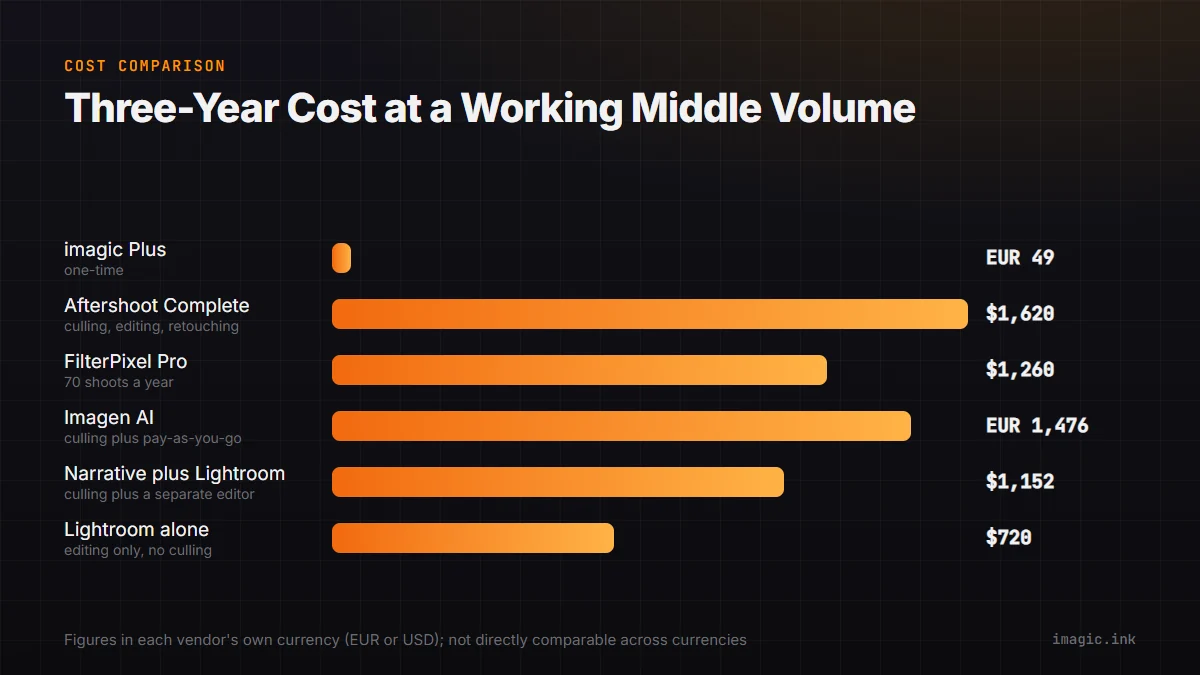
The table below applies the assumptions from the section above, about 20 shoots and 8,000 photos a year, annual billing, and the cheapest plan that fairly covers both culling and editing, to all six rows.
| Tool and plan | Annual cost | 3-year total | What it covers |
|---|---|---|---|
| imagic Plus | EUR49 once | EUR49 | Local culling, RAW editing, batch styles; one-time purchase |
| Aftershoot Complete | $540 | $1,620 | Culling, editing, and retouching bundle |
| FilterPixel Pro | $420 | $1,260 | Culling and built-in AI editing, 70 shoots/year allowance |
| Imagen AI (culling + Pay-as-you-go editing) | EUR492 | EUR1,476 | Unlimited culling plus per-photo editing at 8,000 photos/year |
| Narrative Standard + Lightroom (1TB) | $383.88 | $1,151.64 | Culling (Narrative) plus RAW editing and storage (Adobe) |
| Lightroom Photography (1TB) alone | $239.88 | $719.64 | Editing and storage only; no automated culling, shown for context |
At this middle volume, imagic's one-time EUR49 Plus license is the cheapest of the six rows by a wide margin over three years, precisely because it does not accumulate a recurring charge the way every subscription-based row does regardless of the tier chosen. That comparison only holds, though, for a photographer whose actual needs stop at local culling, RAW processing, batch editing, and one-click styles; a studio that specifically wants cloud-hosted client galleries, multi-user team seats, or a Lightroom Classic catalog is paying for something imagic does not offer at any price, and the honest read of the table is "cheapest for what it does," not "cheapest, full stop."
How the Totals Move at a Lighter or Heavier Volume
A hobbyist shooting five paid sessions and roughly 1,500 photos a year changes two of the six numbers meaningfully. FilterPixel's a la carte option, $7.99 per shoot, undercuts its own Standard subscription below about 23 shoots a year (calculated as $180 divided by $7.99); five a la carte shoots costs $39.95 a year, or $119.85 across three years, well under any annual subscription tier from any vendor in this article. Imagen AI's Pay-as-you-go editing drops to 1,500 times 0.045 euros, or 67.50 euros a year, plus the 132-euro annual culling fee, for a combined 199.50 euros a year, or 598.50 euros across three years. imagic's one-time price does not move at all, since it is not priced by volume; Aftershoot's and Narrative's flat annual tiers likewise stay fixed regardless of how light the year actually was, which is a real drawback of a flat-fee subscription at low usage. A studio paying $540 a year for Aftershoot Complete but only shooting five sessions is paying the same rate as one shooting sixty.
A full-time studio running roughly 60 paid shoots and 30,000 photos a year pushes several of the usage-scaled options past their flat-fee competitors. FilterPixel's Pro allowance, 70 shoots a year, still covers 60 shoots without an upgrade, so its total holds at $1,260 across three years. Imagen AI crosses its own breakeven point at this volume: 30,000 photos a year on Pay-as-you-go would cost 30,000 times 0.045 euros, or 1,350 euros, more than the 1,308-euro annual cost of Limitless (109 euros times 12 months); switching to Limitless plus the 132-euro culling fee brings the annual total to 1,440 euros, or 4,320 euros across three years, the single most expensive figure in this entire comparison at this volume. Aftershoot's Complete bundle and Narrative's flat tiers are unaffected by volume in the same way imagic is, since both are sold as unlimited use within the chosen tier; the practical ceiling for a studio this size is less about per-photo cost and more about whether a plan's shoot allowance specifically, the constraint FilterPixel prices around, gets exceeded.
Team size is a separate axis the volume numbers above don't capture on their own. A second shooter or an editor working alongside the primary photographer changes which tier is even usable, independent of how many shoots or photos pass through it: FilterPixel's Studio tier allows up to five team seats for $780 a year, Narrative's Ultra tier supports up to four users for $720 a year on annual billing, and Aftershoot's per-seat handling for a small team is not listed on its individual-workflow pricing page at all, meaning it would need a direct conversation with Aftershoot before assuming a price. imagic publishes no separate team or multi-seat tier at all across Lite, Plus, or Max, so a studio bringing on a second editor should treat that as an open question to raise directly rather than assume either a bundled allowance or a per-seat charge.
The Cost a Sticker Price Doesn't Show
Every subscription total above assumes the currently published price holds for three consecutive years of renewals, and that assumption is not guaranteed by anything a vendor is bound to. Adobe's own Lightroom (1TB) plan price change notice, last updated 22 June 2026, documents exactly this kind of adjustment reaching an existing subscriber base after signup, not just new customers browsing the pricing page for the first time. None of the culling-specific vendors compared here have published a similarly dated price-change notice as of the check date above, but the absence of one is not a promise that a rate stays locked for three years; a subscription price is set by the vendor and can change at any renewal, where a one-time license's price is fixed the moment the purchase completes and nothing further is owed. Tier structures themselves are not fixed either: a vendor can rename, merge, or retire a plan tier between renewals, which is a separate risk from a straightforward price increase on an unchanged plan, and is worth watching for in a renewal email rather than assumed away.
Cancellation is the other cost a monthly figure hides. What happens to picks, ratings, and edits already made once a subscription lapses varies by vendor and is worth checking directly rather than assumed. Narrative's own quickstart documentation describes writing star ratings as XMP sidecar files next to the source images rather than inside a closed database, which means picks survive an uninstall or a lapsed subscription because they live with the photo files themselves rather than inside an app-specific catalog. Other vendors' cancellation terms, including what becomes inaccessible immediately versus what stays usable afterward, are documented on each vendor's own account or billing pages rather than repeated secondhand here, and are worth reading before a subscription decision rather than after one. imagic sidesteps this particular question by design: since there is no subscription to lapse, culling scores, edits, and exports made with a purchased license keep working exactly as before, with or without an internet connection, for as long as the software runs on the machine it was installed on.
Matching the Cost Model to the Workflow: Not for You If...
A lower three-year total is not automatically the right answer, and every product in this comparison, imagic included, has a genuine limitation worth weighing against its price. The table below is meant to be read alongside the cost tables above, not instead of them, since the cheapest option on paper is only a good fit once the missing features in this table turn out not to matter for a particular studio's actual client work.
| Tool | Not for you if |
|---|---|
| imagic | Cloud sync across devices, mobile capture, multi-seat centralized billing, or built-in client galleries are required, since imagic is a single-machine desktop app without any of those; it also has no layers, HDR or panorama merge, or generative retouching at any tier. |
| Aftershoot | A recurring per-year charge is unwelcome on principle regardless of bundle savings, or the studio-wide API and SDK integration in Aftershoot's enterprise tier is not needed and would rather not be paid for indirectly through a higher bundled rate. |
| FilterPixel | The DeepCull shoot allowance on a given tier is a hard cap that does not comfortably match actual shoot volume without paying a la carte top-ups, or keeping RAW files off a vendor's cloud entirely is the priority, since FilterPixel's culling pass runs through its own infrastructure. |
| Imagen AI | A predictable flat monthly cost matters more than the lower Pay-as-you-go floor at light volume, since per-photo charges scale directly with editing volume and can exceed Limitless once a studio is busy enough, and an account plus cloud upload dependency for RAW editing is unwelcome. |
| Narrative Select | A single subscription covering both culling and full RAW editing is wanted, since Narrative's own workflow exports to Lightroom for the editing step, which means a second, separate subscription cost on top of Narrative's own price. |
| Lightroom (context only) | Automated first-pass culling is the actual problem being solved for, since none of Adobe's plans include a quality-scoring or duplicate-grouping pass; Lightroom remains a capable RAW editor and library tool, not a culling competitor to the other five rows. |
A Five-Step Way to Calculate a Personal Three-Year Number
The totals above use one specific set of assumptions. Redoing them with different numbers takes about the same five steps used to build this article in the first place.
- Count actual shoots and photos per year. A rough figure from the last twelve months of invoices or a memory card log is close enough; the totals here are estimates too, not a precise forecast.
- Pick the plan tier that actually covers that volume. For a shoot-capped vendor like FilterPixel, that means checking the allowance, not just the sticker price, since exceeding it means either an upgrade or a la carte charges.
- Use the annual-billing rate, not the monthly one, if annual billing is realistic. The gap between monthly and annual pricing across the vendors above ranges from noticeable to substantial, and it compounds over three years.
- Multiply the honest annual figure by three. For a one-time license like imagic, skip this step entirely; the number does not change.
- Add anything the subscription requires but doesn't include. Narrative Select needs a separate Lightroom subscription for editing; FilterPixel and Imagen AI both assume a working internet connection for every session, which is worth factoring in for a shoot location without reliable service.
For a deeper look at how the same five tools compare on features, RAW format coverage, and platform support rather than price alone, the full AI photo culling software comparison is the companion piece to this one. A related question, whether any of these tools' cloud steps actually upload client RAW files and under what conditions, gets a dedicated answer in the cloud upload privacy checklist, and a Windows-specific look at Narrative Select's own platform support lives in the Narrative Select alternative guide. Anyone who wants to try imagic's editing engine on a single photo before committing to a trial download can do that first through the free single-photo web editor, with no install and no account required.
Frequently Asked Questions
Is a one-time license actually cheaper than a subscription over three years?
At every volume worked through in this article, imagic's one-time price came out lower than the subscription totals it was compared against, because it is the only row that does not accumulate a recurring charge. That is a fact about the specific tools and volumes calculated here, not a universal rule; a subscription that includes something imagic does not offer at all, cloud client delivery or team seats, for instance, is not a fair apples-to-apples cost comparison even if the number is higher, since the two products are not doing the same job.
Do these totals account for the euro-to-dollar exchange rate?
No. Each figure is shown in the currency the vendor itself publishes, and this article does not apply a conversion rate, since exchange rates move and a fixed conversion baked into an article would go stale the day it changes. A reader comparing a euro price against a dollar price directly should convert using a bank's current rate at the time of the actual purchase decision, not a rate assumed months earlier. A card issuer may also add its own foreign transaction fee on a purchase made in a different currency, another line item this article does not estimate and that is worth checking with the card issuer directly before a purchase.
What happens to culling picks or edits if a subscription is canceled?
It depends on the vendor and is not something this article can answer for all five products with confidence, since only Narrative Select's own documentation was specific enough to cite directly, describing star ratings written as XMP sidecar files that stay attached to the photo files regardless of subscription status. Aftershoot, FilterPixel, and Imagen AI each publish their own cancellation and account terms, and checking those directly before signing up is the safer approach than assuming picks and edits remain accessible after a lapse.
Does imagic's Max tier and its MCP server change any of this math?
No. Max is still a single one-time payment of 99 euros; the MCP server and command-line interface it unlocks are automation tools that let a separately configured AI agent trigger imagic's existing local commands, such as running a cull or export, under a human's setup and consent. Neither the MCP server nor any AI agent connected to it uploads RAW files anywhere or edits a photo by itself without that local command being invoked; it changes how imagic's existing features get triggered, not what they cost or where processing happens.