Search "Fujifilm X-T6" and most of what comes back is speculation: spec leaks, release-date guesses, and forum debate about a camera no manufacturer has confirmed. Checked 15 August 2026, a review of Fujifilm's official product and newsroom pages found no X-T6 product listing, no press release, and no published specification sheet. The X-T5 remains the current model in that line. This guide does not add another leaked-spec roundup to that pile. It separates what Fujifilm has actually confirmed about a successor, which at this point is nothing, from what is circulating as unverified rumor, and spends most of its length on a decision that matters regardless of when or whether an X-T6 ever ships: what an X-T5 owner should do with a growing RAW archive today, and how to weigh buying something else now against waiting on a camera with no confirmed date, name, or price.
What Fujifilm Has Actually Confirmed About an X-T6
Fujifilm's X-T line has used a single incrementing number since the X-T1, so enthusiast conversation about a successor almost universally assumes the next body will carry the name X-T6. That is a reasonable guess based on past naming, not a confirmed name; Fujifilm has not stated what its next X-T-series body, if and when one arrives, will be called. Checked 15 August 2026, no Fujifilm product page, newsroom post, or press kit names an X-T6, lists a sensor resolution or processor for one, or states a release window or price. Every specification, image, or date attached to "X-T6" circulating online at this point originates outside Fujifilm, not from the company itself.
That absence is worth sitting with rather than rushing past. An unannounced camera has, by definition, no confirmed sensor, no confirmed autofocus system, no confirmed video specification, and no confirmed price. Any article, including this one, that states those details as settled fact ahead of an actual Fujifilm announcement is describing a rumor as though it were a release note. The rest of this guide treats that distinction as a hard rule: Fujifilm's own official pages are the only source that counts as confirmed, and repeating that same check closer to any future announcement is the only way to know whether anything has changed.
Rumor Sites vs a Company's Own Pages: Reading Spec Leaks Without Getting Burned
Camera-enthusiast rumor sites are a real, long-running category of content, built around unnamed sources, leaked documents, and pattern-matching against a manufacturer's past releases. Some of that reporting has, across the industry generally, later lined up with what a manufacturer eventually shipped; some has not, and there is no reliable way to know in advance which category a specific rumor belongs to before the manufacturer confirms anything. That uncertainty is why this guide does not repeat a specific sensor resolution, processor name, video codec, or event date currently circulating for an X-T6: none of it can be checked against a Fujifilm source, because Fujifilm has not published one.
A simple filter works for evaluating any camera-rumor article, not just one about a Fujifilm body: does the claim trace back to the manufacturer's own product page, newsroom, or an official regulatory filing, or does it trace back to an unnamed source, a leaked document of unstated origin, or another rumor site's earlier post? The first category is confirmed fact. Everything in the second category is speculation, however confidently it reads, and should be treated as provisional right up until it either appears on the manufacturer's own site or gets dropped entirely once the actual announcement contradicts it.
Why Guessing a Release Date Is Inference, Not a Fact to Plan Around
Camera manufacturers space flagship refreshes differently by line and by company, and a past gap between two models in one line does not guarantee the same gap applies to the next one; treating a prior release cadence as a predictive formula is inference, and inference is not the same thing as a confirmed date. Broader market data can add useful context without turning into a prediction tool. CIPA, the trade body that tracks worldwide camera shipments, publishes ongoing statistics on interchangeable-lens camera shipment volumes across the industry (see CIPA's shipment statistics) alongside periodic press releases summarizing recent trends (see CIPA's press release on shipment figures). That data describes the pace of the overall market, not any single manufacturer's product roadmap, and CIPA does not publish model-specific announcement calendars for any brand. It is useful for understanding whether the wider camera industry is shipping more or fewer units than a year earlier; it is not evidence for or against a specific Fujifilm announcement date, and this guide does not use it that way.
The practical takeaway is to stop trying to predict a date at all. A photographer planning a purchase around the idea that an X-T6 announcement "should be close" is planning around an assumption with no confirmed floor or ceiling. The sections below build a decision framework that works whether an announcement lands in weeks or does not land this year at all.
What an X-T5 Owner Should Do With RAW Files Right Now
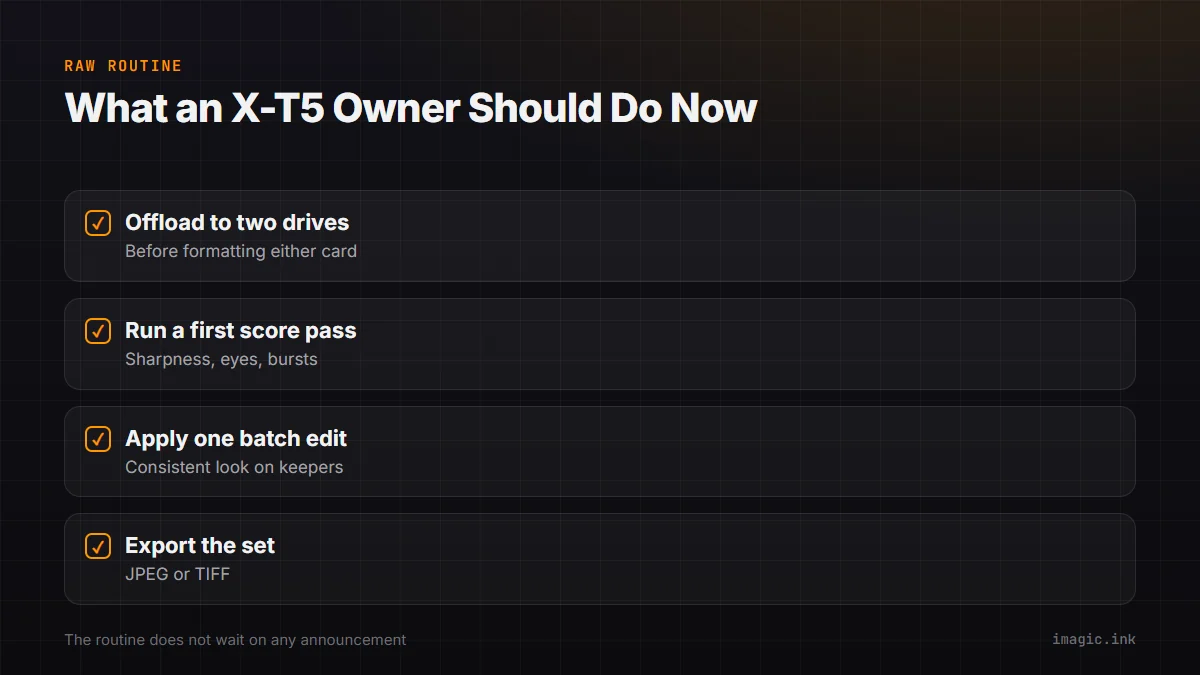
Regardless of when or whether a successor arrives, an X-T5 in active use keeps producing RAF RAW files today, and those files need a culling and backup routine now, not once a future body ships. That routine does not need to wait on any announcement. A working pattern: offload cards to two separate drives immediately after a shoot, before formatting either card; run a first pass that scores frames for sharpness and eye state and groups burst sequences so a full card does not have to be reviewed one frame at a time; apply a consistent edit across the keepers in a single batch pass rather than adjusting each file individually; and export finished work to JPEG or TIFF once the edit is set.
The imagic desktop app covers the culling and batch-editing stages of that routine, reads RAF alongside eight other RAW formats, and processes entirely on the machine it is installed on, with nothing uploaded anywhere as part of that process. Scoring and grouping run locally, batch styles apply non-destructively so the original RAF files are never altered or deleted, and export happens once a person is satisfied with the edit. It is not for you if the plan is tethered capture during a shoot, cloud sync across devices, mobile editing, or full digital-asset-management cataloging across years of archives, since imagic covers local culling and batch editing rather than those adjacent categories. None of that changes based on which camera produced the files; the same routine applies to an X-T5 archive today and would apply to whatever body eventually replaces it.
If the Decision Is to Buy Now: What Is Actually Shipping
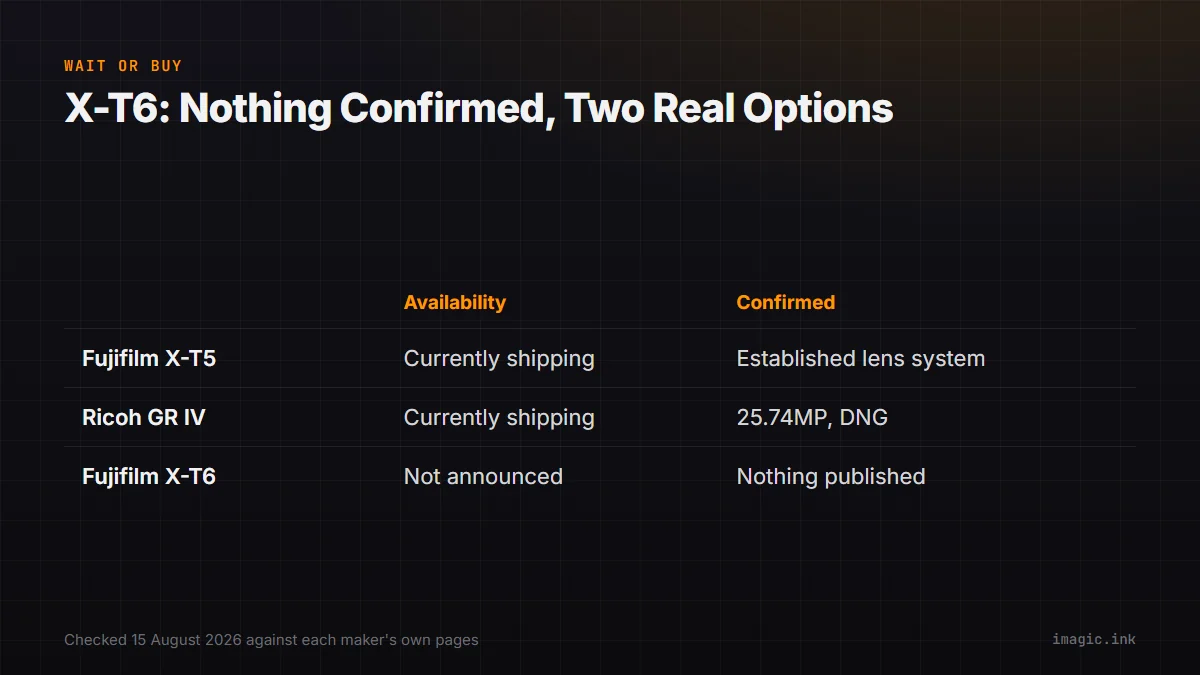
A photographer who needs a second body, or a first APS-C body, this month is not choosing between a current camera and an unconfirmed one; they are choosing between a current camera and nothing, since an unconfirmed camera cannot be bought at any price today. Ricoh's GR IV is one currently shipping APS-C option worth naming specifically, since Ricoh's own specification page lists a 25.74-effective-megapixel sensor, 14-bit DNG RAW capture, and a microSD/microSDHC/microSDXC card slot backed by roughly 53GB of built-in storage (see Ricoh's GR IV specification page). It is a fixed-lens compact built around a wide prime, not an interchangeable-lens body, so it solves a different problem than an X-T5 replacement would; not for you if telephoto reach, a lens swap between shoots, or a built-in electronic viewfinder matters more than pocketable size. For a closer look at that camera specifically, including its own RAW workflow considerations, see imagic's guide to the Ricoh GR IV for street and travel work.
The table below states plainly what is confirmed for each option and what is not, rather than treating an unannounced camera as a real row to compare on specification terms.
| Option | Availability | What is confirmed | Not for you if |
|---|---|---|---|
| Fujifilm X-T5 (current model) | Currently shipping | Established interchangeable-lens APS-C body with a working lens ecosystem already owned by existing users | A newer autofocus or video generation is required for the assignment ahead, since that belongs to an unconfirmed future body |
| Ricoh GR IV | Currently shipping | 25.74MP sensor, 14-bit DNG, microSD card slot, roughly 53GB internal storage, per Ricoh's own page | Interchangeable lenses, a built-in EVF, or long telephoto reach are required, since the GR IV is a fixed wide-prime compact |
| "Fujifilm X-T6" | Not announced; no confirmed date, name, price, or specification | Nothing published by Fujifilm as of the 15 August 2026 check | Anyone needing a camera on a known timeline, since there is currently no confirmed timeline to plan against |
Buying the current X-T5, buying a GR IV as a different kind of tool for a different job, or continuing to shoot an existing body while waiting are all reasonable choices depending on what an assignment actually needs. What is not reasonable is budgeting around a specific X-T6 price or ship date, since neither one currently exists to budget around.
A Wait-vs-Buy Framework, With the Assumptions Shown
Waiting has a cost even when it looks like the free option, and the clearest way to see it is to price the alternative, not the rumor. As a worked example with every input stated so it can be replaced: assume a photographer nets an average of EUR300 from a booking that specifically requires a second working body, and assume that being one camera short costs two turned-down bookings across however many months an announcement, and then an actual retail shipment, ends up taking. Two turned-down bookings at that assumed rate is a EUR600 opportunity cost, against a camera with no confirmed price to compare it to. If the real number of turned-down bookings is zero, because an existing X-T5 or a rented body covers the gap, the opportunity cost of waiting drops toward zero as well; it is the formula, not the EUR300 figure, that should carry over to a reader's own numbers.
A separate, camera-independent calculation is worth running at the same time: how much storage a year of shooting actually needs, since that number does not depend on which body eventually arrives. As an illustrative assumption only, a compressed RAW file from a current 40-megapixel-class APS-C sensor runs roughly 40 to 60MB depending on the scene and compression setting, a planning figure to replace with a reader's own measured average rather than a fixed fact. At 3,000 frames shot in a year and a 30 percent keeper rate after culling, long-term storage for keepers alone comes to roughly 3,000 x 0.30 x 50MB, or about 45GB a year; keeping every frame indefinitely instead of only the culled keepers pushes that closer to 150GB a year. That storage plan is worth building now, on the files already on a drive, rather than deferring it until a future camera's files force the question.
A Workflow That Survives Whichever Body Ships Next
The culling and editing side of a workflow should not need to be rebuilt every time a camera changes. A tool that reads a working set of current RAW formats and processes locally handles a body swap as a settings change, not a software change, provided the new camera's RAW format is already supported. That caveat matters specifically for an unannounced camera: no RAW-processing tool, imagic included, can promise support for a file format that does not exist yet, since there is nothing to test against or build support for until a real camera ships with a real format. If and when a successor to the X-T5 arrives, whether imagic or any other local processing tool reads its RAW files on day one depends on that tool's own update pace after the camera ships, something to confirm directly at that point rather than assume in advance.
What does carry over regardless of camera choice is the rest of the workflow: two-copy backup before formatting a card, an automated first pass to shorten review time, a consistent batch-applied style across the keepers, and a clear export step. Wedding photography sits at a useful comparison point for that same principle, since a wedding day pairs specific camera requirements with a file-management plan built around the whole event rather than a single body's spec sheet; imagic's guide to choosing a camera and file-management plan for wedding photography builds that pairing out in full, and its backup and batch-editing structure works the same way whether the body behind the lens is an X-T5, a GR IV, or whatever eventually replaces either one. For the software side of that recurring cost specifically, priced out across a multi-year window with the same kind of assumption-first math used above, see imagic's breakdown of one-time versus subscription culling software cost over three years.
Frequently Asked Questions
Has Fujifilm officially announced the X-T6?
No. Checked 15 August 2026, no Fujifilm product page, newsroom post, or press kit confirms an X-T6, publishes its specifications, or states a release date or price. Anything more specific currently circulating about an "X-T6" originates from third-party rumor and enthusiast coverage, not from Fujifilm directly, and should be read as unverified until it appears on Fujifilm's own site.
Should an X-T5 owner sell their camera now in anticipation of a successor?
There is no confirmed trade-in timing or resale value to plan around, since there is no confirmed successor to anticipate yet. Selling a working camera ahead of an unannounced replacement risks a real gap without a working body for however long an announcement, and then an actual retail shipment, takes to arrive, which the wait-vs-buy framework above treats as a real cost. Keeping a working X-T5 in active use until a genuine successor is announced, reviewed, and actually shipping is the lower-risk default for most owners.
Will imagic support an X-T6's RAW files if the camera is eventually released?
That cannot be promised in advance, because there is no camera and no RAW format to build support for yet. imagic currently reads CR2, CR3, NEF, ARW, RAF, ORF, RW2, DNG, and PEF, which covers the X-T5's RAF files today; whether a future successor's RAW format gets added, and how quickly after that camera ships, depends on imagic's update schedule at that time and should be confirmed directly once a real camera and a real format exist.
How can a reader tell a credible camera rumor from an unverified guess?
Trace the claim back to its source. A specification, price, or date that appears on a manufacturer's own product page, newsroom, or an official regulatory filing is confirmed. A specification, price, or date attributed to an unnamed insider, a leaked document of unstated origin, or another rumor outlet's earlier report is not confirmed, no matter how many sites repeat it or how confidently it is written, and should be treated as speculation until the manufacturer's own page says otherwise.