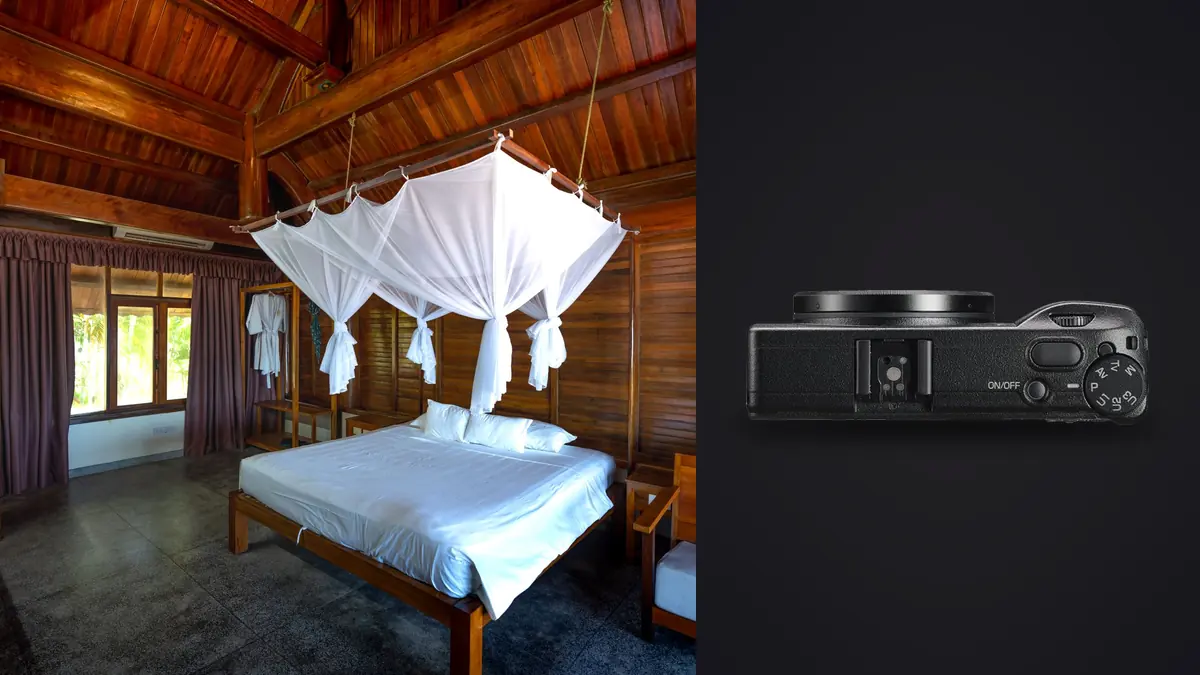
A Ricoh GR IIIx can end up in boudoir sessions almost by accident. Say a subject asks for something "less clinical" than the usual full-frame body and 85mm portrait lens, and there's no second body free that week, so the GR comes along as a backup for behind-the-scenes shots. By the second set of poses you've stopped reaching for the main camera at all. Not long after, it's the camera you plan around, not the one you apologize for.
A 40mm eye in a room that was never built for photography
Boudoir work rarely happens in a studio. It happens in guest bedrooms, rented Airbnbs with too much furniture, hotel rooms with a queen bed pushed against the wall, or a client's own house where you're stepping over a laundry basket to get the angle you want. The GR IIIx's 26.1mm lens, equivalent to roughly 40mm in full-frame terms, sits in an odd but useful spot for this. It's tighter than the 28mm on the standard GR III, which means less of the room creeps into frame, but it's still wide enough that you can shoot a three-quarter pose from six or seven feet away without needing to back into a closet.
That 40mm field of view also reads close to how the eye actually sees a scene, so portraits taken with it tend to look observed rather than composed. For intimate work, where the whole point is that nothing feels performed for the camera, that matters more than it sounds like it should. A 24-70mm zoom at 40mm can do the same math on paper, but a photographer holding a compact the size of a deck of cards changes how a client behaves in front of it. The lens choice and the body size aren't separable variables here.
Why a small, quiet camera changes the room
Shooting boudoir with a full mirrorless kit and a shutter that claps like a door slam can leave a subject visibly flinching at every frame for the first ten minutes. Nobody says anything about it, but you can watch shoulders tense up when a big lens swings toward someone in their underwear. The GR IIIx weighs about 250 grams and its leaf shutter is close to silent, quiet enough that in a lot of ambient room noise you genuinely can't hear it fire from across a bed. That changes the pace of a session. You can shoot through a moment of laughter or a shift in position without announcing that you're shooting, which produces expressions you don't get when every frame is a punctuated event.
There's a trust component too. A client who has never modeled before reads a small camera as lower stakes, even if the resulting files are just as usable as anything off a full-frame body. Subjects may specifically comment that the GR "doesn't feel like being photographed," which is exactly the reaction you want forty-five minutes into a session when the goal is relaxed body language rather than a held pose.
Working distance is the part nobody plans for
The fixed lens is the biggest planning constraint, and it's worth being honest about before you commit a session to it. At 40mm equivalent on APS-C, getting a full-body frame in anything smaller than a decent-sized bedroom is genuinely difficult. I've stood with my back against a wardrobe more than once, wishing for another meter of room that wasn't there. This is the trade-off for the discretion and the natural rendering: you give up flexibility on framing in tight spaces.
| Shot type | Approx. distance needed at 40mm equiv. | Workable in a typical 3m x 3.5m bedroom? |
|---|---|---|
| Close portrait, shoulders up | 1.0 - 1.5m | Yes, easily, from almost any angle |
| Half-body, hips up on a bed | 1.8 - 2.2m | Yes, usually with the bed against one wall |
| Three-quarter, standing pose | 2.2 - 2.8m | Tight, doorways and corners help |
| Full body, standing | 3.0m+ | Often not possible without a hallway shot through a door |
What this table doesn't capture is how much a doorway or a hallway sightline saves you. On more than one shoot I've shot full-body frames from an adjoining room, using the doorframe as a natural vignette. It's a workaround, not a solution, and if someone specifically wants full-length shots in a small rented space, bring a second body with a wider lens rather than force the GR to do a job it isn't suited for.
Light in a real bedroom at four in the afternoon
Most of what I shoot on the GR IIIx is available light: a window with sheer curtains, maybe a reflector propped against a chair, occasionally a single LED panel bounced off a ceiling for fill. The f/2.8 maximum aperture is not fast by prime lens standards, and there's no way around that since you can't swap it for something faster. On an overcast afternoon with decent window light I'm comfortable up to ISO 3200 on the APS-C sensor before grain starts working against skin tones rather than for them. Past that, in a north-facing room after 5pm in winter, I've had sessions where I had to bring in a second light source because ISO 6400 files started needing more noise reduction than I wanted for skin.
The camera's built-in shake reduction (the sensor-shift stabilization Ricoh added starting with the GR III) buys you a stop or so of handheld shutter speed, which helps when you're working at 1/30 or 1/60 in dim rooms, but it does nothing for subject movement. A model shifting weight or adjusting a strap at 1/30s will blur regardless of how steady your hands are. In practice this means I plan sessions around window light hours when I can, and treat the GR as a daylight-and-golden-hour tool first, low-light backup second.
Snap focus instead of chasing autofocus
The GR IIIx's autofocus is fine for static subjects but it's not built for tracking a moving face the way a modern mirrorless system is. What actually works well for this kind of shooting is Snap Focus: setting a fixed distance (I usually run it at 1.5m or 2m depending on the room) and a small aperture like f/5.6 to get enough depth of field that focus-and-recompose isn't a game of precision. With Snap Focus set, the shutter fires instantly with zero focus hunt, which matters when you're trying to catch a genuine laugh or a natural shift in a pose rather than a held expression. I lose some of the shallow depth of field look this way, which is a real trade-off for a genre where a soft, close background is often part of the aesthetic, so I switch back to regular autofocus for the closer, more deliberate portraits and only lean on Snap Focus for movement and candid moments.
What a fixed 40mm camera does to your shot count
Because the GR IIIx invites a looser, more continuous way of shooting, sessions on it generate a lot of near-duplicate frames. A single pose might produce fifteen or twenty images that differ only by a fraction of a second, a slightly different hand position, or a blink resolving into an open eye. That's manageable on a studio shoot with a controlled cadence, but on an intimate session where you're deliberately not directing every single frame, the volume adds up fast. A two-hour session regularly leaves me with 900 to 1,200 frames to get through.
This is where I stopped trying to cull manually in Bridge or Lightroom's grid view. I run the take through imagic first, which scores every frame for local sharpness and focus and clusters the near-identical bursts together, so instead of scrolling through twenty almost-the-same shots of one pose I'm looking at the two or three that are actually sharp on the eyes and well-timed on expression. For a genre where the difference between a keeper and a reject often comes down to whether an eye is a half-second open or closed, having the sharpness scoring do the first pass saves real hours, and it means I don't accidentally bury the best frame in a pile of near-identical ones. If you haven't used software like this before, how AI photo culling actually works is a decent primer on what's happening under the hood.
The privacy angle matters more here than on any other genre I shoot
I'll say this plainly because it shapes how I choose software, not just cameras: boudoir and intimate portrait files are the most sensitive thing on my drive. People trust you with images they wouldn't want anywhere near a cloud server, a syncing folder, or a third-party AI training set. That's a big part of why I moved my culling workflow to imagic in the first place. It runs entirely locally, no upload to a server anywhere, so the culling and scoring happen on my own machine and the files never leave my laptop until I choose to export them. For most photography that's a nice-to-have. For this specific genre it's close to a requirement, and it's worth being able to answer when someone asks how their images are handled before, during, and after editing.
Keeping the look consistent without redoing the grade every time
My boudoir edits lean warm, slightly desaturated, with lifted shadows and a fairly aggressive skin smoothing that still leaves texture visible (nobody wants to look like plastic, and people notice when they do). Getting that same feel out of the flatter, slightly cool JPEGs the GR IIIx produces in-camera used to mean rebuilding the same set of adjustments in Lightroom every single session. I eventually trained imagic's apply_my_style feature on a batch of my previous graded boudoir edits, so it now applies a preset built from my own past work rather than a generic filter, and I use it as a starting point on a fresh GR take before doing the finer skin and dodge-and-burn work by hand. It's not a replacement for actually editing the images, but it kills the fifteen minutes of trial and error I used to spend just getting into the right neighborhood on white balance and tone curve before I could start on the details that matter. If color consistency across a session is something you're still fighting with manually, the guide to photo color grading covers the fundamentals I built that preset on top of.
Where the GR IIIx actually falls short
I don't want to oversell this camera. It has real limitations for this kind of work and I've hit all of them.
- One aperture, one focal length. f/2.8 at 40mm is what you get. There's no reaching for f/1.4 for a dramatically shallow close-up, and no going wider for a full-body shot in a cramped room.
- Battery life is genuinely short. The DB-110 battery is rated for roughly 200 shots, and in practice, with screen-heavy chimping between poses, I've drained one in under an hour on a busy session. I now carry three spares and charge them all the night before every shoot.
- No weather sealing. Not that it usually matters indoors, but a bathroom shoot with steam in the air or a poolside boudoir session in humid air is a real risk to this camera in a way it wouldn't be for a sealed body.
- No viewfinder unless you buy the accessory. Composing on the rear screen in bright window light can be a genuine squint, and the optional optical viewfinder doesn't show exposure or focus confirmation.
For all of that, it's earned a permanent spot in my bag specifically for this genre, not as a novelty second camera but as the primary tool for a meaningful chunk of every session I book.
Frequently Asked Questions
Is the Ricoh GR IIIx fast enough for low-light boudoir sessions?
It's workable up to about ISO 3200 on a decent APS-C sensor before noise starts fighting with skin tones, but the f/2.8 lens means you're relying on ambient light quality more than most fast primes would let you. I treat it as a daylight and golden-hour camera first and bring supplemental light for anything after sunset.
Should I pick the GR IIIx (40mm) or the standard GR III (28mm) for this work?
Depends on the room and the shot list. The 28mm GR III gives you more breathing room for full-body frames in small spaces but introduces more edge distortion on closer portraits. The 40mm GR IIIx renders faces and bodies more naturally but demands more physical distance, which isn't always available. If I could only own one for this specific genre, I'd take the IIIx and plan sessions around its working distance rather than fight the wider lens's distortion on close crops.
Do I need to bring flash or continuous lighting with this camera?
Not always, but I'd plan for it rather than assume you won't. Window-lit rooms in the afternoon are usually enough on their own. Evening sessions, north-facing rooms, or subjects who specifically want a moody, low-key look are where I bring a small LED panel, since pushing the GR IIIx's ISO much past 3200 starts costing you skin detail you can't fully get back in editing.
How do I deal with the sheer number of near-identical frames after a session?
This is the real hidden cost of shooting this loosely. I stopped trying to cull manually and now run every take through imagic before touching Lightroom. It scores sharpness and focus locally and groups the near-duplicate bursts, which turns an hour of scrolling through a grid view into ten or fifteen minutes of confirming picks. It runs entirely on the machine too, which matters given how sensitive these files are.