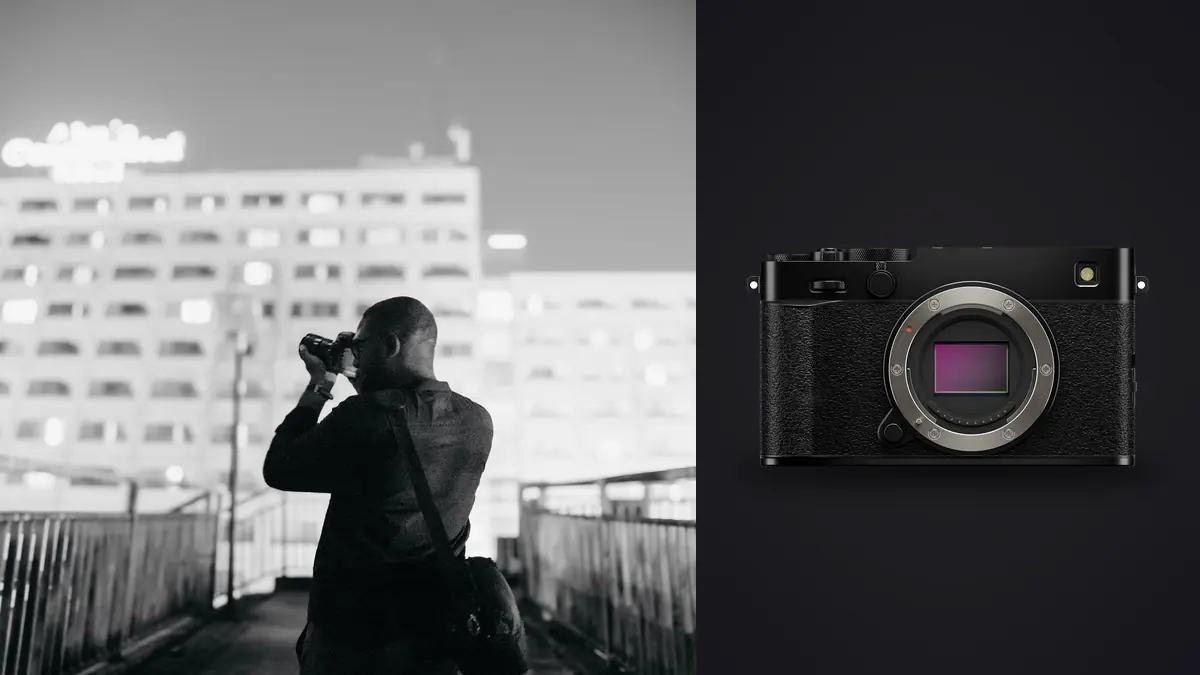
Fujifilm released the X-E5 in August 2025 at USD 1,699.95 body only, or USD 1,899.95 in a kit with the XF23mmF2.8 R WR lens, positioning it as the rangefinder-style body in the X-series lineup rather than the viewfinder-centered X-T line. A year later, in September 2026, it is worth a plain-spec look for anyone considering it specifically for street work, since the rangefinder framing is more about body shape and handling than anything mechanically different from Fujifilm's other APS-C bodies. That distinction is worth making up front because it changes what to actually evaluate the camera on: not an optical rangefinder mechanism the way a Leica M body has, but a specific set of ergonomic and stabilization choices aimed squarely at photographers who want a small, quiet, unobtrusive body for working close to people on the street.
The core specs
The X-E5 uses a 40.2-megapixel back-illuminated X-Trans CMOS 5 HR sensor, the same resolution tier as Fujifilm's X-T5 and X-T50, paired with an updated image processor. Fujifilm's own announcement lists in-body image stabilization rated up to 7.0 stops at the center of the frame and 6.0 stops at the periphery, measured to the CIPA 2024 standard with the XF35mmF1.4 R lens attached, which is a meaningfully stronger IBIS rating than the X-T30 line offers (neither the X-T30 II nor X-T30 III has any IBIS at all). Continuous shooting reaches 8fps with the mechanical shutter, per DPReview's specifications page, with a considerably faster electronic shutter option available. Body weight is approximately 445g including battery.
The film simulation dial
Like the X-T30 III, the X-E5 carries a dedicated film simulation dial in place of a conventional drive dial. Fujifilm's announcement describes three additional custom positions on the dial for saving personal film simulation recipes, so a specific combination of simulation, grain, and color settings can be recalled with a single physical turn rather than navigating a menu. For a body aimed partly at photographers who shoot JPEG or RAW-plus-JPEG and lean on Fujifilm's simulations directly out of camera, that is a genuine workflow feature rather than a cosmetic addition.
Burst shooting, buffer, and the card slot
The X-E5 uses a single UHS-II SD card slot, per DPReview's specification page, a real step up from the UHS-I-only slots on both current X-T30 bodies. UHS-II's higher sustained write speed matters more here than on the X-T30 line specifically because the X-E5's 40-megapixel files are larger to begin with; a faster card slot helps the buffer clear faster between bursts and shortens the wait after a longer sequence before the camera is ready to shoot again. It is still a single slot, so there is no in-camera backup if a card fails mid-shoot, which is worth flagging for anyone considering the X-E5 for paid work rather than personal projects.
RAW files: 40 megapixels and what that means for storage
The X-E5 shoots 14-bit RAW in Fujifilm's RAF format. Fujifilm has not published an official average file size, but because the sensor is the same 40.2-megapixel X-Trans CMOS 5 HR unit used in the X-T50, which does have a figure in imagic's own camera registry, lossless compressed RAF files from the X-E5 should fall in a similar range: roughly 35 to 44 MB per frame. That is close to 50 percent larger than the 26-megapixel X-T30 line's files, which adds up meaningfully over a full day of shooting and is worth planning storage and backup around before a trip, not after one.
Viewfinder, screen, and battery
The X-E5's electronic viewfinder is the same 0.39-inch OLED panel at approximately 2.36 million dots used across Fujifilm's X-T30 line, placed in the top-left corner of the body rather than centered, which is the main physical marker of the rangefinder-style layout. The rear screen is a 3.0-inch touchscreen at approximately 1.04 million dots that tilts forward by up to 180 degrees for selfies and vlogging, but does not tilt to the side or fully articulate, a narrower range of motion than the X-T30 line's up-and-down tilt screen. Power comes from the same NP-W126S battery used across most of Fujifilm's smaller bodies, with Fujifilm rating it at approximately 310 shots per charge, close to the X-T30 III's 315-shot figure despite the X-E5's larger sensor and file sizes. There is no weather sealing on the X-E5 body itself, notably different from the higher-end X-T5, which does have sealing, even though the bundled XF23mmF2.8 R WR kit lens is itself weather resistant.
Why "rangefinder-style" matters for street work
The X-E5 is rangefinder-style in body shape and control layout, an electronic viewfinder positioned at the corner of the top plate rather than centered, a flatter top deck than the X-T line, and a smaller overall footprint, not a true optical rangefinder mechanism like a Leica M. That distinction matters because the actual benefit for street photography is practical rather than mechanical: a smaller, less camera-shaped silhouette draws less attention when raised to eye level, and the flatter body sits better in a jacket pocket or small bag than the X-T line's more pronounced viewfinder hump. Combined with the higher IBIS rating for handheld low-light work and Fujifilm's film simulations for photographers who want a strong look straight out of camera, that is a coherent set of choices for street and documentary shooting specifically, rather than a general-purpose enthusiast body.
The tradeoff for that focus is versatility elsewhere. The corner-mounted electronic viewfinder that keeps the body compact is a genuinely different shooting posture than a centered finder, something worth handling in person before committing to it if a photographer has always shot with a centered viewfinder. And the same small body that disappears easily on the street offers less to hold onto with a longer, heavier telephoto lens attached, which is part of why this body is positioned specifically around street and documentary work rather than as a general-purpose do-everything camera the way the X-T line is marketed.
None of that makes the X-E5 a niche camera in practice; street and documentary work covers a huge share of what enthusiast photographers actually shoot day to day, travel, city walks, family gatherings, events with people moving through a space. The point is narrower than "this camera is only for street photography": the specific set of engineering tradeoffs Fujifilm made here, size over reach, IBIS over a second card slot, a corner viewfinder over a centered one, all point in the same direction, and that direction happens to line up closely with what a street photographer already wants from a camera.
Where the X-E5 sits next to the X-T30 line
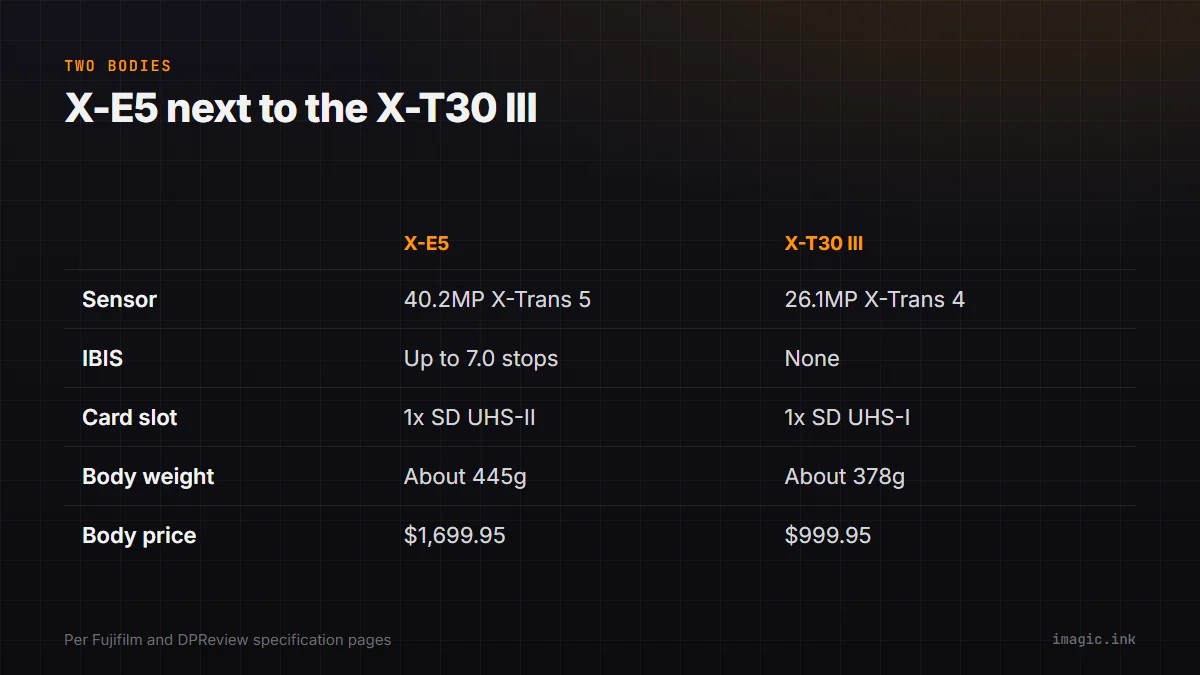
| Spec | Fujifilm X-E5 | Fujifilm X-T30 III |
|---|---|---|
| Sensor | 40.2MP X-Trans CMOS 5 HR | 26.1MP X-Trans CMOS 4 |
| IBIS | Up to 7.0 stops (center) | None |
| Card slot | 1x SD UHS-II | 1x SD UHS-I |
| Mechanical burst | 8fps | 8fps |
| Body weight | About 445g | About 378g |
| Body-only price | USD 1,699.95 | USD 999.95 |
The gap is straightforward: the X-E5 trades a lighter body and lower price for substantially higher resolution, real IBIS, and a faster card slot, at close to double the X-T30 III's launch price. Someone choosing between them is really choosing between a lightweight, budget-conscious travel body and a higher-resolution, better-stabilized body built more specifically around a rangefinder-style street shooting experience.
The IBIS gap deserves its own mention because it changes what is actually possible handheld, not just how comfortable a shot feels. Up to 7.0 stops of stabilization at the center of the frame means shutter speeds several stops slower than the old handheld-shutter-speed rule of thumb stay usable, which matters directly for street and documentary work shot in dim interiors, evening light, or under artificial lighting where a faster shutter would otherwise force a higher ISO. Neither X-T30 body offers any version of that; a stabilized lens is the only way to claw back similar steadiness on either of them, and not every lens in Fujifilm's lineup has it.
Lens options for street work
The X-E5's kit lens, the XF23mmF2.8 R WR, is a compact, weather-resistant 35mm-equivalent prime built specifically to pair with this body, and it is the lens Fujifilm bundles for exactly that reason. For photographers who want a different focal length, Fujifilm's own XF23mmF2 R WR and XF35mmF2 R WR primes weigh 180g and 170g respectively, both compact enough to keep the X-E5's small-body advantage intact rather than offsetting it with a large lens. The 23mm option gives a roughly 35mm-equivalent field of view suited to environmental street shots that include some surroundings, while the 35mm option gives a roughly 50mm-equivalent field of view closer to a standard, more subject-focused framing. Either pairs with the X-E5 at a combined weight well under a kilogram, which is the actual point of a rangefinder-style body: a setup light and small enough to carry all day without a dedicated bag. Both primes also carry Fujifilm's WR weather resistance designation, matching the kit lens rather than trading it away for a smaller size, which is not a given across every compact prime in Fujifilm's lineup. For anyone who eventually wants a second focal length rather than swapping primes mid-shoot, both lenses are light enough to carry together at a combined weight still well under most single standard zooms, without giving up the size advantage that drew them to this body in the first place.
RAW workflow with the X-E5
Larger 40-megapixel RAF files change the math on how fast a culling pass matters. imagic opens RAF files from the X-E5 directly through its own built-in RAW engine, scoring each frame for sharpness, closed eyes, and composition, and grouping visually similar frames from a burst into a single reviewable set rather than forcing a frame-by-frame scroll through larger files than a 26-megapixel body would produce. Everything runs locally on the machine; nothing uploads anywhere during that process. From there, batch editing and one-click styles handle getting a full shoot's worth of files to a consistent look without opening each one individually.
For more on the RAF format specifically, see imagic's RAF file guide. The street photography guide covers workflow considerations that apply to any rangefinder-style or compact body, and the Camera Hardware category has more spec-first coverage like this.
Frequently asked questions
Is the Fujifilm X-E5 a true rangefinder camera?
No. It is rangefinder-style in body shape, a corner-positioned electronic viewfinder and a flatter top plate, not a true optical rangefinder focusing mechanism like a Leica M body. The viewfinder is electronic, same as the rest of Fujifilm's X-series lineup.
Does the X-E5 have in-body stabilization?
Yes. Fujifilm rates it up to 7.0 stops at the center of the frame and 6.0 stops at the periphery, measured to the CIPA 2024 standard with the XF35mmF1.4 R lens attached, a real advantage over the X-T30 line, which has no IBIS at all.
How big are RAF files from the X-E5's 40-megapixel sensor?
Fujifilm has not published an exact figure, but because it shares the same sensor as the X-T50, lossless compressed RAF files should fall in a similar range: roughly 35 to 44 MB per frame, notably larger than the 26-megapixel X-T30 line's files.