
Wildlife Photography: The Burst Problem at Scale
Wildlife photographers face the burst shot problem more acutely than any other genre. A bird in flight, a hunting big cat, a breaching whale — these moments last fractions of a second and must be captured at 10-30 frames per second to guarantee a sharp peak-action frame. A half-day wildlife session can easily produce 3,000-8,000 frames. Without effective tools, the cull becomes a days-long ordeal.
What Makes a Wildlife Shot Selectable
Wildlife culling has a specific hierarchy of requirements:
- Sharp subject: Non-negotiable. The animal must be in focus. Eye focus for mammals, face/bill for birds in flight.
- Good exposure: The subject must be correctly exposed — not blown out (white feathers) or underexposed (black fur in shadow).
- Peak action: Within a burst of a bird banking, the peak moment is specific — wings fully extended, eye looking toward camera, clear sky background.
- Clean background: Branches, fences, or other animals cutting across the subject are editorial problems even if the technical quality is good.
How imagic Handles Wildlife Bursts
imagic's burst detection groups consecutive similar frames automatically. For a wildlife burst of 30 frames taken in 2 seconds, imagic presents these as a group with individual AI scores for each frame. The workflow becomes:
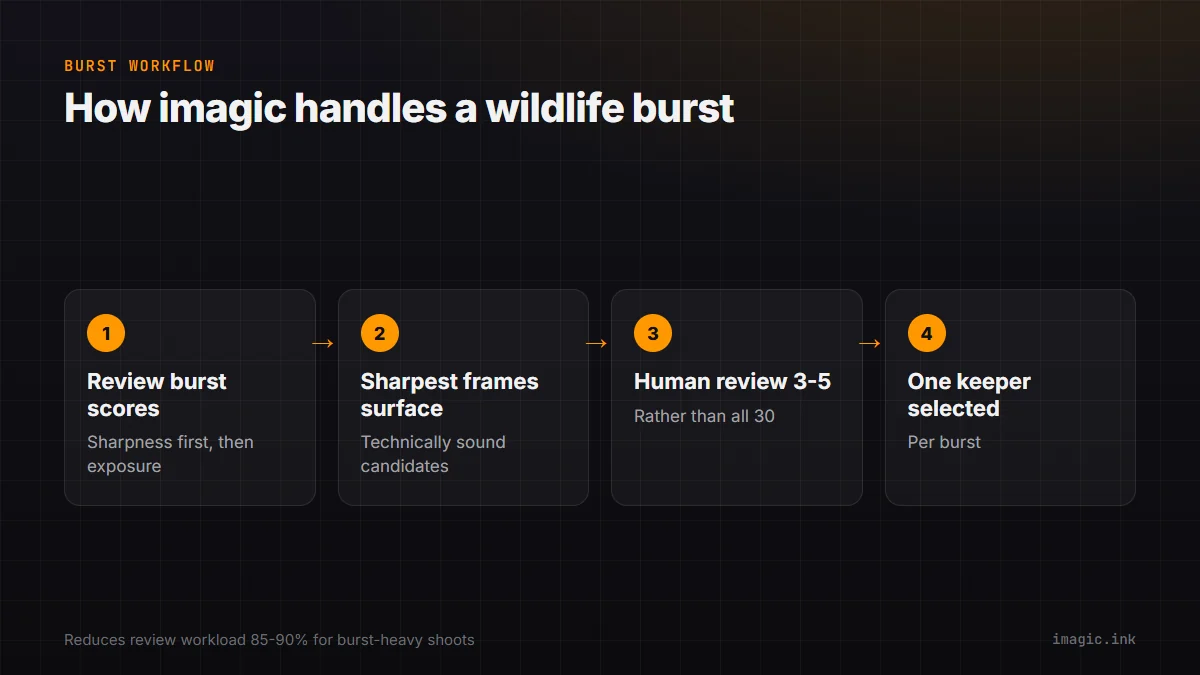
- Review the burst group's scores — sharpness first, then exposure
- The highest-sharpness frames within the group are the technically sound candidates
- Human review of 3-5 candidates (rather than all 30) for peak action and background quality
- One keeper selected per burst
This approach reduces the effective review workload by 85-90% for burst-heavy wildlife shoots.
Dealing with White and Black Animals
White subjects (snowy owls, white swans, Arctic foxes) and black subjects (ravens, black bears, dark-plumaged seabirds) are exposure nightmares. imagic's exposure scoring is calibrated against the RAW data, which can reveal overexposed white feathers even when the JPEG preview looks fine. The exposure score identifies frames where the white channel is clipped or the black detail is lost, before you spend time on them in processing.
RAW Format Support for Wildlife Cameras
Wildlife photography uses a wide range of camera systems:
- Canon (CR2/CR3) — common for telephoto work with the 100-500mm and 600mm lenses
- Nikon (NEF) — Z9 and Z8 are popular for wildlife due to fast frame rates and AF
- Sony (ARW) — A1 and A9 III for maximum frame rate
- OM System (ORF) — Olympus OM-1 II popular for its reach-extending MFT system
imagic supports all of these natively.
Post-Cull Processing for Wildlife
Wildlife RAW processing priorities differ from other genres. Sharpening is critical (feather and fur detail), as is selective noise reduction (background can receive heavy NR; the subject should be sharpened separately). RawTherapee's local adjustment tools let you apply different sharpening and NR settings to subject versus background regions.
Time Investment Reality
A wildlife photographer who spends 6 hours culling a 6,000-frame session manually might reduce that to 90 minutes with imagic — 4.5 hours saved per session. Over a month of regular shooting, that's significant time returned for additional fieldwork, processing, or business development.
Frequently asked questions
How many frames does a typical wildlife burst produce?
A single burst of a bird in flight or a hunting animal, shot at 10-30 frames per second for 1-3 seconds, commonly produces 20-60 frames. A half-day session with many bursts can add up to 3,000-8,000 frames total.
Does AI culling handle white birds and black animals accurately?
Yes. imagic's exposure scoring works from the RAW data rather than the JPEG preview, so it can flag clipped white feathers or lost black fur detail that would otherwise look fine on a small preview screen.
What is the biggest time saver in a wildlife burst workflow?
Grouping each burst and reviewing only the 3-5 highest-sharpness candidates per group, instead of every frame, is what produces the largest time savings, typically an 85-90% reduction in the number of frames a photographer has to look at closely.