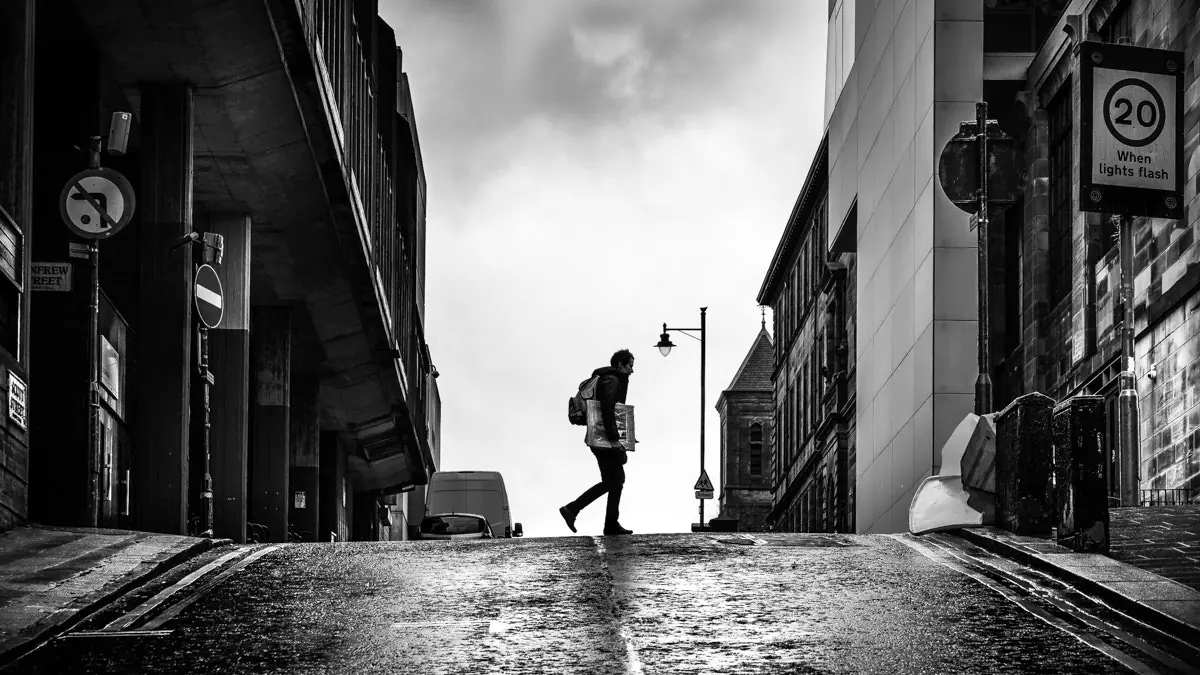
Street photography is one of the few genres where the honest editing advice is do less. Most of the workflow writing on this blog is about doing more, faster: batching, scoring, exporting at scale. Street work runs on a much smaller frame count and rewards a completely different instinct, restraint over polish.
Grain and Contrast as Taste, Not Correction
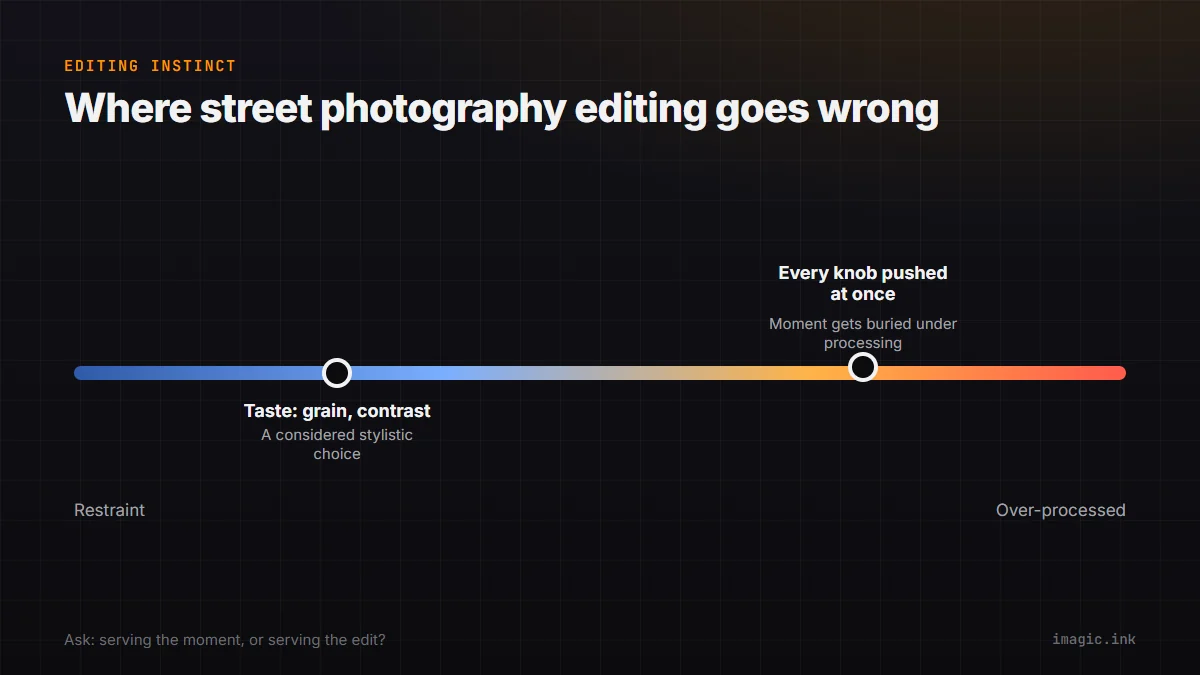
A certain amount of grain and punchy contrast is part of street photography's visual language, tracing back to the high-speed film stocks the genre was built on, and a lot of digital street work deliberately reintroduces some of that texture rather than smoothing it away. This is a taste decision, not a correction, and it is worth treating differently from the noise reduction instinct that applies almost everywhere else in photography. Reach for grain and contrast adjustments as a considered stylistic choice for a specific set of images, not a preset applied uniformly because it worked on one photo. See vignette and grain for a cinematic look for more on this kind of deliberate texture work.
Where Over-Processing Actually Shows Up
The most common street photography editing mistake is not too little contrast, it is pushing every knob at once: heavy clarity, aggressive dodge and burn, saturated color grading, all stacked on a single frame until the moment the photo was actually about gets buried under processing. A useful check is asking whether an edit is serving the moment in the frame or serving the editing itself; if a viewer's first reaction is "wow, that's a heavily edited photo" rather than a reaction to what is happening in the image, the processing has likely gone further than it needed to.
Culling for Moments, Not Sharpness
Street photography culling inverts a rule that holds almost everywhere else: a technically imperfect frame, slightly soft, a touch of motion blur, an off-center composition, can still be the strongest image in a set if it captures a genuine, unrepeatable moment. AI quality scoring is useful here as information, not as a rule: a low sharpness score is worth noting, but it should never be an automatic reject in this genre the way it reasonably would be for a real estate or product shoot. Use scoring to flag technical issues, then make the actual keep decision based on the moment itself.
A Small-Batch Daily Practice Workflow
Many street photographers shoot in small, frequent sessions rather than occasional large shoots, a walk with a camera producing 100 to 300 frames rather than a planned multi-hour session. This suits a lightweight daily habit better than a heavy batch workflow: cull the day's walk down to a handful of real contenders, usually single digits, and only spend real editing time on those. Trying to apply a heavy, scored, batch-processed pipeline built for volume genres to this kind of work usually adds friction without adding value, since the constraint here was never frame count.
When to Reach for More Editing, Not Less
Restraint is a default, not an absolute rule. A genuinely strong frame sometimes benefits from a deliberate contrast or color grade push specifically to match the mood of the moment, a rain-soaked night scene calling for deeper shadows and cooler tones, for instance. The distinction is intent: editing that serves a specific frame's mood is different from a uniform, heavy-handed preset applied to everything by default. See cinematic color grading for photography for more on applying a deliberate look without losing restraint, and imagic for street photography for how batch tools can still help with the small, repeated culling task without forcing volume-style editing onto individual frames. More editing-philosophy pieces like this live in the tips and workflow archive.
Frequently asked questions
Should I ever batch-edit street photography?
Rarely for the final look, since each strong frame usually deserves individual judgment, but a light batch pass for basic exposure consistency across a day's shoot can still save time without affecting the creative editing.
Is a low AI sharpness score a reason to reject a street photo?
Not automatically. Treat the score as information about technical quality, but weigh it against whether the frame captures a genuine moment worth keeping despite the imperfection.
How much grain is too much?
If the grain starts to compete with or obscure the subject rather than adding texture and mood around it, it has likely gone past the point of being a stylistic choice.