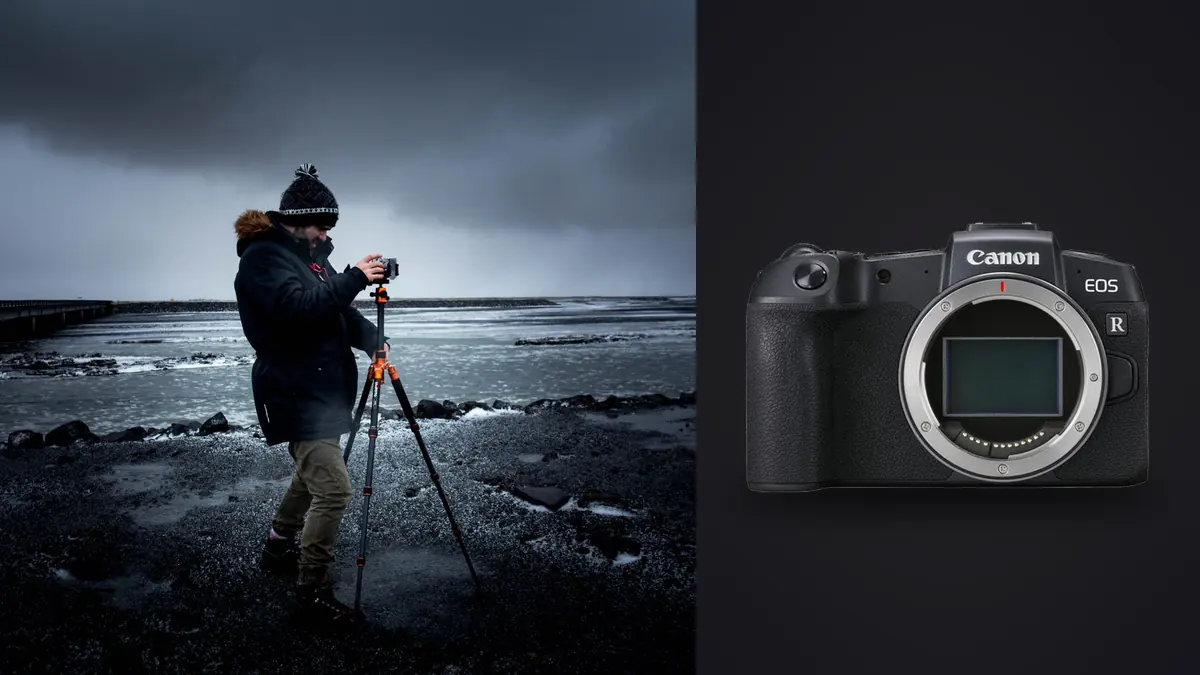
The Canon EOS RP's status got genuinely confusing in 2026, and the confusion is worth untangling before recommending it either way. A PetaPixel report from 24 June 2026 lays out the split directly: the camera has been discontinued in Japan, where Canon's own online store lists "sales ended" and major Japanese retailers mark it discontinued, while Canon USA told PetaPixel the EOS RP "remains available for purchase in the United States, with service and support continuing as no end-of-service life has been determined." Two different answers depending on the market, both accurate at the same time. For anyone shopping specifically for an affordable way into a full-frame sensor, that split status is the single most important thing to understand before looking at the spec sheet at all: this is a body being wound down in some form almost everywhere, and the only real question is how much runway is left wherever a given buyer happens to be shopping.
What Canon actually confirmed
Per PetaPixel's reporting, Canon's stated retirement policy is to retire products after roughly ten years of life. The EOS RP launched in March 2019, which puts it a few years short of that internal threshold as of 2026. In the US specifically, Canon has kept the camera listed with the kind of discount, PetaPixel describes it as "a healthy $350 discount off its retail price", that reads less like a permanent price cut and more like inventory being worked down rather than actively replenished. Nothing in the reporting points to a confirmed end date for US availability; it is simply not guaranteed to stay in the lineup indefinitely.
The core specs
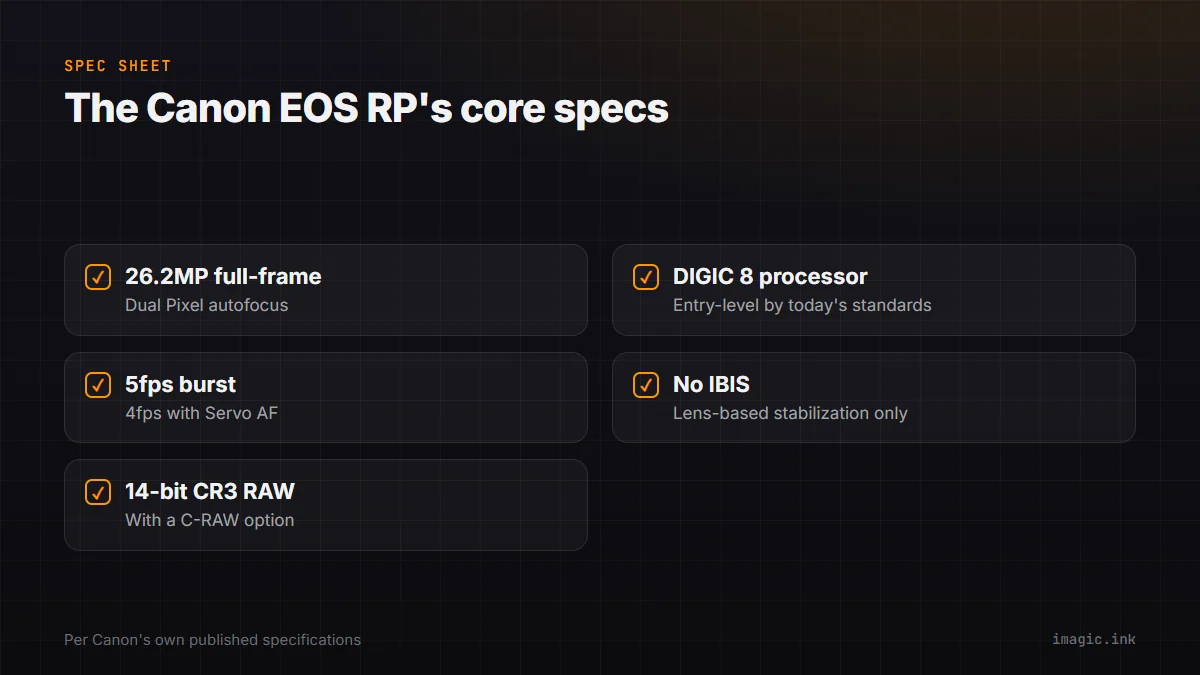
The EOS RP uses a 26.2-megapixel full-frame CMOS sensor with Dual Pixel autofocus, paired with Canon's DIGIC 8 processor. It is a full-frame sensor in Canon's RF mount, which is the entire basis for the "cheapest way into full frame" framing: at launch it was the least expensive way to get a full-frame Canon sensor into an RF-mount body, and that basic math has not changed even as newer, faster RF bodies have shipped around it. Weight is approximately 485g including battery and card, and the body has no in-body image stabilization, leaning on lens-based stabilization instead where a given RF lens has it. For context, that is a genuinely light body for a full-frame camera; part of the reason the EOS RP kept selling for as long as it has is that later, more capable RF bodies with IBIS and faster processors are also meaningfully heavier and larger, a real tradeoff for anyone prioritizing a small travel kit over the fastest specs available.
| Spec | Canon EOS RP |
|---|---|
| Sensor | 26.2MP full-frame CMOS, Dual Pixel AF |
| Processor | DIGIC 8 |
| RAW format | 14-bit CR3, with C-RAW compact option |
| Continuous shooting | 5fps (high-speed), 4fps with Servo AF |
| Card slot | 1x SDXC (UHS-II capable) |
| IBIS | None (lens-based stabilization only) |
| Weight | About 485g with battery and card |
| Battery life (CIPA) | About 250 shots, LP-E17 |
| Launch price / date | USD 1,299 body only, March 2019 |
Burst shooting and autofocus in practice
Continuous shooting on the EOS RP tops out at 5fps in high-speed continuous mode, dropping to 4fps in shooting-speed-priority mode with Servo AF tracking a moving subject, per Canon's own published specs. Autofocus uses Canon's Dual Pixel system with up to 4,779 manually selectable focus points, which was genuinely strong coverage for an entry full-frame body at launch. The autofocus itself remains capable for static and moderately moving subjects, portraits, travel, general work; the 5fps ceiling is the real limiting factor for anything faster, and it is worth being honest that a body from this generation will spend more of a fast-moving session hunting for the right moment between frames than a newer body shooting at double or triple the rate.
Viewfinder, screen, and battery
The EOS RP's electronic viewfinder is a 0.39-inch OLED panel at approximately 2.36 million dots, the same class of finder used across a wide range of entry and mid-tier mirrorless bodies from this era. The rear screen is a fully vari-angle 3.0-inch touchscreen at approximately 1.04 million dots, flipping out and rotating for high-angle, low-angle, and forward-facing shooting, a genuine advantage over a fixed or tilt-only screen for anyone shooting video or vlogging alongside stills. Power comes from Canon's LP-E17 battery, rated at approximately 250 shots per charge under CIPA testing, noticeably lower than the X-T30 or X-E5 bodies covered elsewhere on this site, and worth carrying a spare for on a full shooting day. Weather sealing is a genuinely mixed picture: reviewers have compared the EOS RP's sealing to Canon's own EOS 6D Mark II DSLR, tight tolerances and overlapping body channels, but multiple reviews note there is no rubber gasket around the battery compartment specifically, so treat it as resistant to light moisture and dust rather than a fully weather-sealed body.
RAW files: the CR3 format and file sizes
The EOS RP records RAW files in Canon's CR3 format at 14-bit depth, with a C-RAW compact option available for smaller files in the same wrapper. Per imagic's own camera registry, compressed CR3 files from this sensor run about 26 to 34 MB each, with C-RAW files coming in meaningfully smaller than that. A day of travel or portrait shooting rarely produces the frame counts a sports body does, so storage tends to be less of a bottleneck on this camera than the modest 5fps burst rate is on fast-moving subjects.
What "cheapest full frame" costs in practice
At launch in 2019, the EOS RP shipped at USD 1,299 body only. By 2026, multiple retail-deal writeups, including coverage from Digital Camera World and Imaging Resource, have tracked the body selling as low as USD 799 in promotional windows, and Canon USA's own discount pricing (per PetaPixel's reporting) keeps it well under its original price on an ongoing basis. Deal pricing moves around by retailer and time of year, so treat any single number as a snapshot rather than a fixed price, but the consistent pattern across 2026 coverage is a body selling for roughly 40 to 60 percent off its original launch price. That pattern itself is a useful signal independent of the exact number on a given day: a body that keeps reappearing at deep, repeated discounts across multiple retailers and multiple points in the year, rather than a single one-off clearance event, points toward inventory being worked down steadily rather than a single batch being cleared out before a hard cutoff.
The real cost is the lens system, not just the body
A discounted body is only half the budget picture on the RF mount. Canon's own RF 24-105mm F4-7.1 IS STM, the common affordable kit zoom for this mount, weighs about 395g and has historically listed around USD 399 as a standalone lens, a genuinely compact and inexpensive general-purpose option. Canon's L-series RF 24-105mm F4L IS USM covers a similar range at a constant f/4 aperture with weather sealing, but weighs roughly 700g, nearly double the STM version, and has listed at well over double its price. Someone budgeting a first full-frame kit around a discounted EOS RP body should price the lens alongside it, not just the body: a kit built around the STM zoom keeps the overall cost close to the body's own discount, while building toward L-series glass narrows the total savings considerably even with the body itself heavily marked down.
Who should still buy it in 2026, and who should not
The honest case for the EOS RP in 2026 is narrow but real: someone already invested in a couple of RF lenses, or committed to the RF mount for other reasons, who wants a full-frame sensor at the lowest possible entry cost and does not need fast continuous shooting, in-body stabilization, or top-tier autofocus tracking. Portrait, travel, and general walk-around shooters fit that profile reasonably well, since none of those genres typically depend on a fast continuous-shooting rate to get the shot; a portrait sitting or a travel scene rarely demands more than a couple of frames a second, which is exactly the kind of shooting the EOS RP's 5fps ceiling does not get in the way of. Anyone shooting sports, wildlife, or fast-moving events should look at a newer RF body instead; 5fps is a real ceiling that no amount of good technique works around, and Canon's own current lineup has meaningfully faster options even at a similar price point once the EOS RP's stock eventually runs out.
The ambiguity around its discontinuation status is itself worth factoring into the decision. A body Canon has stopped restocking in some markets, even one still officially sold and supported in others, carries more long-term risk around parts, repairs, and firmware updates than a body currently in active production. For a first full-frame camera bought to be used for several years, that is a real consideration, not just a footnote. For someone buying it specifically as an affordable second body or a way to try RF glass before committing to a pricier body, the same risk matters much less, since the expectation is a shorter ownership window to begin with. It is also worth treating the current pricing as time-limited rather than permanent: once Canon's remaining stock in a given market runs out, the calculation changes, since a newer RF body bought at full price no longer competes against a heavily discounted EOS RP on cost the same way.
Where a culling pass fits
Even at a modest 5fps, a day of full-frame CR3 files still benefits from an automated first pass before editing starts. imagic opens CR3 files directly through its own built-in RAW engine, no separate conversion step, scores each frame for sharpness, closed eyes, and composition, and groups visually similar frames so a short burst gets reviewed as one set. Batch editing and one-click styles then apply a consistent look across a full shoot's worth of files, which matters as much on an affordable body like the EOS RP as it does on a flagship one, since the RAW files themselves carry the same basic editing needs either way.
For more on the format itself, see imagic's CR3 format guide, and the existing Canon EOS RP camera page covers this body's RAW handling in more detail. The Camera Hardware category has more spec-first camera coverage in the same style.
Frequently asked questions
Is the Canon EOS RP discontinued?
It depends on the market. PetaPixel reported in June 2026 that the EOS RP has been discontinued in Japan, with Canon's own Japanese store marking sales ended, while Canon USA stated it remains available for purchase in the United States with no end-of-service life determined.
What RAW format does the EOS RP shoot?
Canon's CR3 format at 14-bit depth, with a smaller C-RAW option available in the same file wrapper. Compressed CR3 files from this sensor typically run about 26 to 34 MB each.
Is the EOS RP fast enough for sports or wildlife?
Not really. Continuous shooting tops out at 5fps in high-speed mode and drops to 4fps with Servo AF tracking a moving subject, which is well below what a dedicated action body offers. It suits portrait, travel, and general full-frame work better than fast-moving subjects.