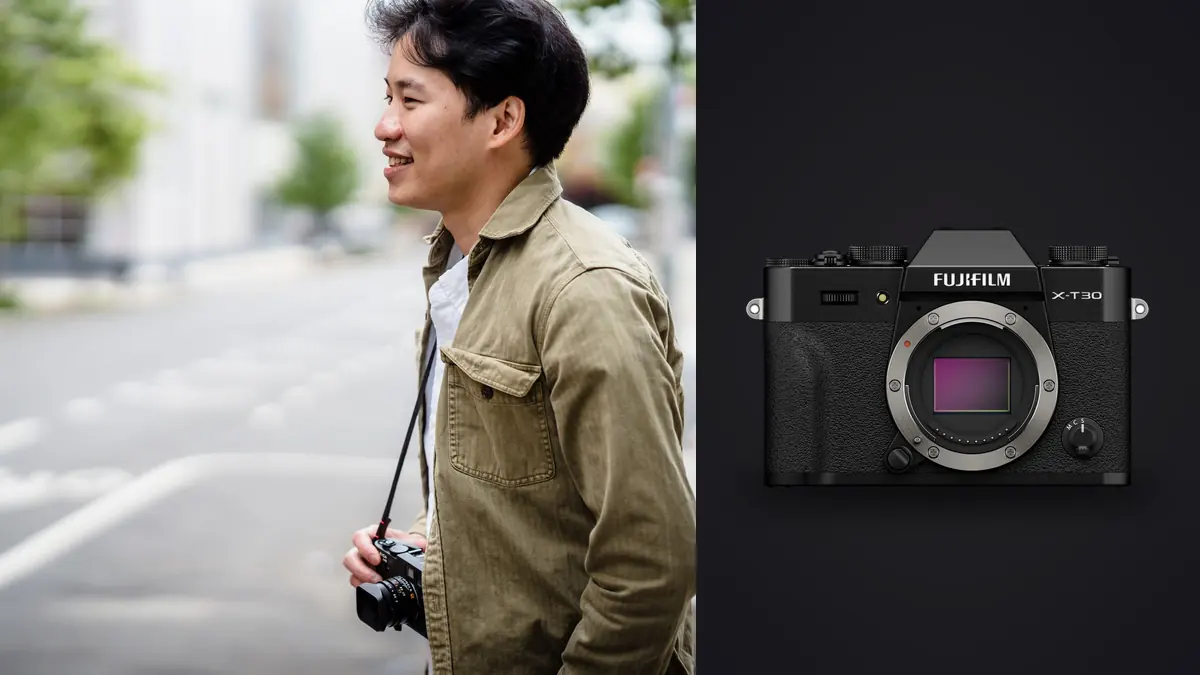
Fujifilm announced the X-T30 III on 23 October 2025 and started shipping the body in late November 2025, with the kit version following in mid-December. Ten months later, in September 2026, it is a fully established, currently-sold body rather than a new announcement, which makes this the right moment to look past the launch coverage at what the spec sheet actually says and what that means for a cull-then-edit workflow.
What the spec sheet says: sensor and processor
The X-T30 III uses the same sensor as its predecessor: a 26.1-megapixel back-illuminated X-Trans CMOS 4 sensor in the APS-C format, maxing out at 6240 x 4160 pixels. What changed is the processor underneath it. Fujifilm's own specifications page lists the X-Processor 5, the same generation of chip used in the company's higher-end bodies, replacing the X-T30 II's X-Processor 4. The practical effect of that swap shows up less in raw resolution, which is unchanged, and more in autofocus and subject detection: Fujifilm's announcement describes AI-based subject detection covering faces, eyes, animals, birds, cars, motorcycles, bicycles, airplanes, trains, insects, and drones, a list that did not exist in this form on the X-Processor 4 generation.
Autofocus in practice: what the AI subject detection actually changes
Fujifilm's own specification page lists 425-point intelligent hybrid autofocus with phase detection covering 100 percent of the frame, and low-light sensitivity down to -7EV. The number of points did not change from the X-T30 II; what changed is the processing behind them. Fujifilm's own guide to the feature describes the X-Processor 5 running deep-learning subject detection across the categories listed above, identifying and tracking a subject rather than requiring a photographer to manually select and follow a focus point through the frame. Independent review coverage describes the tracking as fast and convincing in continuous autofocus mode specifically, while noting Canon and Sony's more expensive bodies still hold a general edge in this category, a gap that has narrowed compared to the X-T30 II's generation rather than closed outright. For street and travel photography, where a subject is often moving unpredictably through a crowd or a scene, that improvement is a genuine, checkable reason to prefer the X-T30 III over its predecessor even though the sensor itself has not changed.
Burst shooting and the single UHS-I card slot
Fujifilm's specification page puts continuous shooting at up to 8fps with the mechanical shutter, and up to 30fps with the electronic shutter at a 1.25x crop (20fps at the full sensor width). Those numbers themselves are solid for an enthusiast APS-C body. What the spec sheet says next matters more in practice: the card slot is a single SD/SDHC/SDXC slot rated for UHS-I speeds only, not UHS-II. That is not a downgrade from the X-T30 II, which uses the same UHS-I single-slot arrangement, but it is a real ceiling if you plan to lean on the 30fps electronic-shutter mode for anything longer than a short burst, since Fujifilm's own spec sheet is explicit that available frame counts before the buffer fills vary by file type, with RAW sequences filling the buffer faster than JPEG-only sequences at the same frame rate. UHS-I write speeds top out well below what UHS-II cards offer, so a long high-speed burst can outrun the card's ability to clear the buffer, and there is no second slot to fall back on if a card fails mid-shoot. For a body pitched at enthusiasts and travel shooters rather than sports specialists, that is a reasonable tradeoff, but it is worth knowing before you buy a slower card and expect sports-body buffer behavior.
RAW files: the RAF format and what a shoot day looks like
The X-T30 III shoots 14-bit RAW in Fujifilm's own RAF format, with both compressed and lossless compressed options available in-camera, per Fujifilm's specification page. Fujifilm does not publish an exact average file size, but because the sensor and bit depth are identical to the X-T30 II, compressed RAF files from the X-T30 III should land in roughly the same range as the X-T30 II's own figures, about 22 to 28 MB per frame for lossless compressed RAF. A full day of travel or street shooting at a few hundred frames adds up to several gigabytes fast, which is the same math that applies to any 26-megapixel body: worth planning storage around, not a reason to avoid RAW.
The choice between the two in-camera RAW options is worth making deliberately rather than leaving on the default. Standard compressed RAF keeps every recorded value but uses a lossy compression pass, trading a small, generally invisible amount of data for a smaller file; lossless compressed RAF keeps every bit of recorded data intact at a larger file size. For street and travel shooting, where card space and transfer time matter more than squeezing out the last percentage of dynamic range, standard compressed RAF is a reasonable default. For anyone planning significant exposure recovery or heavy shadow lifting in post, lossless compressed is the safer choice, at the cost of filling a card and a backup drive faster over a multi-day trip.
Video specs, briefly
Fujifilm's announcement lists internal recording up to 6.2K at 29.97p in HEVC 4:2:2 10-bit, along with DCI 4K, standard 4K, and a 1080p mode up to 240fps for slow motion, with bitrates up to 200Mbps. There is no in-body stabilization for stills or video; the X-T30 III relies on digital stabilization in movie mode only, per Fujifilm's specification page. For a body this size and price, that is consistent with the rest of the X-T30 line rather than a specific weakness of this generation.
Screen, viewfinder, and battery
Fujifilm's specification page lists a 0.39-inch OLED electronic viewfinder at approximately 2.36 million dots, with 100 percent frame coverage and 0.62x magnification, unchanged from the X-T30 II. The rear screen is a 3.0-inch tilting touchscreen at approximately 1.62 million dots, tilting up and down rather than the fully articulating, side-hinged screens found on some competing bodies; that is a real limitation for selfie-style vlogging or working from unusual low angles off to the side, though it covers the common tilt-up waist-level and tilt-down overhead shooting angles most street and travel photographers actually use. Power comes from the same NP-W126S battery Fujifilm uses across most of its smaller X-series bodies, rated at approximately 315 frames per charge in normal mode, extending to 425 frames in economy mode per Fujifilm's own figures, and the battery charges in-camera over USB-C, so a single cable also used for a laptop can top up the camera without a separate charger. There is no weather sealing on the X-T30 III, consistent with its position below the sealed X-T5 in Fujifilm's own lineup, which is worth factoring in for anyone shooting travel in unpredictable weather rather than controlled conditions.
What actually changed from the X-T30 II
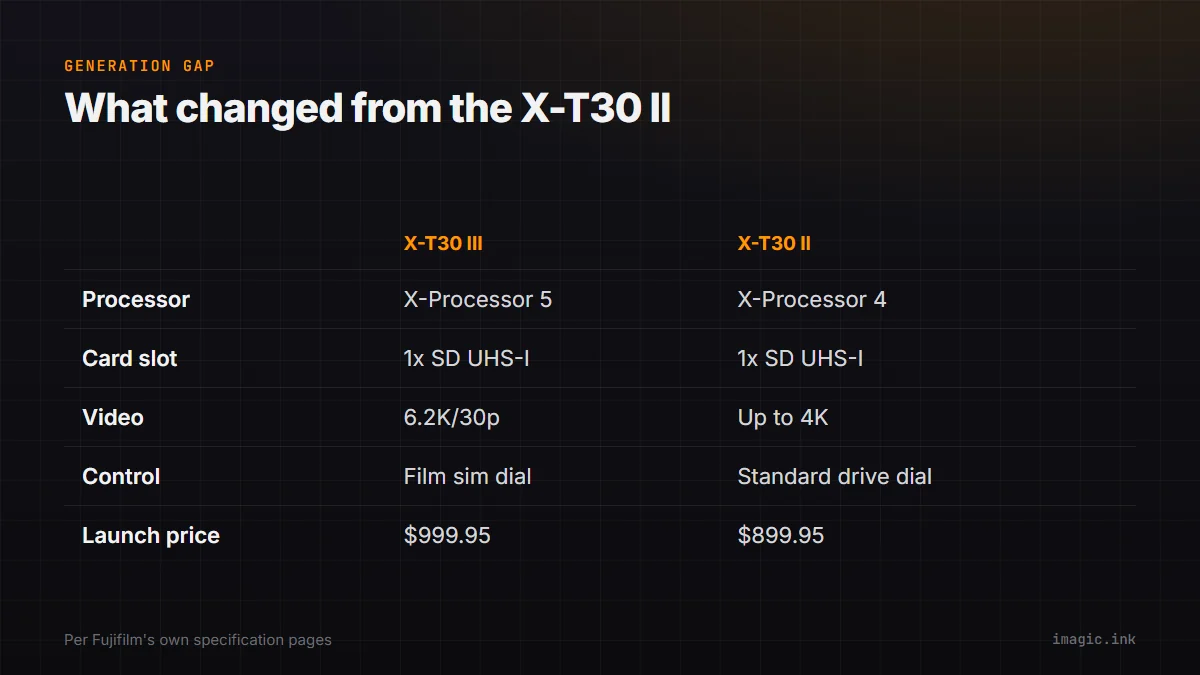
| Spec | Fujifilm X-T30 III | Fujifilm X-T30 II |
|---|---|---|
| Sensor | 26.1MP BSI X-Trans CMOS 4 | 26.1MP BSI X-Trans CMOS 4 |
| Processor | X-Processor 5 | X-Processor 4 |
| RAW format | 14-bit RAF, compressed/lossless compressed | 14-bit RAF, compressed/lossless compressed |
| Continuous shooting | 8fps mechanical, 30fps electronic (1.25x crop) | Electronic shutter up to 30fps |
| Card slot | 1x SD UHS-I | 1x SD UHS-I |
| Video | 6.2K/30p, 4K/60p, 1080/240p | 4K, no 6.2K internal recording |
| Physical control | Film simulation dial (20 simulations, 3 custom slots) | Standard drive dial |
| Launch price (body only) | USD 999.95 | USD 899.95 at launch (November 2021) |
The headline physical change is the new film simulation dial, which replaces the drive dial on the X-T30 II. Fujifilm's announcement lists 20 total film simulations, including REALA ACE and NOSTALGIC Neg, with three customizable positions for saving your own recipes directly to a physical dial rather than digging through a menu. Everything else is closer to an internal refresh than a redesign: same sensor, same resolution, same single UHS-I card slot, a newer processor mainly earning its keep in autofocus and video.
Who the X-T30 III actually fits
The spec sheet points at a specific buyer: someone who wants Fujifilm's color science and a small, light body (about 378g with battery, per Fujifilm's own comparison of the III to its predecessor), values the new subject-detection autofocus and the film simulation dial, and does not need a second card slot, in-body stabilization, or 4K/60p-and-beyond video specs a video-first hybrid shooter might want. It is a travel and street camera first, not a sports or wildlife body; the 8fps mechanical rate and single UHS-I slot say as much on their own. Someone deciding between this and the higher-tier X-T5 or X-T50 is choosing size and price over sensor resolution and card-slot headroom, not a straightforward up-or-down comparison.
It is also worth being clear about who should skip it. Anyone who already owns an X-T30 II and mainly wants the film simulation dial or the newer autofocus should weigh that against a real cost: roughly USD 100 more than the X-T30 II's list price for a sensor and card slot that have not changed at all. Someone who needs a second card slot for paid work, or in-body stabilization for handheld low-light shooting, is better served looking at a higher body in Fujifilm's own lineup rather than either X-T30 generation. The X-T30 III earns its place specifically as a light, affordable, single-body travel and street camera, not as a do-everything upgrade.
Where a culling pass fits into an X-T30 III workflow
Whatever the card slot situation, a day of street or travel shooting on this body still produces a folder that needs sorting before it needs editing, and that is a separate job from what the camera itself does. imagic reads RAF files natively through its own built-in RAW engine, runs sharpness, closed-eye, and composition scoring locally on the files as they come off the card, and groups near-identical burst frames so a 30fps electronic-shutter sequence gets reviewed as one set instead of dozens of nearly identical images. Nothing leaves the machine during that process. From there, batch editing and one-click styles can carry a consistent look across a full shoot without touching each RAF file by hand, covering the develop step the X-T30 III itself has no built-in way to do.
For a closer look at what RAF files are and how they behave across different Fujifilm bodies, see imagic's RAF format guide. The existing Fujifilm X-T30 II camera page has more detail on the predecessor body's own RAW handling, and the Camera Hardware category has more spec-first camera coverage in this style. If a fast culling pass sounds like the missing piece in the workflow, imagic's desktop app runs the whole review-and-edit step locally on Windows or macOS.
Frequently asked questions
Does the Fujifilm X-T30 III have in-body image stabilization?
No. Fujifilm's own specification page confirms there is no IBIS; digital stabilization is available for video only. Stabilization on this body comes entirely from stabilized lenses, if you use one.
What RAW format does the X-T30 III shoot, and how big are the files?
It shoots 14-bit RAF, Fujifilm's own RAW format, with compressed and lossless compressed options. Because it shares the same 26.1MP sensor as the X-T30 II, compressed files should fall in a similar range, roughly 22 to 28 MB each for lossless compressed RAF.
Is the X-T30 III a big upgrade over the X-T30 II?
Not in resolution or card-slot capability, both of which are unchanged. The real differences are the X-Processor 5's AI subject-detection autofocus, meaningfully upgraded video specs up to 6.2K/30p, and the new film simulation dial in place of the old drive dial.