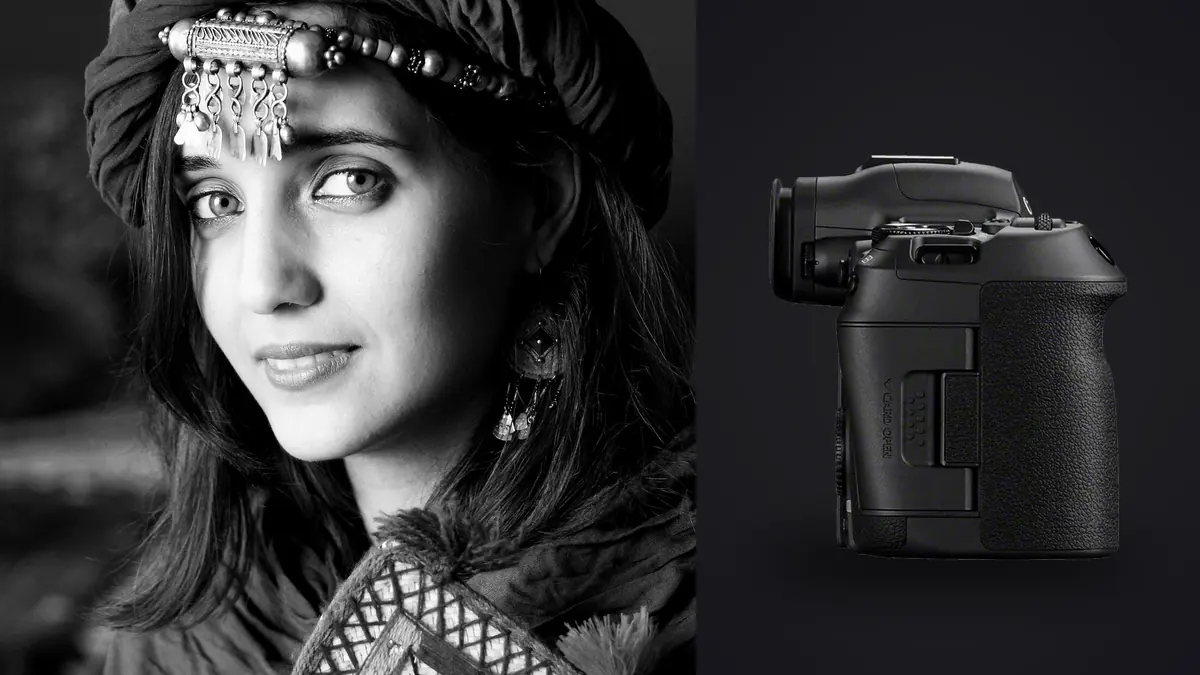
Boudoir is a different kind of portrait work. You're often in a hotel room or a small bedroom, not a studio with 15 feet of working distance, and the subject is usually someone who has never modeled before and is nervous about it. The camera you bring either helps calm that room down or it doesn't. I switched from an R6 II to the Canon EOS R5 Mark II for this work about four months ago, and it has changed a handful of specific things about how I shoot, not the whole job.
This isn't a spec sheet regurgitation. It's what actually mattered once I started pointing this camera at real subjects in real rooms with real time constraints.
The sensor and skin tones, honestly assessed
The 45MP stacked sensor is a genuine step up from the original R5's sensor in one way that matters a lot for this genre: rolling shutter is dramatically better controlled, which means I can shoot fully silent (electronic shutter) without worrying about warped edges if the subject shifts weight or the sheet moves during the exposure. That silence is not a gimmick for boudoir. A mechanical shutter clacking away in a quiet bedroom makes people self-conscious in a way that a lighting change or a "chin down a little" never does. Going fully silent removed one more thing from the room that reminded the subject she was being photographed.
On color: Canon's skin tone rendering out of camera is still the reason a lot of boudoir and intimate photographers stay in the ecosystem, and the R5 Mark II hasn't changed that character. Where it differs from the original R5 is in shadow recovery at higher ISOs. Boudoir lighting is frequently a single window, a string light, or one continuous LED panel bounced off a wall, and I am regularly pushing ISO 3200 to 6400 in a dim room. Shadows pulled up from those files show noticeably less color blotching than the original R5 did at the same ISO. I'm not pretending this is a night-and-day generational leap, but it buys me real flexibility to under-expose slightly for highlight protection on pale skin and still recover the shadow side of the body without the image falling apart.
Eye Control AF: useful, but calibrate it properly or skip it
Eye Control AF (looking at your subject through the viewfinder to move the AF point) sounds perfect for this work, since a lot of boudoir posing involves the subject's face turning while their body stays still, or vice versa, and manually walking the AF point around between frames breaks your rhythm with the client. In practice, it only works well if you run the calibration profile in consistent lighting and don't wear sunglasses or switch eyes on the viewfinder between sessions. I calibrated it once in my apartment under one lamp and it was unreliable in a dark hotel room three weeks later. Recalibrating in conditions closer to an actual shoot fixed it. Once dialed in, it's genuinely fast for close, moving portrait work, but I'd tell anyone buying this camera specifically for that feature to test it in low light before relying on it during a session you cannot redo.
For everything else, Dual Pixel AF II with subject detection set to "people, eye priority" is what I leave running the whole shoot. It holds eye focus through wide apertures reliably even when the subject is partially turned away or has hair falling across one eye, which happens constantly in this genre.
In-body stabilization changes your lighting kit, not just your hands
The rated 8.5 stops of stabilization (with compatible RF lenses) sounds like a spec that only matters for video, but it changed how I light boudoir sessions. I now shoot a meaningful chunk of a session on continuous light alone, no strobe, handheld, at shutter speeds down around 1/15 to 1/30 with the RF 50mm f/1.2, and I get a usable hit rate on static or slow-moving poses. That means fewer flash pops, which again keeps the room calmer, and it means I can move around the subject quickly without recalculating flash-to-subject distance every time I change angle. I still bring a single softbox strobe for the shots where I want punch and separation from the background, but the ratio of available-light frames to flash frames has flipped since I started shooting this body.
Lens pairings that actually work in tight rooms
Boudoir rooms are small. You rarely get the 15-20 feet of backup distance a studio portrait allows, so lens choice is less about "what's sharpest" and more about "what lets me stay close and still get the composition." Here's what I actually reach for and why, based on real sessions with this body.
| Lens | Best for | Working distance in a small room | Notes with the R5 Mark II |
|---|---|---|---|
| RF 50mm f/1.2L | Close, intimate frames; window-light portraits | Comfortable at 6-9 ft | My most-used lens for this genre; IBIS lets me shoot it wide open handheld in dim rooms without a monopod |
| RF 85mm f/1.2L | Compression, isolated detail shots, doorway/window silhouettes | Needs 10-12 ft, tight in small hotel rooms | Gorgeous falloff but I often can't back up far enough; save it for larger spaces or full-length shots down a hallway |
| RF 35mm f/1.8 Macro | Environmental context, getting-ready detail shots, jewelry/lace close-ups | Works down to 3-4 ft | The half-macro function is genuinely useful for detail inserts (rings, lace texture) without a second lens |
| RF 28-70mm f/2L | Fast-changing poses, when there's no time to swap glass | Flexible, 4-10 ft | Heavier than the primes; I use it for shorter sessions where speed matters more than the absolute best bokeh |
If I had to keep exactly one lens for this work, it's the 50mm f/1.2. It's the one that consistently produces the shot the client picks as her favorite from the gallery.
The part nobody puts in the camera review: file volume and privacy
A single 90-minute boudoir session with this camera at 45MP, shooting in bursts to catch the small movements between poses (a hand sliding, a breath, hair falling), regularly produces 900 to 1,400 RAW frames. At roughly 55-65MB per CR3 file, that's 50-90GB off one card before I've even started the second outfit or lighting setup. That volume is the actual bottleneck in boudoir work, not the camera. Nobody tells new boudoir photographers that the editing math is brutal until they're sitting in front of 1,200 nearly-identical frames trying to find the three where the expression, the light, and the pose all land together.
This is where I stopped trying to cull by eye in Bridge or Lightroom's grid view. I run the take through imagic first, which scores focus and sharpness locally on the files themselves and clusters the burst sequences and near-duplicates so I'm choosing between six visibly different options per pose instead of scrolling past forty variations of the same expression. For this genre specifically, the fact that it processes everything on my own machine, with nothing uploaded anywhere, matters more than the speed gain. Models sign a release, but they are still trusting the photographer with images they would never want on a server they don't control, and it is hard to explain to a subject why her RAW files passed through a cloud culling service before they were ever loaded into Lightroom.
Once I've got the culled selects, I lean on imagic's apply_my_style preset feature, which is trained on my own past edits rather than a generic filter pack, to get a first-pass grade on the whole set before I do finish work by hand on the keepers. It doesn't replace the eye you need for skin retouching or dodge-and-burn on a boudoir set, but it gets forty selects to a consistent starting look in the time it used to take me to grade six of them manually. If you're trying to tighten your overall workflow speed on high-volume shoots like this, the culling stage is where the real time is lost, not the editing stage.
Settings I actually dial in, by scenario
These are the starting points I use, adjusted on the day, not theoretical recommendations.
| Scenario | Aperture | Shutter | ISO range | AF setup |
|---|---|---|---|---|
| Morning window light, sheer curtain | f/1.8-2.2 | 1/125-1/250 | 200-800 | Eye detect, single point expand |
| Low-key single strobe, dark background | f/2.8-4 | 1/160 (sync) | 100-200 | Eye detect, servo off (static poses) |
| Continuous LED, moody/dim | f/1.2-1.6 | 1/30-1/60, IBIS-assisted | 3200-6400 | Eye detect, silent shutter, servo on for movement |
| Movement (fabric, hair, spinning) | f/2-2.8 | 1/500+ | 400-1600 | Servo AF, high-speed electronic, pre-continuous burst |
The pre-continuous shooting mode (buffering frames before you fully press the shutter) is more useful in this genre than I expected. Boudoir has a lot of fleeting moments, a laugh, a hair flip, a shift in weight, that happen half a second before you consciously decide to shoot. Having the camera already holding a short buffer means I catch the frame that happens right as I'm reacting to it, not a beat after.
Where it falls short
I want to be straight about the downsides, because most coverage of this camera skips them. Battery life shooting mostly silent electronic shutter with the screen active and IBIS engaged is noticeably shorter than a typical mirrorless session length would suggest on paper. I carry three batteries for a two-outfit session and use most of two of them. The body is also warmer to the touch than the original R5 after 45 minutes of continuous live view in a warm hotel room, not concerning, but noticeable if you're used to a cooler camera. And at this price point, if your boudoir business is early-stage and you're shooting one or two sessions a month, this is not the camera that gets you there faster; a used R6 II will produce client-ready results for a fraction of the cost while you build volume.
Frequently Asked Questions
Is the Canon EOS R5 Mark II too loud or noticeable for a boudoir session?
Not if you use the fully electronic (silent) shutter mode, which the stacked sensor handles well without the rolling shutter distortion that made silent shooting risky on earlier Canon bodies during movement. I shoot the entire session silent unless I need flash sync above 1/250, at which point the mechanical shutter comes back in briefly.
Do I need the RF 50mm f/1.2 specifically, or will a cheaper 50mm work?
The RF 50mm f/1.8 STM is a completely reasonable substitute if budget is tight; it's sharp and light and pairs well with the R5 Mark II's autofocus system. What you give up is the falloff and background rendering at f/1.2, plus slightly more consistent AF tracking on the L-series glass in dim rooms. If you're starting out, buy the body first and the f/1.8 lens, then upgrade the lens once volume justifies it.
How do I manage client privacy when culling and editing hundreds of intimate images?
Keep the culling and first-pass editing offline wherever possible, and be deliberate about which tools touch the files before delivery. I run selects and sharpness culling through imagic specifically because it processes locally rather than uploading a shoot to a server, which matters a great deal when the files are this personal. Beyond software, I also strip metadata and use encrypted storage for archived sessions, and anyone you photograph should be told exactly what your process is before you start.
Is 45 megapixels overkill for boudoir work, given the file sizes involved?
For most deliverables, yes, in the sense that clients receive web and print files well under the native resolution. Where it earns its keep is cropping flexibility on detail shots (hands, jewelry, lace) without losing quality, and the ability to reframe a composition in post when a pose was slightly off but the light and expression were perfect. The tradeoff is exactly what I described above: card space and cull time both go up. If you're comparing bodies specifically for high-volume portrait work, it's worth reading through a broader comparison of culling approaches before deciding whether the extra resolution is worth the storage and sorting cost for your workflow.
What's the single biggest workflow change coming from an R6 II or R5 (original)?
The silent shutter reliability and the shadow recovery at high ISO, not the megapixel count or the video specs everyone talks about. Both directly change how a boudoir session feels for the subject and how usable my low-light frames are afterward. Everything else, the eye control AF, the extra resolution, is a smaller, more situational upgrade.