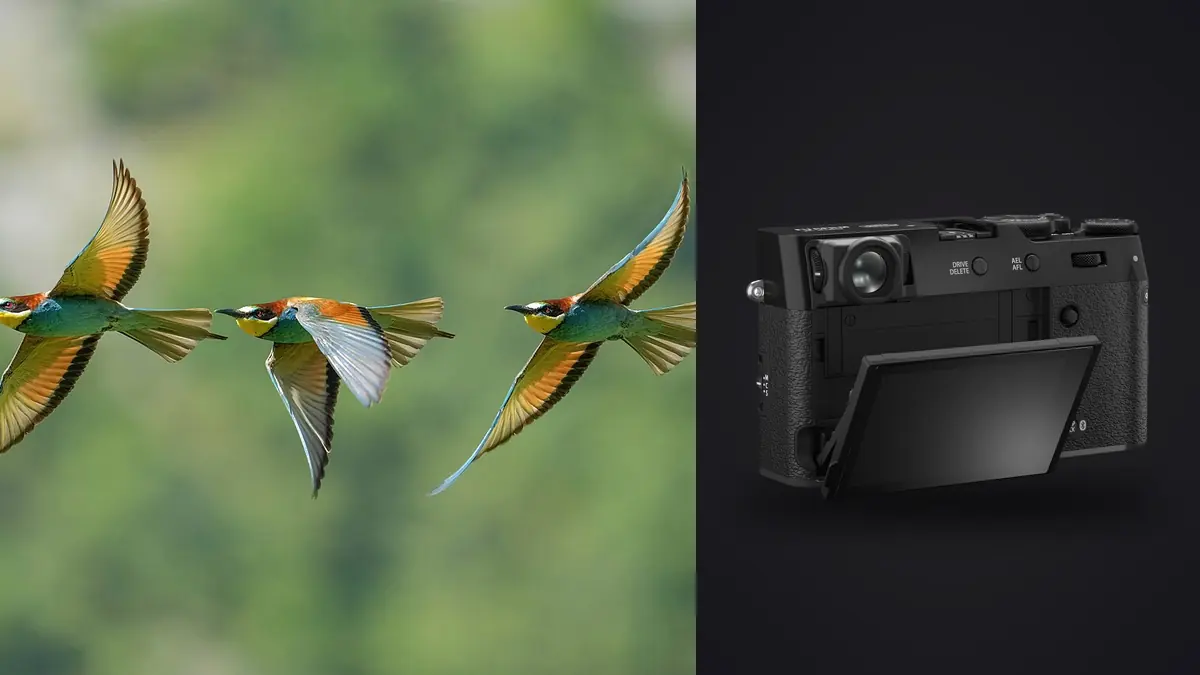
I took the X100VI to a heron rookery last spring more or less convinced I'd talk myself out of it within the hour. A fixed 35mm-equivalent lens on a camera that was designed for street work, travel and portraits is not what anyone would spec if the brief is "birds in flight," and I want to get that out of the way before anything else in this article: if birds in flight are the whole reason you're shopping, this is not your camera. What actually surprised me over three trips with it was how often I still reached for it, and exactly what it was good for once I stopped pretending it was a telephoto rig in disguise.
The lens is the whole conversation
Everything about the X100VI's suitability for wildlife starts and ends with the 23mm f/2 lens bolted permanently to the front of it. On the APS-C sensor that's a 35mm field of view once you apply the 1.5x crop, which is a lovely, honest focal length for documentary work, environmental portraits and travel, and a genuinely bad one for anything that requires reach. The 40.2-megapixel X-Trans CMOS 5 HR sensor behind it is excellent, sharp, low-noise for its class, and it's tempting to think that resolution alone can substitute for focal length. It can, a little. It cannot substitute for 400mm.
The comparison I keep coming back to is a phone camera. Most people who complain that their phone "can't shoot birds" are really complaining about exactly this problem: a wide-ish fixed lens asked to do a telephoto's job. The X100VI is a much better instrument than a phone in every other respect, faster glass, a proper viewfinder, far better files, but the geometry of "small bird, far away" doesn't care how good your sensor is. A robin at ten metres occupies roughly the same tiny fraction of the frame on both.
Doing the actual distance math
I logged distances on my last three outings specifically to put numbers against the feeling, because "it's not great for birds" is the kind of vague claim this camera actually deserves better than. Here's roughly where things land for a mid-sized bird, using a wood pigeon (about 32cm long) as the reference subject, and comparing against a couple of longer Fujifilm setups I also carry.
| Setup | Effective reach | Distance to fill roughly a third of the frame | Realistic keeper rate on birds in flight |
|---|---|---|---|
| X100VI, native 23mm | 35mm equivalent | about 1.2 metres | essentially zero, the bird is a smear |
| X100VI + digital tele (70mm mode) | 70mm equivalent, ~10MP output | about 2.4 metres | still essentially zero in flight, workable for a bird that lets you close in while perched |
| X100VI + TCL-X100 II converter | 50mm equivalent, full 40MP | about 1.7 metres | near zero, but useful for habituated colony birds |
| X-T5 + XF 70-300mm | 105-450mm equivalent | about 5.5 metres at 450mm | roughly 1 in 6 to 1 in 8 frames |
| X-T5 + XF 150-600mm | 225-900mm equivalent | about 11 metres at 900mm | roughly 1 in 3 in decent light |
None of those keeper rates are scientific, they're just what my own culling folders have told me over a few seasons, but the shape of the table is the point. The X100VI needs you to be closer to a bird than almost any wild bird will tolerate, before you've even accounted for the fact that a bird taking off or banking is a moving target you now have to track with a wide-angle field of view that gives you almost no working room to correct your framing.
The teleconverter options, and their real limits
Fujifilm sells an accessory tele-converter for the X100 line, the TCL-X100 II, which clips onto the front and bumps the field of view to roughly 50mm equivalent while keeping the full optical resolution of the sensor. It's a genuinely nice piece of glass and worth owning if you shoot a lot of portraits or tighter street work, but 50mm-equivalent is still a normal lens, not a birding lens, and it adds bulk and a step of fumbling to attach in the field, which matters more than it sounds like when a subject is about to spook.
The in-camera digital teleconverter is the other option, cropping into the sensor and interpolating up to simulate 50mm or 70mm. I use it more than I expected to, mostly because it's a button press rather than a lens change, but you're trading real resolution for reach: the 70mm mode outputs roughly a quarter of the native pixel count. Stack the digital tele on top of the optical TCL-X100 II and you can talk yourself into something like a 100mm-equivalent view, at which point you've spent real money and added real friction to get to a focal length that's still shorter than the kit zoom on most mirrorless bodies.
Three situations where it genuinely earns a place in the bag
Habituated colonies and hides
Puffins on Skomer, gulls that have learned humans mean chip wrappers, gannets at a colony where the birds have stopped registering people as a threat: these are the conditions where 35mm can actually work, because the limiting factor stops being your lens and starts being how close the wildlife will let you get. I've come home with usable, even good, frames of puffins at a metre or two where the wide angle actually helps by including the burrow, the cliff edge, the context that a 600mm lens would crop straight out.
Marine wildlife from boats and shorelines
Seals hauled out on rocks, dolphins riding a bow wave close to the hull, otters that have gotten used to a particular harbour wall: proximity again does the work reach can't. The leaf shutter on the X100VI is close to silent, which matters more here than people expect. A twitchy seal that flinches at a mechanical shutter clack from a DSLR-style rig often won't react to the X100VI at all.
Safari and vehicle-based game drives
This one surprised me most. From inside a vehicle, animals that are wary on foot will often tolerate remarkably close approach, and a 35mm field of view stops being a limitation and becomes an asset for the wide, environmental frame, elephant and dust and light, lion in long grass with the whole scene intact, rather than another tight portrait that looks like everyone else's telephoto shot. I still bring a longer lens for the animals that stay distant. But the X100VI has produced some of my favourite safari frames precisely because it couldn't zoom in and forced a different kind of image.
Autofocus and burst shooting in the field
Fujifilm built the same subject-detection AF system into the X100VI that it uses in bodies like the X-T5, including a dedicated bird-detection mode that will find an eye and lock onto it even against a busy background of branches or reeds. It's genuinely good, better than I expected from a fixed-lens compact, and it's the one part of this camera's spec sheet that occasionally makes me forget the lens problem exists, right up until I remember the bird is a dozen pixels wide in the frame.
Burst speed is respectable on paper: 11fps with the mechanical shutter, up to 20fps electronic. What the spec sheet doesn't tell you is that the X100VI has a single UHS-I card slot, not UHS-II, so if you shoot RAW and lean on that burst rate the buffer fills faster than you'd like and clears more slowly than a body like the X-T5 with a faster card slot. On a genuine flight sequence, wings up, wings down, across a dozen or more frames, I've hit the buffer wall on this camera in a way I never do on my longer-lens body, which is one more small nudge toward using it for single decisive frames rather than long tracked bursts.
IBIS, the leaf shutter, and handholding
The X100VI is the first camera in this line with in-body stabilisation, rated to roughly six stops, and it's a real quality-of-life improvement for handholding at slower shutter speeds when a perched subject sits still. It does very little for you on a bird in flight, where you want a fast shutter speed regardless and the challenge is tracking, not shake. Where it does help is the environmental wildlife shot, the animal-in-habitat frame at 1/60th in low dawn light where a telephoto rig would need a tripod or a much higher ISO. Paired with the near-silent leaf shutter, it makes the camera a genuinely pleasant tool for the patient, close-range side of wildlife work, which is a different discipline from chasing birds across open sky.
The volume problem after the shoot
What nobody mentions about shooting wildlife on a body that pushes 20fps bursts and 40-megapixel files is what your card looks like afterward. A single ten-second burst at a colony can leave you with 150 to 200 near-identical frames, most of them soft, half-blinked, or duplicates of a wingbeat you already have a sharper version of. I stopped sorting these by eye a while back and run them through imagic instead, which does its sharpness and focus scoring locally on the machine and clusters bursts and duplicates automatically, so I'm looking at maybe fifteen genuinely distinct candidates instead of two hundred frames of the same gull. It's entirely offline too, useful when you're culling on a laptop at a harbourside cafe with no signal, which is most of where I actually do this work. If you haven't looked at how that kind of automated culling actually decides what's sharp, this piece on how AI photo culling works goes into the mechanics in more detail than I will here.
The other habit worth building, and this applies whether you're shooting a fixed 35mm compact or a 600mm telephoto, is separating the edit from the culling pass entirely. I run a first pass for sharpness and duplicates, a second for composition and keeper selection, and only then open anything in an editor. For the X100VI files specifically, where I'm mixing straight-out-of-camera JPEGs from a fast colony session with RAWs I want to grade properly later, I lean on imagic's apply_my_style preset, trained on my own past edits, so a rushed batch from a boat trip ends up looking consistent with everything else in the catalogue rather than like a separate project. There's a broader rundown of ordering these steps in this workflow speed guide, most of which applies just as well to a wildlife trip as it does to any other shoot.
Frequently Asked Questions
Can the Fujifilm X100VI actually shoot birds in flight?
Technically yes, in the sense that the autofocus can track a bird and the shutter can freeze motion. Practically, the 35mm-equivalent field of view means a flying bird has to be extremely close, closer than almost any wild bird allows, for the shot to be more than a speck against sky. Treat any in-flight frame from this camera as a happy accident rather than a repeatable result.
Is the digital teleconverter worth using for wildlife?
For perched, close, cooperative subjects, yes, it's a free button press that buys you a bit of extra reach at a real cost in resolution. For anything moving fast or distant it won't change the fundamental problem, you're still working with a wide lens pretending to be a short telephoto.
Should I buy the TCL-X100 II converter specifically for birding?
No. It's a lovely accessory if you already own the camera and want a 50mm-equivalent option for portraits or tighter street shots, and it happens to help a little with close, tame wildlife. But 50mm-equivalent is nowhere near birding territory, and buying it purely for wildlife use is money better spent toward an actual telephoto system.
What's a better option if I want real bird-in-flight results?
Within the Fujifilm system, an X-T5 or X-H2S paired with the XF 150-600mm, or the shorter and lighter XF 70-300mm for closer subjects, will get you results the X100VI simply cannot produce, because the physics of focal length aren't optional. The X100VI still earns a spot in the bag as the camera you bring for everything else on the trip, the habitat shots, the boat, the campsite, the portrait of the guide, while the long lens stays mounted and ready for the birds themselves.