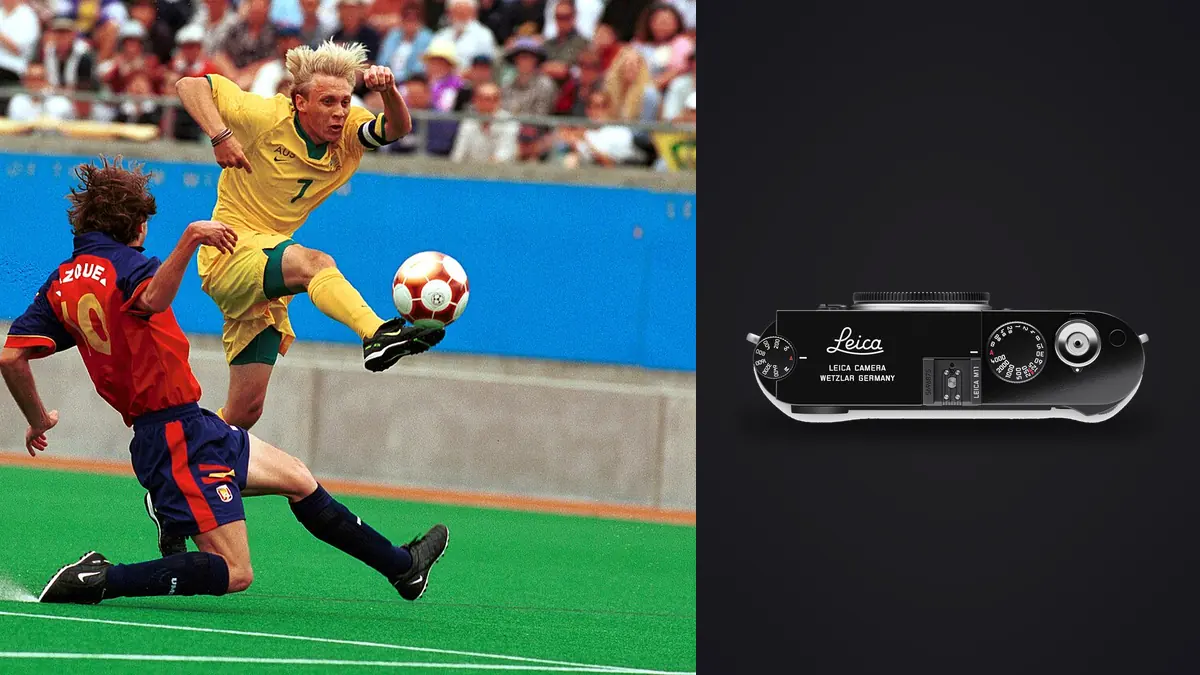
I get asked, semi-regularly, why anyone would show up to a track meet with a Leica M11 slung around their neck instead of something with autofocus. Fair question. The M11 has no autofocus system at all. It has a coupled rangefinder, a fixed 0.73x viewfinder magnification, and a top shooting rate of about 4.5 frames per second that falls off a cliff once the buffer fills. On paper it is close to the worst tool imaginable for the 100m final. In practice, for a specific slice of track and field work, it does something autofocus cameras don't do particularly well: it forces you to know exactly where your subject will be before they get there, and it rewards that knowledge with files that are unusually clean at the moment of contact.
This isn't a "surprise, the weird camera actually works" piece. The M11 fails at plenty of track and field situations, and I'll get to those. But zone focusing a rangefinder at a meet is a real, teachable technique, not a gimmick, and it's worth walking through properly rather than pretending the camera is something it isn't.
Why the Rangefinder Mechanism Matters Here
A rangefinder body doesn't focus through the lens. You're looking through a viewfinder window that overlays a small ghosted patch in the middle of the frame, and you turn the focus ring until two images of your subject converge into one. At 35mm or 50mm this is fast once you've built the muscle memory. At 90mm and beyond, the patch gets harder to read precisely, especially against a moving subject, because the effective base length of the rangefinder mechanism (roughly 47.1mm on the M11, multiplied by the 0.73x viewfinder magnification) puts a real limit on focusing accuracy at longer distances. Past about 15 to 20 meters with a 90mm lens, the margin for error in rangefinder-coupled focus starts to exceed your depth of field at wider apertures. That's not a knock on Leica's engineering, it's optical geometry, and it's the same limitation any rangefinder system has had since the M3.
What that means practically: you are not going to track a sprinter down the home straight and nail focus frame by frame the way a modern AF system with subject tracking would. You're going to lose that battle every time. What you can do is predict a spot, a takeoff board, a hurdle, a finish line painted on the track, set your focus there in advance, and wait for the subject to arrive in that plane. This is zone focusing, and it's an old technique, but track and field is unusually well suited to it because so much of the sport happens at fixed, known locations.
Zone Focusing the Actual Events
Different events give you different amounts of predictability, and it's worth treating them separately rather than assuming one focus distance covers a meet.
Sprints and hurdles: the lane is fixed, the direction of travel is fixed, and if you're shooting from the infield near the finish, you know within a meter or two where the athletes will be at full stride. Prefocus on the finish line paint or a hurdle bar and hold there. This is the single best zone-focus opportunity at a track meet.
Long jump and triple jump: the takeoff board is a hard edge, painted white, that never moves. Focus on the board itself, stop down to get a couple of meters of usable depth either side of it, and fire as the athlete's foot hits. The flight and landing are bonus frames, not the shot you're relying on.
Pole vault: harder. The vaulter's position over the bar shifts meet to meet and even attempt to attempt depending on their run-up and pole choice. I focus on the bar itself and accept a lower keeper rate here than anywhere else on the infield.
Relay exchanges: genuinely difficult, and I'll say plainly that this is where the M11 struggles most. The exchange zone is 20 meters long and where inside it the handoff actually happens is not fixed. More on this in the section on where the camera falls apart.
Throws (shot put, discus, javelin): the circle or runway is fixed, which helps for the release moment, but the athlete's exact position in the circle at release varies by a meter or more depending on technique. Focus on the front of the circle or the foul line and stop down generously.
Working Out Your Depth of Field in Advance
Because you can't chase focus mid-action, the aperture you choose does as much work as the focus ring. I shoot zone-focus track work almost exclusively with a 90mm APO-Summicron-M, and the table below is what I actually use to pick apertures depending on where I'm set up relative to the action. These numbers are calculated for the 90mm lens, full-frame sensor, using a 0.03mm circle of confusion, which is the standard assumption for a 60-megapixel sensor viewed at normal print/screen sizes.
| Subject distance | Aperture | Near limit | Far limit | Total usable depth |
|---|---|---|---|---|
| 8 m (infield, close to track edge) | f/4 | 7.78 m | 8.24 m | 0.46 m |
| 8 m | f/5.6 | 7.70 m | 8.34 m | 0.64 m |
| 8 m | f/8 | 7.58 m | 8.50 m | 0.92 m |
| 12 m (typical long jump position) | f/5.6 | 11.35 m | 12.75 m | 1.40 m |
| 12 m | f/8 | 11.08 m | 13.13 m | 2.05 m |
| 12 m | f/11 | 10.66 m | 13.85 m | 3.19 m |
| 20 m (finish line from infield rail) | f/8 | 18.11 m | 22.36 m | 4.25 m |
| 20 m | f/11 | 17.05 m | 24.55 m | 7.50 m |
At 20 meters and f/11 you've got seven and a half meters of usable depth, which is enough to cover a full lane's worth of drift toward or away from you at a finish line. At 8 meters, which is closer to where I sit for long jump takeoff boards, that margin shrinks to under half a meter even at f/8, which is why I'll go to f/11 or f/16 whenever the light allows it for anything closer than about 10 meters. This is also why the M11's usable ISO range up to 3200 or so without objectionable noise matters more here than it would on a body with autofocus, since you're often trading shutter speed for aperture to buy yourself depth you'd otherwise get from a tracking AF system.
Frame Rate and the File Size Problem
The M11 shoots up to 4.5fps, and the buffer depth depends heavily on which of its three DNG resolutions you're using. At full resolution uncompressed (60MP, roughly 80-90MB per file) the buffer clears in a handful of frames before the camera slows down noticeably. Switch to the compressed DNG option, which drops file size to somewhere around 40-60MB depending on scene detail, and you get meaningfully more frames before the slowdown hits. Drop to the 36MP (DNG M) or 18MP (DNG S) crop modes and buffer depth stops being a practical concern at all for anything short of a long continuous burst.
For zone-focus work specifically, I don't want a long burst anyway. If I'm prefocused on a hurdle, I want three or four frames right around the moment of contact, not fifteen frames of approach and departure that I'll have to sort through afterward. I generally shoot compressed DNG at full resolution for anything where I might crop hard afterward (long jump, pole vault, where the exact framing at the moment of takeoff is hard to predict precisely) and drop to DNG M for events where my framing is tighter and more certain, like a finish line shot where I've already composed for the exact lane.
Lenses That Actually Hold Up
Not every M-mount lens is a sensible choice for this. Wide and normal lenses (28mm, 35mm, 50mm) are too short to isolate a single athlete from the infield at any reasonable working distance, so they're mostly useful for wide environmental shots of a whole heat or the crowd, not for the moment of action itself. My actual working kit for a meet is narrow:
- APO-Summicron-M 90mm f/2 ASPH: this is the lens I use for 80% of the meet. Fast enough to hold a reasonable shutter speed under stadium floodlights, and the rangefinder patch is still workable at this focal length out to 15-20 meters.
- APO-Telyt-M 135mm f/3.4: I bring this for finish lines shot from further back, but I'll be honest that focusing accuracy at 135mm on a rangefinder starts to get genuinely difficult past 15 meters, and I lean on the zone-focus depth table more than the rangefinder patch itself at this length.
- A fast 75mm (Voigtlander APO-Lanthar or similar): a good middle ground when I'm set up closer to the action, for example at a long jump pit, where 90mm would be too tight to keep the athlete framed through their whole approach.
I don't bring anything longer than 135mm in M mount. Beyond that focal length the rangefinder base becomes the limiting factor rather than your technique, and you're better off with a second body and a mirrorless telephoto if you genuinely need 200mm-plus reach for events happening on the far side of the track.
A Realistic Shooting Position
Where you stand matters more with this camera than with an AF body, because you can't compensate for a bad angle by tracking focus through it. I try to position myself where the action crosses a plane roughly perpendicular to my line of sight rather than moving toward or away from me, because lateral motion at a fixed distance is far more forgiving of small focus errors than motion in depth. At a finish line this usually means standing at the rail almost square-on to the lanes rather than at an angle down the track. For long jump, I sit slightly forward of the board so the athlete is moving somewhat across my frame during takeoff rather than straight at me.
Credentialing at most meets puts photographers in fixed positions anyway, so some of this is theoretical, but when you do have a choice of infield spots, favor the one that gives you lateral rather than head-on motion. It buys you real margin with a manual-focus body.
Where This Approach Falls Apart
I want to be straightforward about the situations where I've put the M11 away mid-meet and picked up something else. Relay exchanges are the biggest one: the handoff point inside a 20-meter zone is not predictable enough to zone focus reliably, and by the time you see where it's actually happening, a manual rangefinder can't react fast enough to correct. Indoor meets under weak fluorescent or old sodium lighting are rough too, since you're often pushed to ISO 6400 or higher where the M11's files, while usable, lose the clean look that's the main reason to bring a rangefinder to a sporting event in the first place. And anything involving a false start, a re-set, or an athlete who breaks stride unexpectedly will burn a frame you can't get back, because there's no continuous AF servo quietly correcting for you in the background.
For those situations I'd rather have a second, autofocus-equipped body in the bag, even if it never gets used, than force the M11 into a role it's genuinely bad at.
Sorting the Take After the Meet
A meet like this generates an unusual mix of files: a handful of genuinely sharp, well-timed frames sitting inside a much larger pile of near-misses where focus landed half a step early or late. Because the errors are focus errors rather than motion blur, they can be subtle enough on a phone or a small laptop preview to slip past a quick visual check, especially across the 300-400 frame count of a typical two-hour session at 60 megapixels each.
This is the part of the workflow where I actually lean on imagic rather than doing it by eye. Its local sharpness scoring catches the difference between a frame where the rangefinder patch converged correctly and one where it was a centimeter off, which matters a lot more with manual focus than with AF glass where misses are rarer and usually more obvious. It also clusters the near-identical burst frames from moments where I fired three or four shots around a single takeoff or finish, so I'm reviewing one cluster instead of scrolling through near-duplicates one by one. Because everything runs locally rather than through a cloud upload, that also matters practically at a stadium: you're not waiting on venue wifi to push gigabytes of 60MP DNGs anywhere before you can start culling.
Once the keepers are picked, I run the meet through an apply_my_style preset built from editing I've already done on previous track meets, which gets me most of the way to a consistent look across a set shot under wildly different lighting (bright midday heats, floodlit evening finals) without re-grading each event from scratch. If you're weighing culling software generally rather than just for this workflow, the comparison at /blog/photo-culling-software-comparison-2025 is a reasonable starting point, and the mechanics of how sharpness scoring actually works are covered in more depth at /blog/how-ai-photo-culling-works.
Frequently Asked Questions
Can you realistically track a 100m sprint with a Leica M11?
Not by panning and adjusting focus continuously the way you would with an AF telephoto. What works is prefocusing on a fixed point, usually the finish line, and letting the runners come to that plane. You'll get fewer total frames than a modern mirrorless body would give you, but the ones you get tend to be precisely timed because you composed and focused before the race even started.
Is the M11's 4.5fps burst rate a real limitation at a track meet?
Less than you'd think for zone-focus work, since you're not trying to capture a long sequence, you're trying to catch three or four frames around a single predictable moment. It becomes a real limitation for anything unpredictable, like relay exchanges or reaction shots after a personal best, where a longer burst at a higher rate would genuinely help.
What aperture should I use for track and field with a rangefinder lens?
It depends entirely on your distance from the action. Refer to a depth of field table for your specific lens and working distance rather than a rule of thumb. As a rough guide from my own numbers above, I rarely shoot wider than f/5.6 for anything closer than 12 meters, and I'll go to f/11 or beyond for finish-line work from the infield rail where I have more working distance to play with.
Does manual focus produce more keepers to sort through than autofocus?
It produces roughly the same number of frames but a lower hit rate of genuinely sharp ones, so the sorting burden per usable image is higher. That's the main reason I don't cull this kind of session by eye on a laptop screen anymore. A sharpness-scoring pass catches focus misses that look fine at thumbnail size but fall apart at full resolution, which happens more often with rangefinder work than with tracking AF.