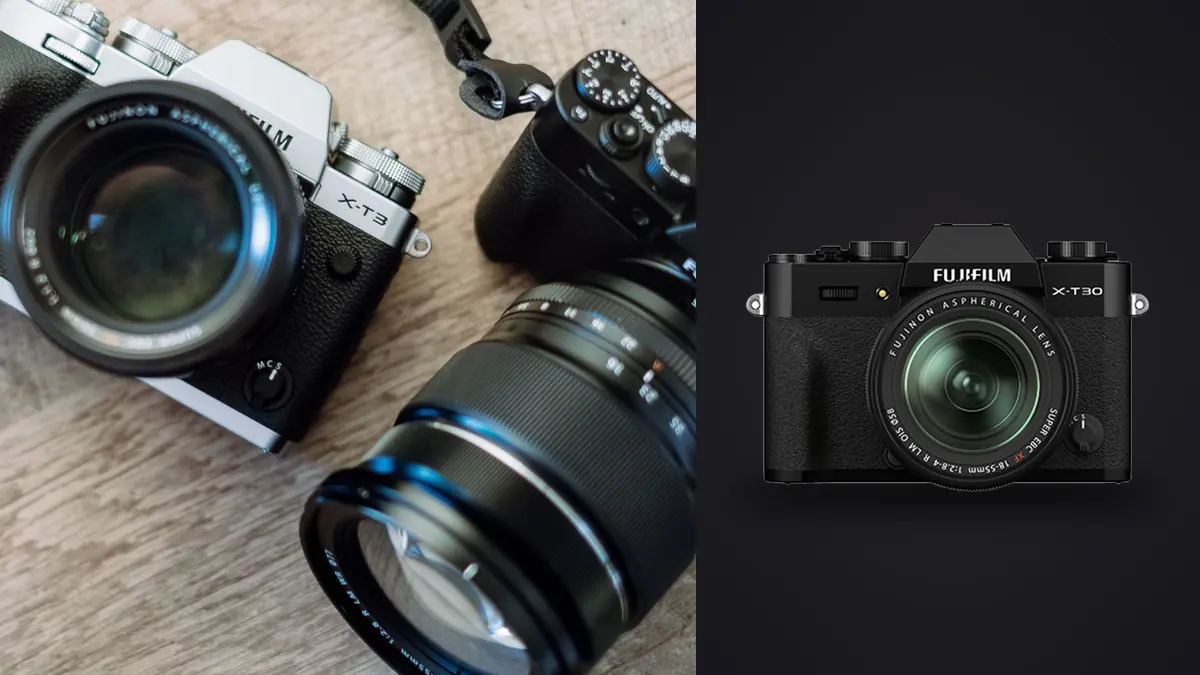
Buying a second camera body is a different decision than buying a first one. A first body has to do everything: cover every lens, every situation, every kind of subject a photographer shoots. A second body only has to be good enough at whatever job it is actually assigned, usually a backup role or a dedicated second-lens setup, which is exactly the case where an older but still-current body at a lower price can make more sense than the newest generation. Fujifilm has not discontinued the X-T30 II. A PetaPixel report from 26 September 2025 states plainly that the body "remains an 'active part'" of Fujifilm's X-Series lineup even after the X-T30 III's announcement the following month. What has changed by September 2026 is availability: stock has tightened at major retailers, with Fujifilm's own US store and several large retailers showing the body out of stock or on backorder at points this year. That combination, an official body that is not being retired but is getting harder to find at its original price, is exactly the situation that makes the X-T30 II worth a straight look as a second body rather than a first purchase.
The core specs
The X-T30 II pairs a 26.1-megapixel X-Trans CMOS 4 sensor, backside illuminated, with Fujifilm's X-Processor 4. It shoots 14-bit RAW in Fujifilm's RAF format. Continuous shooting reaches up to 30fps with the electronic shutter; Fujifilm's own X-T30 III comparison material and independent spec pages both describe the mechanical shutter topping out around 8fps, in line with the rest of the X-T30 line. Neither figure changed when the X-T30 III arrived; the sensor readout speed and shutter mechanism driving those numbers are shared hardware between the two generations, not something the newer processor altered, which is exactly why a photographer choosing between the two bodies for burst performance alone would find no real difference to weigh. There is no in-body image stabilization, and the single card slot is SD/SDHC/SDXC rated for UHS-I speeds. Body weight is about 378 to 383g including battery, depending on the source, and CIPA-rated battery life is around 380 shots per charge.
Screen, viewfinder, and battery
The X-T30 II uses the same 0.39-inch OLED electronic viewfinder at approximately 2.36 million dots as its successor, with 100 percent frame coverage and 0.62x magnification, and the same 3.0-inch tilting touchscreen at approximately 1.62 million dots, tilting up and down rather than fully articulating. Power comes from the NP-W126S battery, the same cell Fujifilm uses across most of its smaller X-series bodies, rated at around 380 shots per charge under CIPA testing. None of this changed when the X-T30 III arrived, which matters for anyone weighing whether the newer body's extra features are worth paying for: the actual shooting experience through the viewfinder and screen is identical between the two. Like the X-T30 III, there is no weather sealing on the X-T30 II, so both bodies carry the same real caveat for anyone shooting in unpredictable conditions.
What "budget second body" actually means in today's pricing
The X-T30 III launched in November 2025 at USD 999.95 body only. Fujifilm's own storefront lists the X-T30 II at USD 899.95 body only when in stock, a real but modest gap given both bodies share the same sensor and resolution. The bigger price argument for the X-T30 II as a second body is not the list-price difference; it is that a second body bought at or below that price, used as a backup or a dedicated second-lens body rather than a primary camera, is a cheaper way to add a spare Fujifilm body to a kit than buying a second X-T30 III, without giving up the sensor that actually determines image quality. The tradeoff is the newer processor's AI subject-detection autofocus and the film simulation dial, neither of which the X-T30 II has.
Burst shooting, buffer, and the single card slot in practice
Because the X-T30 II shares the same single UHS-I card slot as its successor, the same practical limit applies: a long 30fps electronic-shutter burst can write data faster than a UHS-I card can clear it, so buffer depth in real shooting depends heavily on card speed and file type. For a second body used to cover a different lens or a backup role during travel and street work rather than a sustained sports sequence, that ceiling rarely becomes a problem. It is worth knowing if the plan is to lean on the fastest burst mode for long sequences, since there is no faster card slot or second slot to fall back on.
Card choice still matters even within the UHS-I ceiling. A slower UHS-I card, particularly an older one bought years before this body, can meaningfully underperform a current UHS-I card rated near the top of that standard's real-world write speeds. For a second body that mostly sits in a bag until it is needed, it is worth checking that its card is a genuinely fast UHS-I model rather than an old card inherited from a previous camera, since the slot itself cannot make up for a slow card the way a UHS-II slot would.
Why street and travel shooters specifically
A second body earns its place in a bag by being light enough to actually carry and simple enough to grab without thinking, and the X-T30 II fits that brief on paper: a small APS-C body under 400g, Fujifilm's film simulations built in, and a sensor identical to bodies costing meaningfully more. What it gives up next to a higher-tier body, no weather sealing, no IBIS, a single UHS-I card slot, matters less on a walk through a city or a day of travel photography than it would on a paid shoot with no room for a card failure. Pairing it with a small prime rather than the 18-55mm kit zoom keeps the whole setup close to pocketable, which is the actual reason this class of camera gets recommended for street and travel work in the first place. None of the X-T30 III's specific upgrades, the AI subject-detection autofocus, the higher video specs, the film simulation dial, change what a second body is actually being asked to do in this role, which is largely to carry a second lens and be reliable, not to break new creative ground the primary body cannot already cover.
The "second body" framing specifically matters here in a way it would not for a first purchase. A second body used alongside a primary Fujifilm camera is not competing on autofocus sophistication or video specs; its job is to carry a second lens without a lens change mid-shoot, or to act as a backup if the primary body has a problem mid-trip. For that role, a body sharing the same sensor, the same color science, and the same RAF files as a newer primary camera is more useful than a cheaper body with a different sensor generation would be, since files from both bodies edit and grade consistently together. That is the real argument for the X-T30 II over a random budget alternative: it is not just inexpensive, it is specifically compatible with a Fujifilm-based workflow already built around a different body.
X-T30 II vs X-T30 III: what you give up
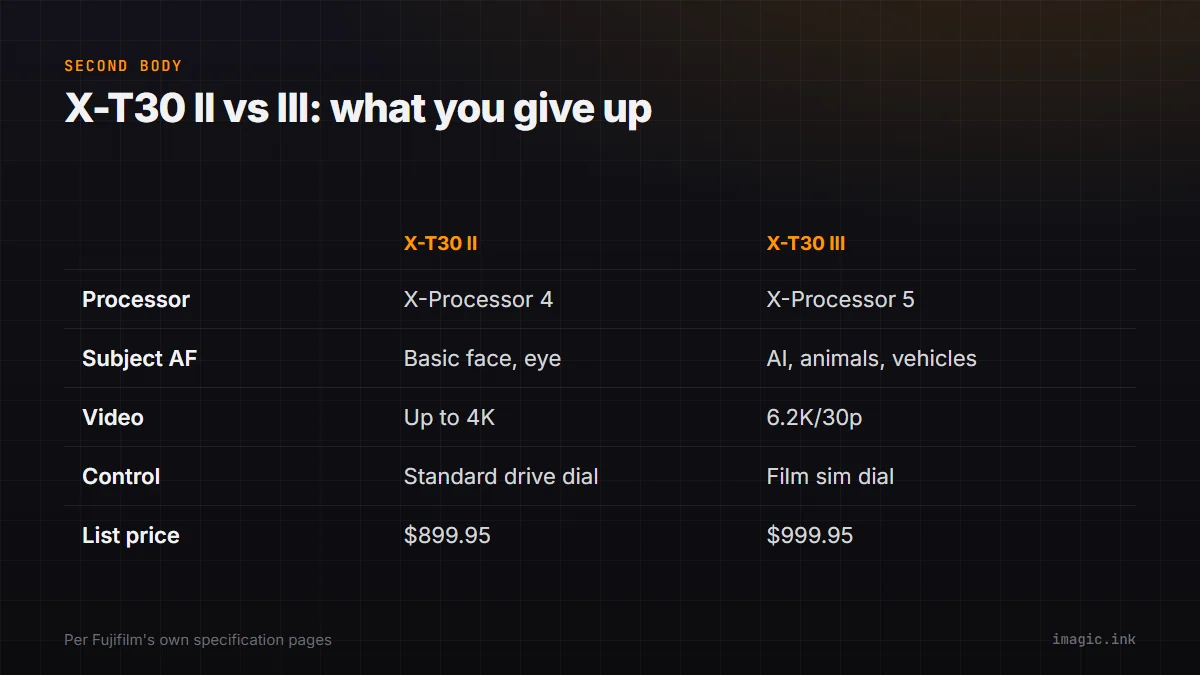
| Spec | Fujifilm X-T30 II | Fujifilm X-T30 III |
|---|---|---|
| Sensor | 26.1MP BSI X-Trans CMOS 4 | 26.1MP BSI X-Trans CMOS 4 (same) |
| Processor | X-Processor 4 | X-Processor 5 |
| Subject-detection AF | Basic face/eye detection | Face, eye, animal, bird, and vehicle AI detection |
| Card slot | 1x SD UHS-I | 1x SD UHS-I (same) |
| Video | Up to 4K | Up to 6.2K/30p |
| Physical control | Standard drive dial | Film simulation dial |
| List price, body only | USD 899.95 | USD 999.95 |
Lens compatibility is not a consideration at all
Because both bodies use the same Fujifilm X-mount, every XF and XC lens in Fujifilm's lineup works identically on the X-T30 II and X-T30 III, with no compatibility gap to plan around. That is worth stating plainly because it removes the usual complication of running two different bodies as a kit: a second body bought specifically to pair with a primary X-T30 III does not narrow the lens options at all, unlike mixing bodies across different mounts or sensor formats. A single small prime, or the kit 18-55mm zoom, moves between both bodies without any adapter or compatibility check, which is a meaningfully lower-friction setup than running two cameras from different systems side by side. Batteries and chargers carry over too: both bodies use the same NP-W126S cell, so a spare battery or a second charger bought for one body works for the other without needing to track which battery belongs to which camera on a long shooting day. The same goes for menus and controls: since both bodies share a near-identical layout and menu system, switching between them mid-shoot does not cost the muscle-memory adjustment that moving between two genuinely different camera systems would.
RAW workflow with the X-T30 II
RAF files off the X-T30 II run about 22 to 28 MB each in Fujifilm's lossless compressed mode, per the file-size figures already established for this body. A travel day with two bodies in rotation, this one and a primary, can easily double the number of RAW files needing review compared to shooting with one camera, which is where a culling pass earns its keep. imagic opens RAF files directly through its own built-in RAW engine, scores frames for sharpness, closed eyes, and composition, and groups near-duplicate frames from either body into the same review set rather than keeping two separate piles to sort through by hand. Batch editing then applies one consistent look across files from both bodies at once, which matters more than it might sound when a second body is being used specifically because its color and files should match the primary camera's output.
For more on the format itself, see imagic's RAF file guide, and the Fujifilm X-T30 II camera page has additional detail on this body's RAW handling specifically. The Camera Hardware category covers more bodies in this same spec-first format.
Frequently asked questions
Is the Fujifilm X-T30 II discontinued?
No. PetaPixel reported in September 2025 that Fujifilm confirmed the X-T30 II remains an active part of the X-Series lineup even after the X-T30 III's announcement. Stock has been inconsistent at some retailers in 2026, but that is an availability issue, not an official discontinuation.
What is the real difference between the X-T30 II and X-T30 III?
The sensor and resolution are identical. The X-T30 III adds a newer processor with AI subject-detection autofocus, meaningfully better video specs up to 6.2K/30p, and a film simulation dial in place of the standard drive dial, for roughly USD 100 more at launch.
Does the X-T30 II have in-body stabilization?
No. Neither the X-T30 II nor the X-T30 III includes IBIS. Stabilization on either body depends entirely on using a stabilized lens.