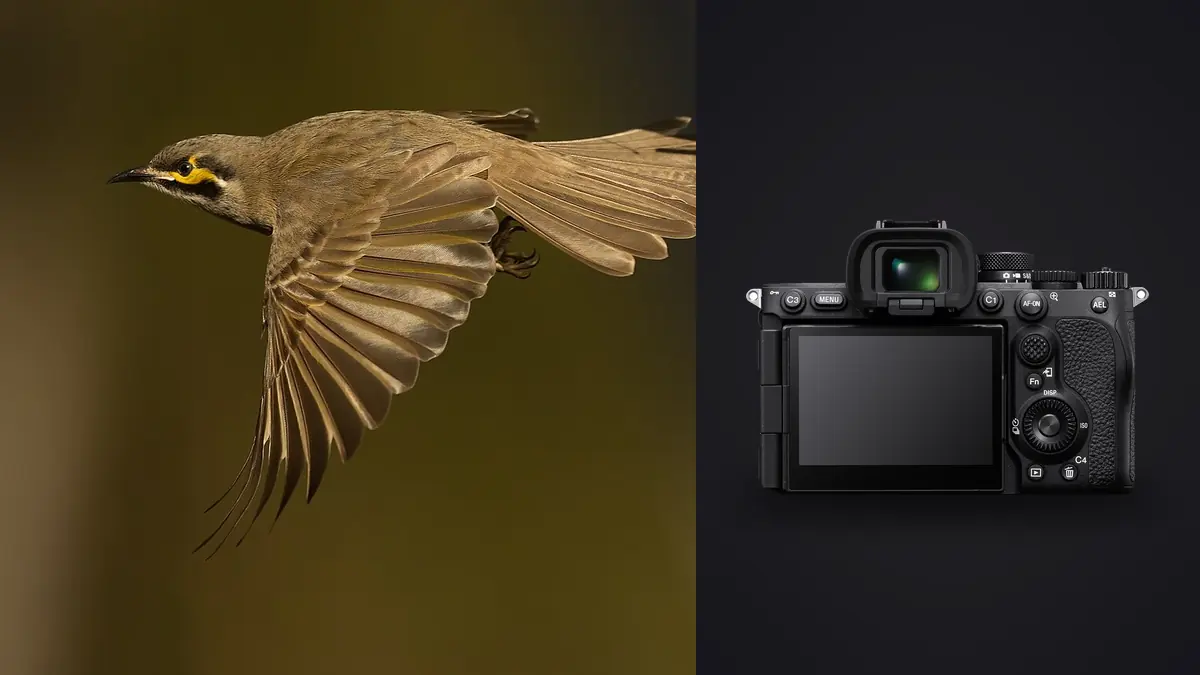
I bought the Sony A7R V in early 2023 for landscape and product work, not birds. For the first few months the bird and animal eye-detection menus sat untouched while I shot tripod-mounted long exposures of coastline. Then a friend who guides shorebird tours asked to borrow a body for a weekend at a tern colony, and I ended up tagging along with the 200-600mm instead of leaving it at home. That weekend changed how I think about this camera. It is not the obvious pick for birds in flight (BIF), and Sony never marketed it that way, but understanding exactly where it helps and where it fights you makes it a genuinely capable tool for the job, not just an adequate one.
Why a 61-Megapixel Body Even Makes Sense for Birds in Flight
The conventional wisdom says high resolution and fast action don't mix well, because bigger files mean slower write speeds, deeper buffers to fill, and more punishing standards for focus accuracy. All of that is true of the A7R V. But the same 61-megapixel Exmor R sensor that makes the camera slow to some eyes is also the reason I keep reaching for it over cameras with faster frame rates. When a tern is 40 meters out and filling a quarter of the frame, a 24 or 33-megapixel file leaves you cropping into a pixel count that falls apart under scrutiny. The A7R V lets you crop a bird down to 60 or 70 percent of the frame in post and still have enough resolution for a two-foot print. Shoot in APS-C crop mode (which the camera does automatically when you mount an E-mount crop lens, or manually via a menu toggle) and you get roughly 26 effective megapixels with a 1.5x reach multiplier, which turns a 600mm lens into an effective 900mm without touching a teleconverter.
The tradeoff nobody glosses over: this is not a stacked sensor. Sony's a1 and a9 series use stacked, backside-illuminated designs that read out the full sensor far faster, which is what lets them shoot at 20-30fps with minimal rolling shutter skew. The A7R V's sensor architecture is closer to the A7R IV's, just refined, and that shows up the moment you push shutter speed and frame rate together on fast-moving subjects. More on that below, because it's the single biggest thing to understand before you commit this camera to a BIF-heavy trip.
Dialing In Bird Recognition Autofocus (It's Not Just "Animal" Mode)
The AI-based subject recognition is the real headline feature for this use case, and it's worth setting up properly instead of leaving it on defaults. In the Subject Recognition menu, choose Birds specifically rather than the combined Animal/Bird setting. In my testing, the dedicated Bird mode locks onto an eye faster on birds against cluttered backgrounds (reeds, branches, a moving flock) than the combined setting does, presumably because the model isn't hedging between two different subject skeletons.
For the actual AF area, I stopped using Wide for BIF almost immediately. It hunts across the frame and occasionally locks onto a background bird when you're tracking a specific one in a mixed flock. Expand Flexible Spot, set to a medium-sized box and recentered with the joystick before the bird enters frame, gives the recognition engine a starting point without letting it wander. Tracking sensitivity I keep at 4 or 5 (leaning toward "locked on") for open-sky flight against featureless backgrounds, and closer to 2 when a bird is weaving through branches or other birds, so focus doesn't jump to whatever crosses closest to the box. AF-C, continuous, always. Back-button focus is not optional here; letting the shutter button also drive focus makes it too easy to yank focus off the subject with a half-press timed badly.
One setting that surprised me: dropping AF Transition Speed and AF Subject Shift Sensitivity down when photographing large soaring raptors (turkey vultures, ospreys riding thermals) rather than up. These birds move slowly and predictably relative to fast-flapping shorebirds, and a twitchy tracking response actually introduces more focus wobble than it prevents.
Rolling Shutter and the Electronic Shutter Trap
Here's where the non-stacked sensor bites. Sony rates the A7R V at up to 10fps in either mechanical or electronic (silent) shutter mode, and on paper those numbers look identical, so it's tempting to default to silent shutter for the reduced vibration and unlimited fps ceiling in theory. Don't, not for fast wingbeats. The sensor readout on this body is measured in the range of roughly 1/20th to 1/25th of a second in electronic shutter, and that's slow enough to produce visible skew and "jello" distortion on anything with quick wing motion against a static background, most noticeably on smaller, fast-flapping birds like terns, plovers, and swallows. A wingtip captured mid-frame can appear to lag or bend relative to the body.
Mechanical shutter avoids this because it uses a physical curtain rather than a rolling sensor scan, at the cost of shutter noise (which matters at a hide or blind where you don't want to spook anything) and slightly more vibration at high shutter speeds. My working rule after a season with the camera: mechanical shutter for anything with fast wing motion at moderate to close range, electronic shutter only for slow soarers, distant subjects where skew is imperceptible at output size, or genuinely noise-sensitive situations where I'm willing to trade some artifact risk for silence.
How It Stacks Up Against the Cameras Birders Actually Compare It To
People shopping for a BIF body rarely compare the A7R V in a vacuum. It usually comes down to a choice between staying in the Sony ecosystem at this resolution or stepping toward something built explicitly for speed. Here's how the realistic contenders compare on the specs that actually matter for flight photography, not the full spec sheet.
| Camera | Resolution | Max continuous shooting | Sensor readout | Buffer (compressed RAW) | Street price (body, 2026) |
|---|---|---|---|---|---|
| Sony A7R V | 61MP | 10fps (mech. or e-shutter) | Non-stacked, ~1/20s | ~180-220 frames | ~€3,700 |
| Sony A9 III | 24.6MP | 120fps (global shutter) | Global shutter, no skew | 1,000+ frames | ~€6,000 |
| Sony A1 II | 50MP | 30fps (e-shutter) | Stacked, ~1/200s | ~400+ frames | ~€6,500 |
| Sony A7 IV | 33MP | 10fps | Non-stacked, similar to A7R V | ~220 frames | ~€2,300 |
The A9 III's global shutter genuinely eliminates rolling shutter as a concern entirely, which is a big deal for fast wingbeats, but you're giving up more than half the resolution the A7R V offers and paying close to double. If your work leans toward large prints, heavy cropping, or you shoot birds alongside landscape and portrait work on the same body, the A7R V's resolution advantage is hard to walk away from. If flight photography is 90 percent of what you shoot and you print at modest sizes, the A9 III or A1 II earn their price premium.
Glass That Pairs Well, and Glass That Doesn't
The 200-600mm f/5.6-6.3 G is the lens I've used most with this body, and it's a sensible pairing: light enough to hand-hold for a few hours at a blind, sharp enough to hold up to 61 megapixels of scrutiny, and affordable relative to the GM primes. Stopped down half a stop from wide open, it resolves detail the sensor can actually use, which isn't true of every budget telephoto at this resolution.
The 100-400mm GM II with the 1.4x teleconverter is my second choice, mainly because the GM II autofocuses noticeably faster and holds up better in low, flat light common at dawn shoots, at the cost of reach compared to the 200-600mm's long end. I'd avoid the 2x teleconverter on either lens for BIF work specifically; the light loss pushes shutter speed down right when you need it high, and autofocus hunting increases noticeably on smaller, faster subjects. For anyone working with a super-telephoto prime like the 400mm f/2.8 or 600mm f/4 GM, the A7R V's in-body stabilization (rated to roughly 8 stops on paper, realistically closer to 5-6 with a long lens in hand) helps more with static perched shots than with flight tracking, where shutter speed does the real work regardless of stabilization.
The Real Bottleneck Starts After You Press the Shutter
A weekend at a tern colony with this camera in mechanical 10fps mode produces an ugly number fast. Two and a half hours of intermittent bursts left me with just over 4,000 frames one Saturday, each compressed RAW file sitting around 65-75MB. That's close to 300GB before I'd even opened a laptop, and the overwhelming majority of those frames are near-duplicates from the same burst: same bird, same wingbeat cycle, three or four frames apart, with only one or two actually sharp on the eye.
This is where I stopped trying to cull manually in Lightroom and moved that first pass into imagic instead. It runs entirely on the machine, no upload queue, which matters at a rental cabin with no real internet, and it does two things well for this specific workload: it clusters burst sequences and near-duplicate frames together so you're comparing four variants of the same wingbeat instead of scrolling past all 4,000 files individually, and it scores sharpness and focus accuracy locally so the genuinely soft frames (the ones where the eye tracking drifted to a wing or a background branch) get flagged before you waste time opening them full-screen. I still make the final keep/reject call myself, but the first pass that used to take an evening now takes about 25 minutes. If you're curious how that clustering and scoring actually works under the hood, this breakdown of AI photo culling covers the mechanics in more detail than I will here.
The other thing that's helped is building a preset from a batch of edits I was happy with, using imagic's apply_my_style feature, which trains on your own prior edits rather than a generic filter. BIF shots from a single session tend to want consistent treatment (similar white balance drift correction, similar sharpening curve for feather detail), and having that applied automatically across a big culled batch saves a second round of tedious per-image work. For anyone drowning in burst-heavy wildlife sessions generally, it's worth reading through these workflow tips as well, several of them assume exactly this kind of file volume.
A Few Sessions From the Field
Common terns diving for bait fish, mid-morning, bright overcast: 1/3200s, f/6.3, Auto ISO capped at 6400, mechanical shutter, Bird recognition, Expand Flexible Spot. This is the scenario where the camera performs best. Predictable flight paths, decent light, and the resolution advantage meant I could crop tight on a dive sequence and still deliver a usable 16x20 print.
Ospreys over a reservoir, low light, early evening: 1/2000s, f/5.6, ISO climbing past 8000 on some frames. Noise at that ISO on a 61-megapixel sensor is more visible pixel-for-pixel than on a lower-resolution body, though it holds together fine after downsampling for web or moderate print sizes. This is the one condition where I genuinely missed having a body with better high-ISO headroom.
Barn swallows over a field, midday, fast erratic flight: this is the session that convinced me to stop using electronic shutter for small fast birds entirely. Several frames showed clear wing skew even at 1/4000s, because the distortion comes from sensor readout speed, not shutter speed. Switching to mechanical shutter for the second half of that session cleaned it up completely, at the cost of dropping from a peak 10fps to a slightly less consistent mechanical 10fps with marginally more viewfinder blackout between frames.
Frequently Asked Questions
Is the Sony A7R V fast enough for serious birds in flight work, or should I skip straight to an A9-series body?
It depends on what "serious" means for you. Ten frames per second with reliable bird-eye tracking is enough to nail flight sequences from predictable subjects like gulls, terns, and raptors, and this body handles that work on its own. If you're regularly photographing erratic, fast fliers like swifts or small passerines in tight, unpredictable light, the frame rate and rolling shutter limitations will frustrate you more often, and that's where an A9 III's global shutter genuinely earns its price gap.
Should I shoot APS-C crop mode for extra reach on birds in flight?
Yes, situationally. Cropping to APS-C gives roughly 1.5x reach at about 26 effective megapixels, which is still plenty for web use and moderate prints, and autofocus performance is unaffected since it uses the same sensor readout. I switch to it when a lens's native reach genuinely isn't enough (a distant raptor on a 200-600mm, for example) rather than leaving it on by default, since you lose the option to recompose or reframe generously in post.
Does the A7R V's buffer actually run out during real flight sequences?
Yes, with a CFexpress Type A card it holds up for a solid burst (I've clocked around 15-18 seconds of continuous 10fps shooting before it noticeably throttled), but it's not the near-infinite buffer of a stacked-sensor body. In practice this pushes you toward shorter, more deliberate bursts rather than holding the shutter down through an entire flight sequence, which honestly isn't a bad habit to build regardless of camera.
Is 61 megapixels overkill for bird photography, or genuinely useful?
Genuinely useful, with a caveat. It's overkill if you're framing birds tight in-camera and printing small. It stops being overkill the moment you're working with distant, uncooperative subjects and need to crop hard, which describes a large share of real BIF shooting. The tradeoff is file size and storage, worth weighing against how you actually shoot before choosing this body purely for the megapixel count.