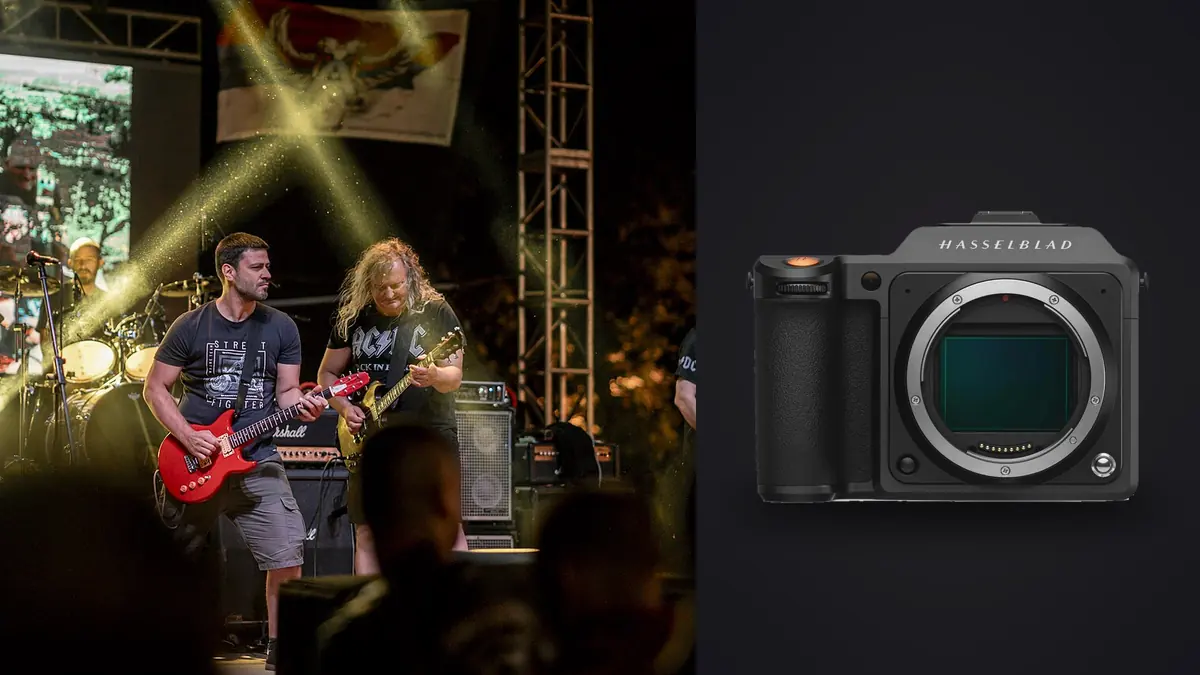
A 100-megapixel medium format body is not the first camera anyone reaches for when the house lights drop and a band walks on stage. Concert photography rewards speed: fast autofocus, deep buffers, high frame rates, and glass that stays open at f/1.8 or wider when the only light in the room is a single moving spot. The Hasselblad X2D 100C was not built with any of that in mind. And yet a growing number of photographers who normally shoot weddings, portraits, or landscape work are bringing it into pits and small venues anyway, because the deliverable they actually need from a show is not thirty usable frames a song, it is three or four extraordinary ones. This is a practical look at what that trade actually costs you, and where it pays off.
Why anyone would bring a medium format body to a gig
Start with the honest case against it. The X2D 100C was designed for studio, landscape, and considered portrait work, situations where you can take your time, chimp the histogram, and reposition the subject. Live music is the opposite of considered. People move fast, lighting changes every four bars, and you rarely get a second attempt at a moment. On paper, none of that favors a medium format sensor with a modest continuous shooting rate.
But the reason it keeps showing up in gig bags anyway comes down to what the images are for. A wire photographer covering a festival for same-day publication needs volume and speed. A photographer hired to shoot a band's next single cover, a tour poster, or a handful of large-format prints for a venue lobby needs one or two frames that hold up at billboard size with clean shadow detail and highlight roll-off that doesn't look clipped under a hard spotlight. That second brief is where the X2D earns its place, and it's a more common assignment than people assume once you get past the arena tier of the industry.
Autofocus and frame rate: the part that actually limits you
Hasselblad rates the X2D 100C at roughly 3.3 frames per second in continuous mode, and that number matters more here than almost any other spec. A drummer's stick hitting a cymbal, a singer's head snap on a downbeat, a guitarist jumping at the end of a bridge: these happen in fractions of a second that a 3 fps burst simply cannot bracket the way a 20 fps sports body can. You are not spraying and hoping the peak lands in the middle of a burst. You are anticipating the beat, pre-focusing, and firing single frames or short two-to-three-frame bursts on purpose.
Autofocus is contrast and phase-detect based and perfectly competent in good light, but it is noticeably less confident than a modern sports-oriented mirrorless system once the venue lighting drops to typical club levels and starts strobing or shifting color temperature. Expect some hunting on fast-moving subjects under low, saturated stage light, especially with slower XCD glass. The workaround most people land on is manual focus with focus peaking, locked to a spot on stage the performer is likely to hit (a mic stand, a monitor wedge, a specific floor mark), and waiting for them to walk into it rather than chasing them with autofocus.
Buffer depth compounds this. A compressed 3FR raw file out of the X2D 100C runs well over 100MB, and even a fast CFexpress card takes a moment to clear a short burst before the camera is fully responsive again. Chimping after every frame, a habit a lot of photographers don't even realize they have, will cost you the next moment. Shoot in short deliberate bursts, then look later.
Light, ISO, and the dynamic range trade-off
Base ISO on the X2D 100C is 64, with a native ceiling around 25,600 and an extended option beyond that. In absolute terms that ISO range sounds competitive with full-frame sports bodies, but the character of the noise at the top of that range, and the fact that most XCD lenses top out around f/2.5 to f/3.5 rather than f/1.8 or faster, means the realistic usable ceiling in a dim club is lower than the spec sheet implies. In practice, most photographers using this body for live work find ISO 3200 to 6400 the comfortable working range indoors, pushing higher only when the alternative is missing the shot entirely.
Where the sensor pays that back is dynamic range. Concert lighting is brutal: a performer half-lit by a hard spot with the rest of the stage in near darkness is a routine exposure, not an edge case. The extra stops of latitude in the raw file mean you can expose for the highlights on a face without losing the background entirely to black, and pull shadow detail back in post without the noise pattern falling apart. On a full-frame body shooting the same frame, you'd often choose between a blown-out cheek or a crushed background. The X2D gives you more room to have both.
Lens choices for the pit
The native XCD lineup is short on speed and long on optical quality. The XCD 80mm f/1.9 is the fastest lens in the system and a genuinely useful portrait-length option for tight stage crops when you can get close. The XCD 38V and 55V (roughly 30mm and 43mm full-frame equivalent) cover wider environmental shots of the stage and crowd, but at f/2.5 they ask for either more light or a higher ISO than you'd like. There is no native equivalent of the 70-200mm f/2.8 that most touring photographers live on, so reach is a real limitation unless you're working close to the stage or shooting a seated theater show where you can use a longer XCD prime without needing continuous autofocus tracking.
Some photographers adapt older Hasselblad V-system lenses for slower, more deliberate sets (a jazz trio, a singer-songwriter set, an orchestral performance) where manual focus isn't a handicap because nobody on stage is running around. That's a legitimate way to stretch the system's usefulness without buying into the full XCD catalog.
How it actually compares on paper
| Metric | Hasselblad X2D 100C | Typical high-speed mirrorless (sports/pit body) |
|---|---|---|
| Continuous shooting | ~3.3 fps | 15-30 fps |
| Sensor / resolution | 43.8 x 32.9mm medium format, 100MP | 35.9 x 23.9mm full frame, 24-45MP |
| Native ISO range | 64-25,600 | 100-51,200 |
| Fastest native lens | f/1.9 (XCD 80mm) | f/1.8-f/2.8 across most of the range |
| Raw file size | ~100-200MB (3FR) | 25-50MB |
| Body weight (approx.) | ~895g body only | 650-900g body only |
| Electronic shutter | Fully silent option, no leaf-shutter sync boost | Silent burst modes, some with global shutter |
| Starting body price | ~$8,199 | $4,000-6,500 |
Where the silent shutter genuinely matters
One underrated advantage for a specific slice of live music work: fully silent electronic shutter shooting. A rock show buries mechanical shutter clatter under a wall of sound, but a solo acoustic set, a string quartet, a jazz club with a hushed room, or a formal orchestral concert does not forgive a clacking shutter three feet from the first row. The X2D's silent mode lets you work through those sets without becoming part of the recording. The trade-off is rolling shutter risk with anything moving quickly, and the possibility of banding under LED stage lighting that's being driven by a fast PWM dimmer, something worth testing at soundcheck rather than discovering mid-set.
What to actually do with a 200MB file once you're home
The practical downside nobody mentions until they've lived with it: a two-hour show on this body can easily produce eighty to a hundred gigabytes of raw files, and every one of them is large enough that a slow culling workflow becomes its own evening of work. This is the part of the job where I've stopped fighting the file size and started using imagic to get through it, since it runs entirely on the machine and never uploads those enormous 3FR files anywhere before I've had a chance to sort them myself. The local sharpness scoring is genuinely useful here specifically because autofocus confidence dips under stage lighting the way I described above, so a chunk of any set will be a hair soft in ways that are hard to catch at a glance on a small screen; having every frame ranked by actual focus data instead of by eye saves real time.
Because the short bursts from a 3 fps body still produce clusters of near-identical frames (three attempts at the same downbeat, say), imagic's duplicate and burst clustering groups those together automatically instead of making you compare them one by one at full resolution, which with files this size is slow enough to matter. And once the set is culled down, the apply_my_style preset (trained on your own previously graded photos rather than a generic look) gets you to a consistent color pass across a night that swung between blue wash, amber spot, and white strobe without regrading every image from scratch. If you haven't looked closely at how automated culling actually decides what's sharp versus soft, this breakdown of how AI photo culling works is a good primer before you trust it with a paid gig's worth of files.
If the bigger issue is that your whole post-show routine feels slow regardless of camera, it's worth comparing notes against these tips for a faster photo workflow, several of which apply directly to sorting a large, uneven concert set the morning after.
Who this setup is actually for
If your job is "three songs, no flash, deliver a gallery of forty usable images by midnight," this is not your camera, and trying to make it one will just cost you good moments. But if you're shooting a single band's album art, a tour poster, an editorial cover, or a handful of large prints for a venue, and you can negotiate even limited stage access or a soundcheck slot, the X2D's file quality gives you room the pit photographers standing next to you simply don't have. I've started treating it as a second body rather than a primary one: a fast mirrorless kit handles the volume and the unpredictable moments, and the Hasselblad comes out for the two or three planned frames I already know I need at a specific point in the set.
Frequently Asked Questions
Can the X2D 100C survive a standard three-song photo pit assignment?
Physically yes, but the 3.3 fps ceiling and buffer clearing time mean you'll come away with far fewer usable frames than a body built for that job. It works better as a supplementary camera for a small number of pre-planned shots than as your only tool for that kind of assignment.
What ISO is actually usable in a typical small venue?
Most photographers land on ISO 3200 to 6400 as the comfortable working range indoors. The native ceiling of 25,600 exists and is technically usable, but noise character and the lack of very fast native glass mean you'll want to avoid relying on it as your default.
Does the electronic shutter cause problems under stage lighting?
It can. LED fixtures driven by fast PWM dimming can produce banding with an electronic shutter at certain shutter speeds, and rolling shutter can skew fast-moving subjects. Test both at soundcheck rather than finding out mid-set, and keep the mechanical shutter as a fallback for anything with quick motion.
Is it worth bringing instead of a second fast mirrorless body?
Depends entirely on the deliverable. For full-set editorial coverage, no, a second high-frame-rate body will serve you better. For a handful of large-format or print-bound images from a night, the extra dynamic range and resolution can be worth the frame rate you're giving up.