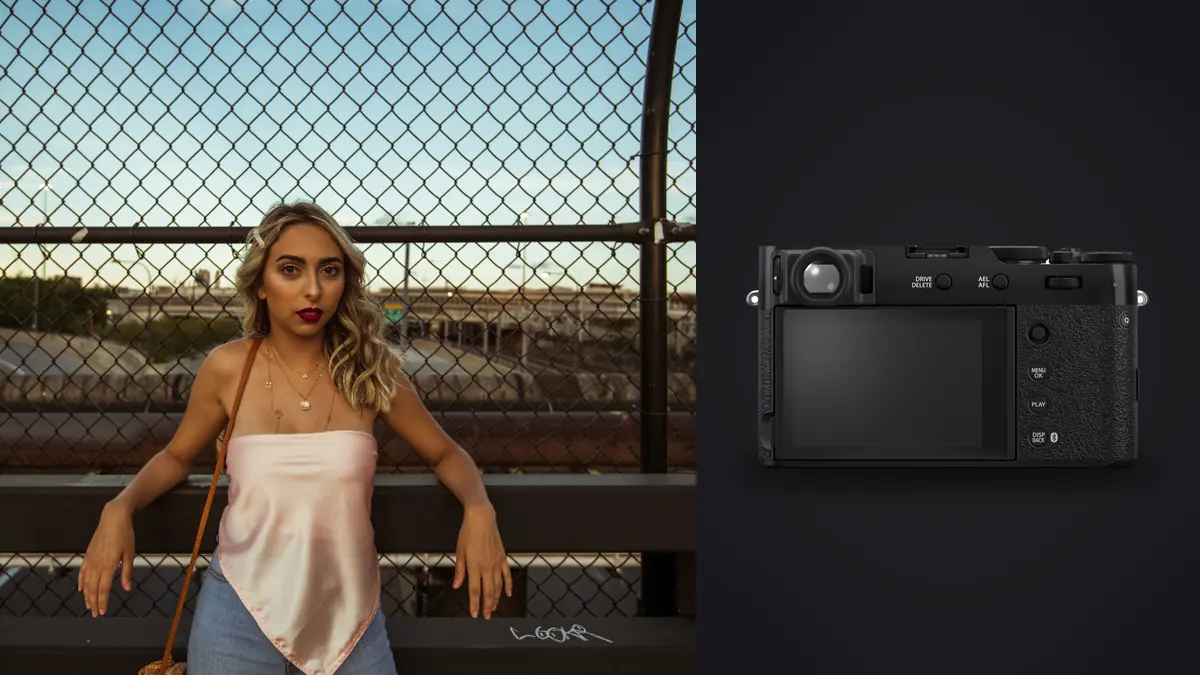
Picture a stylist texting in March to ask whether you could shoot forty looks for a small resortwear label's website lookbook: budget for one camera body, two days, and "please nothing that looks like a rental car ad." Say a Fujifilm X100VI has been a personal camera for about four months and, half as a joke, it goes along as the only body instead of the usual full-frame kit. It ends up shooting the entire job. This is what that would actually involve, not the marketing version.
The Case for One Lens, One Focal Length, All Day
The X100VI's lens is fixed: a 23mm f/2 that, on the APS-C sensor, gives you roughly the field of view of a 35mm lens on full frame. There's no zooming out of a bad angle and no reaching for a longer lens when the next rack of clothes is crowding the background. On a lookbook day that sounds like a limitation until you notice how much it speeds up decision-making. You stop asking "which lens" and start asking "where do I stand." After the first handful of looks I had a mental map of exactly how far back I needed to be for a full-length shot, a three-quarter shot, and a close crop on a collar or a cuff, and I stopped checking the LCD to confirm framing because the math didn't change from garment to garment.
"Where do I stand" has a real, fairly boring answer, and it's worth knowing before you agree to shoot a lookbook in a location you haven't scouted. These are the distances that actually worked for me across two days of shooting, not manufacturer marketing numbers.
| Shot type | Approx. distance from subject | Digital tele setting worth trying | Practical note |
|---|---|---|---|
| Full length, head to floor | 3.2 to 3.5 meters | None, use native 35mm | You need a genuinely open room or a wide stretch of street; a tight studio corner won't give you this |
| Three-quarter, mid-thigh up | 1.8 to 2 meters | 50mm equivalent | Comfortable working distance without crowding a nervous model |
| Waist-up / half body | 1.2 to 1.4 meters | 50mm equivalent | Good for direction-giving between frames, you're close enough to talk normally |
| Close crop, neckline or fabric detail | 0.4 to 0.7 meters | 70mm equivalent | Near the lens's minimum focus distance; check focus confirmation, don't trust the finder alone |
One thing worth being straight about: the in-camera digital teleconverter, which steps the finder and JPEG preview to a 50mm or 70mm equivalent framing, is genuinely handy for previewing a tighter crop without physically closing the distance and spooking someone in front of the camera for the first time. But if you're shooting RAW for a paid commercial job, which you should be, the teleconverter only tags a crop guide onto the file. It doesn't add optical reach. What you're seeing at 50mm or 70mm is a preview of a crop you'll make yourself later from the same 40-megapixel frame you'd have captured anyway. Worth knowing before you describe it to a client as more than it is.
The Leaf Shutter Is the Feature Nobody Talks About Enough
This is the part that gets buried under sensor and autofocus talk in most reviews, and it's the reason I'd genuinely recommend the X100VI to another fashion photographer over bodies with better specs on paper. Because the shutter is built into the lens itself rather than sitting in front of the sensor, the X100VI syncs flash at every shutter speed up to its mechanical maximum of 1/4000s. A typical mirrorless or DSLR body with a focal-plane shutter caps flash sync somewhere around 1/200s or 1/250s, which is exactly the ceiling that ruins outdoor lookbook shoots at midday. You either drag your shutter speed down into a range where the sky blows out, or you lean on high-speed sync and lose a stop or two of flash power right when you need it most.
The outdoor looks on the resortwear job were shot on a white sand beach between 11am and 2pm, because that's when the stylist had the models booked, not because it was flattering light. With a single small speedlight camera-left at maybe quarter power, 1/2000s and f/4, I could hold detail in a bright sky and still lay a clean edge of light on dark fabric that would otherwise have gone flat and shadowed against that background. That's not a workaround, that's just the shutter doing its job. I don't own strobe gear expensive enough to fight full midday sun that hard on a body limited to a 1/250s sync speed without adding a second light and a bigger battery pack I didn't have room for in a two-bag kit.
The built-in neutral density filter helps with the other half of that same problem: shooting wide open at f/2 in bright sun without the ND filter, you're often forced up past 1/4000s or into unusably high ISOs to avoid overexposing. Flip the ND on and you get roughly three stops back, enough to keep the aperture open for shallow depth of field on a garment detail shot even at noon.
Where It Actually Struggles as Your Only Camera
I wouldn't tell a photographer switching entirely off a full kit for commercial fashion work to sell everything and buy just this. A few real limits showed up over the two days.
- Buffer depth. Bursting through a jump shot or a fabric-movement sequence, the buffer fills within a couple of seconds shooting RAW plus JPEG, and it clears slowly enough that I lost a couple of usable frames when a model spun a dress mid-look on day two. A body built around continuous shooting this is not.
- No compression option. There's no reaching for an 85mm or 135mm to get that flattened, long-lens look a lot of editorial fashion wants for close beauty crops. At 35mm equivalent, a close portrait puts you physically near the subject with more background and more perspective distortion than a longer lens would give you.
- Single card slot. No in-camera backup while shooting. On unrepeatable looks with a stylist and a rented location on the clock, nightly backup to two separate drives stopped being optional after day one.
- Battery life. Running the EVF and chimping between looks, I was getting closer to 300 usable shots per charge than the number on the spec sheet. I carried four batteries and a charger and still cut it close on day two.
Film Simulations as a Brand Decision, Not a Filter
The X100VI added Reala Ace to the film simulation menu, sitting between Provia's neutral rendering and Astia's softer skin tones. For the resortwear brand, whose product leans toward warm linen and terracotta tones, Classic Neg works well as the shooting simulation for the whole job. Not because the aim is to deliver JPEGs straight out of camera (every selected RAW gets graded afterward) but because it gives the stylist and the brand's founder something honest to look at on the back of the camera between looks. Classic Neg's slightly desaturated, faded-shadow rendering can match the mood board closely enough that nobody spends set time debating whether a look "felt right" from a glance at the LCD. Nostalgic Neg, by comparison, pushes warmer and would fight the terracotta tones already in play.
None of this replaces an actual grade later. It's a communication tool on set, and a fast way to hand a stylist a usable-looking reference JPEG the same afternoon while the RAW files go through real post-production on a different timeline.
From Card to Delivered Lookbook
Forty looks across two days, shot RAW plus JPEG on one fixed lens, came out to just under 3,800 frames. A fixed 35mm lens doesn't reduce how much you shoot; if anything it increases it, because you can't zoom in to check a detail, so you take a few extra frames at different distances to cover yourself. That's a lot of near-duplicate shots to sort through by eye at eleven at night in a hotel room.
I ran the card through imagic that first night instead of scrubbing through frames manually. Its duplicate and burst clustering grouped the twirl sequences and the "model blinked, shoot it again" repeats automatically, and the local sharpness scoring flagged which frame in each cluster actually had crisp focus on the eyes rather than on the fabric behind them, which matters more than people expect when you're shooting f/2 at 0.7 meters. That took the pile from 3,800 down to a shortlist closer to 400 in under twenty minutes, which is the difference between finishing selects before bed and finishing them on the flight home two days later.
There was also a confidentiality reason to run culling locally rather than through a cloud-based tool. The label hadn't announced the collection yet, and our agreement with them was explicit about not putting unreleased product anywhere outside our own machines before the launch date. imagic runs its sharpness and duplicate detection on the laptop itself, nothing gets uploaded anywhere to do it, so that condition was easy to meet without having to explain to a client why their unreleased resortwear line was sitting on somebody else's server. That question has come up on more commercial jobs than it used to a few years back; brands are asking about it before they sign off on a workflow now, not after something's already gone wrong.
For the grade itself, a preset built from earlier edits with imagic's apply_my_style feature can help, since it trains off edits you made yourself rather than a generic preset pack bought online. Running that across the shortlisted resortwear frames gets every look to a consistent starting point (same white balance logic, same shadow lift) before look-by-look adjustments on the handful of shots that need more attention, such as beach frames where sand reflection blows out skin tones unevenly. If you want the mechanics behind how the culling side actually scores a frame, I've laid that out separately in how AI photo culling works; the broader habits around shoots that generate this many frames in a short window are covered in 10 tips for a faster photo workflow, if forty-look days are becoming a regular thing for you too.
Frequently Asked Questions
Is a fixed 35mm-equivalent lens really workable for a full lookbook, or just for a handful of looks?
It's workable for a full lookbook if you scout the space first. The distances in the table above are non-negotiable: a full-length shot needs roughly 3.2 to 3.5 meters of clear room behind you, and if the location can't give you that, you'll be cropping full-length shots down from a three-quarter frame instead of shooting them properly. I'd walk any new location with a tape measure attitude before committing to this as your only camera for the day.
Does the leaf shutter's flash sync advantage matter if I'm shooting indoors with studio strobes?
Less than outdoors, but it still helps. Indoors you usually have enough control over ambient light that a 1/200s sync ceiling isn't fighting you the same way direct midday sun does. Where it still pays off indoors is with fast-recycling monolights near large windows, or any set where you're deliberately mixing daylight and flash and don't want to compromise on aperture to control exposure. Outdoors in hard sun is where the difference is dramatic rather than marginal.
How does the X100VI actually compare to bringing a full-frame body with a 35mm prime for the same job?
A full-frame body with an interchangeable 35mm gives you the option to swap to an 85mm for beauty crops mid-shoot, which the X100VI simply can't do. That's a real advantage if your lookbook needs both wide environmental shots and tight compressed portraits in the same session. What you give up for that flexibility is bag weight, a less discreet camera on set (useful when you want candid, unposed moments between the posed looks), and unless you own one of the handful of expensive leaf-shutter lenses on the market, the flash sync advantage disappears entirely. I'd pick the X100VI for a lookbook that's mostly environmental and full-length work, and a full-frame kit for one built around tight beauty crops.
Is 40 megapixels overkill for lookbook images that mostly end up on a website?
For a web lookbook or a downloadable PDF catalog, it's more headroom than you need day to day, but it earns its keep given how the digital teleconverter actually works. Since the 50mm and 70mm crop settings don't add optical reach, cropping a look to a tighter three-quarter shot in post from the full 40-megapixel file holds up fine at web and catalog print resolution. The only place it gets tight is a full-bleed large print, where you'd want to plan for native framing rather than relying on a heavy crop.