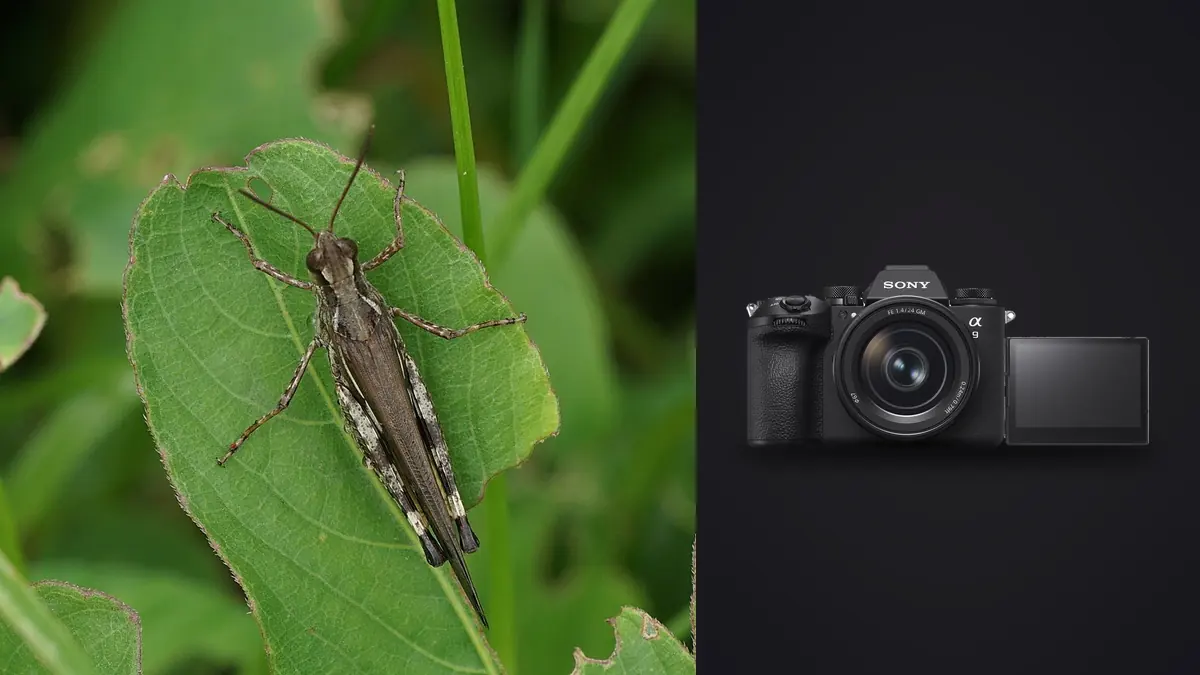
A camera built for football sidelines and Formula 1 pit lanes is not the obvious choice for photographing a jumping spider on a leaf two centimetres from your lens. But I spent most of a dragonfly season this summer with a Sony A9 III strapped to a macro rail, mostly because it was the body sitting in the bag when a friend needed his A7R V back, and I came away with opinions I did not expect to have. Some of them are enthusiastic. A couple of them are complaints I have not seen written down anywhere else, because almost nobody reviews this camera for bugs.
Why a sports camera ends up in the macro bag
The A9 III was designed to solve problems that have nothing to do with insects: rolling shutter distortion on a golf swing, banding under stadium lighting, and keeping up with an athlete who changes direction in a tenth of a second. None of that sounds like macro photography until you remember that a hoverfly's wings beat somewhere around 200 times a second, that a lot of good insect light comes from LED panels and ring lights that flicker at frequencies your eye cannot see but your sensor absolutely can, and that a paper wasp deciding to leave a flower gives you about as much warning as a sprinter leaving the blocks.
Put those three things together and the case for a global shutter camera in a macro bag stops sounding strange. It still surprised me how much of the difference showed up in the first afternoon.
The global shutter's real payoff for insects
Sony's global shutter reads every pixel on the sensor at the same instant instead of scanning line by line, and for macro work the two places this matters most are wing motion and artificial light. With a rolling shutter body, a fast-moving wing edge against a static body produces a subtle skew, almost a smear, that only becomes obvious when you pixel-peep a 100% crop. On the A9 III that skew is gone. Dragonfly wings that were slightly warped on my A7R V crops came out geometrically honest on the A9 III, which matters if you print big or if you are the sort of photographer who notices these things and cannot stop noticing them once you have.
The flicker issue is the one I did not expect to care about. I shoot a lot of ground-level macro under an LED panel bounced off a reflector, and on rolling shutter bodies at faster shutter speeds you occasionally get a banding artifact across the frame, a darker stripe that ruins an otherwise perfect shot of an ant carrying a leaf fragment. The A9 III does not do this, at any shutter speed, because every part of the sensor is exposed simultaneously. The other thing the global shutter unlocks that actually changes how you shoot: flash sync at any shutter speed, all the way up to 1/80000s. For daylight insect macro where you want a fast shutter to freeze wing motion and a small aperture for depth of field, but also want fill flash without a black background problem, that combination used to require compromises. Here it does not.
Where the resolution runs out
Now the complaint. 24.6 megapixels is not much sensor to work with once you start cropping into something the size of a grain of rice. A jumping spider filling maybe a fifth of the frame at 1:1 magnification leaves you with a genuinely small usable pixel count after you crop tighter in post, and I found myself wishing for the A7R V's 61 megapixels more than once, specifically on subjects under 5mm where getting true 1:1 magnification physically close enough was not possible or safe for the insect.
This is less of an issue than it sounds for anything dragonfly-sized or larger, where you are filling more of the frame at capture and cropping is a minor adjustment rather than a rescue operation. But if your actual interest is jumping spiders, springtails, or the smaller solitary bees, the resolution ceiling on the A9 III is a real limitation you should weigh against the shutter and autofocus advantages before buying one specifically for this. I would not buy an A9 III as a dedicated macro body for tiny subjects. I would absolutely keep using one as a second body for anything that flies or jumps.
Where compound eyes give autofocus trouble
Sony's Eye AF is trained on mammal and bird eyes, and it shows. Point it at a bee and the camera hunts, sometimes locking onto the thorax, sometimes onto a wing vein, occasionally onto nothing useful at all. Real-time tracking does a reasonable job of following a moving insect once you have a general area selected, but at true macro magnifications the depth of field is measured in fractions of a millimetre, and autofocus this imprecise is not accurate enough to reliably land on a compound eye. In practice I ended up doing what most serious macro shooters already do regardless of camera: manual focus with focus peaking turned up, body movement instead of lens focus ring for the fine adjustment, and a lot of missed frames accepted as the cost of the technique. The A9 III's autofocus speed is wasted on this kind of work. Where it earns its keep is tracking a dragonfly in flight at a slightly wider focal length, not locking onto a still subject at 1:1.
Lens pairing and working distance
The lens matters more than the body for how close you can get before an insect notices you and leaves. I rotated through four options over the season, and working distance turned out to be the deciding factor far more often than magnification ratio.
| Lens | Max magnification | Approx. working distance | Native AF on A9 III | Best suited to |
|---|---|---|---|---|
| Sony FE 90mm F2.8 Macro G OSS | 1:1 | ~28cm | Yes, fast and quiet | Dragonflies, butterflies, general field work |
| Sony FE 50mm F2.8 Macro | 1:1 | ~16cm | Yes | Flowers with resident insects, tighter garden spaces |
| Sigma 105mm F2.8 DG DN Macro Art | 1:1 | ~29.5cm | Yes | Bees and wasps where extra distance means fewer defensive flights |
| Laowa 90mm F2.8 2X Ultra Macro APO | 2:1 | ~14cm at max magnification | Manual focus only | Static or slow subjects under 10mm, patient tripod work |
The 105mm from Sigma became my default for anything with a stinger, purely because an extra centimetre or two of working distance is the difference between a bee tolerating you and a bee deciding you are a threat. The Laowa produces the most striking 2:1 detail of the group but the working distance at full magnification is short enough that it is nearly useless on anything that can fly away, and manual focus only at that magnification is genuinely difficult handheld. It is a tripod lens, full stop.
What the burst mode actually buys you in the field
The A9 III's blackout-free viewfinder and up to 120fps continuous shooting sound like sports camera marketing until you are trying to photograph a bee launching off a flower. That launch happens in a handful of frames and gives almost no visual warning. Shooting at 120fps with the EVF staying live through the entire burst, rather than freezing or blacking out between frames the way older mechanical shutter cameras do, meant I could actually track the subject through the takeoff instead of losing it the instant the mirror or shutter interrupted my view. Pre-capture buffering helped even more: with the buffer set to grab up to a second of frames before the full shutter press, I stopped missing the actual moment of takeoff entirely, because the camera had already captured it before my finger reacted to what my eye saw.
The tradeoff is obvious and worth saying plainly: 120fps for two or three seconds produces an enormous number of frames, and most of them are nearly identical. A single decent hoverfly sequence can leave you with 200 to 300 raw files that differ from their neighbours by nothing more than a wingtip position.
Sorting through what actually comes home
This is where the trip from the field to the edit becomes the real bottleneck, and it is the part almost nobody talks about when they review a camera on burst rate alone. A full day chasing dragonflies at a pond with the A9 III set to high-speed continuous can easily produce four or five thousand frames, and manually scrubbing through that to find the handful where the wings are positioned well and the eyes are sharp is not a reasonable way to spend an evening. I run everything through imagic afterward specifically because it clusters near-duplicate burst sequences and scores focus locally on the machine, so instead of opening every one of those 300 near-identical hoverfly frames I get shown the two or three where the focus actually landed on the eye rather than the wing or the leg. If you shoot the A9 III the way it wants to be shot, in long bursts chasing unpredictable subjects, some kind of automated culling stops being optional. For a longer look at how that scoring actually works, this piece on AI photo culling covers the mechanics in more depth than I will here. I revisited the same body earlier in the season too, and wrote up a few more field notes in an earlier A9 III macro session, which covers some of the same ground from a different week's shooting.
Keeping the edit consistent across a whole season
The second place software ends up mattering is consistency. Macro insect work tends to happen across a lot of separate short sessions rather than one big shoot, a morning here, an evening there, spread over a whole summer, and it is easy for your color and contrast choices to drift session to session without noticing until you look at a full season side by side. I trained imagic's apply_my_style feature on a batch of macro edits I was already happy with, greens that did not go neon, backgrounds that stayed soft rather than muddy, and it has kept new sessions looking like they belong to the same body of work without me manually matching sliders every time. It is a small thing but it adds up over a hundred outings.
Field days at nature reserves also tend to mean no signal and no wifi, which is the other reason I care that the whole culling and editing pass happens locally on the laptop rather than depending on an upload. Nothing about a pond two hours from the nearest town should require a cloud connection to sort a memory card.
Battery, heat, and weather in real field conditions
A few practical notes that do not show up on a spec sheet. Running high frame rate bursts repeatedly through a warm afternoon does drain the battery faster than the rated shot count suggests, and I carried three batteries on longer days rather than the two I initially packed. The body itself handled a light drizzle at a wetland reserve without complaint, weather sealing on Sony's higher end bodies has been solid for a few generations now, but the lenses in the table above vary in their own sealing, and the Laowa in particular is not rated for the kind of damp grass and pond-edge crouching that dragonfly photography involves.
Frequently Asked Questions
Is the 120fps burst mode actually useful for insect photography, or is it overkill?
For anything airborne, genuinely useful. For a stationary beetle on a leaf, overkill and mostly a way to fill your memory card faster. The frame rate earns its place specifically on takeoff and flight sequences where the moment you want lasts a fraction of a second and gives no visual cue beforehand.
Can the A9 III's autofocus actually track a flying insect at macro distances?
It tracks motion well at slightly wider focal lengths and moderate distances, following a dragonfly patrolling a pond edge reasonably competently. At true 1:1 or greater magnification, where depth of field shrinks to a sliver, I did not find the autofocus precise enough to trust, and manual focus with peaking produced a much higher keeper rate.
Is 24.6 megapixels a real limitation for macro insect work?
For subjects that fill a meaningful portion of the frame at capture, dragonflies, butterflies, larger beetles, it is rarely an issue. For anything under about 8mm that you need to crop aggressively after the fact, a higher resolution body will give you noticeably more room to work with, and it is worth weighing against everything the A9 III does well before committing to it as a dedicated small-subject macro camera.
Do I need flash for insect macro, and does the global shutter change that?
Flash is not mandatory but it solves real problems: freezing wing motion beyond what shutter speed alone can manage, and filling in shadow detail under a small aperture. The global shutter's full-range sync means you can combine a fast shutter with flash without the usual sync speed ceiling, which gives you more control over how dark or light the background falls relative to the subject, useful for the classic black-background macro look shot in full daylight.