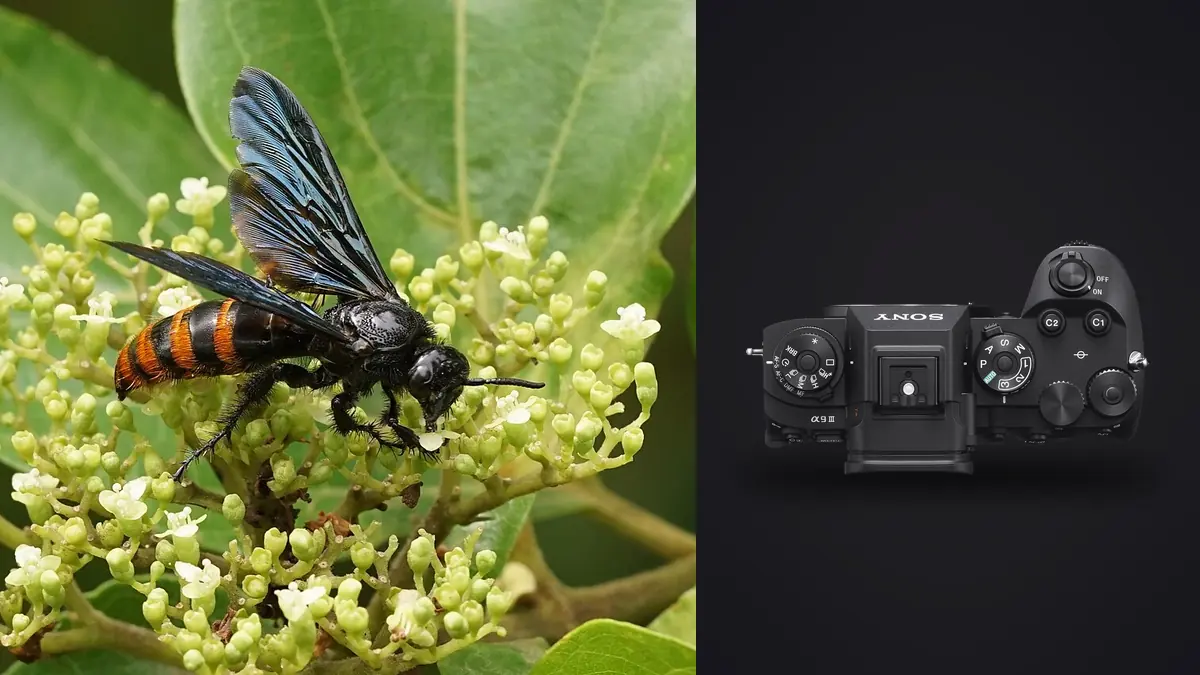
I spent most of one soggy June morning last year lying on a drainage ditch bank in a nature reserve, an A9 III on a focusing rail, waiting for a hairy dragonfly to warm up enough to fly but not so much that it would clear off before I got a frame. That's the actual working condition of insect macro photography: you are usually cold, damp, and racing a subject's metabolism. Most of what gets written about the Sony A9 III treats it as a sports and bird body, which it is, but the same global shutter sensor that keeps a football in focus during a blackout-free 120fps burst also solves two problems that have quietly annoyed macro shooters for a decade: flash sync ceilings and rolling shutter skew on fast-moving small subjects. Neither of those show up in a typical spec sheet comparison, so I want to walk through what actually changes at insect scale, and where the A9 III's strengths stop mattering.
The shutter mechanism nobody thinks about until it ruins a wing
Rolling shutter is the reason a dragonfly's wing looks bent or smeared in a photo taken with almost any mirrorless camera at a fast but not instant readout speed. A conventional stacked sensor scans line by line, and if a hoverfly's wings are moving through dozens of beats per second while that scan happens, you get warping that no amount of sharpening fixes in post. The A9 III's sensor reads every pixel at the same instant, full stop, which is the entire point of a global shutter. For static macro subjects (a beetle sitting on a leaf, a moth at rest) this barely matters. For anything with wings in motion, it is the difference between a clean freeze and a slightly alien-looking smear across the wing membrane.
The bigger practical win, in my experience, is flash sync. Because there's no rolling curtain to outrun, the A9 III syncs flash at any shutter speed up to 1/80000 second without touching high-speed sync mode. Macro insect work leans on flash constantly, because stopping down to f/13 or f/16 for depth of field at high magnification eats several stops of light that ambient can rarely supply, especially under tree canopy at 6am. On a normal body you're stuck under roughly 1/200 or 1/250 sync speed unless you switch to HSS, which cuts your effective flash power dramatically. On the A9 III you can run 1/2000 or faster with full flash output, which lets you freeze a bee's wingbeat (some species beat well over 200 times a second) while still controlling ambient light enough that the background doesn't blow out or turn into mush.
Autofocus that helps less than you'd think, and a little that helps a lot
Sony's subject recognition system includes an insect category, inherited from the same AI processing unit that first showed up on the A7R V and later rolled out across the rest of the lineup. In practice it's genuinely useful for perched subjects at moderate magnification, roughly 0.5x to 1x, where the AF system can still identify an eye or a head shape and lock onto it reliably. Point it at a dragonfly perched on a reed from four feet away and it tracks the eye through minor repositioning without much fuss.
Where it stops helping is past 1:1 magnification, which is where most serious insect macro work actually happens. At 2x or higher, depth of field collapses to fractions of a millimeter, and the plane of focus moves faster than any autofocus motor can chase reliably, especially with a live subject shifting its posture between breaths. Most macro shooters I know, myself included, switch to manual focus and physically rock the camera or lens forward and back on a rail, using focus peaking to judge the moment the eye snaps sharp, then firing. The A9 III's autofocus speed is largely irrelevant at that point. What does help is the blackout-free EVF, because you can watch the subject continuously through the rocking motion instead of losing the frame every time the shutter fires, which matters a lot when the insect might bolt at any second and you want to know immediately if it did.
For subjects that hold still (cold mornings are your friend here, since most insects are torpid below about 12°C and won't move until the sun hits them), the body's focus bracketing menu lets you set a shot count and step width and let it walk through a stack automatically, which you then merge in post. That's the one place autofocus-adjacent automation earns its keep on truly static macro subjects.
How the A9 III stacks up against the other Sony bodies people actually consider for this
Nobody buying into insect macro work is choosing between the A9 III and a Nikon; within the Sony lineup the real decision is usually between four bodies, and each one trades something specific away.
| Body | Sensor | Native ISO floor | Flash sync ceiling | Rolling shutter risk on wings | Where it actually wins for bugs |
|---|---|---|---|---|---|
| Sony A9 III | 24.6MP stacked, global shutter | ISO 250 | 1/80000s, any shutter speed | None, ever | Wingbeat freezing, no-HSS flash power, erratic fliers |
| Sony A1 II | 50.1MP stacked | ISO 100 | 1/400s native, HSS beyond that | Low but present at fast e-shutter speeds | Cropping into small subjects while keeping detail |
| Sony A7R V | 61MP BSI | ISO 100 | 1/200s native, HSS beyond that | Noticeable on fast wings at e-shutter speeds | Maximum resolution for extreme detail crops |
| Sony A7 IV | 33MP BSI | ISO 100 | 1/250s native, HSS beyond that | Moderate at e-shutter speeds | Budget entry point, static and slow subjects |
The A1 II and A7R V both out-resolve the A9 III on paper, and that matters if you're routinely cropping into a jumping spider's face from three feet away because you couldn't get physically closer. But a 24.6MP sensor has an underrated advantage for macro specifically: less resolving power per pixel means diffraction softening from small apertures (f/16, f/18, f/22, all common in macro work for depth of field) shows up later and less severely than it does on a 61MP sensor, where diffraction limits become visible well before f/16. So the "lower" resolution body sometimes actually holds up better at the apertures macro shooters are forced to use.
Building a kit around it
Lens choice
The native Sony FE 90mm f/2.8 Macro G OSS remains the sensible default, autofocuses reasonably well up to 1:1, and its optical stabilization helps with handheld framing even though you'll mostly be manually focusing at high magnification anyway. For anyone wanting beyond 1:1 without buying a second lens, the Laowa 90mm f/2.8 2x Ultra Macro APO in E-mount is worth the manual-focus-only tradeoff, since at 2x magnification autofocus wouldn't help much regardless. Sigma's 105mm F2.8 DG DN Macro is a reasonable middle ground if you're already invested in Sigma glass elsewhere.
Flash and diffusion
A single on-camera flash bounced off a diffuser panel gets you through casual shooting, but a twin-flash bracket mounted either side of the lens barrel gives much more even, controllable light and avoids the harsh single-source shadow that a ring flash tends to produce on a subject with any texture (which is every insect). Given the sync speed headroom, I run flash power lower than I would on a normal body and let the fast shutter do more of the ambient-light control, which keeps recycle times shorter for back-to-back bursts.
Support
A focusing rail helps for genuinely static subjects like dew-covered spiders at dawn, but most live insect work is handheld, because a tripod-mounted rail can't reposition fast enough when a subject shifts three inches to the left. I keep a monopod nearby mainly to rest the rig between subjects, not to shoot from.
Working the early window
The best insect macro light and the most cooperative subjects both show up in the same narrow window: roughly 30 to 90 minutes after sunrise, when overnight cold has left insects too sluggish to fly off but the light has just started to warm up. Dew clinging to a beetle's exoskeleton or a spider's web is a byproduct of the same temperature drop, not something you can fake later. Working silently matters here too, and the A9 III's fully electronic shutter is genuinely silent, no mechanical clack to spook a torpid moth mid-approach. Once the sun clears the treeline and body temperature rises, most subjects become mobile and considerably harder to work with, which is when the flash sync and continuous shooting speed actually start earning their keep, because you're now photographing things that fly rather than things that sit.
What a morning of 120fps bursts does to your evening
Shooting bursts at high frame rates to catch a bee mid-launch produces an absurd number of near-identical frames. A three-second burst at even a conservative 30fps subset of the camera's top speed is ninety images of essentially the same wingbeat sequence, most of them slightly soft as the subject moves through the plane of focus. Multiply that across a two-hour session and you're looking at several thousand frames to sort through by evening, which is where I actually use imagic rather than scrolling through Lightroom's grid view frame by frame. Its local sharpness scoring flags which frame in each burst actually nailed focus on the eye, and its duplicate and burst clustering groups the near-identical shots together automatically so I'm not manually comparing frame 214 against frame 215 by eye. Because it runs entirely on the machine rather than uploading anything, it works fine at a reserve car park with no signal, which matters more than it sounds like it would when you've got four hundred RAW files and no wifi. If you haven't looked at how AI-assisted culling actually decides what counts as sharp versus soft, this breakdown of how AI photo culling works covers the mechanics in more detail than I will here.
Keeping the edit consistent across a whole season
Insect macro work tends to accumulate into big, sprawling projects rather than single shoots, sixty species photographed across a summer, say, and the biggest practical headache isn't any single edit, it's making frame 40 from July look like it belongs in the same set as frame 1200 from September. I trained imagic's apply_my_style feature on a batch of macro edits I was happy with (my usual green-channel pull to keep foliage from turning neon, a fairly restrained highlight rolloff to preserve texture on shiny exoskeletons) and now run new sessions through it as a starting point rather than rebuilding the same three sliders from scratch on every single image. It's not a substitute for judgment on a genuinely tricky frame, but it removes the repetitive part of the job, which after a four-hundred-frame day is most of the job. Since it's a one-time purchase rather than a subscription, it's also just cheaper over a multi-year project than paying monthly for a cloud-based equivalent that wants to upload your whole RAW library somewhere.
For anyone trying to get through a backlog faster generally, not just with this camera, these workflow tips cover more of the culling and sorting habits that make the biggest time difference before you even open an editor.
Frequently Asked Questions
Do I actually need 120fps for insect macro, or is that overkill?
For perched or static subjects, no, you're better off shooting single frames or short bursts at 10-15fps and saving card space. The high frame rates matter specifically for capturing takeoff and flight sequences, a dragonfly leaving a perch happens in a fraction of a second, and even at 30fps you might only get two or three usable frames of the actual wing position you wanted. I reserve the top speeds for exactly those moments and shoot everything else conservatively.
Does the ISO 250 floor cause problems when I need small apertures for depth of field?
It's a real constraint but a manageable one. At f/16 or f/18 handheld with flash, ISO 250 as your floor isn't a meaningful handicap because the flash is doing most of the exposure work anyway and ambient light is largely irrelevant to the final image. It becomes more noticeable if you're trying to shoot available-light macro without flash in shade, where a lower floor on another body would let you drop noise slightly. In practice, most serious insect macro work uses flash regardless, so this matters less than the spec sheet suggests.
Is 24.6 megapixels enough resolution for small subjects like jumping spiders or aphids?
At true macro magnifications (close to 1:1 or beyond with a dedicated macro lens) the subject already fills a large portion of the frame, so you're not relying on heavy cropping the way you would photographing a bird from fifty yards away. For a jumping spider photographed at 1:1 from a few inches, 24.6MP gives you plenty of detail on the eyes and setae without needing to crop hard afterward. Where it gets tight is photographing something you couldn't approach closely, an aphid on a plant you didn't want to disturb, say, and had to shoot from further back than ideal. In that specific case a higher-resolution body like the A7R V does give you more room to crop after the fact.
Which macro lens should I actually pair with the A9 III?
If you want autofocus to still function some of the time and don't want to think about a second lens purchase, the Sony FE 90mm f/2.8 Macro G OSS is the sensible default and covers up to 1:1 magnification competently. If you're chasing magnifications beyond life-size, which is where a lot of the more striking insect detail work happens, a manual-focus option like the Laowa 90mm 2x macro is worth the tradeoff, since autofocus isn't doing much useful work at 2x regardless of which body it's attached to.