The 24-70mm f/2.8 and a set of fast primes solve different wedding problems. The zoom controls framing when access is limited and events move without warning. Primes trade that flexibility for wider apertures, a more deliberate working distance, and often less weight per lens. Choosing between them is not a verdict on optical quality. It is a location strategy tied to where the photographer can stand, how quickly the scene changes, and whether a lens swap creates an unacceptable gap in coverage.
The most reliable plan assigns lenses to phases of the day rather than defending one type from preparations through the reception. A cramped room, a dark ceremony, an open portrait location, and a crowded dance floor impose different constraints. Build the kit around those constraints, then reduce unnecessary changes so attention stays on people and timing.
Define what each lens is buying
A 24-70mm covers wide environmental frames, natural-perspective midrange work, and short-telephoto portraits without changing lenses. Its constant f/2.8 aperture keeps exposure behavior stable while zooming. That is valuable when the photographer cannot step backward during a processional or forward through seated guests. The cost is a relatively large lens whose maximum aperture may be restrictive in very low light or when strong background separation is desired.
A prime fixes the angle of view and asks the photographer to move or accept the framing. A 35mm can show context without becoming extremely wide. A 50mm offers a neutral working perspective. An 85mm can isolate expressions and compress a busy background when space permits. Faster maximum apertures can lower ISO or increase shutter speed, but shallow depth of field also increases focus risk when people move or stand on different planes.
Neither option guarantees a better photograph. The zoom is useful when uncertainty is spatial. The prime is useful when the desired perspective is known and light or rendering needs outweigh framing flexibility.
Map the venue before choosing the bag
Use the schedule and venue information to mark physical restrictions. Ask where photographers may stand during the ceremony, whether aisles can be crossed, how close preparations happen to windows, where portraits will be made, and how much of the reception floor will be blocked by tables. If possible, inspect room dimensions and backgrounds rather than relying on labels such as ballroom or suite.
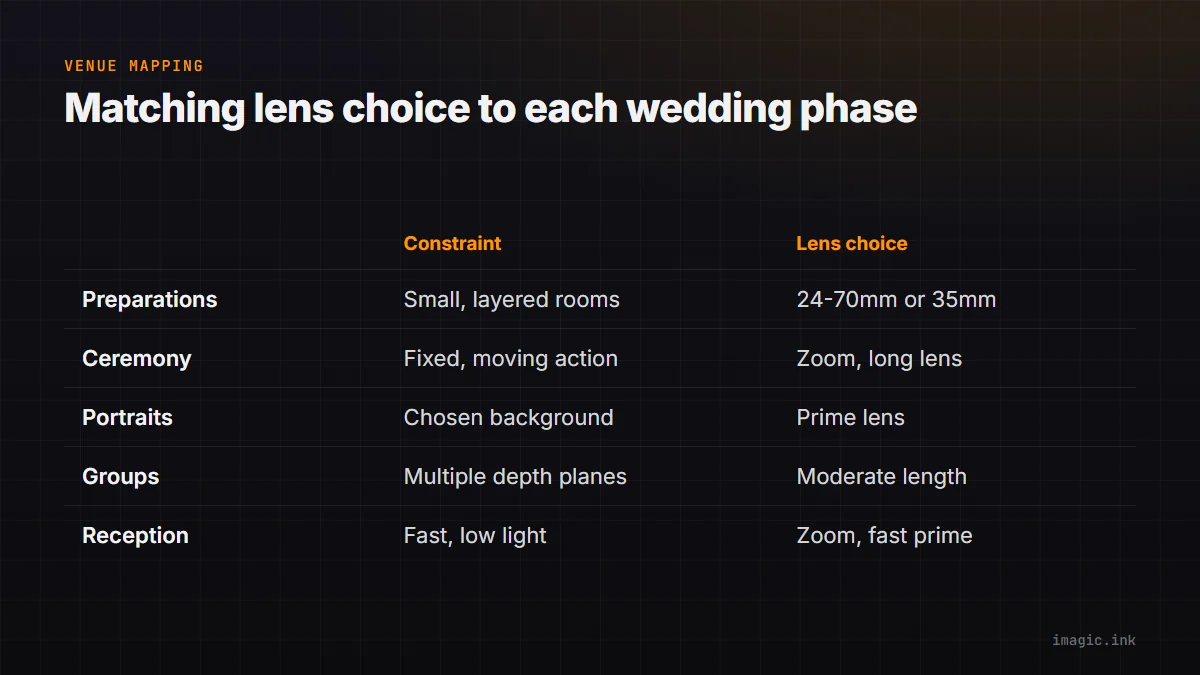
| Wedding phase | Common constraint | Useful starting choice |
|---|---|---|
| Preparations | Small rooms and layered activity | 24-70mm or 35mm |
| Ceremony | Restricted movement and fixed moments | Zoom plus longer lens on second body |
| Portraits | Controlled pace and chosen background | Prime selected for perspective |
| Groups | Several depth planes | Moderate focal length at stopped aperture |
| Reception | Fast changes, low light, crowded edges | Zoom for coverage, fast prime for a defined look |
Weather changes the calculation. A lens-changing plan that works on a dry portrait walk may be unwise in rain, dust, or sea spray. A single zoom can keep the mount closed. Conversely, a covered, controlled portrait location may allow a prime to stay mounted for an entire segment.
Use the zoom where position is not yours to choose
Ceremonies reward framing flexibility because the photographer often has one approved position while the action changes distance. At 24mm, the same lens can establish the room or include architecture. Near 50mm, it can cover a pair at the front without severe spatial exaggeration. Toward 70mm, it can isolate a hand, expression, or exchange without moving into the guests' view.
That flexibility also helps during preparations, entrances, confetti, and unscripted family interactions. The photographer can react to a person stepping into the foreground by tightening the frame rather than backing into furniture. It is especially useful on one body when the second body carries a telephoto for distant moments.
A zoom should not encourage stationary shooting. Focal length changes framing, but camera position controls perspective and background relationships. Move when movement is safe and respectful, then use the zoom to refine. Standing in one place and rotating the ring can produce a monotonous set even when every image is technically framed.
Use primes where perspective and atmosphere are controlled
Portrait sessions give the clearest opportunity for primes because the photographer can choose a background, set a mark, and direct spacing. Select the focal length according to the desired relationship between subject and environment. A 35mm includes location and energy. A 50mm balances context with subject emphasis. An 85mm simplifies a cluttered distance and can flatter close portraits, but it requires enough working room and stronger communication.
Fast apertures help in dim preparation spaces and candlelit receptions, yet the maximum setting is not automatically the best setting. A couple walking toward the camera, two faces at slightly different distances, or a layered family group may need more depth than f/1.4 provides. Use the extra aperture as capacity, then choose the depth that supports the picture.
Primes can also enforce visual coherence. Keeping one focal length through a short portrait sequence stabilizes perspective and working distance, which makes the resulting spread feel intentional. That discipline is useful only if it does not cause missed transitions or constant lens changes.
Calculate fatigue as a coverage risk
A 24-70mm f/2.8 is usually substantial, but three primes, rear caps, pouches, and repeated swaps also create weight and handling cost. Compare the carried system, not one lens against one lens. Two bodies with a zoom and telephoto may weigh more on the shoulders but reduce changes. One light body with a small prime may feel easy until another focal length is repeatedly retrieved from a bag.
Fatigue changes photographs indirectly. A heavy front-loaded setup encourages the camera to stay lowered, slows transitions between horizontal and vertical framing, and makes low or high viewpoints less appealing late in the day. A complicated prime rotation consumes attention and can leave the sensor exposed during hurried swaps. The best kit is the one that remains usable during the final hour, not only during a short showroom comparison.
Two-body coverage changes the calculation again. It reduces lens swaps and provides immediate backup if one body fails, but it adds strap management, duplicated batteries, and more weight during every quiet interval. Give each body a clearly different focal role so the choice is automatic. A 24-70mm beside a 70-200mm creates continuous coverage; a 35mm beside an 85mm creates two distinct perspectives. A 24-70mm beside a 50mm can work when the prime is reserved for low light or rendering, but without that rule the overlap can slow decisions.
Consider sensor cleanliness as part of the change strategy. Outdoor swaps in wind, confetti, dust, or rain should be minimized, and rear caps should never float loose in a bag. Prepare caps and the replacement lens before exposing the mount, turn the body away from blowing debris, and make the exchange efficiently. Preventing contamination is easier than repairing repeated spots across a reception sequence.
- Carry the planned setup for a full practice walk, not a few minutes.
- Check whether straps interfere when two bodies are raised alternately.
- Place the most likely spare lens where it can be reached safely.
- Plan a clean, dry swap location instead of changing lenses in the aisle.
- Remove accessories that do not have a scheduled use.
Build a hybrid kit with distinct jobs
For many weddings, the strongest answer is not zoom or primes but a small hybrid. A 24-70mm can cover preparations, ceremony transitions, groups, and reception movement. One fast prime can provide a defined portrait look or additional low-light capacity. A longer zoom or prime on a second body can handle ceremonies where distance is fixed.
Avoid redundant choices. Carrying 35mm, 40mm, 50mm, and a 24-70mm creates decisions without meaningfully expanding coverage. Choose one prime because it changes the result or solves a light problem. If it remains in the bag for several weddings, the plan is providing evidence that it is not essential.
Assign a default state for every transition. For example, arrive at preparations with the 24-70mm mounted, move to the ceremony with the zoom and long lens ready, use the chosen prime only during directed portraits, and return to the zoom before the reception entrances. Defaults prevent a beautiful but unsuitable portrait lens from remaining mounted when an unrepeatable wide moment begins.
Let file review inform the next lens decision
After the wedding, sort selects by focal length and phase. Look beyond keeper totals. Note missed frames caused by insufficient reach, moments lost during swaps, excessive crops, repeated wide-open focus misses, and focal lengths that produced strong compositions. This turns the lens debate into evidence from the photographer's own assignments without inventing a universal answer.
imagic can locally group duplicate and burst sequences and score sharpness, exposure, closed eyes, and composition before the final human cull. Because edits are non-destructive, a consistent starting style can be applied after selection while the original RAW files remain untouched. The desktop workflow is useful when high wedding volume makes sequence review the bottleneck, and the Lenses and Optics section provides more lens-selection context.
Record focal length, aperture, phase, and reason for rejection in a simple post-job note. Patterns become visible over several assignments: perhaps the 85mm is excellent outdoors but unused indoors, or the zoom dominates coverage while a 35mm creates the portrait work clients choose. The next packing list can then be smaller and more intentional.
Use a phase-by-phase decision checklist
- Identify where movement is restricted and place zoom coverage there.
- Identify one controlled phase where a prime changes perspective or light capacity.
- Confirm that required group depth is achievable at the planned focal length and aperture.
- Set default lenses for each schedule transition.
- Choose a protected location and time for any lens change.
- Remove lenses whose role duplicates another item without a clear benefit.
Frequently asked questions
Is f/2.8 fast enough for a dark wedding ceremony?
It depends on available light, subject movement, stabilization, and acceptable ISO. A faster prime adds capacity, but depth of field and focus accuracy still need to match the people being photographed.
Can a 24-70mm replace every wedding prime?
It can cover many essential angles, but it cannot reproduce the light-gathering or rendering of a much faster aperture. Use a prime when that difference has a specific role rather than carrying one from habit.
Which prime is the safest addition to a 24-70mm?
The safest choice is the focal length that changes the intended result and fits the venue. A 35mm emphasizes environment, a 50mm is balanced, and an 85mm isolates when working distance allows.
Does using primes make a wedding gallery more consistent?
It can stabilize perspective during a planned sequence, but constant swapping can make coverage less consistent. Coherence comes from deliberate use, not from the prime label alone, throughout the complete wedding day.