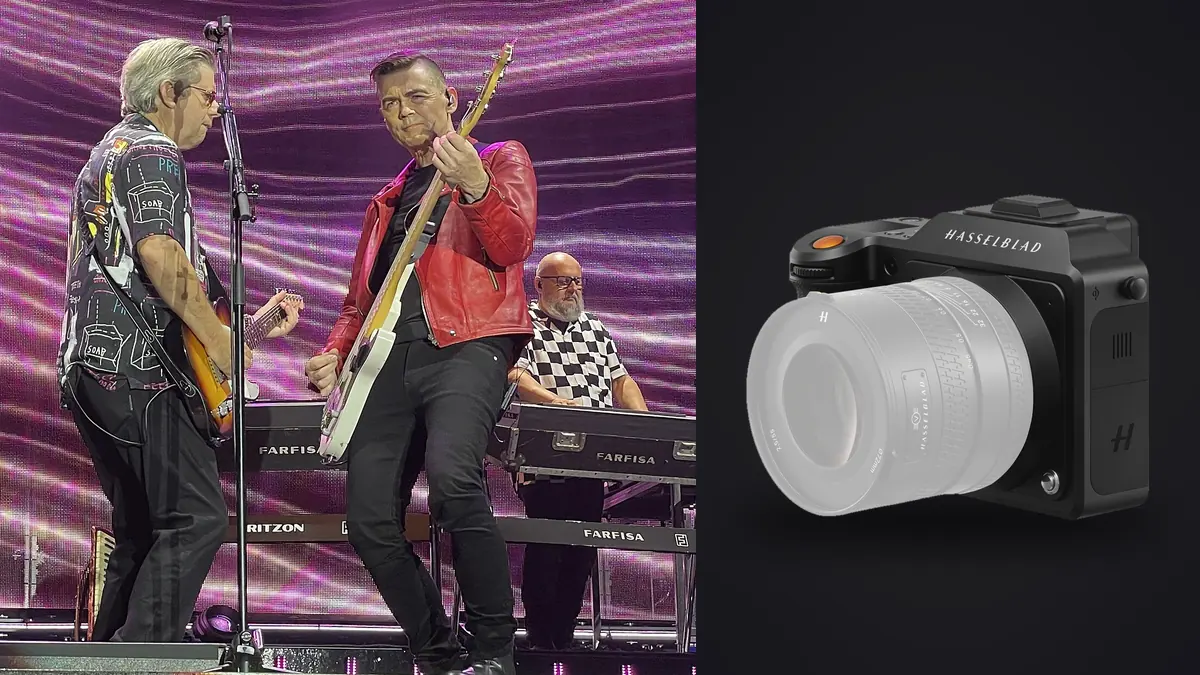
The Hasselblad X2D 100C can produce highly detailed concert files, but it asks the photographer to build the assignment around medium-format priorities. Its large high-resolution sensor and XCD lenses favor considered framing, while concert work often demands quick subject acquisition, fast glass, long reach, and large sequences under difficult LEDs. The combination is viable in selected venues, not an obvious general-purpose pit system.
Lens and location strategy determine whether the X2D becomes distinctive or frustrating. A theater soundcheck, seated performance, or commissioned backstage portrait gives the camera time and access. A dark club with three songs from a crowded barrier may reward a faster, lighter action body. This guide maps lenses, position, support, and workflow to those conditions.
Choose assignments that suit the camera's rhythm
The X2D is best considered for planned artist portraits, rehearsal coverage, acoustic performances, orchestral or theater work from a stable position, and environmental frames where stage architecture matters. These situations provide time to place focus, control bursts, and use the high resolution for a deliberate composition.
A general-admission club creates the opposite conditions. The subject changes distance quickly, sight lines disappear, light is dim, and the camera may be held above or around other people. The X2D body and many XCD lenses are not designed primarily as a high-speed sports system. Current firmware capabilities should be checked, but a menu update cannot change lens aperture, system mass, or the venue's access.
Define the required frames before bringing the camera. If the commission needs one hero portrait and several atmospheric wides, the X2D can take that role beside a faster body. If it must be the only camera for unpredictable jumps and crowd interaction, test it at a similar event before accepting the risk.
Map focal length to actual position
From the barrier, a moderate wide lens can include performer and stage design. A normal lens isolates a single musician without erasing the environment. From a fixed rear position, a short telephoto or longer option becomes necessary. Medium-format focal lengths produce a wider angle of view than the same number on full frame, so compare the actual field rather than relying on familiar labels.
Use a planning visit or venue diagram to estimate distance. Frame a person at that distance with the candidate lens before the event. Leave margin for movement and account for the final crop. A hundred-megapixel file allows refinement, but it does not turn a normal lens into a clean long telephoto when haze, focus, and motion limit detail.
Zoom flexibility is valuable when the photographer cannot move, while compact V-series or P-series primes can keep the system more manageable. The exact choice should follow light, distance, and permission to carry multiple lenses. Avoid changing lenses in a smoky, crowded pit if a second body or planned sequence can remove the need.
Account for XCD aperture in low light
Many XCD lenses prioritize compactness, optical quality, or medium-format coverage rather than the very wide apertures common in smaller systems. An f/2.5 or f/2.8 medium-format lens can create shallow depth, but exposure still follows the marked f-number. A dark venue may force a higher ISO or slower shutter than a smaller system with an f/1.4 lens.
Choose shutter speed from performer movement. A seated musician may tolerate a slower exposure than a drummer or jumping singer. In-body stabilization can reduce camera movement but cannot freeze the subject. If shutter must remain short, accept the required ISO and expose carefully rather than making a clean-looking preview through severe underexposure.
Test corner and point-light behavior at the intended aperture. Stage lamps create flare, ghosts, and chromatic fringes that may not appear in daylight samples. Remove unnecessary filters and use a hood that does not block the frame.
Use leaf shutters for what they actually offer
XCD lenses incorporate leaf shutters, which expose the frame differently from a focal-plane shutter and support flash synchronization across their specified shutter range. That can be valuable for commissioned portraits with permitted flash. Most live concerts prohibit flash, so the feature may have little impact during the performance itself.
Do not interpret leaf shutter as immunity from every stage-light problem. Pulsing LEDs can still make consecutive exposures vary, and electronic components or certain modes may behave differently. Test the actual lighting and camera mode during soundcheck when possible. Compare smooth backgrounds and skin for bands or color shifts.
Leaf-shutter lenses also have maximum shutter limits that vary by lens generation. Check the current Hasselblad specification for the exact lens. If daylight outdoor performance requires a very short exposure, an electronic option or lower ISO may be needed, each with its own consequences.
Plan venue access as carefully as the lens
Ask where photographers may stand, when they may shoot, whether sound restrictions apply, and whether a tripod or monopod is permitted. A lens strategy built around a center aisle fails if access is limited to the rear corner. Confirm bag size rules and whether lens changes are practical.
Scout bright screens, moving lights, haze machines, mirrors, railings, and speaker stacks. The X2D resolution can render stage detail beautifully, but it also records every distracting cable and stand. A small horizontal change in position can separate a microphone from a face or place a light behind the subject.
For rehearsal or soundcheck, coordinate with production staff rather than wandering onto the stage. Mark safe cable paths and never block crew sight lines. At a public performance, preserve audience experience by keeping screens dim, movements limited, and shutter behavior appropriate to the music.
Choose support that does not become a venue hazard
In-body stabilization helps handheld composition with static scenes, but a monopod can reduce fatigue with a longer XCD lens from a fixed position. Set it within the photographer's own footprint and ensure it cannot trip an audience member. Many pits and aisles prohibit support, so obtain permission first.
A tripod belongs mainly in an empty venue, rehearsal, control position, or commissioned wide shot. Use sandbags only where they do not create another obstacle. A secure plate and L-bracket make orientation changes predictable, while a strap remains necessary when equipment could be bumped.
For handheld use, support the lens with the left hand and keep elbows relaxed. Raise the camera only for the planned sequence rather than holding a heavy combination continuously. A second lighter body should be carried so the two cannot strike each other.
Build focus around predictable marks
When the performer stays near a microphone, stool, piano, or pool of light, pre-focus on that mark and choose enough depth to allow small movement. Use single autofocus or magnified manual confirmation for a static portrait. For movement, use the current continuous-focus and area behavior available in the installed firmware, but test it rather than assuming equivalence with a dedicated action body.
High resolution makes a slight miss visible. Inspect the eye or instrument detail in a short early sequence and find the actual sharp plane. If the background is sharp, acquisition failed. If everything smears, shutter time or camera motion is the issue. If one eye is sharp and the other is not, depth and pose geometry may be working as set.
Keep bursts short. The X2D is not valuable at a concert because it can create the largest number of files; it is valuable when one carefully timed frame uses its tonal and spatial qualities. Anticipate breath, hand movement, and lighting cues.
Prepare for hundred-megapixel file handling
Large RAW files require enough internal or removable storage, verified backup space, and a workstation able to review them. Confirm the camera's current storage options and card compatibility, then test a complete ingest. Do not discover after the show that the reader, cable, or software version cannot open the files.
Separate portraits, performance, backstage, and technical tests at ingest. Cull first for focus and motion, then for expression, instrument position, light, and visual variety. imagic can locally analyze supported RAW files only when their format is among its supported list; verify the current tool output rather than assuming native X2D support. Unsupported files need another RAW route.
The lenses and optics guides can help frame system choices, while the blog hub covers broader photographic workflow. Keep original files and edit non-destructively in software confirmed to support the camera.
A practical fit matrix
| Concert situation | X2D fit | Primary reason |
|---|---|---|
| Commissioned backstage portrait | Strong | Controlled distance, time, and optional permitted light |
| Quiet seated performance | Possible | Predictable movement and deliberate framing |
| Theater rehearsal | Strong with access | Repeatable marks and time to test stage light |
| Three-song crowded pit | Limited | Fast movement, restricted position, and handling pressure |
| Distant arena soundboard | Lens dependent | Reach and atmosphere limit usable detail before resolution |
Rent the exact body and lens for a realistic venue before making a system decision. Process the resulting files at the actual delivery size, carry the kit for the expected duration, and compare missed moments as well as successful detail.
Divide coverage across two complementary bodies
If the X2D is paired with a faster camera, assign roles before the performance. The action body can cover unpredictable movement and long-lens frames, while the Hasselblad handles portraits, stage-wide compositions, and predictable marks. This avoids changing tools only after a moment has already begun.
Synchronize clocks and use distinct filename prefixes or card folders. Match a neutral color reference under the stage light if the two systems must appear in one gallery. The final set does not need identical rendering, but unexplained color and contrast jumps can make coverage feel fragmented.
Carry the cameras so they cannot collide. A substantial XCD lens hanging beside another body can damage both and obstruct movement in a pit. When space is tight, keep one secured in a permitted bag or choose a single system rather than creating a hazard.
Use a soundcheck to test the complete chain
When access is granted, use soundcheck for more than focus. Photograph the brightest programmed lamp, the darkest expected position, the LED wall, and a performer at each mark. Compare consecutive frames for flicker and check whether the chosen shutter freezes hands and face.
Then ingest a few files on the actual laptop or workstation. Confirm decoding, color profile, transfer method, and export. A camera can look excellent on its rear screen while the selected software lacks current RAW support or the venue light pushes one color channel beyond recovery.
Record the working lens, aperture, shutter range, focus method, and position. During the show, begin from that proven setup and change only when the lighting or assignment requires it.
Frequently asked questions
Is the Hasselblad X2D 100C a fast concert camera?
It is not primarily designed as a high-speed action body. It fits planned portraits, rehearsals, and predictable performances better than a chaotic pit where rapid tracking and long bursts dominate.
Which XCD lens is best for concerts?
The answer depends on access: wider near the stage, normal for environmental performer frames, and longer from a fixed rear position. Test aperture, autofocus, flare, and actual field of view at the venue distance.
Does in-body stabilization freeze performers?
No. It reduces camera movement, while the musician's hands, face, and body still require a suitable shutter speed or controlled pose.