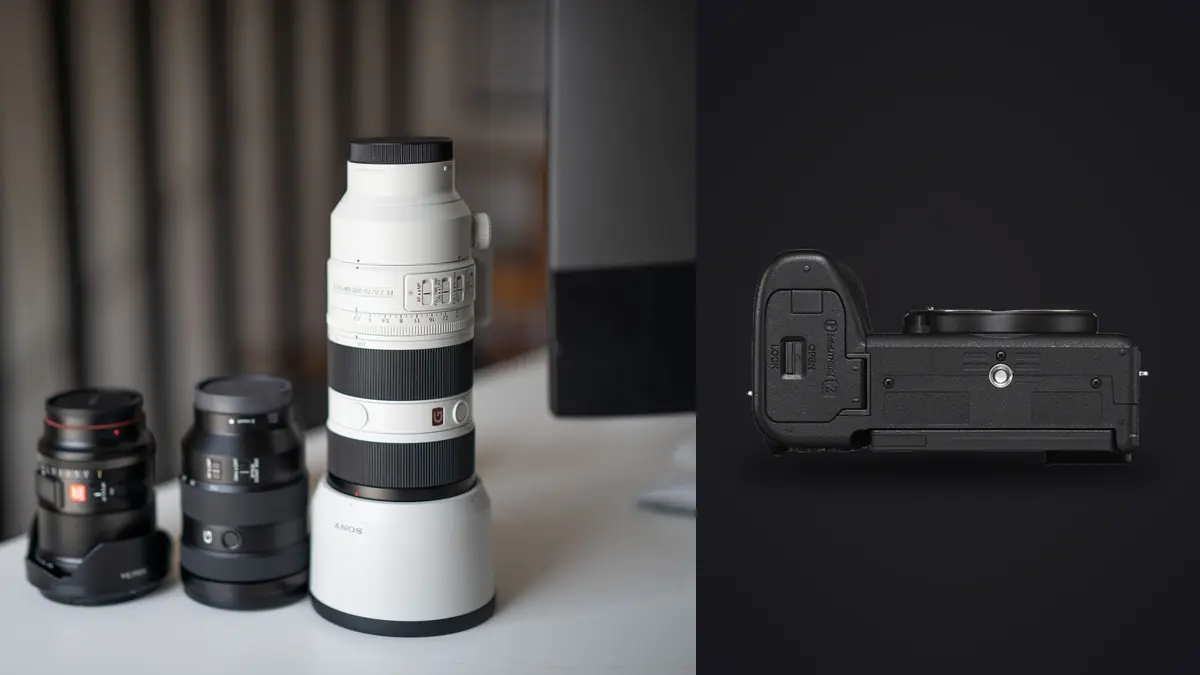
The Sony A6700 pairs a 26.0-megapixel APS-C sensor with Sony's E mount, and it accepts both APS-C-format E lenses and full-frame FE lenses without an adapter, since FE lenses simply use less of their image circle on the smaller sensor. That gives A6700 owners a genuinely wide lens pool to choose from, which also means the actual decision, a compact APS-C zoom versus a heavier full-frame lens carried over for its optics, is worth walking through deliberately rather than defaulting to whatever shipped in a kit. The lenses below cover the situations an A6700 owner is most likely to actually run into: an everyday standard zoom, the common kit lens already in many owners' bags, a telephoto for distance work, a pair of fast primes for low light and portraits, and the specific case where reaching for a full-frame lens actually makes sense.
The body behind the lens choice
Lens recommendations only make sense in the context of what the body can actually do with them. Sony's own specifications for the A6700 list 5-axis in-body image stabilization plus 759 phase-detection autofocus points in stills mode, covering 93 percent of the frame, backed by a dedicated AI processing unit that Sony describes as improving both subject recognition and communication with the lens for more stable framing before a shot is taken. That combination matters directly for lens choice: a body this capable at tracking and stabilizing makes a fast, unstabilized prime like the Sigma 18-50mm or Sigma 56mm a genuinely practical choice rather than a compromise, since the body itself is doing meaningful stabilization work that would otherwise fall entirely on a lens-based system.
The A6700's sensor and RAW format, briefly
The A6700 records RAW files in Sony's ARW format at 14-bit depth, with lossless compressed and standard compressed options available in-camera. Independent reporting on A6700 file sizes describes lossless compressed ARW files landing in roughly the 35 to 45 MB range depending on scene detail and ISO, with the compressed option running smaller at some cost to data retained. Every lens on this list works with the camera's 1.5x APS-C crop factor, so a lens's actual angle of view on the A6700 is its stated focal length multiplied by 1.5, not the number printed on the lens barrel. That crop factor is worth keeping in mind throughout this guide: every equivalent focal length quoted below is what the lens actually behaves like on the A6700, not the number printed on the lens itself, and it is the reason APS-C-native lenses tend to cover a given angle of view at a shorter, lighter, cheaper design than the full-frame lens that produces the same field of view.
Standard zoom: three real options at different weights
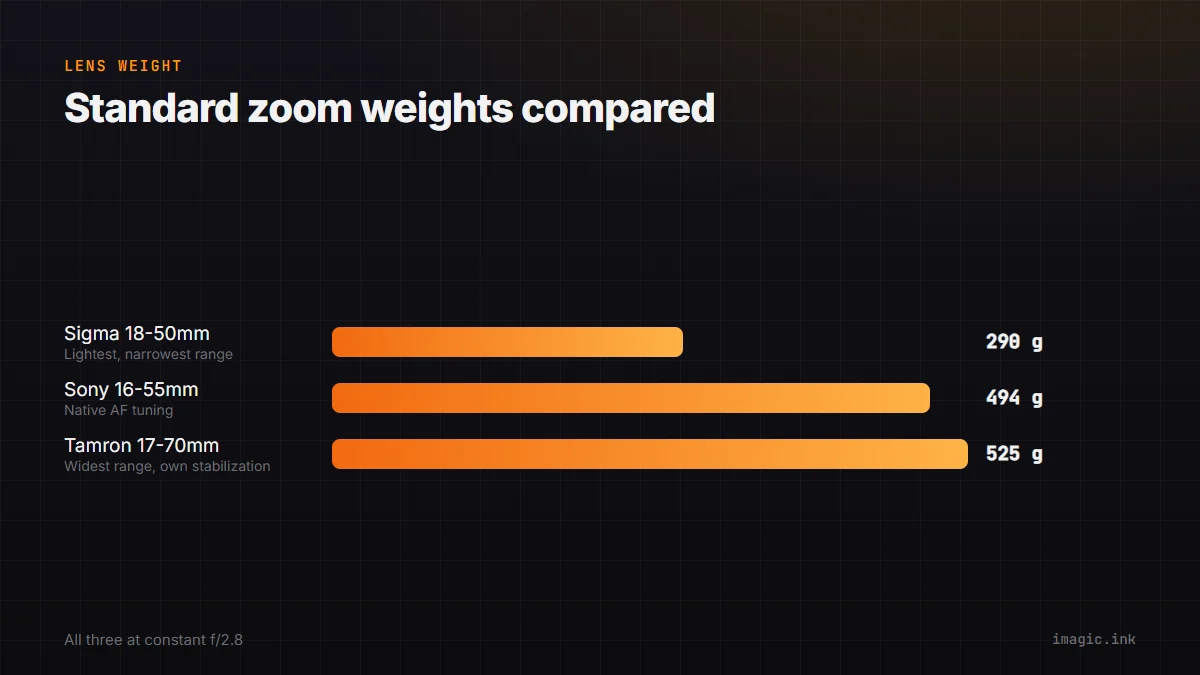
The standard-zoom decision on the A6700 comes down to three lenses that all cover roughly the same useful range at a constant f/2.8, with very different size and weight tradeoffs.
| Lens | Mount / format | Focal range (equiv.) | Aperture | Weight | Stabilization |
|---|---|---|---|---|---|
| Sony E 16-55mm F2.8 G | E, APS-C | 16-55mm (24-83mm) | Constant f/2.8 | 494g | No (body IBIS only) |
| Sigma 18-50mm F2.8 DC DN | E, APS-C | 18-50mm (27-75mm) | Constant f/2.8 | 290g | No (body IBIS only) |
| Tamron 17-70mm F2.8 Di III-A VC RXD | E, APS-C | 17-70mm (25.5-105mm) | Constant f/2.8 | 525g | Yes (VC, lens-based) |
Sony's own 16-55mm F2.8 G is the closest thing to a factory-standard option, with the shortest zoom range of the three but Sony's own autofocus tuning and build. Sigma's 18-50mm F2.8 is the lightest lens on this list by a wide margin, a genuinely small lens for a constant f/2.8 zoom, at the cost of the narrowest zoom range here. Tamron's 17-70mm covers the widest range of the three by far, close to a 4x zoom ratio at a constant aperture, and is the only one of the three with its own optical stabilization (Tamron's VC system) rather than relying solely on the A6700's in-body stabilization. For anyone shooting handheld video where the A6700's own IBIS is doing double duty, that lens-based stabilization is a real practical difference, not just a spec-sheet checkbox.
Kit lens reality check: the 18-135mm
Sony's E 18-135mm F3.5-5.6 OSS, commonly bundled as a kit lens, weighs about 325g and covers a 27-202.5mm equivalent range with built-in Optical SteadyShot stabilization. It is not a low-light lens, the variable aperture narrows to f/5.6 by the long end, but as an all-in-one travel option it covers a genuinely useful range in a single lightweight lens, which is exactly the case for keeping it rather than immediately upgrading if the A6700 was bought as a kit. Anyone shooting mostly outdoors in good light, travel, general walk-around work, gets real use out of it before a constant-aperture zoom becomes worth the extra weight and cost.
Telephoto for wildlife and sports: the 70-350mm
Sony's E 70-350mm F4.5-6.3 G OSS weighs 625g and covers a 105-525mm equivalent range on the A6700's APS-C sensor, with Optical SteadyShot stabilization built in. That reach, over 500mm equivalent at the long end, is the main reason to reach for this lens over a standard zoom: it is a genuinely long telephoto in a package still light enough to handhold for a day of shooting, useful for birds, distant wildlife, or field sports where getting physically closer is not an option. The variable f/4.5-6.3 aperture narrows meaningfully at the long end, so expect to lean on higher ISOs in anything but good light, which is where the A6700's own high-ISO performance and the lens's OSS stabilization both matter for keeping shutter speeds workable.
A fast wide prime for low light and environmental work
Sony's own APS-C wide-prime lineup gives A6700 owners two real options at different weights and apertures. The E 15mm F1.4 G weighs 219g and covers a 22.5mm equivalent field of view at a fast constant f/1.4, with Sony's G-series aperture control ring and build quality. The E 11mm F1.8, at 181g, is lighter and covers a wider 16.5mm equivalent field of view at f/1.8. Both are E-mount APS-C-native lenses, not adapted full-frame optics, which keeps them compact next to the A6700's small body. The choice between them comes down to how wide the actual working focal length needs to be: the 15mm's narrower field of view and faster aperture suit low-light environmental portraits and interiors where a slightly longer angle still reads as wide, while the 11mm's wider field of view suits tighter interiors, architecture, and situations where getting close is not physically possible.
A portrait prime option
For portrait work specifically, the choice is generally between Sigma's 56mm F1.4 DC DN, at 280g, and Sony's own E 50mm F1.8 OSS, at 202g. Both give a roughly 75-85mm equivalent field of view on the A6700's APS-C sensor, the classic portrait range. Sigma's lens is the faster of the two at f/1.4 versus f/1.8, and reviewers have noted its all-metal construction as the reason for its extra weight over the Sony lens's mix of plastic and metal. Sony's 50mm F1.8 includes its own Optical SteadyShot stabilization in addition to the A6700's body IBIS, doubled-up stabilization that helps specifically for handheld video rather than stills, where the body's own IBIS already does most of the work. For stills-first portrait work, the Sigma's extra stop of light matters more than the Sony's built-in OSS; for hybrid stills-and-video shooters, the Sony's lighter weight and lens-based stabilization are the more practical everyday choice.
When a full-frame FE lens makes sense
Sony's FE 24-70mm F2.8 GM II, at 695g and USD 2,299 at its original list price, is a full-frame lens that also mounts and works on the A6700 without an adapter, giving a 36-105mm equivalent range on the APS-C sensor. It has no built-in optical stabilization, relying entirely on the A6700's body IBIS. Carrying a lens like this on an APS-C body only makes sense in specific cases: someone who already owns it for a full-frame Sony body and wants to share glass across two cameras, or someone planning to move to a full-frame Sony body later and buying lenses with that future system in mind. For A6700-only use, the APS-C-native 16-55mm F2.8 G covers a similar effective range at nearly 200g less weight and roughly a third of the price, which is the more sensible default unless that cross-system reason applies.
The same logic extends to any full-frame FE lens under consideration, not just the 24-70mm GM II specifically. A full-frame lens brings a bigger, heavier front element than an equivalent APS-C-native design needs, since it has to cover a larger sensor's image circle even when mounted on a smaller one. That is a fixed cost regardless of which FE lens is in question, telephoto or wide, prime or zoom, and it is the reason a dedicated APS-C lens usually beats the full-frame equivalent on a body like the A6700 unless lens sharing across two camera systems is a genuine part of the plan.
Matching lens choice to shoot volume and RAW workflow
Lens choice on the A6700 has a direct effect on how much review work a shoot creates. A 70-350mm telephoto session shooting wildlife or sports tends to produce long bursts of near-identical frames as a subject moves through the frame, exactly the pattern that benefits most from an automated first pass rather than a manual scroll through hundreds of similar shots. imagic opens ARW files directly through its own built-in RAW engine, scores each frame for sharpness and composition, and groups visually similar burst frames into a single reviewable set, whether the lens behind them was a fast standard zoom or a long telephoto. Batch editing and one-click styles then carry a consistent look across the kept frames, useful regardless of which of these lenses produced the shoot.
For more on the format itself, see imagic's ARW file guide. The wildlife photography guide and street photography guide cover workflow considerations specific to those genres, and the Lenses & Optics category has more focal-length and lens-buying guides in this format.
Frequently asked questions
Can full-frame FE lenses be used on the Sony A6700?
Yes. FE lenses mount and function fully on the A6700 without an adapter; they simply use less of their image circle on the APS-C sensor, giving a 1.5x crop on the lens's stated focal length.
What is the best all-around standard zoom for the A6700?
It depends on the priority. Sigma's 18-50mm F2.8 is the lightest option at 290g, Tamron's 17-70mm F2.8 covers the widest range with its own stabilization at 525g, and Sony's own 16-55mm F2.8 G sits in between with Sony's native autofocus tuning at 494g.
Is the kit 18-135mm lens worth keeping?
For outdoor and travel shooting in good light, yes. It covers a broad 27-202.5mm equivalent range at 325g with built-in stabilization. Its variable aperture, narrowing to f/5.6 at the long end, makes it a weaker choice for low light than a constant-aperture zoom.