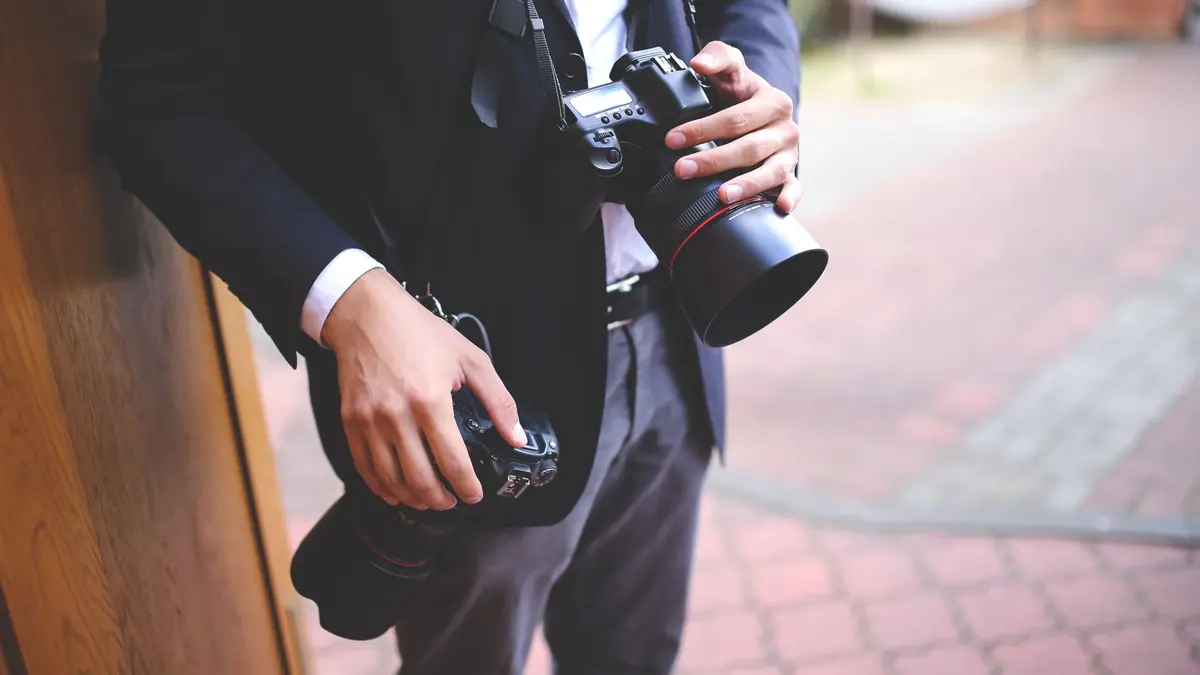
The prime-versus-zoom question at a wedding is not a contest between optical virtue and convenience. It is a coverage design problem. A photographer must move from confined preparation rooms to formal ceremony positions, group portraits, low-light speeches, and a crowded dance floor without missing unrepeatable moments. Focal length, aperture, handling, backup, and venue rules all matter, and the best answer can change between parts of the same day.
Prime lenses offer fixed fields of view, often with wide maximum apertures and compact options. Zooms offer several framings from one position and can reduce lens changes. Neither category guarantees better sharpness, autofocus, rendering, or low-light results across every model. Compare actual lenses, bodies, and assignments, then build a role for each item carried.
Begin with access and movement
Map where the photographer may stand during each part of the day. Ceremony venues may restrict aisles, balconies, movement, flash, or proximity to participants. Preparation rooms may be too small to step backward. Portrait locations may allow controlled distance, while receptions can become physically crowded. Focal length should solve these constraints without disrupting the event.
A zoom is valuable when the shooting position is fixed and subject distance changes. From the back or side of a ceremony, it can move between a wider relationship and a tighter reaction without a body switch. A prime is valuable when the working distance is predictable and its field of view supports a consistent visual approach. Moving to compose is useful only when movement is permitted and does not intrude.
Scout with the actual camera or a field-of-view tool. Note aisle width, ceiling height, background clutter, window position, officiant rules, and safe storage. Ask the venue or coordinator rather than assuming last year's access still applies.
Assign perspective, not just focal length
Perspective is determined by camera position. A wider lens used close to a face exaggerates near-to-far relationships; a longer lens used farther away compresses apparent spacing. Cropping a wide frame later can match framing but cannot recreate the perspective from a different position. Wedding lens choices should therefore begin with the desired relationship among people and environment.
Moderate wide focal lengths support preparation context, room reveals, groups in tight spaces, and dance-floor immersion. Normal focal lengths can feel balanced for documentary moments and small groups. Short telephotos give flattering working distance for portraits and isolate reactions. Longer telephotos support restricted ceremonies and candid distance but can make navigation and subject acquisition slower in tight rooms.
Build a visual rhythm. If every frame is compressed and isolated, the gallery may lack place. If every frame is close and wide, faces at the edges can distort and quiet moments can feel crowded. Assign environmental, relational, and detail roles across the kit.
Evaluate aperture as a system tradeoff
A wide-aperture prime can gather more light and create shallow depth, but the usable benefit depends on focus accuracy, subject movement, group depth, and lens behavior at that aperture. Two people leaning on different planes may exceed the depth of field. A moving processional can leave little tolerance for a misplaced focus point.
A slower zoom may require higher ISO, added light where allowed, or a lower shutter speed, but image stabilization can help with stationary subjects and camera movement. It cannot stop a walking person, gesture, or fabric. Exposure should satisfy subject motion first. Modern camera files may tolerate high ISO well, but test the exact output instead of adopting a universal ceiling.
Stopping a prime down can improve depth and consistency, while a zoom may be strongest somewhere other than its maximum aperture. Judge delivered files at realistic size. Maximum aperture is a creative and operational option, not the required setting because the lens provides it.
Use zooms where moments outrun movement
Processionals, recessional movement, confetti exits, speeches, first dances, and rapidly changing family interactions can reward a zoom. The photographer can hold a stable, respectful position while framing evolves. This is especially useful when a second body or assistant cannot cover another angle.
A standard zoom can carry much of an unpredictable day, while a telephoto zoom handles ceremony restrictions and reactions across a room. That does not mean both must remain attached all day. Choose the combination that avoids an uncovered distance rather than maximizing range overlap.
Watch the zoom ring and aperture behavior. Variable-aperture lenses can change exposure while reframing. Extending barrels may affect balance and attract attention. A broad range can also encourage frantic reframing instead of waiting for composition. Practice finding common focal positions by feel.
Use primes where consistency and light lead
Preparation, portraits, quiet documentary work, and low-light ambient scenes can suit primes when the photographer can choose position. A fixed view reduces framing decisions and can create a coherent relationship to the subject. Smaller prime options may also be less visually imposing, which can help people relax.
Wide maximum apertures allow more light or shallower depth, but they should serve the picture. Use enough shutter speed for movement and enough depth for the important faces. Check edge rendering when people stand near the frame boundary, and avoid relying on blur to hide a weak background that could have been improved by moving slightly.
Prime-based coverage benefits from deliberate body pairing. Two bodies can carry complementary views, reducing lens changes and providing redundancy. The tradeoff is weight, straps, collision risk, control consistency, and the need to keep time and settings aligned.
Design redundancy around failure, not symmetry
A wedding kit needs a path through body, lens, card, battery, flash, and trigger failure. Two beautiful primes that cover nearly the same view may not solve a failed telephoto requirement. One versatile zoom and one fast prime can provide both overlap and a distinct low-light option. Two bodies with compatible controls reduce recovery time.
Identify the minimum kit that can finish the assignment at each stage. During a restricted ceremony, that may require a backup body and a lens with enough reach. During group portraits, it may require a focal length that fits the space without edge distortion. Keep backups accessible, not sealed in a vehicle far from the venue.
Lens changes create dust, drop, and delay risk. Change in a controlled position with one item secured before another is released. Avoid open mounts in rain, confetti, dust, or a packed dance floor. A zoom can reduce changes, while a two-body prime plan can nearly eliminate them; both strategies need safe handling.
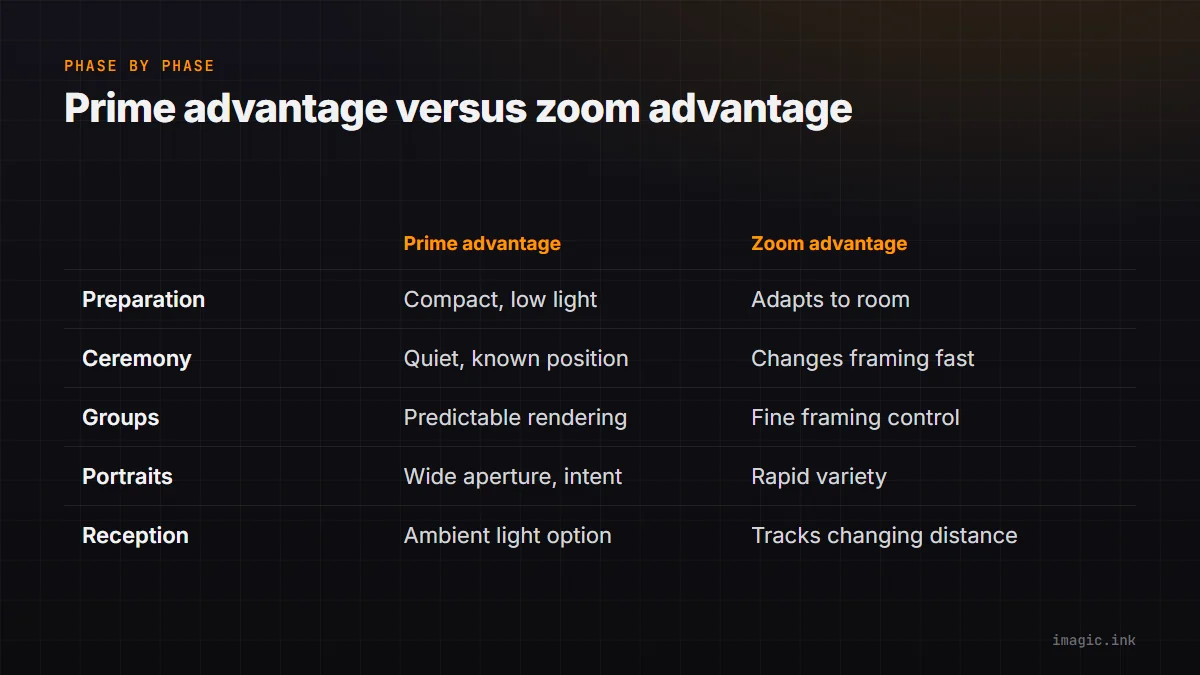
Match lenses to each wedding phase
| Phase | Prime advantage | Zoom advantage |
|---|---|---|
| Preparation | Compact, low-light, consistent viewpoint | Adapts to room size and layered activity |
| Ceremony | Quiet visual discipline from known positions | Changes framing when movement is restricted |
| Groups | Predictable rendering at a chosen distance | Fine framing without moving the group |
| Portraits | Wide aperture and intentional perspective | Rapid variety under limited schedule |
| Reception | Ambient-light options and compact handling | Tracks changing distance and reactions |
This is a planning guide, not a requirement to switch categories at every phase. A photographer who knows one standard zoom deeply may create more consistent work than a photographer carrying several unfamiliar primes. Familiarity should be tested under motion and low light, not inferred from ownership time.
Control autofocus and exposure across bodies
Calibrate the human interface. Put autofocus activation, area selection, subject switching, exposure compensation, and review controls in equivalent positions where bodies allow. Confirm that each lens receives current firmware and behaves reliably at working distances. Test backlit faces, low-contrast fabric, dance lighting, and subjects entering the frame.
Use manual exposure or controlled auto exposure according to changing light and movement. Match white-balance strategy across bodies. Different lenses can transmit color and contrast differently, especially under flare; photograph a neutral reference and the same scene when a coherent set matters.
Synchronize clocks before the day and after any battery or daylight-time issue. A two-body sequence that sorts incorrectly creates needless culling friction. Keep filenames unique across bodies so duplicate names cannot collide during ingest.
Test the carried weight over a full day
Lens choice affects posture, fatigue, and attention. A heavy zoom may replace several lenses but remain on the shoulder for hours. Multiple primes may be lighter individually yet require a larger bag and more decisions. Measure the complete carried system: bodies, straps, flash, batteries, cards, support, water, and backup.
Rehearse a long walking day and the movements required to kneel, turn, climb stairs, and move through seated guests. Check whether two bodies strike each other, a long lens blocks a table, or a bag prevents safe movement. Adjust straps and storage before the event, not during a processional.
Fatigue can reduce framing discipline and increase handling mistakes. A slightly less capable lens that remains comfortable and ready may produce better coverage than an ideal optic left in the bag. Operational fit is part of image quality.
Cull with focal-length variety in mind
After backup, group repeated moments and select for expression, gesture, focus, obstruction, and narrative. Then inspect the gallery's perspective mix. A zoom can produce near-duplicates at slightly different focal lengths; choose the framing that best clarifies the relationship. A prime sequence can repeat the same composition; protect the one moment that changes the story.
imagic can scan a copied directory and locally analyze sharpness, exposure, closed eyes, composition, and near-duplicate or burst groups. Culling changes status without deleting originals. This can reduce mechanical comparison, while final wedding selection still requires knowledge of participants, relationships, and promised coverage. The desktop workflow describes that local review, and the Lenses and Optics section supports further kit planning.
Use missing coverage as feedback. If the edit lacks environmental context, a longer-lens habit may be responsible. If faces near wide-frame edges repeatedly fail, working distance or group placement needs attention. Change the next kit because of a recurring picture problem, not because another lens was recently announced.
Choose a primary system and an exception lens
A practical conclusion is often one primary system plus one exception. A zoom-led photographer may add a fast prime for low light, discretion, or a particular portrait view. A prime-led photographer may add a telephoto zoom for restricted ceremonies or rapidly changing distance. This preserves a consistent way of working while covering the known failure case.
Rent the exact lenses and rehearse a mock timeline. Include a dark room, walking subjects, a group at frame edges, flare, flash where relevant, body switching, card changes, and a full edit. The best kit is the smallest dependable system that can honor the access, visual brief, and redundancy requirement of the day.
Frequently asked questions
Are prime lenses always sharper than wedding zooms?
No. Performance varies by exact lens, aperture, focus, and output. Compare the models under realistic working conditions rather than treating lens category as a quality result.
Can one standard zoom cover an entire wedding?
It can cover many events if its range, aperture, and backup plan meet the venue and brief. Restricted ceremonies, very low light, or specialized portraits may justify another lens.
How many lenses should a wedding photographer carry?
Carry enough to complete every required phase after a plausible failure, but assign each lens a clear role. Extra overlap adds weight and decisions without necessarily adding coverage.