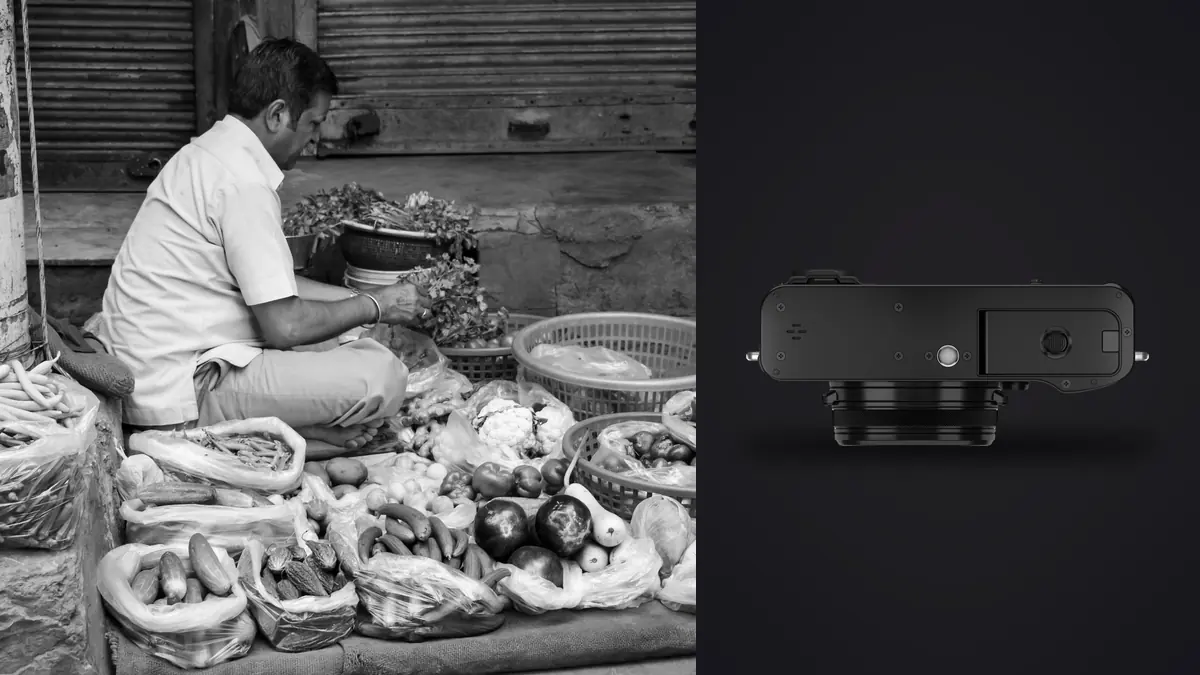
I spent four months shooting a documentary project on a fishing cooperative with the X100VI as my only camera, no backup body, no second lens. That was partly a budget decision and partly curiosity: could one fixed 35mm-equivalent lens actually carry a real documentary assignment, or would I spend the whole project wishing I'd brought something longer? The short answer is that the camera earned its place, but not for the reasons Fujifilm's marketing leans on. It wasn't the retro dials or the film simulations that mattered most on the dock at 5am. It was how little the camera got in the way.
The Case for a Fixed 35mm Lens on Assignment
The X100VI ships with a 23mm f/2 lens, which works out to roughly 35mm in full-frame terms. For street documentary work, that focal length sits in an odd but useful spot. It's wide enough to hold context (a room, a street corner, two people and the space between them) without turning into the exaggerated perspective you get from anything wider. It's also tight enough that a genuine portrait, taken close, doesn't feel like a surveillance photo. Most of the documentary and street work that has held up over decades was shot somewhere between 28mm and 50mm, and 35mm sits right in the middle of that range for a reason: it forces you to be part of the scene rather than photographing it from a comfortable distance.
What surprised me is how quickly not having a zoom stopped feeling like a limitation. Within a week I'd stopped thinking about focal length at all and started thinking about distance instead. Need a tighter frame? Walk closer. That sounds obvious written down, but it changes how you approach people. Zooming in from fifteen feet away reads as detached. Walking six feet closer and raising the camera reads as intentional, and subjects respond to that difference even when they can't articulate why.
Working Around One Focal Length
The 40-megapixel sensor in the X100VI does give you a safety net the older X100V didn't have. Fujifilm bakes in digital crop modes that simulate 50mm and 70mm equivalents, and because you're starting from 40 million pixels instead of 26 million, a 50mm crop still leaves you with a genuinely usable 20-megapixel file. I used the 50mm crop constantly for tighter portraits where walking closer wasn't an option, whether that was a language barrier, a moment I didn't want to interrupt, or just physical distance across a boat deck. It's not a substitute for a real second lens and the file does get softer as you push toward 70mm, but as a compromise for a one-lens documentary kit, it's genuinely useful rather than a marketing checkbox.
If you need actual optical reach, Fujifilm sells the WCL-X100 II wide converter and TCL-X100 II tele converter, which bring you to roughly 28mm and 50mm equivalents with a real optical change rather than a crop. I own the tele converter and used it maybe a dozen times over the whole project. It's well made but adds bulk and a step of screwing on glass in the moment, which runs against the whole point of carrying this camera. For documentary work where speed matters more than precision, I'd rather crop in camera and keep the lens bare.
Shooting Quietly: the Leaf Shutter and Hybrid Viewfinder
The single biggest practical advantage of the X100VI for documentary work isn't image quality, it's how quiet the camera is. The leaf shutter built into the lens produces a shutter sound so faint that people two feet away often don't register that a frame was taken. Combine that with the fully electronic shutter mode (silent, up to 1/180,000s) and you can work a room, a wake, a protest, or a quiet domestic scene without announcing every frame with a mechanical clack. I've shot with DSLRs and mirrorless bodies that have a "quiet mode," and none of them come close to how unobtrusive the X100VI actually is in practice.
The hybrid viewfinder is the other piece that changes how you shoot. Flip the lever on the front and you switch between an optical viewfinder with projected frame lines (rangefinder style, so you see slightly outside your frame) and a full electronic viewfinder overlay. I default to optical for fast, reactive street work because you see the moment arrive before your frame lines confirm it, which matters when someone's expression only holds for half a second. I switch to electronic for anything requiring precise framing, manual focus confirmation, or shooting in low light where the optical finder goes dim and unreliable. Having both in one eyepiece, without swapping bodies or accessories, is the kind of feature that sounds like a gimmick until you've actually needed it mid-shoot.
How It Stacks Up Against the Other Compacts People Actually Compare It To
Every documentary shooter considering the X100VI is also weighing it against a short list of other fixed-lens compacts. Here's how they actually compare on the things that matter for this kind of work, not just spec-sheet numbers.
| Camera | Sensor / Resolution | Lens (equiv.) | Viewfinder | Shutter sound | Weight | Street price (2026) |
|---|---|---|---|---|---|---|
| Fujifilm X100VI | APS-C, 40.2MP | 35mm f/2 | Hybrid (optical + EVF) | Very quiet leaf shutter, silent e-shutter | 521g | ~$1,700, often over MSRP |
| Fujifilm X100V (used) | APS-C, 26.1MP | 35mm f/2 | Hybrid (optical + EVF) | Very quiet leaf shutter | 478g | ~$1,100-1,300 used |
| Ricoh GR IIIx | APS-C, 24.2MP | 40mm f/2.8 | None (rear LCD only) | Near silent leaf shutter | 262g | ~$1,050 |
| Leica Q3 43 | Full-frame, 60.3MP | 43mm f/2 | EVF only | Quiet electronic shutter | 743g | ~$6,500 |
The Ricoh is the honest alternative if pocketability is your priority over anything else; it disappears into a jacket pocket in a way the X100VI never will, but you lose the viewfinder entirely and have to shoot from the LCD, which changes how discreet you can actually be in a crowd. The Leica is a different category of purchase and mostly buys you a full-frame sensor and Leica glass rendering, not a meaningfully better documentary tool. The used X100V is worth mentioning because a lot of working photographers are still shooting it happily and don't need the resolution jump; if 26 megapixels is enough for your output, the money saved is real.
Field Settings That Actually Hold Up
I shoot the X100VI almost entirely in aperture priority with auto ISO capped at 6400 and a minimum shutter speed floor set around 1/125s, bumped to 1/250s when I know I'll be shooting kids or anything moving unpredictably. Fujifilm's auto ISO implementation lets you set that floor directly rather than fighting the camera's guess, which matters a lot for documentary work where the light changes every time you walk through a doorway.
For focus, I use single-point AF with the joystick most of the time, and I switch to zone focusing manually when I know I'll be working fast and close, typically f/5.6 to f/8 with focus set around 2 to 3 meters. The X100VI's autofocus is genuinely fast for a fixed-lens compact and the subject detection modes (face and eye) work well on stationary or slow-moving subjects, but it's not built for sports-level tracking. For a kid running toward camera or someone weaving through a crowd, zone focus with a smaller aperture still beats trusting autofocus to keep up.
A Grab-Shot Recipe I Keep Coming Back To
When I know I only get one chance at a frame, I preset f/8, ISO on auto with the 6400 ceiling, shutter floor at 1/250s, and focus pre-set to about 2.5 meters using zone focus. That combination gets me a usable, reasonably sharp frame from almost any daylight or bright interior situation without touching a dial. It's not a creative choice, it's insurance. The creative shooting, wide open at f/2 with shallow depth of field, happens on the frames where I have time to actually compose and focus deliberately.
After the Shoot: Turning 900 Frames Into a Story
A single day of street documentary shooting with this camera routinely leaves me with 600 to 1,000 frames, a lot of them near-duplicates from working a moment in bursts of three or four to catch the exact expression or gesture. Sorting that manually used to eat half my evening. I've moved that part of my workflow onto imagic, which runs entirely on the machine (nothing gets uploaded anywhere, which matters to me on documentary work where subjects haven't necessarily consented to their images sitting on someone else's server before I've even made a selection). It groups those burst sequences and flags near-duplicates automatically, and its local sharpness scoring catches the frames where my zone focus guess was off by a few inches, which happens more often than I'd like to admit when I'm shooting fast and close.
The other piece I've come to rely on is imagic's apply_my_style feature. I trained it on a batch of my own finished edits from an earlier documentary series, and it now applies that same tonal approach (slightly desaturated, lifted shadows, a specific contrast curve I use for this kind of work) across a new set of imports as a starting point. It's not a substitute for finishing each image by hand, but it means I'm not manually re-creating the same grade on frame 340 that I already dialed in on frame 12. If you're trying to tighten a workflow like this yourself, our breakdown of how AI photo culling actually works covers the mechanics in more detail, and the workflow speed tips piece is worth reading if culling is where your evenings are disappearing.
Where the X100VI Falls Short
None of this means the camera is without real problems for this kind of work. Battery life is mediocre, I carry three NP-W126S batteries for a full shooting day and still cut it close. The camera launched into a market where demand wildly outpaced supply, and used or new units have traded well above the $1,599 launch MSRP for most of the last two years, which is a genuine barrier if you're trying to build a documentary kit on a budget. There's no in-body weather sealing unless you buy the separate adapter ring and protective filter, an extra purchase Fujifilm doesn't make obvious at checkout. And if your documentary work regularly needs a longer lens (event coverage, sports-adjacent work, anything requiring real compression), this camera simply isn't built for that job and no amount of digital cropping changes that.
Frequently Asked Questions
Is the X100VI's autofocus fast enough for candid street moments?
For walking-pace subjects and reactive candid work, yes, it locks quickly enough that I rarely miss a moment because of AF lag. For anything moving quickly and unpredictably toward the lens, I fall back on zone focusing rather than trusting subject tracking, since the system isn't built for that kind of fast, erratic motion.
Does a fixed 35mm-equivalent lens actually limit documentary storytelling?
It limits your options, but I'd argue it doesn't limit the storytelling itself. Most documentary work that has aged well was shot in a narrow focal range anyway. The bigger effect is on your habits: you end up moving your feet and getting physically closer to your subjects, which tends to produce more honest, engaged photographs than shooting from a comfortable distance with a zoom.
How quiet is the shutter, realistically, in a silent room?
The mechanical leaf shutter is quiet enough that most people a few feet away won't notice it under any normal ambient noise. In a genuinely silent room, someone paying close attention can hear a faint click. Switch to the fully electronic shutter and it's completely silent, though you'll want to watch for rolling shutter distortion on fast-moving subjects or artificial lighting flicker in that mode.
Is the X100VI worth the price jump over a used X100V for documentary work specifically?
If in-body stabilization and the extra resolution for cropping to 50mm or 70mm equivalents matter to your work, yes, those two upgrades are genuinely useful for a documentary shooter working handheld in unpredictable light. If you don't need either, a used X100V does the core job (same lens, same quiet shutter, same hybrid viewfinder) for meaningfully less money, and the money saved might be better spent on the tele converter or extra batteries.