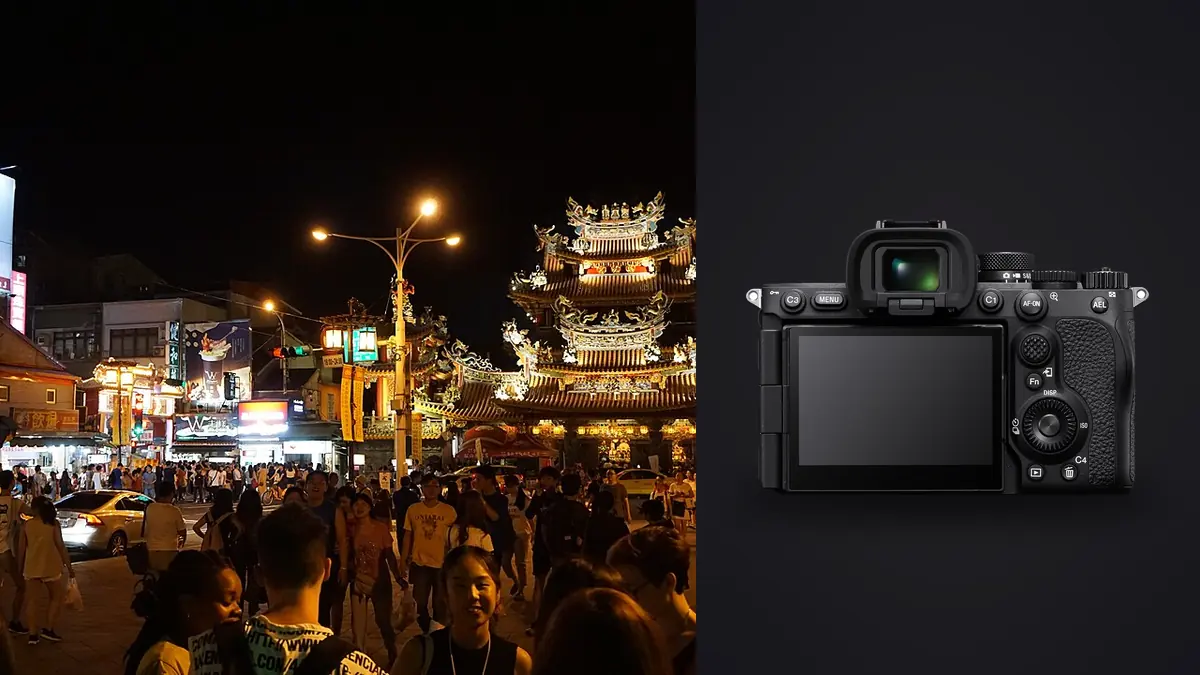
I carried a Sony A7R V through six weeks of a documentary project in a fish market outside Lisbon, the kind of assignment where you're up before the boats come in and shooting into hard, low sunlight bouncing off wet concrete. It is not the camera most people reach for when they think "street." It's a 61-megapixel high-resolution body built as much for landscape and studio work as for anything fast-moving and unpredictable. And yet it earned a permanent spot in my bag for a reason that has nothing to do with pixel count and everything to do with how it reads a scene before I do.
The resolution question nobody asks until the cards fill up
Sixty-one megapixels sounds like a spec-sheet flex until you're three days into a shoot and your 256GB card is showing 40% capacity remaining. Compressed RAW files off the A7R V land somewhere between 55MB and 95MB depending on scene detail, and if you shoot lossless compressed (which you should, the compression artifacts on the standard setting are visible in shadow gradients once you push exposure) you're closer to 70-120MB per frame. A single morning at that fish market, maybe 900 frames across a few hours of activity, chews through 70-80GB before lunch.
That's the tax you pay. What you get back is real: I've cropped frames shot at 24mm down to what looks like an 85mm composition and still had enough resolution for a two-page magazine spread. For documentary work where you often can't reposition (you're in a crowd, or the moment happened three feet to your left and there's no time to move), that cropping headroom has saved shots I would have otherwise thrown away. It's a different way of working the street than shooting tight and trusting your legs. You shoot a bit wider, let the moment happen, and decide the final framing at the desk.
Autofocus in a crowd is where it actually earns the trip
The subject recognition on this body (it shares the same AI-based subject detection as the A7 IV and A1) handles chaotic scenes better than any Sony body I used before it. Point it at a group of five people moving in different directions and it will lock onto the nearest face, hold it through partial occlusion (someone walks in front, a hand comes up, a hat brim drops), and reacquire fast enough that I stopped thinking about focus and started thinking about timing. That's the whole point of documentary work. You want the machine to handle the technical problem so your attention stays on the human one.
Where it struggles: side profiles in low light, and subjects under 20% of the frame in a genuinely busy background. In the market, with fish stalls, moving hands, and steam off ice, I lost lock more often than I'd like on distant, small subjects. Eye AF for humans is excellent up close. Animal and bird detection modes are irrelevant to this kind of work and I never touched them. If your documentary subject is mostly people at conversational distance, this camera's tracking is a genuine advantage over older Sony bodies and most of what Canon or Nikon offer at a comparable price.
Handling it like a street camera instead of a studio camera
The body is 723g without a lens, which is not heavy by full-frame standards but is noticeably larger and grippier than something like an A7C II or a Fujifilm X100VI. That grip depth is genuinely useful when you're shooting one-handed with the other hand holding a notebook or fending off a crowd, but it also means this camera does not disappear the way a compact rangefinder-style body does. People notice it. In a market where vendors already half expect tourists with cameras, that wasn't a dealbreaker. At a protest or in a situation where you want to be genuinely unobtrusive, it's a real consideration.
The shutter is quieter than I expected for a mechanical shutter, and the fully electronic silent mode is close to silent in a room with any ambient noise at all, though you'll get banding under certain LED and fluorescent lighting if you're not careful with shutter speed. The 4-axis multi-angle screen (it tilts and swings out) turned out to be more useful for documentary work than I expected going in. Low-angle shots at the edge of a stall, shooting over a crowd at arm's height, composing from the hip without crouching into someone's personal space. That flexibility changed how I framed a fair number of shots I'd otherwise have missed entirely.
Battery and cards, the unglamorous part
The NP-FZ100 battery gets you through a genuinely long day of documentary shooting, somewhere around 500-600 real-world frames with the EVF used heavily and the screen checked constantly, more if you're conservative about chimping. I carried two spares and never used the second on a single-day shoot. Card slot 1 takes CFexpress Type A or UHS-II SD, slot 2 is UHS-II only, and if you want the full buffer depth advantage on high-resolution compressed RAW bursts, you need CFexpress in slot 1. On UHS-II SD alone the buffer clears noticeably slower and you'll feel it if you burst on a fast-moving scene.
How this compares to the obvious alternatives
People considering the A7R V for street or documentary work are almost always cross-shopping something smaller or something cheaper. Here's how the numbers actually stack up based on what I've shot with each, not manufacturer marketing copy.
| Factor | Sony A7R V | Sony A7C II | Fujifilm X-T5 |
|---|---|---|---|
| Resolution | 61MP full-frame | 33MP full-frame | 40MP APS-C |
| Body weight (no lens) | 723g | 514g | 557g |
| Compressed RAW file size | 55-95MB | 30-45MB | 45-65MB |
| Grip / discretion on the street | Substantial, noticeable | Compact, blends in well | Compact, retro styling draws less attention |
| Subject tracking in crowds | Excellent | Very good, same core AI system | Good, noticeably behind Sony in erratic motion |
| Battery life (real-world frames) | ~500-600 | ~450-500 | ~450 (varies by EVF use) |
| Rough used price (mid-2026) | 2,600-2,900 USD | 1,900-2,100 USD | 1,300-1,500 USD |
If discretion is the top priority, the A7C II wins that fight outright, same sensor family, same lens mount, dramatically smaller body, and it still carries the AI subject tracking that makes crowd work manageable. The X-T5 is the value play and its color science straight out of camera is genuinely a joy for documentary black-and-white work if you shoot Fujifilm's Acros film simulation, but its buffer clears slower on sustained bursts and its tracking, while good, isn't quite at the same level in chaotic scenes. The A7R V wins when the final output demands cropping flexibility or large-format printing, and loses when the priority is staying invisible or keeping the kit light for a twelve-hour walking day.
Lens choices that actually make sense for this kind of work
I ran three lenses through the Lisbon project: the 35mm f/1.4 GM, the 40mm f/2.5 G, and occasionally the 24mm f/2.8 G for wider environmental shots. The 40mm G is the one that stayed on the body most days. It's small, light enough that the whole rig doesn't feel front-heavy, and the focal length sits right in that documentary sweet spot between "clearly a photograph of this scene" and "clearly a portrait of this person." The 35mm f/1.4 is the better lens on paper (faster, sharper wide open, gorgeous rendering) but it's also bigger and heavier, and on a body that's already not small, the combination starts to feel like a lot of camera for a day of walking.
The 24mm gets you closer to classic street photography framing, the kind where you're nearly in the scene, but it demands you actually get close, and getting close with a body this size draws attention in a way a 24mm on a smaller mirrorless or a film rangefinder doesn't. None of these are wrong choices. They're just different tradeoffs depending on how confrontational your working style is.
Getting through the files afterward
The unglamorous truth about a 61-megapixel body on a multi-week documentary shoot is that the culling problem gets bigger, not smaller. A market morning that produces 900 frames at 80MB average is 72GB of data, and a big chunk of it is duplicate attempts at the same gesture, the same three-frame burst where only one has the right expression. I've been running everything through imagic for this, mostly because it scores sharpness and focus locally on the machine rather than uploading anything, which matters when you're working with a client's documentary archive and don't want RAW files leaving your laptop. The burst and duplicate clustering catches those near-identical fish-market sequences and groups them so I'm picking one from a cluster of six instead of scrolling past the same handshake five times.
The other piece that's turned out to matter more than I expected is imagic's apply_my_style preset. I trained it on a batch of edits from an earlier documentary project (mostly desaturated shadows, warm midtones, a specific contrast curve I use for this kind of reportage work) and it now applies a consistent starting point across a new set of imports before I do anything by hand. It's not doing the editing for me, it's doing the tedious first 60% so I can spend my actual attention on the ten or fifteen frames from a shoot that need real judgment calls. It's also a one-time purchase rather than another subscription line item, which matters when you're already budgeting for CFexpress cards and spare batteries for a body this demanding.
Where I'd steer someone away from this camera
If your documentary work is mostly handheld, low-light, run-and-gun video-adjacent stills where you need to move fast and pack light for weeks at a time, I'd look at something smaller first. The A7R V's size and file weight are a real cost, and 61 megapixels is wasted resolution if your final output is web galleries or a photobook at modest print sizes. It's the wrong tool for someone counting grams on a long assignment with limited backup storage in the field. Where it makes sense is exactly the opposite case: a project where the final deliverable benefits from cropping latitude, large prints, or gallery-scale output, and where you're not trying to be the smallest camera in the room.
Frequently Asked Questions
Is the Sony A7R V too loud for candid street shooting?
The mechanical shutter is moderate, comparable to other full-frame mirrorless bodies, not silent but not attention-grabbing in normal street noise. Switch to the fully electronic silent shutter for genuinely quiet operation, just watch for banding under flickering artificial light and be aware rolling shutter can distort fast-moving subjects at high shutter speeds.
Do I actually need 61 megapixels for documentary photography?
Only if your workflow benefits from aggressive cropping after the fact, or your final output includes large prints or double-page spreads. For web-first or modest print documentary work, the file size cost (both on cards and in editing time) outweighs the resolution benefit, and a 24-33MP body will get you there with less friction.
How does the A7R V's autofocus handle fast, unpredictable street scenes?
Its AI subject recognition is strong on human subjects at conversational distance and holds through partial occlusion reasonably well. It's less reliable on small, distant subjects in cluttered backgrounds, which is a real limitation if your documentary style favors wide environmental frames over closer human-centered ones.
What's the realistic battery life for a full day of documentary shooting?
Expect roughly 500 to 600 real-world frames on a single NP-FZ100 charge with heavy EVF and screen use. Carrying one spare battery comfortably covers a full working day; two if you're shooting a lot of video alongside stills or reviewing frames constantly in the field.
For photographers weighing this against lighter alternatives, it's worth reading through our photo culling software comparison to see how the file-management side of a high-resolution body actually plays out once you're back at the desk, and our notes on building a faster photo workflow apply directly to anyone dealing with the larger file sizes this camera produces.