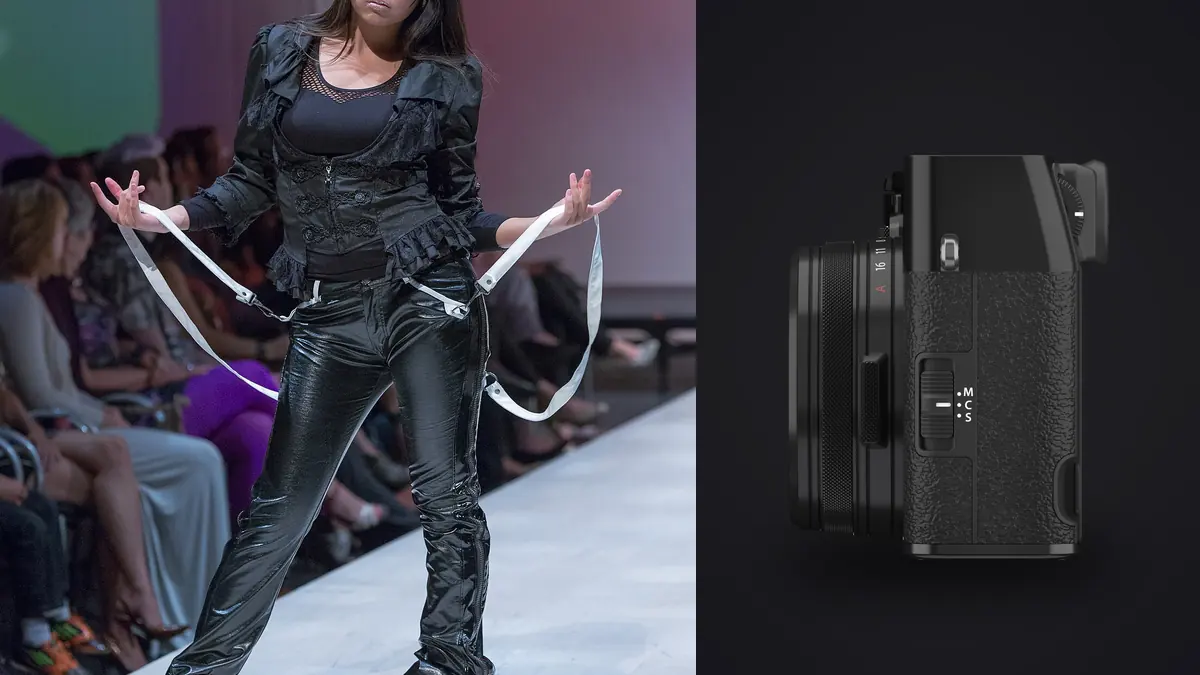
Why a fixed 35mm shows up on lookbook call sheets at all
Picture a twelve-look lookbook for a small knitwear label, budget tight enough that "camera package" means whatever you already own. You bring a full-frame body with a 35mm prime and, almost as an afterthought, the X100VI you bought for personal work. By look four, the X100VI is doing more of the actual selects than the "real" camera. Not because the file quality is better (it isn't, not against a modern full-frame sensor at the same aperture), but because the fixed 35mm-equivalent lens and the camera's small footprint changes how the models move. Nobody postures for a camera that looks like it belongs to a tourist. You get looser hands, less chin-tuck, more of the walking-between-shots moments that end up as the best frame in the set anyway.
That's the actual case for the X100VI on a lookbook, and it has almost nothing to do with the spec sheet. The 40.2-megapixel X-Trans CMOS 5 HR sensor (up from 26.1 megapixels on the X100V) gives you enough resolution to crop hard in post if a client wants a tighter book than you shot, and the newly added in-body stabilization, rated around 6 stops, means you can hand-hold at 1/15s indoors without the shake penalty the X100V charged you. But the reason it's on the call sheet is the 35mm field of view and a body small enough that a stylist doesn't flinch when you're eighteen inches from a garment.
The crop-mode workaround for a lens you can't change
The obvious objection is the one every fixed-lens camera gets: you can't zoom, and you can't swap to a longer lens for a tighter three-quarter shot without physically walking closer, which changes the perspective compression, not just the framing. Fujifilm's answer is the in-camera digital tele-converter, which crops to a simulated 50mm or 70mm field of view using the extra resolution the 40-megapixel sensor gives you. At the 50mm crop you're still working with roughly 20 megapixels, plenty for a web lookbook or even a small print run. At 70mm you're down closer to 10 megapixels, usable for online galleries but not something I'd hand off for a billboard.
In practice, I shoot the wide 35mm framing for anything documentary or full-length, and switch to the 50mm crop for waist-up detail shots of trims, buttons, and drape. I almost never use the 70mm crop on a lookbook; if I need that much reach I've usually misjudged the location and should have brought a second body.
The leaf shutter matters more outdoors than the megapixel count does
The X100VI's leaf shutter syncs with flash at every speed up to 1/4000s, mechanically. That's the detail that actually changes how I light an outdoor lookbook. A conventional focal-plane shutter on a full-frame body caps you around 1/200s to 1/250s for full-power flash sync (faster with high-speed sync, at a real power penalty), which means shooting a model against bright sky at f/2 with fill flash usually forces you to either stop down hard or burn through strobe power fighting the ambient exposure. With the X100VI, I can shoot wide open at f/2, keep shutter speed up around 1/2000s to knock the ambient light down two or three stops, and still get a clean flash sync on the subject. That's a genuinely useful trick for the "shot at golden hour but the sky needed to stay dramatic, not blown out" look that a lot of lookbook briefs ask for without knowing the technical name for it.
It's not a free win. The built-in flash is weak and mostly useless outdoors; you need an off-camera speedlight or small strobe on a trigger, and the X100VI's flash sync situation (hot shoe only, no PC sync port) means your remote trigger needs to be reliable. On two separate shoots I've had a cheap trigger drop a frame here and there at the higher shutter speeds, which is exactly the kind of thing you only notice back at the desk. This is where imagic's burst and duplicate clustering actually earns its keep: instead of manually scrolling through forty near-identical frames of the same pose looking for the one where the flash actually fired, it groups the repeats together automatically and I only need to eyeball the outliers.
Where it genuinely falls short of a full commercial setup
I don't think the X100VI should be anyone's only camera on a paid, contracted lookbook shoot, and I'll list the specific reasons rather than hand-wave at "it has limitations."
Tethering is the big one. Fujifilm's tethering has improved a lot over the last few camera generations, but it's still not the rock-solid, zero-lag experience you get from a Canon or Sony body running Capture One over USB-C on a stable client machine. Art directors on commercial lookbook jobs want to see frames land on a screen in real time, and a connection that drops mid-shoot and needs reconnecting is an awkward pause with six people standing around waiting.
Single SD card slot is the second issue. For a paid job with a client present, you want two cards mirroring each other, and the X100VI doesn't give you that option. Carry a backup body specifically because of this, which somewhat undercuts the "just bring the small camera" pitch.
Battery life is mediocre, rated around 450 shots per charge under CIPA testing, and in practice with the EVF on and chimping between every setup, I get closer to 300 usable frames before I'm swapping batteries. On a twelve-look shoot with reshoots, that's two or three battery changes across the day, not a huge deal but worth planning around.
And the fixed lens is still a fixed lens. If a brief calls for a genuine wide environmental shot (think 24mm) or a compressed telephoto beauty crop (85mm-plus), the X100VI simply cannot do it, crop modes or not. It's a specialist's tool for a specific look, not a do-everything commercial body.
| Practical factor | Fujifilm X100VI | Full-frame body + 35mm f/1.4 prime kit |
|---|---|---|
| Body + lens weight | Approx. 478g total | Approx. 1,100g to 1,400g combined |
| Typical street price (body + optics) | Around $1,600 | $3,500 to $5,500 depending on brand |
| Max flash sync (full power) | 1/4000s (leaf shutter) | 1/200s to 1/250s (focal-plane shutter) |
| Focal length options | 35mm native, 50mm/70mm digital crop | Swap lenses for any focal length needed |
| Card slots | Single SD, no mirrored backup | Usually dual slots with mirrored backup |
| Subject comfort / discretion on set | High, reads as a small personal camera | Lower, reads as "professional gear" |
| Tethering reliability for live client review | Improved but occasionally drops connection | Generally stable over USB-C |
Color out of the camera actually saves time on lookbook turnaround
Lookbooks tend to run on a tighter turnaround than an editorial shoot; sometimes a client wants a contact sheet the same evening. This is where the X100VI's film simulations stop being a gimmick and start being a real time saver. Reala Ace, added with this generation, gives skin tones that need very little correction straight out of camera, closer to a properly exposed slide film than the punchier Velvia or Classic Chrome looks the older Fuji bodies leaned on. For a same-day client preview, shoot JPEG+RAW, hand over a folder of Reala Ace JPEGs for the quick look, and keep the RAW files for the actual grade.
For the final pass, you can build a preset in imagic from a batch of lookbook edits you were happy with from an earlier shoot, using the app's apply_my_style feature, which trains on your own previously edited photos rather than shipping a generic preset pack. Running the new set of RAW files through that gets you about eighty percent of the way to a consistent look across all twelve outfits before you touch anything manually, which matters more than it sounds like on a job where five different outfits were shot at three different times of day and need to look like they belong in the same book.
What a full day on set actually generates, and how to get through it
A twelve-look lookbook shot handheld on the X100VI, three to five setups per look counting wide, medium, and detail crops, plus a flash test frame or two at the start of each setup, lands somewhere around 900 to 1,400 total frames by the end of the day. That's not an outrageous number by digital standards, but it's still an evening of culling if you're doing it by eye, frame by frame, especially with a leaf-shutter camera that lets you rattle off bursts faster than you'd think given the 8fps mechanical-shutter ceiling.
I run the card straight into imagic before I open anything else. The local sharpness and focus scoring catches the frames where a model blinked mid-blur or the flash trigger missed sync, which happens more than I'd like to admit with the X100VI's leaf shutter at the higher speeds. Because the whole process runs on the machine and nothing gets uploaded anywhere, you don't have to think about an unreleased collection sitting on someone else's server before the client has even approved a single frame, which matters more to some brands than others and is a fair question for a client to ask. If you're new to how automated culling actually decides what's sharp versus soft, the breakdown in how AI photo culling works covers the mechanics better than I can in a paragraph here.
From roughly 1,200 raw frames, a typical shortlist is 150 to 200 for the client to pick from, with a final book of 20 to 30 images. The duplicate and burst clustering does most of the heavy lifting getting from 1,200 down to something reviewable, since a leaf-shutter camera fired in bursts produces a lot of near-duplicate frames that differ only by a fraction of a second. If your culling routine currently involves scrolling a folder in Lightroom flagging one star at a time, the general habits in 10 tips for a faster photo workflow apply just as well to a fixed-lens body as they do to any other camera; the volume problem doesn't care what lens you were using.
Frequently Asked Questions
Can you actually deliver a full lookbook on a fixed 35mm lens, or do you need a second camera?
You can deliver a complete book on the X100VI alone if the brief leans documentary or lifestyle, since 35mm covers full-length, environmental, and (via the crop modes) tighter waist-up framing reasonably well. Where it struggles is true beauty or product detail work that wants a longer, more compressed lens, and anything requiring a genuine wide establishing shot under about 28mm. For those specific frames I still reach for a second body, but that's maybe two or three shots out of a hundred-plus on a typical job.
Is the leaf shutter's flash sync speed actually noticeable, or is it a spec-sheet detail?
It's noticeable the first time you shoot a model against bright midday sky at f/2 and realize you don't need to stop the aperture down or add ND to control ambient exposure. Full-power sync at 1/4000s is the difference between fighting the sun and using it. It's the single feature you'd miss most going back to a focal-plane shutter body for outdoor lookbook work.
Does the in-body stabilization actually change anything for this kind of shoot?
Mostly it means fewer soft frames indoors or in low, moody light without reaching for a tripod, which matters on a lookbook because you're often moving fast between setups and don't have time to set up support gear for every shot. It doesn't stop a moving subject, so it's not solving motion blur on a model walking, only camera shake from your own hand.
Is a single SD card slot really a problem for paid client work?
Yes, and I don't think it's overstated. On a lookbook where the client or their team is on set watching, losing a card mid-shoot with no mirrored backup is a real risk, not a theoretical one. Carry a second body specifically to cover this gap, and treat that as a non-negotiable part of the kit rather than an optional extra if you're shooting the X100VI for anything with a paying client attached.