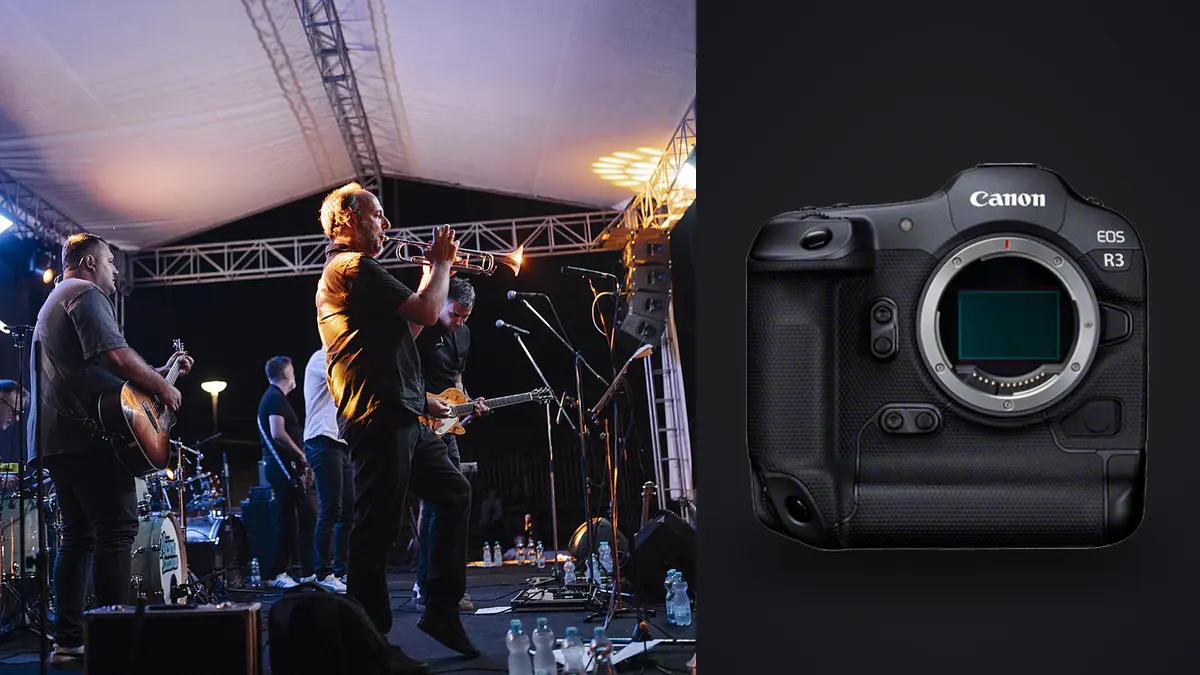
Three songs, no flash, and a rail packed with elbows. That's the deal at most photo pits, and it's the reality the Canon EOS R3 has to perform in if it's going to earn its keep for live music work. It suits club shows, festival side stages, and arena gigs where the lighting rig alone probably costs more than a car. It is not a perfect concert camera (nothing is), but it solves problems that used to eat whole sets: rolling shutter smear under moving LED walls, autofocus that gives up when the follow spot swings off the singer, and the dull thud of a mechanical shutter going off during a quiet acoustic breakdown.
Why sensor readout speed matters more than resolution here
Concert photographers get pitched megapixels constantly, and for this genre of work it's mostly the wrong number to chase. What actually changes your keeper rate is how fast the sensor reads out, because that governs rolling shutter distortion and whether you can shoot silently without your files falling apart. The R3's 24.1MP stacked, back-illuminated sensor reads out fast enough that whip pans across a guitarist mid-solo don't turn the neck of the guitar into a rubber band, which is a real problem on slower-readout bodies when you're shooting fully electronic.
That speed is also what makes the silent electronic shutter usable for actual assignments and not just a spec sheet bullet. I've shot entire unplugged sets in full silent mode, standing four feet from a vocalist with an acoustic guitar, and nobody in the front two rows noticed a camera was firing. Try that with a mechanical shutter slapping away at 8-12fps and you'll get looks from the sound engineer, if not the artist.
One caveat worth knowing before your first arena gig: LED video walls and a lot of modern moving-head fixtures flicker at frequencies that don't always play nice with fast electronic readout, and you can get banding across frames even on a body this quick. The R3's anti-flicker shooting mode helps, but I still keep a mechanical-shutter custom setting saved for songs where the backdrop is a giant screen running content, because banding on a 30fps electronic burst is a much bigger headache to sort through than on a handful of 12fps mechanical frames.
Autofocus when the lighting is actively working against you
Stage lighting design exists to look dramatic, not to make autofocus easy. Backlighting, single-color washes, strobes timed to the kick drum, a spotlight that's on the singer for four bars and gone for the next eight. The R3's AF is rated to work down to roughly -7.5 EV with a fast prime, and in practice that translates to it locking onto a face lit by nothing but a blue wash and a haze machine when older bodies I've used would hunt and give up.
The feature that actually changes how I shoot, though, is Eye Control AF. Look at the frontperson's eye through the viewfinder and the camera shifts its AF point there, which matters a lot in a five-piece band where the drummer, two guitarists, and a keyboard player are all in frame and the camera's subject-detection has no idea which one you actually want. It's genuinely useful, but it needs a proper calibration session first, and it drifts. I recalibrate roughly every few months, and if I'm wearing my regular glasses instead of contacts the tracking accuracy drops noticeably. Photographers who wear glasses full time should test this thoroughly before trusting it at a show; for me it's a supplement to zone AF and back-button focus, not a replacement.
Subject tracking with people-detection holds onto a musician through fairly aggressive movement, jumping off drum risers, spinning with a guitar, that kind of thing, as long as you don't lose them behind another band member entirely. Where it still struggles is a singer who ducks fully below the monitor line or a bassist who turns their back to the crowd for a few bars. No AF system I've used handles that gracefully, so I still ride the focus point manually for those moments rather than trusting the camera to guess who I meant.
Buffer depth and cards: what actually survives a real set
Here's where spec sheets and pit reality diverge. Canon rates the R3 for up to 30fps electronic and around 150 raw frames before the buffer fills, but that number assumes a CFexpress Type B card in slot one. Drop an SD card into slot two and set the camera to write to both simultaneously for backup, and your effective burst depth for the night drops hard because the camera has to wait on the slower card. For a real photo pit set (three songs, maybe nine minutes, a lot of it spent not shooting because you're repositioning along the rail) this rarely bites you at 30fps. It absolutely bites you if you get lazy and hold the shutter down through an entire guitar solo hoping to catch "the moment," which is a habit worth breaking on any high-speed body.
Here's how the R3 stacks up against the two other bodies most working pit photographers are choosing between right now, based on the specs and behavior I've either tested directly or cross-checked against other shooters who use them regularly:
| Camera | Max e-shutter burst | Low-light AF rating | Realistic buffer at max speed | Native ISO ceiling | Notable pit-specific trait |
|---|---|---|---|---|---|
| Canon EOS R3 | 30 fps | approx. -7.5 EV | ~150 raw frames (CFexpress) | 102400 | Eye Control AF, blackout-free EVF |
| Nikon Z9 | 20 fps raw (30 fps in high-efficiency JPEG mode) | approx. -8.5 EV | Effectively unlimited on CFexpress | 25600 (expandable to 102400) | No mechanical shutter at all, fully electronic body |
| Sony A9 II | 20 fps | approx. -3 EV | ~360 raw frames | 51200 | Smallest, lightest of the three for a full pit shift |
The numbers above are approximate and firmware has shifted some of them since launch, so treat them as directional rather than gospel. What they tell you practically: the R3 wins on raw speed and low-light AF confidence, the Z9 wins on buffer depth if you shoot in long, undisciplined bursts, and the A9 II is still the one photographers reach for when their shoulder is the limiting factor after five bands on a festival day.
Lenses that actually make sense in a crowded pit
The RF 24-70mm f/2.8 covers the wide-to-mid range you need when you're jammed against a barrier with three other shooters and can't step back for anything. The RF 70-200mm f/2.8 is the one that actually earns money though, since most of your usable frames in a three-song pit come from 100-200mm where you can isolate a face from a cluttered stage. Both are heavy enough that a full night on a strap starts to hurt, and paired with the R3 body (just over a kilogram on its own) you're carrying real weight through a whole festival day. I switch to a monopod for anything past two hours, not because the R3 is unusually heavy for its class, but because nothing in this class is light.
If your budget stops at one lens, the 70-200 is the better first purchase for concert work specifically. Wide shots of a whole stage are nice for context but rarely the frame that sells, and a lot of festival photo pits don't give you enough room to use a wide lens meaningfully anyway with three photographers shoulder to shoulder.
The viewfinder detail nobody mentions until they've used it
The 5.76-million-dot EVF runs at up to 120fps and, critically, doesn't blackout between frames during a burst. This sounds like a minor spec until you're tracking a singer jumping off a monitor wedge at 20+ fps and realize you never lost the frame, never lost their eyes, never had that half-second where a mechanical viewfinder blacks out and you come back to find they've already landed and moved on. For fast, chaotic stage movement this single feature probably does more for my keeper rate than any autofocus algorithm.
Getting through the footage after the show
A five-band bill shot in the pit and from the soundboard easily produces four or five thousand frames by the time the headliner wraps, and a lot of those are near-duplicate bursts of the same jump or the same guitar swing. I run everything through imagic before I touch Lightroom. Its local sharpness and focus scoring flags which frame in a 20-shot burst actually has the crispest eyes and hands, which matters a lot when you're comparing frames where a drummer's stick is mid-blur in half of them, and the duplicate and burst clustering groups those near-identical shots together instead of making me scroll through all twenty one by one.
Because it processes everything locally with no cloud upload, I can cull a whole night's shoot on a tour bus or in a green room with no wifi, which matters more than people expect when you're filing images to a publication on a deadline right after the encore. Once I've graded a first pass of color for a tour, I set that as an apply_my_style preset in imagic so the next city's shoot starts from my own look instead of a generic default, which saves a real chunk of editing time across a multi-date run. If your workflow is currently "import everything, scroll through it exhausted at 2am," it's worth reading through how AI photo culling actually works before you buy anything, since the software side of this problem is arguably a bigger time sink than the camera body.
Once the culling's done, the edit itself moves faster if you've got a consistent process rather than reinventing your approach every show; a few habits from general workflow speedups apply directly to a touring photographer's routine, especially around batching your color grading rather than treating every night as a from-scratch job.
Where it falls short
It's expensive, full stop, and the ecosystem of RF lenses that actually make sense for this work (the 70-200 f/2.8 especially) aren't cheap either. Battery life on the LP-E19 is genuinely good and I've made it through five-band nights without a swap, but the body itself runs warm during long silent-shutter bursts in summer festival heat, and I've had it throttle briefly on the hottest day I shot with it. It's also not a global shutter sensor, so while rolling shutter is much better controlled than on older bodies, it isn't eliminated, and you can still catch faint skew on the fastest-moving elements under a video wall if you go looking for it. None of that has cost me a usable frame, but it's worth knowing going in rather than discovering it on your first big gig.
Frequently Asked Questions
Is the R3's silent shutter actually silent enough for a quiet acoustic set?
In practice, yes. I've shot unplugged sets from a few feet away in full electronic silent mode and gotten no reaction from performers or front-row audience. There's no mechanical noise at all in that mode, so the only sound is whatever ambient noise is already in the room.
Does Eye Control AF hold up when you're shooting from a photo pit rail?
It works, but it's not something I'd rely on without a fresh calibration and some warm-up shots first. Glasses reduce its accuracy for me personally, and it works best when you're relatively still and can keep your eye steady on the intended subject, which isn't always realistic when you're being jostled by other photographers on a packed rail. I treat it as a fast way to shift AF points rather than a fully hands-off system.
How far can I push ISO before stage lighting noise becomes a problem?
I'm comfortable up to around ISO 12800 for delivery without much hesitation, and I'll go higher than that for a moment that's worth the extra grain, up into the 20000s. Past that, colored stage lighting (deep reds and blues especially) starts showing chroma noise that's harder to clean up than luminance noise, so I'd rather underexpose slightly and recover in post than blow past 25600 as a default habit.
Is the R3 worth choosing over a Nikon Z9 or Sony A9 II for touring live music work?
If you're already invested in RF glass, yes, without much hesitation, especially for the AF confidence in low light and the blackout-free viewfinder. If you're starting from nothing, the decision comes down more to lens ecosystem and body weight over long tours than any single spec in the table above. All three are capable of professional concert work; the differences show up in small workflow frictions rather than dealbreakers.