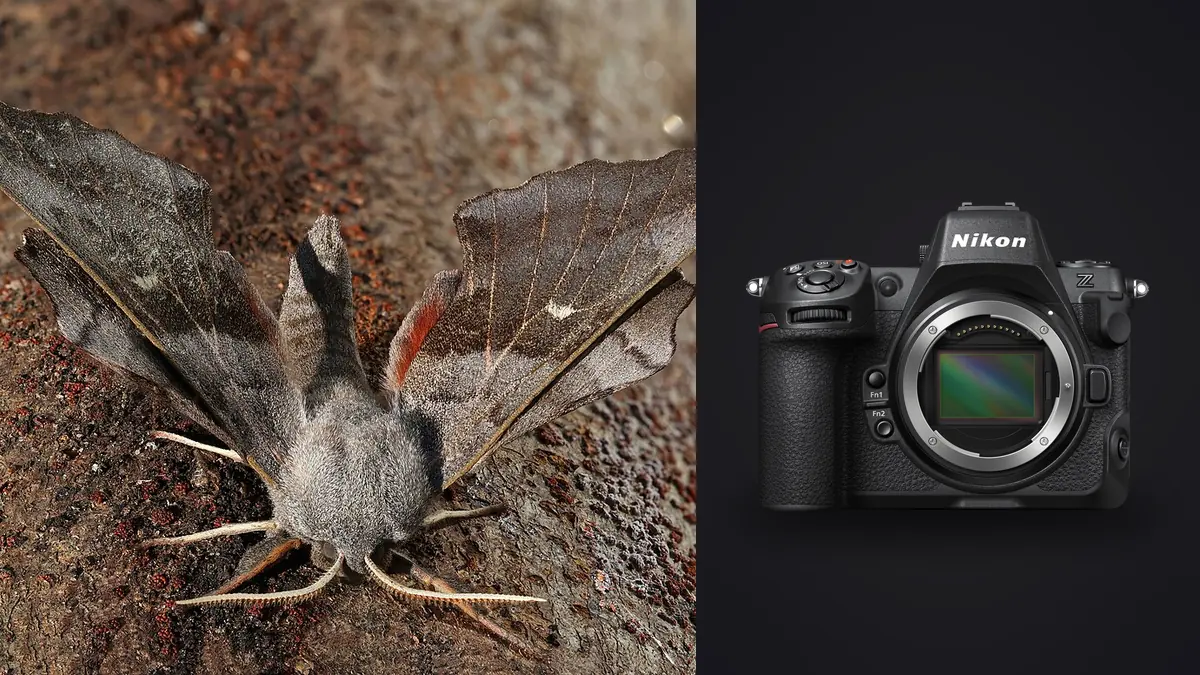
I spent the better part of two mornings this spring lying on damp grass at 6am trying to get a hoverfly to sit still long enough for a clean 1:1 frame, and it took roughly four hundred exposures to get eleven I'd actually call good. That ratio is the honest starting point for any conversation about shooting insects with the Z8. The camera does not make bugs cooperative. What it does is remove most of the mechanical excuses you'd otherwise have for missing the shot when a dragonfly finally holds still on a reed for two seconds.
What the Z8 actually changes for bug hunting
The stacked sensor and the buffer are the two things that matter here, more than any spec-sheet megapixel count. Insect work is a game of tiny windows: a jumping spider turns its head, a bee's wings stop vibrating for a fraction of a second, a damselfly's compound eyes catch the light just right. You are not composing so much as reacting, and reacting well needs two things: a shutter that doesn't lag, and a card that doesn't fill up mid-burst and force you to wait.
On the Z8 I shoot the electronic shutter almost exclusively for macro work, partly for the frame rate and partly because there is zero shutter shock at these magnifications. At 1:1 or higher, even a small mechanical vibration shows up as visible blur in a way it never would at normal shooting distances. Pair the electronic shutter with 20fps raw (or drop to JPEG/lossless-compressed raw at higher rates if you want the full 30fps or the cropped 120fps mode) and you can hold the shutter down through the one moment a mantis strikes and actually have a frame that captures the strike rather than the half-second before or after it.
Pre-release capture buffering is the other feature I lean on constantly and rarely see mentioned in general Z8 reviews, because it's not really a general-photography feature. Half-press to track focus, and the camera is already buffering frames before you fully press the shutter. For anything that moves unpredictably (a fly grooming itself, a beetle about to take off), that half-second of retroactive capture has saved more shots for me than any AF improvement.
Where the AF system actually helps, and where it doesn't
Nikon markets the eye-detection AF as covering people, animals, and birds. It was not built with insects in mind, and it shows: it will occasionally lock onto a large, high-contrast eye on a dragonfly or a jumping spider, but it's inconsistent enough that I don't build a workflow around it. For anything under about 20mm across, I'm back to single-point AF-S with a small focus box, or full manual focus racked by rocking my body forward and back rather than turning the focus ring, which is the traditional macro technique and still the most reliable one at high magnification. The autofocus earns its keep for wider insect shots (a spider in its web from thirty centimeters, a butterfly on a flower head from arm's length) where there's enough working distance for the AF module to have something to grab onto.
Lens choice matters more than body choice
I get asked more about lens selection than anything else, and the honest answer is that working distance, not magnification, is what decides whether you get the shot with most insects. A 1:1 lens that lets you stand 15cm from a dragonfly beats a 2:1 lens that requires you to get within 5cm of a subject that flies off the second your shadow crosses it.
| Setup | Max magnification | Working distance at max mag | Weight | Where it actually works |
|---|---|---|---|---|
| Nikkor Z MC 50mm f/2.8 | 1:1 | ~4.5cm | 260g | Flowers, slow beetles, anything that won't spook at close range |
| Nikkor Z MC 105mm f/2.8 VR S | 1:1 | ~14cm | 630g | Dragonflies, damselflies, butterflies, most general field work |
| Nikkor Z MC 105mm + Nikon extension tube | ~1.4:1 | ~10cm | ~700g | Pushing past 1:1 without buying a specialty lens |
| Laowa 100mm f/2.8 2X Ultra Macro (FTZ, manual) | 2:1 | ~15cm | 638g | Jumping spiders, ants, extreme detail on patient or dead-still subjects |
| AF-S 200mm f/4D Micro (FTZ adapter) | 1:1 | ~24cm | 1190g | Skittish dragonflies and wasps where every extra centimeter of distance counts |
The 105mm S is what's on the camera for probably 80% of my insect sessions. It's the sensible middle ground, and the VR helps more than you'd expect when you're handholding at 1:1 and even your own pulse becomes visible in the viewfinder as camera shake. But when I know I'm chasing dragonflies specifically, the old AF-S 200mm f/4 adapted through the FTZ earns its extra weight. Dragonflies perched on a reed will tolerate you approaching to about 30-40cm before they bolt; the 200mm gets a 1:1 frame from further back than that, so you're not the thing that ends the shot.
The Laowa is worth knowing about even if you don't buy it
The 2x Laowa macro is manual focus only, has no electronic contacts, and won't report any EXIF data to the camera, which annoys some people enough that they skip it entirely. I still keep one in the bag for jumping spiders and ants, because nothing else gets you leg-hair-level detail without a full extension tube stack. The tradeoff is that at 2:1 your depth of field is measured in fractions of a millimeter even at f/11, so it's really a tripod-and-focus-rail lens, not a handheld-in-the-field lens. If your subject moves, you've lost the shot; there's no fast refocus with a manual lens at that magnification.
Settings that actually hold up outdoors
Diffraction becomes visible on the Z8's 45.7-megapixel sensor earlier than people expect, generally from around f/11 onward, but at macro magnifications you need the extra depth of field enough that I still shoot f/13 to f/16 most of the time and accept the softening. The alternative (focus stacking) works beautifully for anything that holds still, and falls apart completely for anything that doesn't, which for insect work is most of the time.
| Condition | Aperture | Shutter | ISO | Notes |
|---|---|---|---|---|
| Cool dawn, dew-slowed insects | f/11-f/14 | 1/250s | 200-800 | Insects are genuinely sluggish before the air warms; this is when stacking is realistic |
| Mid-morning, active flight | f/9-f/11 | 1/1000s or faster | 800-3200 | Trade some depth of field for a shutter speed that freezes wingbeats |
| Overcast midday, low contrast | f/10 | 1/500s | 400-1600 | Even light is forgiving, less need for fill flash |
| Bright sun, harsh shadow on subject | f/13 | 1/500s + flash at -1.7EV | 200-400 | Flash fills the shadow side without blowing out the highlight side |
Dawn is genuinely the best time to shoot insects, not for the light (though it is nice) but because cold-blooded insects are slow before the sun warms them. A dragonfly that would be airborne in a heartbeat by 9am will sit and let you take forty frames at 6:30am while dew is still beaded on its wings. If you only have weekend mornings to shoot, get there before the sun clears the treeline.
Flash, and why I stopped fighting the wind instead of the light
A small diffused flash, either a dedicated macro ring light or a single speedlight with a homemade diffuser (a piece of white foam board bent into a scoop works fine), solves two problems at once: it lets you stop down further for depth of field without the shutter speed collapsing, and it freezes subject motion that no shutter speed alone reliably catches when there's a breeze moving the plant your subject is on. I used to fight wind by waiting for it to stop. It doesn't, not reliably, not in most places. Flash at 1/500s with the shutter as the ambient-light control and the flash as the subject-freezing control does more for keeping shots sharp outdoors than any camera setting.
The part nobody warns you about: what happens after the walk
A two-hour morning session chasing insects with the Z8 at 20fps easily produces two to four thousand frames, and the overwhelming majority of them are near-duplicates of the same three or four subjects, taken a fraction of a second apart while you were trying to nail focus on a moving eye. Sorting that by hand at the end of a long shoot is exactly the kind of task that makes people quietly stop shooting bursts, which is the wrong fix. The better fix is not shooting less, it's not culling by hand.
This is where I actually use imagic rather than just having it installed. It runs local sharpness and focus scoring across the whole card and ranks frames by which one is actually in focus on the part of the insect that matters, which after a macro burst is a genuinely hard call to make by eye on a laptop screen at normal zoom. It also clusters the burst and near-duplicate frames together instead of showing you four hundred thumbnails that all look identical at a glance, so you're reviewing maybe thirty clusters instead of scrolling through the whole card one frame at a time. Because it's a one-time purchase and processes everything locally with no cloud upload, I can run the cull sitting in the car in a parking area with no signal, which after a morning shoot in a place with no reception is not a small thing.
The other feature in imagic I've come to rely on for this specific kind of work is apply_my_style, a preset trained on my own past edits rather than some generic macro preset. Insect shots have a particular color and contrast profile that flatters them (saturated but not oversaturated greens, controlled highlights on shiny exoskeletons, backgrounds pushed soft), and once you've dialed that in on a set you actually like, having it applied automatically across a new batch keeps a season's worth of insect photos looking like they belong together instead of each session having its own slightly different look depending on how tired you were during editing. If you haven't sorted out a culling routine at all yet, the workflow breakdown in how AI photo culling works is a reasonable starting point before you're standing in a field with four thousand frames and no plan.
A few field habits that made more difference than gear
- Approach insects from the side and slightly below rather than head-on and from above; the shadow of a photographer looming overhead is what triggers most flight responses, not the sound of the shutter.
- Use the tilting rear screen instead of the viewfinder for low subjects. Lying flat in wet grass every single time is not sustainable across a whole season, and you lose almost nothing in AF performance shooting from the screen on the Z8.
- Carry a plain grey or dark green card to slide behind a subject on a busy background. It's a two-dollar fix for the single biggest thing that separates a good insect shot from a cluttered one.
- Shoot slightly wider than you think you need to. Insects are surprisingly hard to crop back into a tight composition later if the framing was off, because you lose exactly the fine leg or antenna detail that makes the shot interesting in the first place.
None of this is exotic advice, and none of it requires the Z8 specifically. What the Z8 buys you is more chances per outing to apply it correctly, because the buffer doesn't fill, the shutter doesn't shake the frame, and pre-release capture occasionally hands you a shot you didn't think you'd actually pressed the button for. For a more general look at trimming the review side of a shoot like this down, these workflow tips cover ground beyond just macro subjects.
Frequently Asked Questions
Do I need the 105mm S lens specifically, or will any adapted F-mount macro work?
Any F-mount macro lens works through the FTZ adapter, though AF speed and accuracy on older screw-drive lenses will be noticeably slower than the native Z-mount options. For insects specifically, where AF speed matters less than working distance (since you're often on manual focus anyway at high magnification), an adapted 105mm f/2.8 VR from the DSLR era is a perfectly reasonable budget option and a lot of macro shooters still use one happily.
Is 20fps overkill for something that isn't moving fast, like a resting butterfly?
For a genuinely still subject, no. A single frame at a careful shutter speed does the job. The high frame rate earns its keep specifically during the transition moments: wings opening, a proboscis extending into a flower, the half-second before takeoff. Those are the frames worth having, and they're also the frames you can't predict well enough to time with a single shutter press.
Does the Z8's weather sealing actually hold up shooting in wet grass at dawn?
I've had mine out in heavy dew and light drizzle regularly without issue, but I still treat the lens mount and card door as the weak points and avoid changing lenses or cards outdoors in genuinely wet conditions. Sealing keeps moisture out during normal use, it isn't a guarantee against water getting in through an open door or a loose adapter connection.
How many shots from a burst should I actually expect to keep?
From a genuinely difficult subject like an active dragonfly, somewhere between two and five percent keepers is normal, and that's not a sign you're doing something wrong. It's the nature of shooting fast, small, unpredictable subjects at high magnification where depth of field is measured in millimeters. Budgeting for that ratio, rather than being surprised by it during editing, is half the battle.