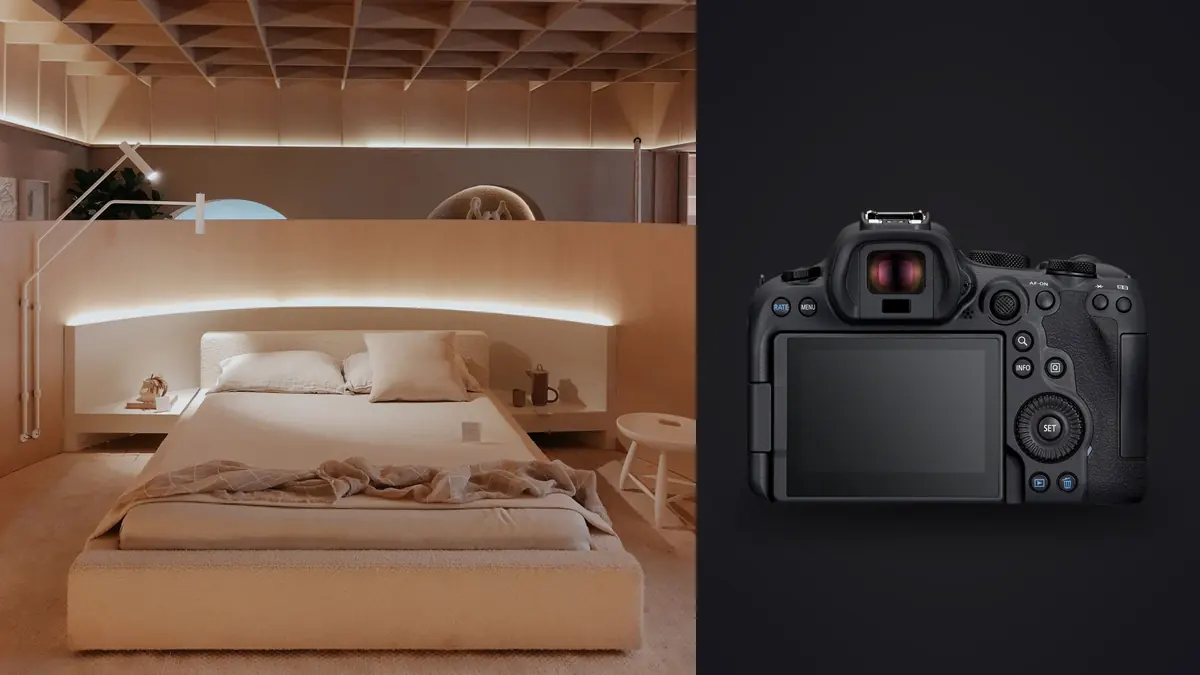
Boudoir work is unforgiving in a way landscape or event photography just isn't. You're in a bedroom, a hotel suite, or a small studio corner with one client, minimal crew, and light that changes every time someone opens a blind or steps in front of a lamp. The camera has to disappear into the process instead of fighting you for focus or forcing a lighting setup that kills the mood. I've been shooting the Canon EOS R6 Mark II for this kind of session for a little over a year, after moving off an original R6 that kept losing eye tracking whenever a subject turned her head into shadow. Here's what actually matters about this body in a boudoir room, not the spec sheet version.
Autofocus that holds up when the subject isn't posing for a camera
Most boudoir sessions aren't a sequence of held poses. They're a slow drift of small movements: a shoulder dropping, hair falling across a face, a hand moving from a hip to a sheet. The R6 Mark II's Dual Pixel CMOS AF II with deep-learning subject detection is genuinely good at following that kind of motion. It keeps landing on an eye even when the client is three-quarters turned away, half in shadow, or partially behind a sheet or a strand of hair, which happens constantly in this genre. On the original R6 I'd lose the eye box the moment a subject looked down at her hands. On the Mark II it holds, and holding focus without me chasing it with a joystick means I'm watching the person instead of the screen.
One thing worth knowing before you rely on the electronic shutter for its silence: shooting under LED lamps or dimmable hotel lighting at high electronic shutter speeds can introduce banding you won't see on the rear screen until you're reviewing files later at 100%. I now default to mechanical shutter or the "1st curtain electronic" hybrid mode whenever a session is lit by anything other than window light or my own continuous LED panel, and I test a burst against the room's lamps before the subject undresses, not after.
Working the sensor in low, mixed light
A lot of boudoir happens in rooms that were never designed to be photographed in. Curtained bedrooms, hotel suites with warm 2700K lamps, studio corners with one softbox and no fill. I shoot this genre between ISO 400 and ISO 3200 far more often than I shoot it at base ISO, and the R6 Mark II's 24.2MP full-frame sensor holds detail in skin and fabric at those values without turning into mush. At ISO 3200 there's visible grain, but it reads as film-like rather than digital noise, and for this genre that's often a feature rather than a flaw. Clients tend to like a bit of texture in a boudoir print more than they like a scrubbed, plastic-smooth ISO 100 look.
In-body stabilization is the other piece that changes how I shoot this genre specifically. With a continuous LED panel instead of flash (flash pops are jarring in an intimate setting and tend to snap a client out of whatever relaxed state you've built), I can hand-hold at 1/30s or even 1/20s on a 50mm or 85mm and still get a sharp eye more often than not. That lets me stay mobile around the bed or the chaise instead of locking the camera to a tripod, which matters when half the job is reacting to a moment that lasts two seconds.
Lens pairing for rooms that are smaller than you'd like
Boudoir happens in tight spaces. You rarely get the backing-up room that a wider lens wants, so the choice of glass matters more here than it does for outdoor portrait work. This is roughly how I split my kit and why, based on the RF lenses I've actually shot this genre with.
| Lens | Max aperture | Closest focus | Where it earns its keep | The real trade-off |
|---|---|---|---|---|
| RF 35mm f/1.8 IS Macro STM | f/1.8 | 0.17m | Small hotel rooms, environmental context shots that include the whole bed or window | Faces near the edge of frame stretch noticeably; keep the subject centered or step back |
| RF 50mm f/1.2L | f/1.2 | 0.40m | The default for close, intimate framing without the compression getting extreme | Heavy front element makes handheld low-angle work tiring after an hour |
| RF 85mm f/1.2L | f/1.2 | 0.85m | Flattering compression for face and shoulder work, creamy background falloff even in cluttered rooms | Needs real distance to focus; unusable in genuinely small rooms unless you shoot through a doorway |
| RF 24-70mm f/2.8L | f/2.8 | 0.20m (at 24mm) | Detail shots, varied framing without a lens change mid-session, safest general-purpose choice | Two stops slower than the primes, which matters once you're past ISO 3200 in a dim room |
If I had to keep one lens for this genre it's the 50mm f/1.2L. It's close enough to fast primes territory to isolate a subject from a cluttered bedroom background, but it still lets me back into a corner and get a three-quarter body shot without needing a wide lens's distortion. The 85mm is beautiful but I only reach for it in suites big enough to actually use it, which is maybe a third of the locations I shoot.
Directing without breaking the moment: bursts, buffer, and what happens after
The R6 Mark II's dual SD UHS-II slots and improved buffer over the original R6 mean I can shoot a real burst through a sequence of small movements (a client shifting weight, hair falling, a breath) without the camera stalling mid-sequence. I shoot in short bursts constantly in this genre because the best frame in a boudoir sequence is rarely the one where the client knows you pressed the shutter. It's the half-second before or after.
The cost of that approach is obvious: a 90-minute session regularly leaves me with 1,800 to 2,500 raw files, and a meaningful chunk of those are near-duplicate frames from the same three-second burst. Given how personal this content is, uploading that folder to a cloud culling service was never something I was comfortable doing, so I run everything through imagic locally instead. Its sharpness scoring flags which frame in a burst actually landed critical focus on the eye, and the duplicate and burst clustering groups those near-identical sequences together so I'm not scrubbing through six nearly identical frames one at a time deciding which shoulder position looks best. It cut my culling time on a typical boudoir set from most of an evening down to under an hour, and none of the files leave my machine to get there.
Color, skin tones, and building an edit that doesn't wobble session to session
Canon's color science out of the R6 Mark II renders skin warm without tipping orange, which matters a lot in mixed window and tungsten light where white balance is genuinely difficult to nail in camera. I still shoot a custom white balance reading off a gray card at the start of every session because relying on auto white balance across a room with a lamp on one side and a window on the other produces inconsistent skin tones frame to frame, and that inconsistency is the kind of thing people notice in a gallery even if they can't name why.
Where this gets practical for delivery speed is in the edit itself. Boudoir clients expect a consistent look across their gallery, not forty images that each got a slightly different curve. Once I had a body of work I was happy with, I used imagic's apply_my_style feature to train a preset off my own past edits rather than starting from a generic preset pack, and it's genuinely closer to how I'd grade skin tones by hand than any off-the-shelf LUT I tried first. If you're building your own color approach from scratch rather than adapting an existing one, our color grading guide is a decent starting point for figuring out what you're actually trying to preserve in skin tone before you start pulling sliders.
Handling the files afterward, which is where privacy actually lives
Nobody talks enough about what happens to boudoir images between the camera and the delivered gallery. These are files a client is trusting you with, and the culling and editing stage is where most of that trust gets tested, because it's the stage most software vendors want you to hand off to their servers. Between the raw dump and the final select, I don't want those 2,000 images touching a cloud queue anywhere, and that was the main reason I moved my culling workflow off a subscription tool that processed everything remotely. Doing it locally isn't just a privacy preference for this genre, it's close to a requirement. If you're curious how automated culling actually separates a usable frame from a near-miss without any of that leaving your drive, we've written more on how AI photo culling works.
What I'd actually tell someone buying this camera for boudoir specifically
At 588 grams the body is light enough to hold one-handed for long stretches while directing with the other, which matters more in this genre than in most, since you're often coaching posture or adjusting a sheet between frames. The fully articulating rear screen is more useful here than it sounds on paper. Low floor-level angles, shooting past a mirror, or checking framing while the camera is held above a bed all become easier with a screen that actually flips out rather than just tilting up and down. And the near-silent shutter genuinely changes the energy of a session. Clients who are nervous about being photographed in this context relax measurably faster when the camera isn't announcing every frame with a mechanical clack. None of that shows up on a spec sheet, but it's the difference between a session that feels clinical and one that feels comfortable.
Frequently Asked Questions
Does the R6 Mark II's silent shutter actually change how clients behave during a session?
In my experience, yes, more than any other single feature. A loud shutter reminds a client every frame that they're being documented, which works against the relaxed, unguarded moments boudoir is trying to capture. Switching to electronic silent shooting, with the banding caveat under certain LED lighting mentioned above, noticeably shortens how long it takes a nervous client to stop performing for the camera.
Is 24.2 megapixels enough resolution for boudoir album prints?
For anything up to a large coffee-table album, yes. I've printed 20x30cm spreads from R6 Mark II files with no visible resolution issues. Where you'd want more is if you're delivering large-format wall art beyond roughly A2 size, in which case cropping tightly on a 24MP file starts to limit your options. For standard boudoir album and print packages, the resolution has never been the bottleneck.
How many usable images should I expect to deliver from a typical boudoir session?
From a 90-minute session shooting roughly 2,000 raw frames, I typically deliver 60 to 90 finished images after culling. That ratio (around 3 to 5 percent of total frames delivered) is normal for burst-heavy genres like this one, and it's exactly why culling software matters so much more here than in genres where you shoot single frames deliberately. Running that volume through local sharpness scoring before you even start subjective editing saves real hours per session.
Should I shoot boudoir entirely in full silent electronic shutter mode?
Not entirely, no. I default to it for the reasons above, but I switch to mechanical shutter for anything shot under lamp or LED lighting that isn't flicker-free, since rolling shutter banding at high electronic shutter speeds under certain light sources can ruin an otherwise perfect frame in a way you won't catch until you're reviewing on a full screen later. Test the room's lighting with a quick burst before the session gets underway.