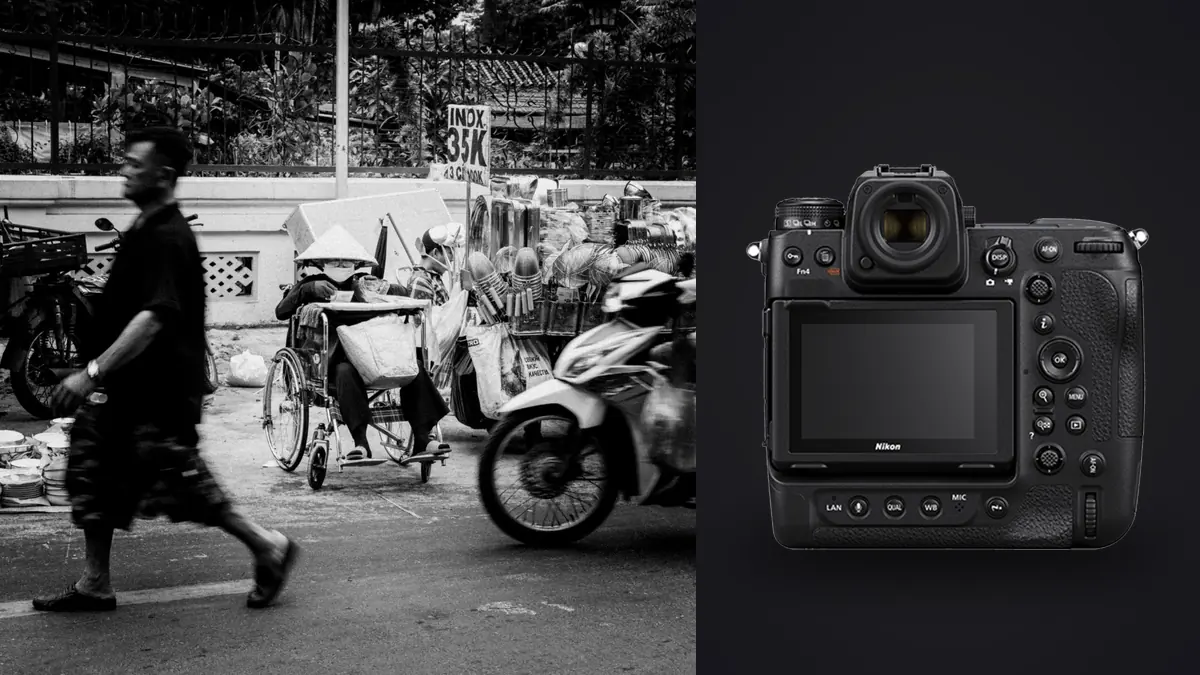
The Nikon Z9 is a 45.7-megapixel professional body with a stacked full-frame sensor, all-electronic shutter, integrated vertical grip, and two CFexpress Type B or XQD card slots. It can react quickly and operate silently, but its physical presence is impossible to ignore. A good street setup therefore controls not only autofocus and exposure, but also how the camera is carried, how much attention it draws, and how the photographer behaves around people.
This guide configures the Z9 for documentary observation rather than maximum burst speed. It favors a consistent exposure floor, a small set of autofocus choices, quiet feedback, and short sequences. Ethics and local law remain separate from camera capability: silent capture is not hidden permission.
Troubleshoot street failures without chasing menus
Troubleshooting Nikon Z9 street photographs begins with a small set of visible clues. A crisp storefront behind a soft person points to subject selection or autofocus-area placement. Directional blur on the person with stable architecture points to shutter speed. Repeating bands under signs or indoor lamps point to electronic-shutter interaction. Clipped faces in a pool of sunlight call for exposure protection, while a frame that feels confrontational may reflect carrying position and distance rather than a technical setting. Save one known control state, compare failures against it, and avoid changing focus mode, metering, and drive simultaneously. Documentary context is easier to preserve when the camera response remains predictable.
Choose a carrying setup that acknowledges the body size
The integrated grip supports long battery life and comfortable vertical shooting, but it also makes the camera conspicuous. Pair it with a modest lens when the assignment permits. A compact prime or restrained zoom reduces front weight and avoids turning every interaction into a gear display.
Keep the strap short enough that the camera does not swing into people, storefronts, or railings. A cross-body strap can distribute weight, while a wrist strap may suit short periods with the camera already in hand. Do not conceal the camera in a way that suggests covert intent; the goal is controlled handling and respectful presence.
Remove unnecessary cages, brackets, and large hoods. Cover or disable distracting indicator lights where the camera settings lawfully allow, but retain enough feedback to know whether recording is active. A visible photographer who behaves calmly often attracts less concern than someone repeatedly hiding and revealing a large body.
Build two autofocus modes, not a menu of possibilities
For open scenes with one main person, AF-C with 3D tracking or a suitable subject-detection area can follow movement after the intended subject is acquired. For crowded frames, a smaller wide-area box or single point provides more authorship. The camera cannot know which of several similar faces carries the story.
Assign the primary focus method to the AF-ON button and a temporary alternate area to another reachable control. One press can then move from broader tracking to a precise point without opening the information display. Practice until the change is possible through the viewfinder.
Subject detection can fail when faces are tiny, turned away, masked, reflected, or crossed by foreground objects. In those situations, focus on a high-contrast edge at the same distance or use a small area over the torso. The important behavior is keeping control of subject choice, not waiting for an eye box.
Set an exposure floor for human movement
Manual exposure with Auto ISO works well when shutter speed and aperture define the frame while light changes across a street. Choose a minimum shutter that handles ordinary walking and hand gestures, then raise it for bicycles or quick crossings. Stabilization steadies the camera; it does not freeze the person.
Aperture controls both depth and the visual relationship between subject and setting. A wide aperture isolates but leaves less room for focus error at close distance. A moderate aperture can hold two people or a subject within an environment. Let ISO rise when the moment requires both depth and speed rather than sacrificing one by habit.
Use highlight-weighted metering or exposure compensation when bright signs, pale clothing, or sunlit faces are central. Deep street shadows do not always need to be lifted to midtone. Protect important highlights and preserve the intended contrast, then use RAW latitude with restraint.
Configure silent capture without losing awareness
The Z9 has no mechanical shutter, so every still is made electronically. Its stacked sensor readout reduces rolling-shutter problems, but artificial lights can still band and very fast motion can still reveal artifacts. Test LEDs, signs, and indoor fixtures at the intended shutter speed.
Electronic shutter silence changes photographer feedback. Enable a discreet viewfinder indicator or low-volume artificial sound where appropriate, and know how it behaves in both orientations. Avoid a bright screen flash that draws more attention than a quiet click would.
Silence is useful during ceremonies, quiet interiors, and close documentary moments, but it should not be used to bypass consent, venue rules, or reasonable privacy. If someone objects, lower the camera and address the interaction. Technical discretion does not override human boundaries.
Map controls for changing street conditions
- Front command dial: aperture, so depth can change without leaving the viewfinder.
- Rear command dial: shutter speed, including a quick move from walking to faster motion.
- AF-ON: primary continuous tracking method.
- Fn button: temporary precise autofocus area for crowds and reflections.
- Second Fn button: exposure mode or metering behavior used for difficult highlights.
- Record button in still mode: a carefully chosen function such as image area, only if accidental activation is unlikely.
Lock controls that are often bumped while carrying the large grip. Keep menu banks or custom settings limited and named by situation, such as daylight documentary and artificial-light interior. A complex bank that changes dozens of unfamiliar values is harder to audit than a focused configuration.
Use the four-axis screen and vertical grip deliberately
The tilting rear screen supports waist-level work in both horizontal and vertical orientation. A lower viewpoint can reduce the confrontational feel of raising a large camera to the eye, and it can align the frame with seated people or reflective surfaces. Keep awareness outside the screen; street safety and changing interactions matter more than perfect framing.
The vertical controls help with portrait-oriented documentary frames, but the integrated grip can encourage a tight hold. Relax the shoulders and rotate the whole camera smoothly. Check that duplicate controls are not pressed against clothing when the body hangs at the side.
Use the viewfinder for fast motion and bright daylight, and the screen for deliberate low or high framing. Do not switch automatically. Each viewing method affects how people perceive the photographer and how well surrounding activity remains visible.
Control drive speed and file volume
The Z9 can record full-resolution RAW at high continuous rates and even faster JPEG modes. Street work rarely needs the maximum. Set a modest continuous drive for gestures and single frame for quiet observation. Short two- or three-frame sequences often cover a blink or foot position without producing a wall of duplicates.
Use full-resolution 14-bit RAW when crop latitude and tonal adjustment matter, and consider Nikon's high-efficiency RAW option after confirming software support and image behavior. Keep one format through an assignment unless a clear output need changes. Mixed file types make later assumptions about latitude less reliable.
The two card slots allow simultaneous recording or overflow. Backup can be valuable for documentary work that cannot be repeated. Use matched, tested media, format only after verified copies, and keep exposed cards separate from empty cards even when the camera normally holds both all day.
Prepare for common street failures
| Failure | Likely setup cause | Correction |
|---|---|---|
| Wrong face is sharp | Area too broad for the crowd | Use the temporary precise area and reacquire. |
| Hands blur while the wall is sharp | Shutter floor too low | Raise shutter speed; stabilization cannot stop gestures. |
| Indoor frames show bands | Electronic readout and pulsing light | Adjust shutter speed and test flicker controls. |
| Unexpected series of files | Drive left at a high rate | Return the default bank to low continuous or single. |
| Camera attracts more attention than expected | Large lens and active handling | Simplify the rig and slow the photographer's movements. |
Keep documentary context through the edit
At ingest, preserve capture order and make verified copies before selection. Group obvious bursts, but do not judge frames only by face or eye sharpness. Gesture, relationship, signage, and the sequence before or after an action may carry the documentary meaning.
imagic can score sharpness, exposure, closed eyes, and composition and group near-duplicates locally. Review the shortlist manually because intentional motion, reflection focus, and partially obscured faces may be central rather than defective. Adjustments remain non-destructive, and final files can be exported as JPEG or TIFF.
For a local workflow overview, visit imagic desktop. Related equipment articles are available under Camera Hardware.
Set privacy and metadata habits before walking
Documentary files can contain faces, home locations, medical details, protests, children, or other sensitive context. Decide whether location data should be recorded and whether precise coordinates belong in delivered metadata. Convenience is not a reason to publish information that could expose a vulnerable person or private place.
Use factual captions and separate observation from inference. Record names only when they are offered and needed, spell them back for confirmation, and do not infer occupation, relationship, motive, or legal status from appearance. Keep a secure note that links captions to filenames without placing sensitive details in a public folder name.
When a person requests no photograph or no publication, mark the relevant sequence immediately using a rating or written note that will survive ingest. Do not rely on recognizing the face days later. This field habit matters as much as focus accuracy because a technically successful frame can still be inappropriate to deliver.
Prepare a simple response for questions about the work: who the photographer is, what the project covers, and where images may appear. Clear answers reduce uncertainty. If the situation cannot be explained honestly in a sentence, pause and reconsider whether making the frame is appropriate.
Keep a contact card or project page available without requiring a stranger to share personal information. Transparency should be easy for the subject and should not turn a brief street interaction into pressure to participate.
Field reset checklist
- Set the daylight or artificial-light bank and confirm the shutter floor.
- Choose low continuous drive unless a specific action requires more.
- Verify primary tracking and the temporary precise focus area.
- Check the current lens, hood, strap length, and card destinations.
- Test for bands when entering a new artificial-light environment.
- Confirm screen and viewfinder feedback are visible but discreet.
- Review one frame for focus and highlights, then return attention to the scene.
Frequently asked questions
Is the Nikon Z9 too large for street photography?
It is conspicuous and heavy compared with compact bodies, but it can work when durability, battery life, and familiar controls matter. Pair it with a restrained lens and handle it openly and calmly.
Which autofocus area is best in a crowd?
A smaller wide area or controlled point gives more subject authority than the broadest automatic mode. Acquire the intended person first, then let tracking follow when appropriate.
Does the Z9's electronic shutter avoid all light banding?
No. The fast stacked readout helps, but some pulsing LEDs and signs can still create bands or uneven exposure. Test the actual light and adjust shutter speed.
Should high-speed burst remain enabled all day?
No. Use single or low continuous drive as the normal state and reserve faster sequences for brief, unpredictable actions. This reduces duplicates and keeps timing intentional.