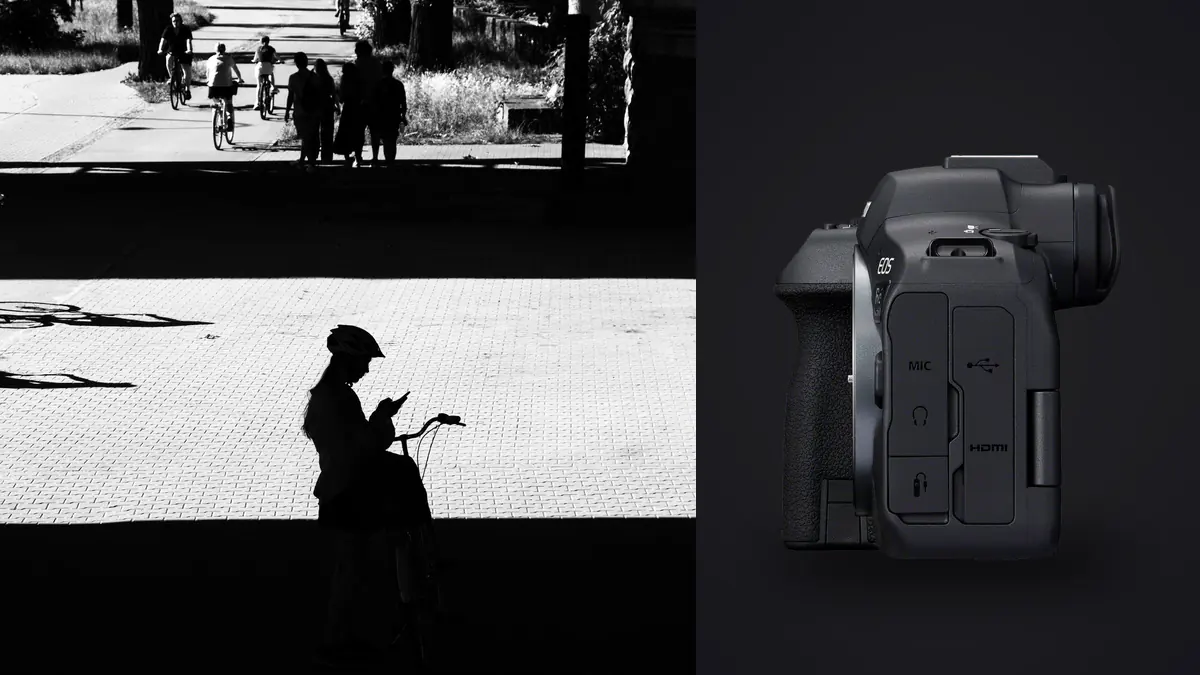
I picked up the R6 Mark II about eighteen months ago for a documentary project that had me following a family-run fish market through its last year before a redevelopment forced it out. Six days a week, mixed light, moving subjects, and a lot of moments that happen once and don't repeat. That's a fairly brutal test for a camera, and it's a different test than the studio and landscape reviews usually run. This is what I've learned about using it for that kind of work, not what the spec sheet promises.
Why this body works for candid, unscripted shooting
The single biggest thing the R6 Mark II gets right for street and documentary work is that its autofocus rarely makes you think about it. The deep-learning subject detection picks out people reliably even when they're partially hidden behind a stall, a doorway, or another person's shoulder, and it holds onto them through the kind of erratic movement you get on a market floor or a protest march. I don't shoot with back-button AF tracking locked on for everything, because a lot of street work is closer to "point the camera where something interesting is happening" than "follow this one person," but when I do need continuous tracking on a subject, it sticks in a way the original R6 sometimes didn't.
The 24.2-megapixel sensor is also a genuinely good compromise for this genre. It's enough resolution to crop a frame that was composed a half-second too wide, which happens constantly when you're shooting from the hip or reacting fast, but the files stay small enough that a week of documentary shooting doesn't produce a card full of forty-megapixel monsters that choke your laptop every evening. I've shot the same kind of documentary work on higher-resolution bodies and spent real time waiting on previews and exports that I'd rather have spent editing.
Silence matters more in this genre than almost any other, and the fully electronic shutter mode is close to silent in practice. No slap, no click that makes a subject's head turn. For a documentary piece where you're trying to be furniture in the room, that's not a minor convenience, it's the difference between getting the unguarded moment and getting the moment where someone notices you and stiffens up.
How I actually set the camera up before a shoot day
Out of the box the R6 Mark II is configured more like a general-purpose hybrid camera than a street shooter's tool, so the first hour with it is spent building custom modes. I keep three saved on the mode dial (C1, C2, C3) and cycle between them depending on what the day is actually going to look like, rather than trying to find one universal setting that handles everything badly.
| Situation | Shutter / drive | AF area | ISO range | Why I set it this way |
|---|---|---|---|---|
| Daylight walking, general candid work | Mechanical shutter, 3fps low-speed continuous | Whole-area AF, Eye Detection on, tracking off | Auto 100-6400, min. 1/250s | Mechanical avoids any rolling-shutter skew from cyclists or traffic, and 3fps is plenty when you're reacting rather than spraying frames |
| Night market or low-light street | Mechanical, single shot | 1-point or small zone, manually placed | Auto 100-25600, min. 1/125s | Full electronic shutter bands under a lot of sodium-vapor and cheap LED signage, so I trade the silence for clean exposures here |
| Sit-down interview for a documentary sequence | Silent electronic shutter, single shot | Eye Detection, single subject priority | Auto 100-3200, min. 1/125s | Subject isn't moving fast, so rolling shutter isn't a risk, and full silence keeps the room natural |
| Fast-breaking action (a scuffle, a parade, a crowd surge) | Electronic shutter, up to 40fps with pre-continuous shooting on half-press | Whole-area with subject tracking locked | Auto 100-12800, min. 1/500s | Pre-continuous buffering has caught frames of something starting before I'd finished mashing the shutter, worth the rolling-shutter risk on anyone sprinting through frame |
The pre-continuous shooting mode in that last row deserves a mention on its own. When it's enabled, half-pressing the shutter starts buffering frames before you commit to the full press, up to half a second's worth at the fastest setting. It sounds like a gimmick until the first time a fight breaks out at a market stall two feet from you and you catch the first swing because the camera had already been recording before your finger finished moving. That's a real documentary-specific advantage, not a marketing line.
Lenses that make sense for a full day on foot
The R6 Mark II body alone is around 588 grams, which is reasonable but not tiny, so lens choice does most of the work in deciding whether your neck and shoulder survive a twelve-hour shoot day. The RF 35mm f/1.8 Macro IS STM has been my default for probably 70 percent of the work I do on this camera. It's small, it focuses close enough to grab a detail shot of a market vendor's hands without swapping glass, and the image stabilization means I can shoot handheld well under 1/30s indoors when I need to keep ISO down.
For genuinely tight, discreet street work I'll switch to the RF 50mm f/1.8 STM, which is cheap enough that I don't worry about it getting knocked around in a crowd. It's not a glamorous lens optically, a little soft wide open at the corners, but for environmental portraits and closer interactions it renders faces well and the size keeps the whole rig from looking like "a photographer with a big camera," which changes how people react to you on the street.
I've tried the RF 28mm f/2.8 STM pancake as a walk-around option too. It's the lightest RF option by a wide margin and genuinely pocketable on the body, but the maximum aperture limits it in the kind of dim interiors documentary work often ends up in, so it stays as a backup rather than a primary. If your project is mostly daylight exteriors it's a perfectly reasonable main lens and it keeps the whole kit under a kilogram.
Dynamic range and the reality of harsh urban light
Street shooting rarely gives you flattering light. You're working under midday sun bouncing off concrete, or mixed shopfront lighting with three different color temperatures in one frame, or a doorway with someone backlit against a bright street. The R6 Mark II's sensor has enough shadow latitude that I routinely expose for highlights and pull detail back out of the shadows in post without the noise becoming distracting, at least up through ISO 6400 or so. Past that it's usable but you notice it, particularly in the blue channel.
What surprised me more than the raw dynamic range number is how the metering handles high-contrast scenes without babysitting. Evaluative metering linked to the detected subject's face tends to get skin tones right even when the background is blown out by three or four stops, which for candid work means fewer blown highlights ruining a frame you can't reshoot because the moment is gone.
The unglamorous logistics: batteries, cards, weather
None of this is exciting to write about, but it's what actually determines whether you come home with the shot. The LP-E6NH battery gets me through a full day of intermittent shooting, call it 600 to 700 frames of mixed EVF and rear-screen use, as long as I'm not chimping every image on the big screen. I still carry a spare, because a documentary day doesn't pause for a battery swap at the wrong moment.
Dual UHS-II SD card slots matter more here than they might for a studio shooter, because a multi-day documentary assignment means footage that can't be recreated. I run one card as the working card and mirror to the second in-camera, so a card failure on day four of a week-long shoot doesn't mean losing the first three days of material.
Weather sealing is roughly on par with Canon's older 90D, which is to say it's fine for rain, dust, and the general abuse of being carried on a strap all day, but I wouldn't take it into a genuine downpour without a rain cover. For documentary work that follows subjects outdoors regardless of weather, that's worth planning around rather than assuming the camera will just handle it.
Where the take actually gets sorted
A single day of street shooting on this camera routinely produces 800 to 1,500 frames once you account for how many near-identical bursts a moving subject generates. Multiply that across a week-long documentary shoot and manually sorting keepers from near-duplicates becomes the actual bottleneck, not the shooting itself. I run the take through imagic afterward specifically because it clusters burst sequences and near-duplicate frames locally, so instead of scrolling through nine almost-identical frames of someone walking past a stall I'm looking at the two or three that are actually different in expression or gesture. Everything stays on my laptop rather than getting uploaded anywhere, which matters when some of the subjects in a documentary piece haven't agreed to their images going anywhere public yet.
The sharpness scoring has also changed how forgiving I am about shooting fast and sorting later. Electronic shutter at 40fps on a moving subject produces plenty of frames that look fine on a phone-sized preview but are actually a touch soft from motion or missed focus, and having that flagged automatically rather than caught after the fact has saved me more than once. If you're curious how that kind of local sharpness and duplicate detection actually works under the hood, I wrote up the mechanics in more detail in how AI photo culling works.
The other feature I lean on for this specific genre is imagic's apply_my_style preset, which is trained on your own past edits rather than a generic filter. Documentary work usually needs a consistent look across a body of images shot over weeks or months in wildly different light, and having a preset that's actually learned from how I've graded my own street work in the past gets me closer to a finished edit on the first pass than starting from a default profile every time.
What I'd tell someone before they buy it for this specific use
It's not the smallest or lightest option for street work. A Fujifilm X100VI or a Ricoh GR III disappears into a jacket pocket in a way the R6 Mark II with any lens attached never will, and there's a real argument that a smaller, less "camera-shaped" tool gets you more natural street reactions. If pure discretion and all-day pocketability are the priority over autofocus performance and file quality, those are worth considering instead.
Rolling shutter on the electronic shutter mode is also a genuine limitation, not a theoretical one. Shoot a cyclist crossing close to frame at 40fps and you'll see the wheel and frame geometry skew. For most street and documentary work that's a rare edge case, but if your project involves a lot of fast lateral motion close to the lens, know that going in and default to the mechanical shutter for those situations.
And there's no built-in ND filter, which matters if you like shooting wide apertures in bright daylight. I carry a couple of screw-in NDs for the 35mm now, which is one more thing to manage during a shoot day.
Frequently Asked Questions
Is the Canon EOS R6 Mark II too big for candid street photography?
It's larger than a rangefinder-style compact but smaller than most full-frame DSLRs, and with a small prime like the RF 35mm f/1.8 it's manageable for a full day on foot. It won't disappear the way a compact does, but the silent electronic shutter and fast, reliable autofocus more than make up for the size in most documentary situations.
Should I shoot street photography with the electronic or mechanical shutter?
Default to electronic shutter for discretion in daylight and static or slow-moving scenes. Switch to mechanical for fast lateral motion (traffic, cyclists, sports-adjacent action) to avoid rolling-shutter skew, and for shooting under flickering artificial light like sodium-vapor streetlamps or cheap LED signage, where electronic shutter can introduce banding.
What's the best RF lens for documentary work on a budget?
The RF 50mm f/1.8 STM is the best value entry point, it's inexpensive enough not to worry about in a crowd and renders well for portraits and closer interactions. The RF 35mm f/1.8 Macro IS STM costs more but earns it back with image stabilization and close-focus versatility for detail shots.
How do I manage the sheer number of frames from a multi-day shoot?
Build a triage habit rather than trying to review everything at full resolution every night. Running the day's take through culling software that clusters bursts and flags soft frames locally, like imagic, cuts a folder of a thousand-plus images down to a realistic shortlist before you ever open an editor, which is a workflow step worth reading up on in 10 tips for a faster photo workflow if this is new to your process.