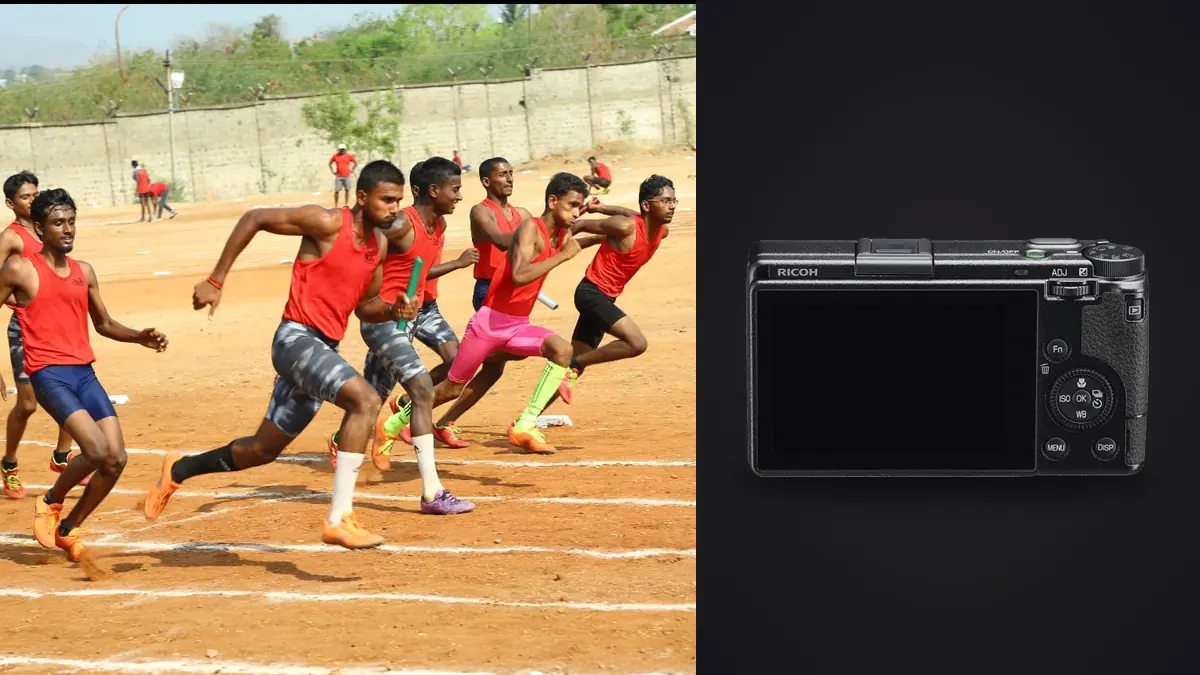
My mirrorless body was at the shop for a sensor clean the same week a friend asked me to cover her daughter's Saturday invitational, six events, one small-town track, no press credential, no second camera. The only thing left in the bag was a Ricoh GR IIIx. I almost said no. A fixed 40mm equivalent lens, a leaf-type shutter built into the lens barrel, and an autofocus system tuned for street work is not what anyone would choose to shoot sprints and field events. I said yes anyway, mostly out of curiosity about where the limits actually sit rather than where I assumed they'd sit.
This isn't a "surprisingly good sports camera" piece. The GR IIIx is not a sports camera and I'm not going to pretend otherwise. But six events, roughly 1,400 frames, and one very sore set of knees from crouching at track level later, I came away with a much more specific picture of what this camera can and can't do at a meet, and where a fixed 40mm lens actually forces better decisions than a zoom would.
The Honest Limitations Going In
Three things work against the GR IIIx at a track meet before you even lift it to your eye. First, the lens doesn't zoom, so every framing decision is a walking decision, and a track has fences, officials, and lane restrictions that don't care how badly you want to walk somewhere. Second, continuous shooting sits around 4 frames per second, which is fine for a runner crossing a mostly static frame but nowhere near enough to guarantee you catch the exact instant a baton changes hands. Third, and this is the one that actually mattered most on the day, the autofocus system hunts on anything moving directly at the camera. It's built to nail a person walking across a street at a diagonal, not a sprinter closing distance at 9 or 10 meters per second head-on.
Shutter speed tops out at 1/4000s, which is plenty to freeze a sprinter's legs if you get the exposure right, and the in-lens shutter is genuinely quiet, quieter than any DSLR I've stood next to at a meet. Nobody flinched when I was three feet from the shot put circle. That discretion turned out to matter more than I expected.
Working a 40mm Field of View Without a Zoom
The workaround for a fixed lens at a multi-event meet is simple to state and hard to execute: you plan your position around the event, not the other way around. I spent the morning walking the fence line more than I spent shooting. Here's roughly what worked and what didn't, event by event, shooting native 40mm with no crop.
| Event | Working distance for a full-body frame | How it actually went |
|---|---|---|
| 100m / 200m sprints | About 10-12 meters, infield side of lane 1 | Fine for the start and the last 15 meters near the finish. Everything in the middle needed a long walk between heats to reposition. |
| 4x100m relay exchange | 3-5 meters, right at the exchange zone | This was the best event for the lens. The zone is only 20 meters long, so you can plant yourself and let the handoff come to you. |
| Long jump | 4-6 meters from the pit, side-on | Good for landing frames. Takeoff off the board needed the 71mm crop mode to avoid getting the whole runway in frame. |
| Shot put / discus | 2-3 meters outside the safety fence | Surprisingly strong. The circle is small and the release happens close to the fence line, which suits a wide-ish prime. |
| 1600m / distance | Trackside, any point on the back straight | Weakest event for this camera. Pack running at a distance reads as a blur of similar torsos at 40mm; you lose who's who. |
| High jump / pole vault | 5-8 meters, low angle at the bar | Workable but you get one clean attempt per athlete before officials reposition the mats and block your line. |
The pattern that emerged: events with a fixed, small area (relay exchange, throwing circles, the jump pits) suit a 40mm prime because you can pre-plan your spot and let the action arrive. Events that sprawl across the full oval (distance races, the far side of a 200m curve) do not, and no amount of good positioning fixes that without more reach than this lens has.
Do the Crop Modes Actually Help
The GR IIIx has two in-camera digital crop modes that simulate longer focal lengths by cropping the 24-megapixel APS-C sensor and scaling the JPEG preview and EVF-less LCD framing accordingly. I used both throughout the day, mostly for long jump takeoffs and high jump clearances where I couldn't physically get closer without walking onto the runway.
| Mode | Equivalent focal length | Resulting resolution | Where I actually used it |
|---|---|---|---|
| Full frame, no crop | 40mm | Roughly 24 megapixels | Relay exchanges, shot put, anything close |
| Crop 1 | 50mm | Roughly 15 megapixels | Long jump landings, general reach when I couldn't move |
| Crop 2 | 71mm | Roughly 7-8 megapixels | High jump bar clearance, long jump takeoff board |
The catch, and it's a real one if you shoot RAW: the crop only affects the JPEG and the framing on screen. If you're shooting RAW+JPEG the way I was, the RAW file still records the full 40mm frame, and you have to crop it yourself in post to match what you saw when you pressed the shutter. That's not a complaint exactly, it's just something to know going in so you're not surprised when the RAW opens up wider than expected. For JPEG-only shooters the crop modes are genuinely useful and I'd use the 50mm crop by default at a track meet if I only had this camera again.
Snap Focus Beat Autofocus Every Time
The single biggest adjustment I made over the course of the morning was giving up on autofocus for anything moving toward the camera and switching to the GR IIIx's snap focus setting instead. Snap focus locks the lens to a preset distance the moment you half-press (or fully press, depending on your button mapping), with no hunting and effectively no shutter lag. I set it to roughly 5 meters for the relay exchange zone and to about 8 meters for the long jump pit, then just waited for athletes to cross that plane and fired.
This is basically zone focusing, the same technique street photographers have used with manual rangefinders for decades, applied to a track meet. It trades flexibility for certainty: you can't chase a subject that drifts off your preset distance, but you also never miss focus on a subject that's exactly where you predicted it would be. For a sport where athletes run predetermined lines through fixed zones, that trade works far better than you'd expect. My keeper rate on relay exchanges using snap focus was noticeably higher than my keeper rate on sprint starts using continuous autofocus, where the camera kept trying to refocus as the runners came out of the blocks.
Buffer Depth and the 4fps Ceiling
Four frames per second sounds slow next to a modern mirrorless body doing 20 or 30fps, and it is. In practice it meant I had to time my burst rather than spray and pray. For a relay handoff I'd start firing about half a second before the exchange zone and let it run for maybe eight frames, which was enough to catch the actual hand-to-hand moment somewhere in the sequence most of the time, but not every time.
Shooting RAW, the buffer filled fast enough that a long burst wasn't really an option anyway. After roughly a dozen frames in quick succession the camera would pause to write, which taught me quickly to shoot in short, deliberate bursts timed to the action rather than holding the shutter down through an entire race. That discipline is arguably good practice regardless of camera, but the GR IIIx enforces it rather than allowing you to fix bad timing with volume.
Light Across a Full Day of Events
The meet ran from an overcast 9am start through to under-lights finals around 7pm, which meant three distinct lighting situations on one memory card. Morning heats were flat and even, easy exposure, ISO 200-400 at 1/2000s to freeze motion. Midday sun through a partly cloudy sky was the hardest, with athletes moving in and out of shadow from the grandstand roof, and I ended up riding exposure compensation more than I'd like to admit. Evening finals under the stadium lights pushed me to ISO 3200-6400 to hold 1/1000s or faster, and that's where the small sensor and older processor in this camera show their age a little, with visible noise in shadow areas that a newer APS-C or full-frame body would handle more cleanly.
The 3-axis in-body stabilization helped for handheld shots between events at lower shutter speeds, but it does nothing for subject motion blur on a moving athlete, which is a different problem entirely. That one's on shutter speed and light, not the stabilizer.
Sorting 1,400 Frames Without Losing the Evening
Here's where a day like this actually gets hard, and it's not the shooting. Between snap-focus bursts, crop-mode duplicates, and RAW+JPEG pairs, you can come home with about 1,400 files and maybe 60 usable images the client actually wants. Manually stepping through that at full size to check focus on every frame from a zone-focus technique, where some frames land the athlete exactly on the plane and others land them a half-step early or late, is exactly the kind of grinding, error-prone task I don't want to do at 11pm.
I ran the whole card through imagic that night. Its local sharpness scoring is the actual reason snap focus is viable as a technique at all for me now, because it flags the frames where the athlete actually landed on my preset focus distance versus the frames where they were a stride off, without me squinting at a laptop screen pixel by pixel. It also clustered the relay-exchange bursts and the long jump crop-mode sequences into groups automatically, so instead of scrolling through eight nearly identical frames of a handoff I was picking one from a pre-grouped set. Since everything runs locally on the machine, none of a client's kid's photos went anywhere near a cloud server, which matters more to youth-sports parents than most photographers give it credit for.
Getting the Color Consistent From 9am to 7pm
Three lighting situations in one day usually means three different starting points in the edit, and normally that's hours of work matching white balance and contrast across morning, midday, and under-lights frames so the final gallery doesn't look like it came from three different shoots. I'd built a preset in imagic from a batch of my own previously edited sports and event work using the apply_my_style feature, trained on edits I'd already made rather than a generic look, and ran the culled selects through it as a starting point. It didn't replace individual adjustments on the trickiest midday shadow shots, but it got every image to a consistent baseline fast enough that I wasn't starting from zero on each lighting condition. That's the difference between a same-week delivery and a same-day one, and for a parent who wants photos before Monday, that matters.
If you're new to culling workflows generally rather than this specific camera, it's worth reading through how AI photo culling actually works before you're standing in a field with a full card and a deadline. It changed how I plan a shoot day now, not just how I edit after one.
Where This Camera Actually Won
The quiet shutter and small footprint got me access a bigger camera wouldn't have. I stood inside the shot put safety fence next to a volunteer official without anyone treating me as a distraction. I sat on the infield grass at the relay exchange without a lens hood the size of a coffee can blocking anyone's sightline. Parents and coaches were noticeably more relaxed around a camera that looks like a point-and-shoot than they would have been around a body with a 70-200mm hanging off it, and that relaxed atmosphere shows up in the candid frames between events, kids laughing at the fence, a coach adjusting someone's blocks, the stuff that isn't the sprint itself but ends up being half of what a family actually wants from the gallery.
That's really the honest takeaway. As a dedicated action-freezing tool for a full slate of track events, this camera is outmatched by essentially any current APS-C or full-frame body paired with a telephoto zoom, and it is a poor choice as the only camera when the results really matter. But for the in-between moments, and for the handful of tight, predictable zones (relay exchanges, throwing circles, jump landings) where a fixed 40mm and a fast, quiet shutter can be positioned and pre-focused ahead of time, it did more than I expected going in. If you're weighing a compact against a longer kit for general event coverage rather than pure action, some of the framing and pacing habits in tips for a faster photo workflow apply directly, since a fixed lens forces exactly the kind of deliberate shooting that piece argues for anyway.
Frequently Asked Questions
Can the GR IIIx actually track a sprinter down the straight?
Not reliably with continuous autofocus. The system hunts on subjects closing distance head-on, and by the time it locks, the moment has usually passed. Snap focus set to a fixed distance the runner will cross works far better than trying to track them the whole way down the lane.
Is the 71mm crop mode a real substitute for a longer lens?
For JPEG delivery, yes, within reason, it gets you a usable frame on events you can't physically get closer to, like a high jump bar. For RAW shooters it's more of a framing preview than a true crop, since the RAW file still holds the full 40mm image and you crop it yourself afterward. Either way you're trading resolution for reach, down to roughly 7-8 megapixels at the longest crop.
How do I stop the battery dying halfway through a full meet?
I carried two spares and still came close to needing a third by the evening finals. Constant LCD framing (there's no viewfinder unless you add the optional external one) and repeated review between events drains the battery faster than a typical mirrorless body with an EVF you can leave mostly off between shots. Budget for at least two extra batteries for a full day of events.
Will parents or officials notice the shutter or the AF beeps?
Barely. The in-lens shutter is genuinely quiet, quieter than any focal-plane shutter camera I've used trackside, and I turned off the AF confirmation beep before I ever left the house. That combination is honestly the camera's strongest argument for this kind of work, even with everything else it's missing for actual action tracking.