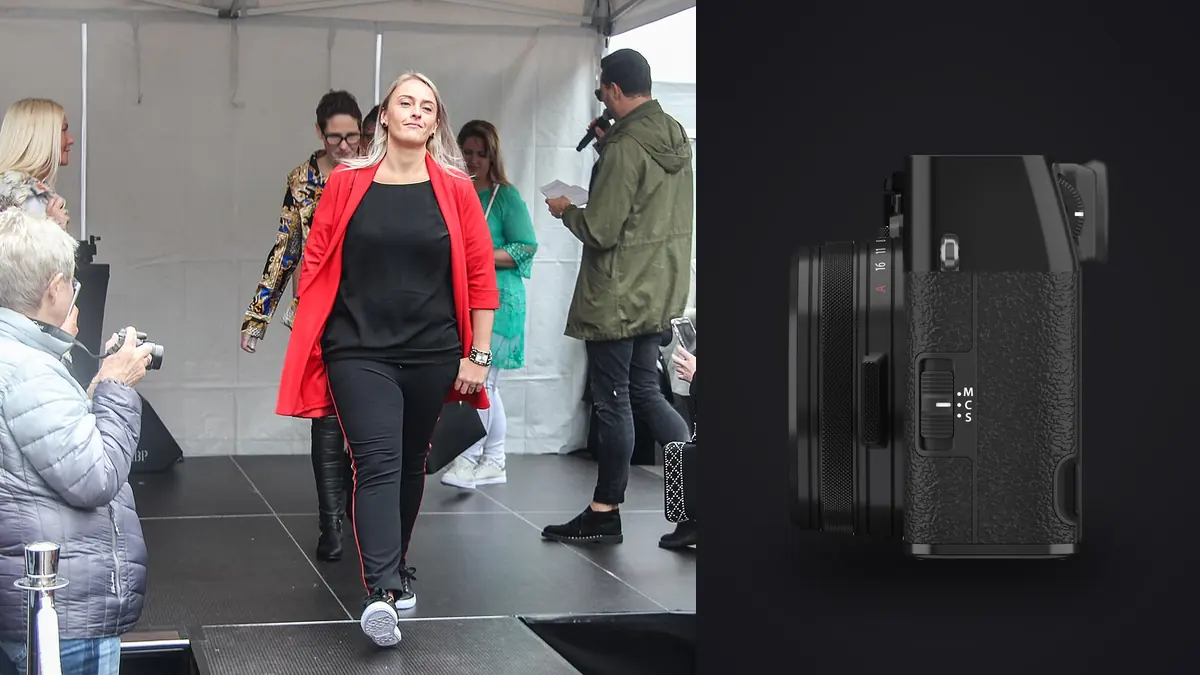
Picture pitching a client on shooting their spring lookbook with a fixed-lens compact instead of a full kit of zooms, and the art director pausing for a beat too long before saying "okay, walk me through that." Fair reaction. A lookbook has to deliver consistent, bookable images across a dozen or more looks, usually on a tight afternoon, usually with a client standing behind you checking the back of the camera. Bringing a single 35mm-equivalent prime to that job sounds like a way to make your life harder, not easier. Used well, though, I don't think it is. It changes how you shoot a lookbook, and some of those changes are genuinely useful.
The Fixed 35mm Equivalent: What It Actually Forces You to Do
The X100VI's 23mm f/2 lens (35mm full-frame equivalent) is the whole reason people either love or dismiss this camera for commercial work. On a lookbook, you're usually covering three shot types per look: a full-length hero, a three-quarter, and a detail or texture crop for fabric and stitching. With a zoom, you'd rack focal length for each. With the X100VI, you move your feet, and that discipline actually speeds up a shoot once you're used to it, because you stop pixel-hunting through a zoom range and start walking a fixed distance for each shot type you already know you need.
Where it gets genuinely limiting is tight editorial crops on set with no room to step back, cramped showroom fittings, or anything that wants a longer lens for compression on a full-body shot against a distant backdrop. In a narrow stairwell, 35mm equivalent can be too wide for the three-quarter shot and you may have to crop in post, which the 40.2MP sensor tolerates far better than the older 26MP X100 bodies did. That resolution buffer is what makes the fixed lens workable for commercial use in the first place; on the X100V you'd think twice about a 40% crop for a paying client, on the X100VI you needn't.
RAW Files: What the 40MP X-Trans Sensor Actually Gives You
The X100VI's 40.2MP APS-C X-Trans CMOS 5 HR sensor produces RAW files that run roughly 45-60MB uncompressed lossless, depending on scene detail, or closer to 25-35MB with lossy compression turned on. For a lookbook where you're shooting 15-30 frames per look across a dozen looks, that adds up fast. A full afternoon shoot with wardrobe changes routinely leaves me with 500-700 RAW files and north of 25GB on the card by wrap.
The color science out of this sensor at base ISO (125) is clean enough that skin tones on a lookbook rarely need heavy correction, which matters when a client wants same-day previews. Where you have to be careful is X-Trans's non-Bayer color filter array: some older RAW converters render slightly mushy fine detail on things like knit fabric or lace at 100% zoom, an artifact of the demosaicing algorithm rather than the sensor itself. Recent versions of Lightroom and Capture One have mostly closed that gap, but if a client is going to pixel-peep a wool coat's weave on a double-page spread, it's worth test-processing one file before committing to your usual RAW workflow.
Dynamic range is solid for outdoor lookbook work, roughly 12-13 stops usable at base ISO, enough to hold a bright sky and recover shadow detail on a model standing in open shade without stacking exposures. Past ISO 3200 you start losing that latitude and shadows get noisy fast, which matters for indoor showroom shoots under mixed tungsten and window light.
Leaf Shutter and Flash Sync: The Underrated Part for Studio Work
This is the feature that most changes how the X100VI fits into paid work. The leaf shutter syncs with strobes at every shutter speed up to 1/4000s, not just the 1/250s ceiling you get with a focal-plane shutter. On a studio lookbook against seamless, that means you can shoot wide open at f/2 with continuous studio strobes and still control ambient light with shutter speed alone, instead of stopping down to f/8 or f/11 just to stay under sync speed. For a lookbook where the client wants shallow depth of field separating the model from a plain background, that's a real advantage over most interchangeable-lens bodies without a leaf-shutter lens.
The built-in 4-stop ND filter compounds this outdoors. Shooting a lookbook at midday with the sun directly overhead, f/2 and a fast shutter speed alone won't get you under the exposure without blowing highlights; flip the ND filter on and you can hold a wide aperture in full sun without an external filter fumbled on and off between looks. It's a small thing that saves real minutes across a dozen wardrobe changes.
Handling It on a Moving Set
In-body stabilization rated to 6 stops matters more for a lookbook than you'd expect, not because you're shooting long exposures but because you're often walking backward, adjusting on the fly, and shooting handheld at slower shutter speeds indoors where you don't want to push ISO. It buys you clean frames at 1/30s that would otherwise be a coin flip.
The hybrid viewfinder is the other piece worth calling out specifically for directing a model. Switching to the electronic viewfinder lets you check exposure and film simulation preview in real time without chimping the rear screen between every frame, which keeps eye contact and momentum with the model instead of breaking the flow to check a screen. I default to EVF during active shooting and flip to the optical finder when I want a wider view of the set to time a walk or a turn.
Three Lookbook Scenarios, and What I Actually Shot Them At
| Scenario | Aperture | Shutter Speed | ND Filter | ISO | Frames per Look | Avg. RAW Size |
|---|---|---|---|---|---|---|
| Outdoor courtyard, midday sun, backlit | f/2 | 1/1000s | On (4-stop) | 125 | 18-24 | ~52MB |
| Studio, seamless backdrop, two strobes | f/2.8-f/4 | 1/250s | Off | 200 | 12-16 | ~48MB |
| Showroom, mixed window and tungsten, dusk | f/2 | 1/60-1/125s | Off | 1000-3200 | 28-35 | ~55MB |
The dusk showroom numbers are the ones that surprise people. Frame count goes up because at f/2 and slower shutter speeds you're shooting more attempts per look to land a sharp one, and that's exactly the scenario where a fast, reliable way to sort sharp frames from soft ones matters most after the fact.
Getting Through the Take Without Losing the Evening
Five hundred RAW files from one lookbook shoot is not unusual, and going through them one by one at 100% zoom to check focus on a model's eyes is the part of this job nobody enjoys. I run the day's card through imagic before I open anything in Lightroom. Its local sharpness and focus scoring flags which frame in a run of near-identical shots actually has the sharpest eyes, which is the single most useful thing a culling pass can do for fashion work where focus falls off fast at f/2 and a few centimeters of model sway changes which frame is usable. The duplicate and burst clustering handles the courtyard and dusk scenarios from the table above especially well, since those runs of 20-30 frames per look are exactly the kind of burst that's tedious to sort manually and easy for software to group.
Because it processes everything locally with no cloud upload, unreleased lookbook images (which are usually under an embargo until the client's own launch date) never leave your machine during the cull. That's not a small detail on commercial fashion work where the contract often has a confidentiality clause about pre-release imagery. If you're curious how the scoring and clustering actually work under the hood, I wrote more about that process in how AI photo culling works.
Matching Color Across a Full Day of Looks
Fujifilm's film simulations are genuinely useful straight out of camera for same-day client previews. It helps to shoot with a simulation like Reala Ace or Classic Neg baked into the JPEG preview so the client sees something close to final look on the tethered monitor, while the RAW file stays untouched for the real grade later. The problem with a full lookbook is consistency: a shoot that spans a courtyard scene at noon and a showroom scene at dusk can drift in color balance if you grade each batch separately, and a client comparing pages 4 and 14 of the same lookbook will notice if the whites don't match. I built a preset in imagic from the grade I do most often on X100VI files, using apply_my_style to train it on a set of my own past edits, and I run each batch through that before doing scene-specific tweaks. It doesn't replace judgment on the dusk shots that need individual attention, but it gets 80% of a shoot to a consistent baseline before I touch anything by hand, which is the part of a rushed delivery timeline that used to eat the most time. For the manual half of that process, our guide to color grading workflow covers the grading side in more depth.
Where This Camera Actually Falls Short for the Job
It's worth being honest about the limits, because a lookbook is paid work and a camera failure mid-shoot is a real cost. The X100VI has a single UHS-I card slot, and UHS-I write speeds mean the buffer can back up if you shoot long continuous bursts at the top of its 11fps mechanical rate. In practice I shoot short bursts of 3-5 frames rather than holding the shutter down, which fits fashion work fine since you're chasing a specific expression or pose rather than sports-style continuous action. Battery life is the other real constraint. I get roughly 300-350 shots per charge in mixed EVF/OVF use, which on a 500-700 frame lookbook day means carrying at least two spares and swapping mid-afternoon. And because the lens is fixed, there's no reaching for a longer focal length when a client wants a compressed, far-away hero shot; you may have to talk clients out of shots that would need an 85mm equivalent, or borrow a second body for that one setup. If your lookbooks regularly need that kind of compression, the X100VI works best as a second body alongside something with an interchangeable long lens, not as the only camera in the bag.
Frequently Asked Questions
Is the X100VI's fixed 35mm equivalent lens too limiting for a full lookbook shoot?
Not for the core shot list most lookbooks need (full-length, three-quarter, detail crop), since the 40.2MP sensor gives you enough resolution to crop in for a tighter framing after the fact. It does get limiting for compressed, long-lens hero shots or very cramped indoor spaces where you can't step back far enough, so plan those setups around the lens rather than expecting it to zoom out of a problem.
Can the leaf shutter really sync with studio strobes fast enough for commercial lighting setups?
Yes, up to 1/4000s, well beyond the 1/250s ceiling of a typical focal-plane shutter camera. That lets you shoot wide apertures with strobes without needing to gang up ND filters or stop down past where you want to be for shallow depth of field against a backdrop.
How well do the 40MP RAW files hold up for a printed lookbook or a double-page magazine spread?
Well, at base ISO. Files hold detail through moderate crops and print comfortably at large sizes given the resolution. The one caveat is X-Trans demosaicing on very fine repeating textures like tight knit fabric, which can look slightly soft at 100% in some RAW converters; worth a test file before committing your full workflow if fabric texture is a focal point of the campaign.
Do I need a second camera body for a paid lookbook shoot with the X100VI?
I'd recommend it, less because the camera is unreliable and more because a single UHS-I card slot and no interchangeable lens leave you exposed if a card fails or a client asks for a focal length the fixed lens can't deliver. A second body, even a modest one, is cheap insurance against losing a shoot day.