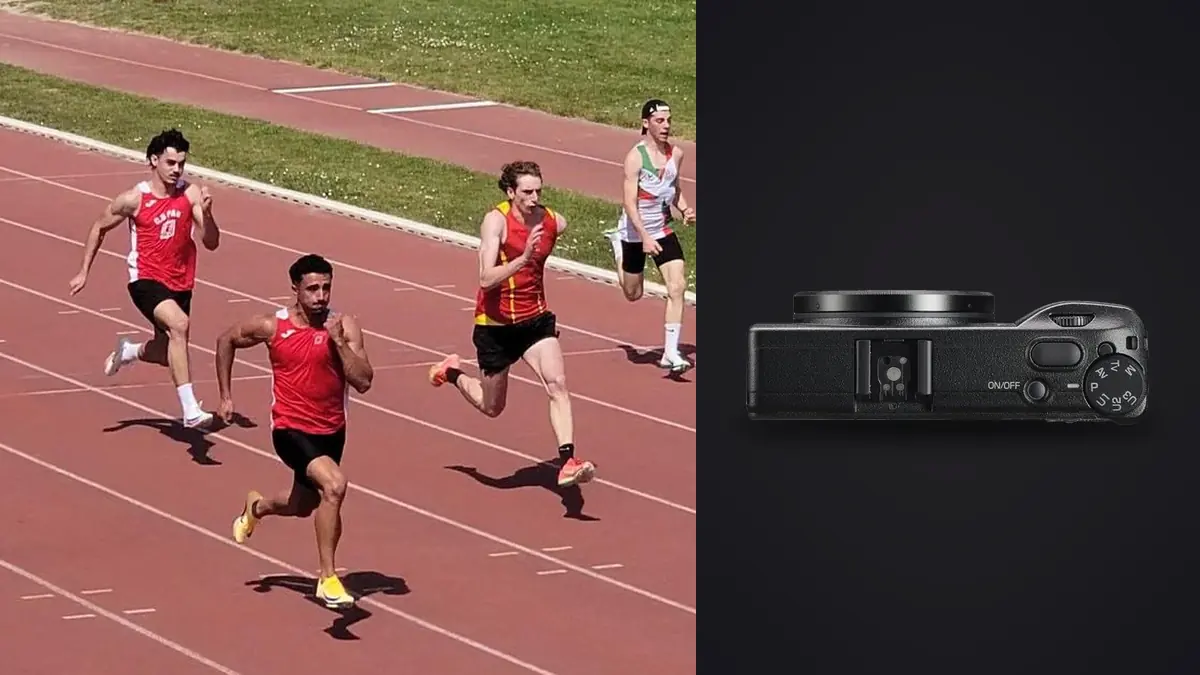
I did not buy the Ricoh GR IIIx to shoot sports. Nobody does. It is a 40mm-equivalent, fixed-lens, contrast-detect-only compact built for street work, and every review you will find treats "action photography" as something the camera tolerates rather than something it does well. But I spend a fair number of weekends at a local track club and a small cyclocross series, and after two seasons of bringing the GR IIIx along as a second body, I have a pretty specific opinion about where it earns its spot in the bag and where it flatly does not.
What you're actually working with
The GR IIIx pairs a 24.2MP APS-C sensor with a fixed 26.1mm lens, which works out to roughly 40mm in full-frame terms. That is a genuinely useful focal length for track and field, cyclocross, or skatepark work, but only if you accept the framing constraint that comes with it: there is no zoom ring, no teleconverter that actually helps, and the built-in digital crop modes (roughly 50mm and 71mm equivalent) just punch into the same 24 megapixels rather than adding real reach. At 71mm-equivalent crop you are down to something like 6 effective megapixels, which is fine for a web gallery and not fine for a print.
Autofocus is contrast-detect only. Ricoh never put phase-detect pixels on this sensor, and no firmware update has changed that. For static subjects it is fast enough that you stop noticing it. For anything moving toward or across the frame at speed, contrast-detect AF hunts, because it has to rack focus past the correct point to figure out which direction is "correct." That single fact shapes almost everything else in this article.
The shutter is worth understanding too, because it is a leaf shutter built into the lens rather than a focal-plane shutter in the body, and leaf shutters lose top speed as you stop down. Wide open at f/2.8 you can get up near 1/4000s. Stop down to f/8 for more depth of field on a panning shot and that ceiling drops hard, down into four-figure territory. On a bright afternoon at a track meet this matters: you cannot have maximum aperture-driven shutter speed and a forgiving depth of field at the same time on this body. Something gives, and on the GR IIIx it is usually depth of field, because a slightly soft background beats a subject that is simply out of focus.
Why autofocus tracking is the wrong plan here
My first few outings with this camera at the track were a mess, because I tried to use AF-C the way I would on a mirrorless camera with a long lens. Multi AF, tracking box, trust the camera. It does not work. By the time contrast-detect AF locks onto a runner closing distance at nine or ten meters per second, the runner has moved a meter or two past where the lens focused. You end up with a folder of frames that are almost sharp, which is the most annoying kind of miss because you cannot tell from the small LCD that you've missed until you're home looking at full-size files.
The fix is to stop asking the camera to focus at all. Ricoh's Snap Focus mode lets you assign a fixed focus distance to a button or to the shutter's half-press, choosing from presets like 1m, 1.5m, 2m, 3m, 5m and infinity, and combine that with the depth of field from a chosen aperture. This is old-fashioned zone focusing, the same technique press photographers used before autofocus existed, and it is the only approach that reliably works for fast action on this camera. You pick a spot the action will pass through, prefocus to that distance, and fire the instant your subject enters the zone. It sounds primitive next to eye-tracking AF on a modern mirrorless body, and it is, but it also never hunts, because there is nothing to hunt.
Setting it up before you need it
I keep Snap Focus mapped to the ADJ lever rather than buried in a menu, because reaching a submenu while a heat is lining up is how you miss the start. Before the first race or first flight of jumps, I walk to the spot I plan to shoot from, measure the distance to my intended focus zone by eye against the lens's distance scale in the viewfinder overlay, and dial that in. Then I check depth of field at my working aperture using the on-screen scale the camera shows in Snap Focus mode, which tells you the near and far edges of acceptable sharpness at that distance and aperture. If the zone is too thin, I stop down and accept whatever shutter speed the leaf shutter gives me at that aperture, then compensate with ISO rather than trying to open back up.
Matching settings to what you're actually shooting
The right combination changes a lot depending on the sport and how close you can physically get, which on a 40mm-equivalent lens is the real variable. Here's roughly what I run for the four situations I shoot most with this camera, based on where I can legally or practically stand relative to the action.
| Scenario | Working distance | Snap Focus preset | Aperture | Shutter target | Practical note |
|---|---|---|---|---|---|
| Track & field, home straight from the infield rail | 6-10m | 5m | f/5.6 | ~1/2000s | Depth of field at 5m/f5.6 covers most of the lane width; ISO auto handles exposure swings |
| Cyclocross corner or barrier run-up | 3-5m | 3m | f/8 | ~1/1250s | Riders slow through corners, so the shutter ceiling drop at f/8 is less of a problem here |
| Skatepark bowl edge or street ledge | 2-4m | 2.5m | f/5.6 | ~1/1600s | Snap distance needs re-checking between spots since skaters move around the park |
| Indoor roller derby, apron or infield | 4-7m | 4m | f/4 | ~1/800s | Rink lighting forces ISO up regardless; wider aperture buys back the shutter speed |
None of these numbers are gospel. Track lighting, the specific venue, and how tight the action packs into your frame will shift them. But they're the starting points I actually dial in before the first heat, rather than something I discover by chimping through a ruined burst.
Burst shooting has a ceiling, and it's lower than you think
The GR IIIx's continuous H mode runs at roughly 4 frames per second, which already puts it well behind anything marketed as a sports camera. The bigger issue is the buffer. Shooting RAW, I get somewhere around four to six frames before the camera slows down and starts eating a second or more between shots while it clears data to the card. JPEG buffers deeper because the files compress smaller, but even then a long burst through a full skate run or a whole home straight will outrun it.
What this means practically is that spraying and praying is a bad strategy on this camera. I shoot short, deliberate bursts of three or four frames timed around the moment I actually want (the foot planting on a jump takeoff, the bike leaning into a corner apex) rather than holding the shutter down from the moment action starts. It forces better anticipation, which is not a bad habit to build even on cameras with deeper buffers, but it is not optional here the way it is elsewhere.
Where the 40mm frame actually works in your favor
Everything above sounds like a list of reasons not to bring this camera to a track meet, and if your goal is a tack-sharp 400mm shot of a sprinter's face at the finish line, it is the wrong tool, full stop. Bring a long lens on a body with real subject tracking for that. But the GR IIIx is genuinely good at a category of shot that longer glass makes awkward: the close, environmental, storytelling frame. Hands taping up before a race. A coach's reaction from three meters away. The moment a rider dismounts and runs a barrier at a cyclocross course, close enough that a 300mm lens would be cropping air around them. A skater's face right as the trick lands, shot from inside the bowl where a tripod-mounted supertelephoto simply cannot go because there's no room and no time to set it up.
The small size matters here too, separate from the optics. I can carry the GR IIIx clipped to a strap across my chest all day at a cyclocross race and still climb over tape, jog between vantage points, and get low without the fatigue or the bulk of a gripped body with a 70-200mm hanging off it. For events where I'm also shooting with a longer lens on a second body, the GR IIIx is what comes out for the shots the long lens physically can't get.
A real Saturday: shooting a local cyclocross round
Last month's race is a fair example of how this actually plays out. I worked one sandy corner and one barrier section for most of the morning, moved to the finish straight for the last two categories, and came home with just under 900 frames off the GR IIIx alone, on top of what I shot with a longer lens elsewhere. A meaningful chunk of that total was near-duplicate frames from short bursts at the barrier, riders dismounting in almost the same position across three or four consecutive shots, plus a run of test frames I fired while re-checking the Snap Focus distance every time I moved spots.
That kind of file count from a single lens is exactly the situation where I lean on imagic afterward instead of scrolling through everything at full size in Lightroom. It runs the sharpness and focus scoring locally, so it flags which frame in each barrier-dismount burst actually landed the zone focus and which ones drifted a few centimeters outside the depth of field (a difference that is genuinely hard to see at thumbnail size but obvious once you're picking a hero shot). It also groups the near-duplicate frames from those short bursts automatically, so I'm choosing between three grouped options instead of scrubbing past all 900 files one at a time. Because it processes everything on the machine rather than uploading to a cloud queue, I can do this culling pass in the car in the venue parking lot with no signal, which at a lot of the courses I shoot is the only option anyway.
What happens after culling
Once I've got a shortlist, editing a batch of trackside or course-side frames shot on the same body, in roughly the same light, at roughly the same aperture, is fairly repetitive work: similar white balance corrections, similar contrast and clarity moves to make the action pop against a busy background. This is the other place imagic earns its keep for this kind of shoot. I trained its apply_my_style preset on a set of my own previously edited race photos, and running a fresh batch through it gets me most of the way to a finished look in one pass, rather than rebuilding the same adjustments frame by frame. I still hand-finish the shots I'm actually going to publish or hand to a rider, but the bulk pass alone saves the better part of an evening after a full day of shooting.
If you're weighing tools for this kind of high-volume, single-session culling generally rather than specifically for a GR IIIx workflow, the breakdown in how AI photo culling actually works covers the sharpness-scoring approach in more depth, and the workflow habits in 10 tips for a faster photo workflow apply just as well to a day of zone-focused bursts as they do to any other high-volume shoot.
Is it worth carrying to your next event
If you already own a GR IIIx for street or travel work and you're wondering whether to bring it to a race, meet, or skate session: bring it, but as a second camera, not your primary tool. Set up Snap Focus before the action starts, accept that you're working a fixed 40mm-equivalent frame rather than reaching for anything, and shoot short deliberate bursts instead of long sprays that will outrun the buffer anyway. If you don't already own one and you're shopping specifically for sports and action work, this is not the camera to buy for that job. Its real strength (a small, quiet, genuinely pocketable body with a sharp lens) is built around a completely different kind of photography, and action work is something it can be bent toward for specific close-in shots, not something it was designed to do.
Frequently Asked Questions
Can the Ricoh GR IIIx autofocus fast enough to track a runner or cyclist?
Not reliably. It uses contrast-detect autofocus with no phase-detect assistance, so continuous AF on a subject closing distance quickly tends to lag behind by the time it locks. Zone focusing with Snap Focus, prefocusing to a fixed distance and firing when the subject reaches it, is far more consistent for fast action than trusting AF-C.
Is 40mm-equivalent a usable focal length for track and field or cyclocross?
It's usable if you can get physically close, which is possible at most local meets and grassroots race series where you can shoot from the infield rail, a corner, or a barrier section. It is not usable for shooting from bleachers or a fenced-off spectator area far from the action; there's no zoom to compensate for that distance, and the built-in digital crop modes cost you resolution rather than adding real reach.
How many continuous shots can the GR IIIx actually capture before slowing down?
In RAW, expect the buffer to hold roughly four to six frames at the camera's continuous H rate before it slows noticeably while it writes to the card. JPEG buffers somewhat deeper because the files are smaller. Either way, it's built for short deliberate bursts around a specific moment rather than long sprays through an entire play or run.
Does the leaf shutter actually limit shutter speed at smaller apertures?
Yes. Because focus and shutter live together in the lens rather than as a separate focal-plane shutter in the body, the maximum shutter speed drops as you stop down. You get the fastest ceiling wide open around f/2.8 and progressively less as you close the aperture, which is worth factoring in before you pick f/8 or f/11 for extra depth of field on a bright day.