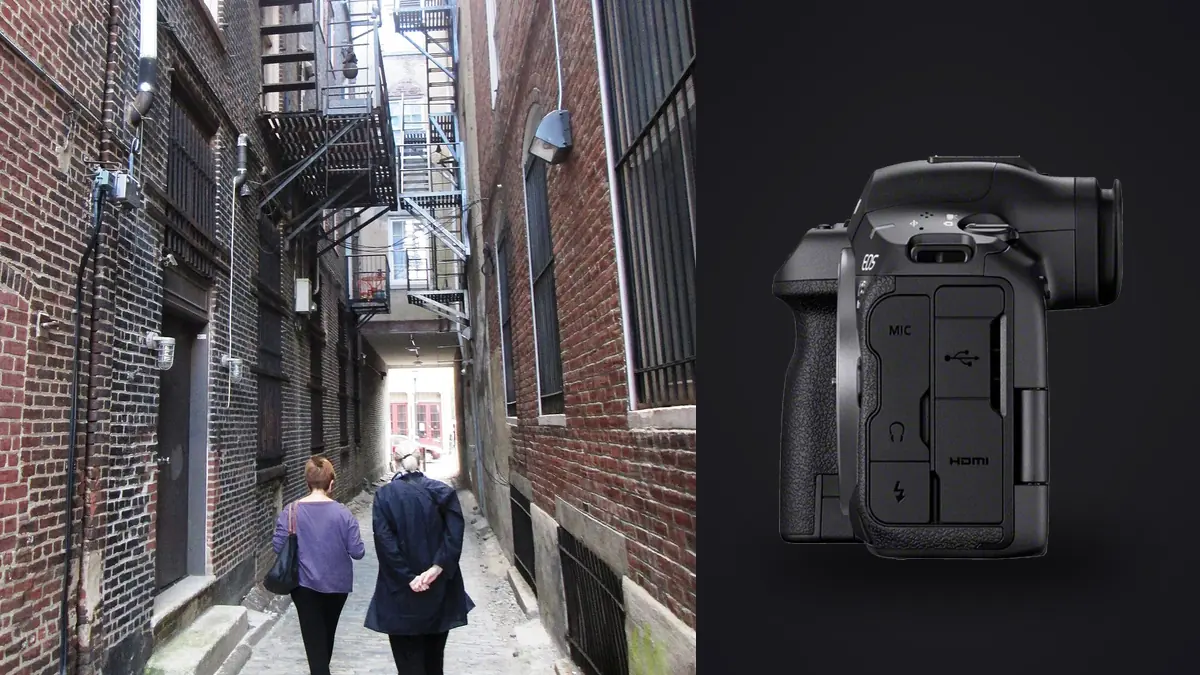
I spent about four months shooting a documentary project on a fish market and the surrounding neighborhood with a Canon EOS R5 Mark II as my only body, after years of running a Fujifilm rangefinder-style setup for the same kind of work. Switching to a full-frame, 45-megapixel, stacked-sensor camera for street and documentary shooting felt like the wrong tool on paper. In practice it changed how I work more than any camera upgrade I've made in a decade, for reasons that have almost nothing to do with the marketing copy.
This isn't a spec sheet regurgitation. It's what actually matters when you're following a fishmonger through a crowded stall, or standing on a corner for forty minutes waiting for someone to walk into a frame you've already composed.
The shutter is the whole story for candid work
Canon redesigned the shutter mechanism on the R5 Mark II specifically to cut down on shutter shock and vibration, and that engineering choice matters more for documentary shooters than the resolution bump does. The mechanical shutter tops out around 12 fps and it's noticeably quieter and softer in feel than the original R5's shutter, which had a distinct clack that carried in a quiet room. In electronic first-curtain mode it's close to silent, and full electronic shutter (up to roughly 30 fps) is dead silent, no rolling shutter drama in most street situations unless you're panning fast across something with hard vertical lines like a chain-link fence or a passing bus with lettering.
For street work, silent electronic shooting is the single biggest reason to consider this camera over an older-generation body. I shot an entire wake for a documentary piece without a single person turning toward the sound of my camera, something that would have been impossible with my old DSLR. The tradeoff is that electronic shutter under certain LED or fluorescent lighting (subway platforms, some market stalls) can introduce banding, so I keep mechanical shutter as a fallback for indoor scenes with sketchy lighting rather than assuming electronic-only is always the safer choice.
Autofocus in chaos, not in a studio
Canon's subject detection on this body has gotten good enough that I mostly leave it on "people" priority and stop thinking about it, which is exactly what you want when you're reacting to a scene rather than composing it. Eye detection holds through partial occlusion better than I expected, someone's face half-blocked by a shoulder in a crowd, or a kid running behind a market stall, and it recovers fast when the subject re-emerges. It is noticeably worse with sunglasses and with faces turned more than about three-quarters away, which happens constantly in street work since people don't pose for you.
Eye Control AF, the feature that lets the camera track where you're looking through the viewfinder and shift focus there, is one of those features reviewers either love or dismiss, and my experience lands in between. It works well once calibrated properly and it's genuinely useful for compositions where your subject isn't dead center, but recalibrating every time you put on or take off glasses (I wear readers for close menu work) gets old fast. I use it maybe 30% of the time and rely on standard subject tracking with a small focus zone the rest.
Pre-capture, Canon's raw burst mode that buffers frames before you fully press the shutter, is more useful for street photography than I expected going in. It's saved me on unrepeatable moments, a pigeon taking off at the exact second a cyclist crossed the frame, more than once. The catch is that it eats buffer and card space fast, so I only trigger it for scenes I can see building rather than leaving it on constantly.
Size, weight, and the discretion problem
At around 746 grams body-only, the R5 Mark II is not a discreet camera in the way a Fujifilm X100 series or a Leica Q is discreet. Paired with the RF 35mm f/1.4 or the 28-70mm f/2, you're carrying a rig that reads as "photographer with real gear" to anyone paying attention. For documentary access work where you've already been granted permission and people know you're there, this doesn't matter. For pure candid street photography where you want to disappear into a crowd, it's a real disadvantage compared to smaller mirrorless bodies or rangefinders, and no amount of silent shutter fixes that.
What the size buys you is weather sealing that held up through a full afternoon of on-and-off rain at a market without a rain cover, and a grip substantial enough to shoot one-handed for long stretches while holding a notebook or a release form in the other hand. That's a real consideration on documentary assignments where you're also managing subjects, not just shooting.
How the R5 Mark II compares for this specific kind of work
I get asked constantly whether it's worth the jump from an R6 Mark II or whether a rangefinder-style body would serve documentary work better. Here's how I'd actually lay it out, based on cameras I've shot with on real assignments rather than specs alone.
| Camera | Shutter sound (electronic) | Raw buffer at high fps | Body weight | Best fit for street/doc work |
|---|---|---|---|---|
| Canon EOS R5 Mark II | Silent | ~200+ frames (CFexpress) | ~746g | Access-based documentary, fast-moving action, low light |
| Canon EOS R6 Mark II | Silent | ~75 raw frames | ~670g | Budget-conscious documentary shooters, lighter carry |
| Fujifilm X100VI | Silent (leaf shutter) | ~15-20 raw frames | ~478g | Pure candid street, one-lens discipline, travel |
| Leica Q3 | Near-silent (leaf shutter) | ~15 raw frames | ~743g | Slow, deliberate street work, high image quality per shot |
| Sony a7CR | Silent | ~40+ raw frames | ~515g | Solo travel documentary, compact full-frame |
The buffer numbers are the part people underestimate. On a fast-moving documentary scene, a protest, a parade, an argument breaking out at a market stall, the R5 Mark II's buffer means you can hold the trigger down through the whole sequence without the camera locking up mid-scene the way a shallower buffer will. That capability comes at a direct cost, though, which is the next problem.
The lens question nobody answers honestly
For documentary and street work I settled on two lenses after trying most of Canon's RF lineup: the RF 35mm f/1.4 as my primary, and the RF 24-70mm f/2.8 for assignment days where I don't know what I'll need. The 35mm stays on the camera for probably 80% of my shooting, it's close enough to how I see a scene that I stopped thinking about focal length entirely, which is the whole point of a documentary prime.
If you're coming from Canon's EF system with a bag of older L-series glass, the adapter works fine and autofocus performance barely suffers, but you lose the weight savings that's part of the appeal of a mirrorless system in the first place. I'd rather buy into RF glass gradually than carry an adapted 24-70mm f/2.8 EF lens that weighs about as much as the body it's attached to.
A note on the 28-70mm f/2
Canon's RF 28-70mm f/2 gets recommended constantly for documentary work because of the constant f/2 aperture, and it is genuinely excellent optically. I sold mine after three months. It weighs close to a kilogram on its own, and for handheld, all-day street and documentary shooting, that weight changes how you move through a scene. You start avoiding shots that require raising the camera quickly because your arm is tired. A lighter prime that forces you to move your feet instead of zooming produced better work for me, but that's a personal call, not a universal one.
What 45 megapixels actually does to your workflow
Here's the part that doesn't show up in gear reviews: shooting a stacked-sensor, 45-megapixel body at up to 30 fps for a full day of street work generates an absurd number of files. A single afternoon at the market produced over 3,000 frames, most of them near-duplicate bursts of the same three seconds of action, chasing the one frame where the composition, the gesture, and the focus all land together.
That volume is exactly the problem I built my culling process around, and it's why I run everything through imagic before I open a single frame in an editor. The duplicate and burst clustering groups those chase sequences automatically so I'm not scrolling through forty nearly identical frames of the same handshake or the same kid jumping off a curb, and the local sharpness scoring catches the frames where eye detection technically locked on but a hand or a passing shoulder caused motion blur that's easy to miss at thumbnail size on a laptop screen at 2am. Because it runs entirely offline, I can cull a day's documentary shoot on a train home without uploading anything, which matters when some of what you've photographed involves people who haven't seen a release form yet.
If you're new to culling workflows generally rather than just this camera, how AI photo culling works is a reasonable starting point before you're staring down a 3,000-frame folder for the first time.
Keeping a documentary series visually consistent
The other workflow problem specific to long-form documentary work, as opposed to one-off street shooting, is keeping the edit consistent across weeks or months of shooting in wildly different light. The fish market at 6am under fluorescent stall lighting looks nothing like the same market at noon in open sun, and if every session gets edited from scratch you end up with a series that doesn't read as one body of work. I built a set of reference edits early in the project and used imagic's apply_my_style feature, which trains on your own past edits rather than a generic preset, to carry that look across the rest of the shoot as a starting point. It's not a substitute for actually looking at each frame, skin tones under market fluorescents still need individual attention, but it cuts the baseline grading work down enough that I'm not starting from zero on session two hundred. For anyone trying to speed up the back half of a shoot without flattening every frame the same way, 10 tips for a faster photo workflow covers the surrounding habits that make this actually work.
Battery life and cards, the unglamorous part
One CFexpress Type B slot and one UHS-II SD slot is the right call for this camera, but it means you're paying CFexpress prices if you want to use the full burst and buffer capability, and a slow SD card in the second slot will bottleneck you if you're recording to both simultaneously. I run CFexpress as primary and SD as backup rather than trying to split raw and jpeg across both, since jpeg backups aren't much use for documentary work where you want full raw flexibility later.
Battery life sits around 340-500 shots per charge depending on how much electronic shutter and video you're mixing in, which in real terms meant carrying two spare batteries for a full documentary day and never running dry, but I wouldn't push it to a third day of travel shooting without a charger.
Frequently Asked Questions
Is the R5 Mark II too loud or conspicuous for candid street photography?
The electronic shutter is silent, so sound isn't the issue. Size and presence are. It's a full-frame body that reads as serious camera gear to anyone who notices it, which matters less on documentary assignments with prior access and more on pure candid street work where blending in is the goal. A smaller body will get you closer to invisible.
Do I need the RF 28-70mm f/2 or is a prime lens better for this kind of work?
For all-day handheld street and documentary shooting, I'd lean prime. The 28-70mm f/2 is optically excellent but the weight adds up over a long shooting day in a way that changes your shooting behavior. A 35mm or 28mm prime keeps the kit light enough that you're not avoiding shots out of arm fatigue.
Is 45 megapixels overkill for street and documentary photography files?
For the final image, often yes, most documentary work doesn't need that much resolution unless you're printing large or cropping aggressively. The real cost is on the back end: bigger files, longer culling sessions, and more storage per shoot. It's worth it for the cropping flexibility on candid work where you can't always get close, but budget your workflow time accordingly.
How reliable is Eye Control AF for people wearing sunglasses or moving quickly?
Noticeably less reliable. Eye Control AF depends on tracking your own eye through the viewfinder, and if you're wearing sunglasses, readers you swap in and out, or shooting fast and re-framing constantly, recalibration becomes a hassle. I use it selectively rather than as a default, and rely on standard subject tracking for the bulk of fast-moving street scenes.