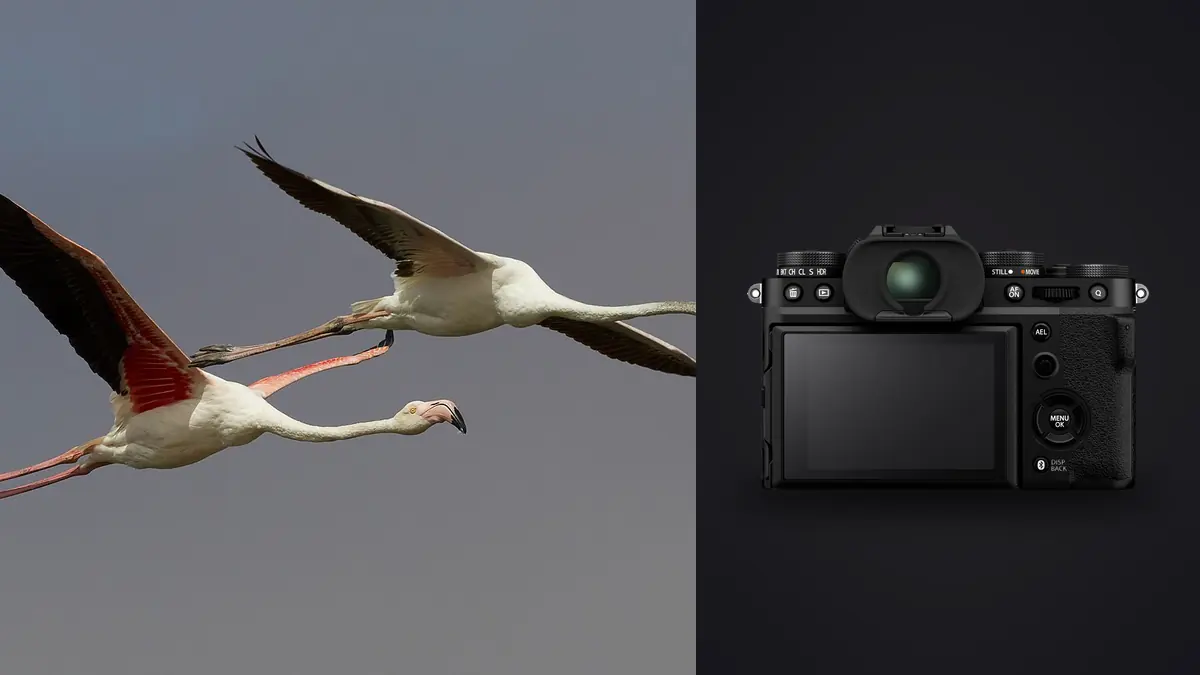
The Fujifilm X-T5 was never marketed as a wildlife camera. Fuji built it around resolution and stills quality first, and most of the launch coverage focused on the 40.2-megapixel sensor and the retro three-dial layout rather than anything to do with tracking a peregrine falcon. Even so, a lot of bird photographers have picked one up anyway, mostly because the body costs meaningfully less than a stacked-sensor sports camera and the APS-C crop factor stretches a 600mm lens into something close to 900mm equivalent without adding weight. After a season shooting herons, ospreys and a genuinely uncooperative kingfisher at a local wetland, the picture that emerges is mixed: capable in some conditions, frustrating in others, and worth understanding in detail before you plan a season of birding trips around it.
A 40-Megapixel Sensor Cuts Both Ways for Flight Shots
The X-Trans CMOS 5 HR sensor is the headline feature, and for perched birds or static portraits it is genuinely excellent: the extra resolution means you can crop a distant bird by 30 or 40 percent and still print it. For birds in flight, though, that same sensor becomes the source of the camera's two biggest limitations. First, 40 megapixels means large files (compressed raw runs 40 to 55MB per frame in my experience, more for busy feather detail against a bright sky), which fills a card fast when you're firing bursts at a swooping tern. Second, and more importantly, a 40MP sensor without stacked, back-side readout circuitry takes longer to scan line by line than a lower-resolution stacked sensor does. That readout speed is the real story behind almost everything else in this article: the shutter mode you pick, the buffer depth you get, and how much rolling shutter distortion shows up in a bird's wingtip mid-flap.
None of this makes the X-T5 a bad wildlife camera. It makes it a camera where shutter mode selection matters more than it would on something like an X-H2S, which uses a stacked sensor built specifically to read out fast. On the X-T5 you're managing a genuine trade-off every time you go out, not just picking a default and forgetting about it.
Choosing a Shutter Mode When the Bird Won't Wait
The X-T5 gives you three practical options for birds in flight, and each one trades speed, buffer depth and image integrity differently. The mechanical shutter tops out at 15fps with no crop and no rolling shutter risk at all, but the buffer is shallow, roughly 19 to 20 uncompressed raw frames before the camera slows down, which is a little over a second of full-speed shooting. Switch to the electronic shutter at full sensor resolution and you get 13fps with a similarly shallow uncompressed buffer, plus a slower readout that shows up as skew or a slight "jello" warp on fast wingbeats or a bird crossing the frame quickly. Add the 1.29x digital crop and the electronic shutter jumps to 20fps with a noticeably deeper buffer (Fuji rates it around 22 to 23 uncompressed raw frames, and considerably more in lossless compressed or standard compressed raw), at the cost of a smaller 24-megapixel file and the same rolling shutter risk as the uncompressed mode.
| Shutter Mode | Max FPS | Effective Reach with a 150-600mm Lens | Approx. Uncompressed RAW Buffer | Rolling Shutter Risk | Best For |
|---|---|---|---|---|---|
| Mechanical | 15fps | ~229-914mm equiv. | ~19-20 frames | None | Perched birds, slower flight, clean wingtips |
| Electronic, full sensor | 13fps | ~229-914mm equiv. | ~19-20 frames | Moderate on fast wingbeats | Silent shooting near nests or blinds |
| Electronic, 1.29x crop | 20fps | ~296-1,179mm equiv. | ~22-23 frames | Moderate to high | Fast, erratic flight where you need reach and rate |
In practice I default to mechanical for anything perched or slow (herons stalking, gulls gliding on a thermal) and switch to the 1.29x crop electronic mode the moment something like a swallow starts working a pond. The extra reach matters as much as the frame rate there; a bird that's already small in the frame benefits from both the longer effective focal length and the higher capture rate, and 24 megapixels is still plenty for a web gallery or a modest print. What I avoid is the 13fps full-sensor electronic mode for actual flight work. It gives up frame rate compared to mechanical without buying back enough buffer depth or reach to justify the rolling shutter risk; I only reach for it when I need silence near a nest and the subject isn't moving fast.
Bird Detection AF: Useful, Not Magic
Fujifilm added Bird as a dedicated subject-detection category in a firmware update, and it does what it says on the perched shots and against clean sky: it finds the eye reliably and holds it through moderate movement. Where it struggles is exactly where you'd expect any camera's subject detection to struggle, a bird crossing in front of a busy reed bed, backlighting from a low morning sun, or a small subject like a warbler that's more silhouette than shape against foliage. In those situations I've had more consistent results switching to a single, smaller AF zone and tracking manually rather than trusting Bird detection to pick the right blob out of a cluttered background.
The other thing worth knowing: subject detection AF combined with 20fps electronic shooting is genuinely demanding on the processor, and I've noticed the camera occasionally lags a frame or two behind a fast direction change, a heron suddenly banking hard, for example. It's not a dealbreaker, but it means you can't treat 20fps burst mode as a substitute for good anticipation and panning technique. The camera helps; it doesn't do the tracking for you the way a dedicated stacked-sensor body increasingly can.
Lens Choices That Match What the Body Can Actually Do
Two Fujinon telephotos cover most of the practical range for this body. The XF 100-400mm f/4.5-5.6 R LM OIS WR (152-609mm full-frame equivalent) weighs 1,375g and runs around $1,900; it's the lighter, more all-purpose choice and the one I'd hand to someone shooting birds alongside other subjects on the same trip. The XF 150-600mm f/5.6-8 R LM OIS WR (roughly 229-914mm equivalent) weighs 1,605g, costs around $2,000, and gives up a stop or more of maximum aperture at the long end in exchange for genuinely useful extra reach for small, distant birds. Both take Fuji's 1.4x and 2x teleconverters, which push the 150-600mm out to 840mm or 1,200mm native (well over a full-frame-equivalent 1,200mm and 1,800mm respectively with the crop factor), but the resulting f/11 to f/16 maximum aperture slows autofocus noticeably, especially at dawn or dusk when a lot of bird activity actually happens. I use the 1.4x teleconverter on the 150-600mm for genuinely distant subjects in good light and leave it in the bag otherwise.
Both lenses carry weather sealing rated to work down to -10°C, which matches the X-T5's own sealing and matters more than people expect if you shoot dawn sessions in damp or frosty conditions. In-body stabilization on the X-T5 is rated to 7 stops, which helps handheld work with the 100-400mm at moderate shutter speeds, though for genuine birds-in-flight work you want a fast shutter speed regardless (1/2000s or faster for anything with quick wingbeats) so the stabilization matters more for framing steadiness than for freezing motion.
What a Full Day of Bursts Does to Your Card, and Your Evening
A single morning at the wetland with the crop-mode electronic shutter, chasing terns and the occasional kingfisher dive, can easily produce 2,000 to 3,000 frames. At 40 megapixels (or 24 in crop mode), that's a serious amount of data to sort through, and the vast majority of it is either a duplicate of the frame next to it or technically soft because the bird moved faster than the AF system could react. This is where the shutter speed you need for wildlife (fast, to freeze wingbeats) works against you afterward: a 15-frame burst of a heron taking off contains maybe two frames with genuinely sharp eye focus, and finding them by eye on a laptop screen after a long day is slow and easy to get wrong.
This is the part of the workflow where imagic actually earns its keep for me. Because it clusters burst and near-duplicate frames locally and scores sharpness and focus on the actual pixels rather than a thumbnail, I can point it at a folder of 2,500 raw files from a morning shoot and get back the handful of frames per burst that are actually in focus on the eye, without dragging every card's worth of images to a cloud service first. That matters for two practical reasons: bird photography often happens somewhere with no signal worth mentioning, and a card full of 40MP raw files is not something you want to upload before you can even start culling. Everything runs on the laptop I bring into the field, and the files never leave the drive.
Once the culling pass is done, I lean on imagic's apply_my_style feature for the color pass, since I trained it on a batch of my own previously edited wetland shots and it now applies a consistent, recognisable look across a season's worth of images in one pass rather than me manually matching white balance and contrast across dozens of different lighting conditions from a single outing. It's a smaller win than the culling stage but it adds up over a season of shoots.
Handling in the Field: Cold Mornings, Wet Blinds, Awkward Angles
Birding often means low-angle shooting, crouched at a nest box or shooting from a floating hide close to water level, and the X-T5's three-way tilting screen (up, down and out to the side for portrait orientation) covers most of those positions without needing to lie flat in the mud, though it's not a fully articulating screen and won't flip forward. The body itself is small and light at 557g, which matters after a few hours holding a 1.6kg lens up at a heron that refuses to do anything interesting. Weather sealing has held up through drizzle and a couple of genuinely cold mornings well below freezing without issue, which is more than I can say for some older bodies I've used.
One practical note: the smaller grip that comes with the compact body style is noticeably less comfortable than a deeper grip once you're supporting a 1.4kg-plus lens for an extended handheld session. An L-bracket or a monopod takes the edge off a long morning far more than any camera setting will.
Battery Life for a Dawn-to-Dusk Session
The NP-W235 battery is CIPA-rated at 580 shots per charge in normal mode, or 740 in Economy mode, and in practice that number drops noticeably once you're firing 15 to 20-frame bursts on a bird that keeps almost-but-not-quite launching. A single spare battery has been enough for a full dawn-to-midday session for me, but anyone planning a genuine dawn-to-dusk day, especially in cold weather, which drains batteries faster regardless of camera brand, should carry at least two spares rather than relying on a single top-up.
Frequently Asked Questions
Is the Fujifilm X-T5 fast enough for birds in flight?
Yes for most flight photography, with the caveat that its shallow buffer means you can't hold down the shutter indefinitely the way you can on a stacked-sensor body. Short, deliberate bursts timed to wing position work better than spraying continuously through an entire flight pass.
Should I buy the XF 100-400mm or the XF 150-600mm for the X-T5?
If you shoot birds almost exclusively and mostly at distance, the 150-600mm's extra reach is worth the smaller aperture and higher price. If wildlife is one subject among several you shoot, the lighter, faster 100-400mm is more versatile and easier to hand-hold for a full day.
Does the 1.29x crop mode hurt image quality noticeably?
The resulting files drop from 40 to about 24 megapixels, which is still enough for most prints and any web use. For a distant, fast-moving bird, the extra reach and frame rate the crop mode buys you generally matters more than the resolution you give up.
How many keeper frames should I expect from a burst of a bird taking flight?
In my experience, roughly one in five to one in eight frames from a 15 to 20fps burst has genuinely sharp eye focus once the bird is moving fast, which is exactly the kind of ratio that makes a fast culling pass worth building into your workflow rather than reviewing every frame by eye.
The X-T5 isn't the easiest camera to shoot birds in flight with, but it's a genuinely capable one once you understand where its sensor readout speed limits you and plan your shutter mode and lens choice around that instead of fighting it. If you want to see how a local, sharpness-aware culling pass handles a real burst-heavy wildlife folder, how AI photo culling actually works is a reasonable next read, and imagic's pricing page lays out the one-time purchase options if you decide to try it on your own card dump.