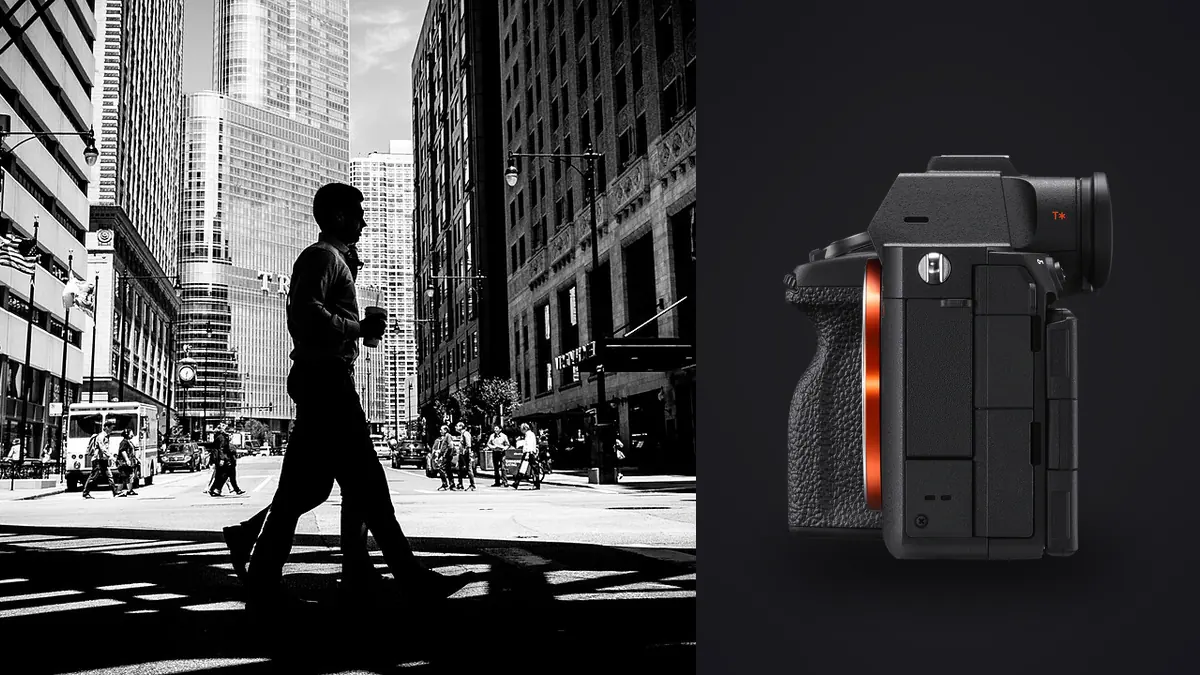
I didn't buy the Sony A7R V for street work. I bought it for architecture shots that needed pixel-shift files, and it sat in my bag for three months before I ever pointed it at a stranger. When I finally did, on a humid evening at a night market outside Chiang Mai, I expected to hate it. A 61-megapixel resolution monster with a grip built for landscape tripods didn't sound like a street camera. It ended up staying in rotation for eighteen months of documentary work anyway, and I want to walk through why, plus the specific ways it fights you if you're used to something smaller.
Why a resolution monster ends up in a street bag at all
The instinct is to assume more megapixels means more camera to carry and more friction on the street, and that's partly true. But the A7R V's 60.2MP BSI sensor buys you something documentary shooters actually use: crop room after the fact. A lot of decisive-moment photography happens at 28mm or 35mm because that's the focal length you can react fast with, and then you crop to a tighter composition once you see what actually happened in the frame. On a 24MP body that crop costs you print quality. On the A7R V you can punch in 40% and still have a file that holds up in a photobook or a gallery print. I've reframed more "almost" shots into keepers with this sensor than with any camera I've owned, simply because there was enough resolution left after cropping out a stray elbow or a badly placed sign.
The weight tax nobody mentions in spec sheets
Body weight is 723g, and once you put a 35mm f/1.4 GM on it you're carrying close to 1.2kg around your neck for eight or ten hours. That's not dramatic on paper, but by hour six of a documentary shoot following someone through their workday, the difference between this and a Fuji X100VI (521g, fixed lens) is real. My neck knows the difference. I've switched to a wrist strap and a sling bag specifically because of this camera, and I'd be lying if I said the size and heft never cost me a shot. Twice I've hesitated raising the camera in a tense moment because it reads as "serious photographer with serious camera" rather than "person with a small thing." That hesitation matters more in documentary work than most gear reviews admit.
Autofocus is the one upgrade that actually changes how you shoot
The A7R IV's autofocus was good but occasionally stubborn on erratic human subjects, especially in low light. The A7R V's dedicated AI processing unit is a genuinely different experience. It's not just "better eye AF," it's better at understanding what a body is doing even when the face is turned away or half-obscured by a market stall. I shoot mostly in Tracking: Expand Flexible Spot with human pose/body priority, and I let it hold focus through partial occlusions, like a subject stepping behind a pole for half a second, without hunting. That's the difference between catching the moment when they re-emerge and missing it because the lens racked to the background. For pure documentary sequences, where you're following someone doing something repetitive (a fisherman mending nets, a tailor cutting fabric), the AF holds onto the same subject across dozens of frames without you touching a focus point. That reliability is worth more to me day to day than the resolution bump.
Silence, shutter behavior, and not getting made
Fully electronic shutter with zero sound is available, and I use it constantly for anything involving religious ceremonies, funerals, or crowded interiors where a mechanical clack draws eyes. The tradeoff is rolling shutter. This isn't a stacked sensor like the A9 series, so panning with a fast-moving subject (a motorbike weaving through traffic, a kid on a bike) under electronic shutter will skew straight lines into a slight parallelogram. I learned this the annoying way on a scooter-heavy street in Hanoi where every panning shot came back with visibly bent wheel spokes. My workaround now is simple: electronic shutter for anything static or slow, mechanical shutter the instant something starts moving fast laterally across the frame. It's one more decision to make mid-shoot, which is the opposite of what you want in a street camera, but it's manageable once it's a habit.
Rolling shutter in practice
To put a number on it: readout speed on the A7R V's electronic shutter is noticeably slower than a stacked sensor, roughly in the range where fast horizontal motion at 1/500s or faster starts showing skew. It's not a dealbreaker, it's a known limitation you plan around, the same way you'd plan around a fixed 28mm lens on a Leica Q3.
The file size problem nobody warns you about
A single compressed RAW off this sensor runs 60 to 90MB depending on scene complexity. Shoot a five-hour documentary day at even a moderate clip and you're looking at 600 to 900 RAW files and 50+ GB of data before you've touched a single edit. Multiply that across a multi-day assignment and you understand why culling workflow stopped being optional for me. I used to drag-select through Bridge at the end of a shoot, half-asleep, rejecting duplicates by eye. That doesn't scale at 61 megapixels; your eyes get worse at spotting micro-blur differences the longer you stare at full-res previews, and burst sequences of the same gesture start looking identical. This is where I switched to imagic for the first pass. It runs sharpness and focus scoring locally on the RAW files themselves, so a folder of 900 A7R V frames from a market shoot gets ranked by actual focus accuracy rather than me guessing from a thumbnail. It also clusters near-duplicate bursts, which matters a lot with this camera because 10fps at 61MP produces street sequences where three or four frames look nearly identical until you check focus on the eyes specifically. Everything happens on my laptop rather than uploading source files anywhere, which is worth mentioning for documentary work specifically. Some of what I shoot involves people who haven't agreed to have their images sitting on a third-party server, so offline processing isn't a nice-to-have for me, it's closer to a requirement.
If you're new to the general idea of algorithmic culling versus manual review, how AI photo culling works is a decent primer on what's actually happening under the hood. And if the day-to-day workflow question is less "what software" and more "how do I not burn three hours a night on a shoot," this rundown of faster workflow habits covers a lot of the same ground I had to learn by trial and error.
How it stacks up against the other cameras people actually carry on the street
Everyone eventually compares the A7R V against smaller street-oriented options, so here's how the numbers actually sit next to each other, based on my own use and published specs rather than marketing copy.
| Camera | Body weight | Sensor | Compressed RAW buffer (fast card) | Silent shooting | Street price (2026) |
|---|---|---|---|---|---|
| Sony A7R V | 723g | 61MP full frame | ~1,000 frames (CFexpress Type A) | Fully electronic, silent | ~$3,300 |
| Sony A7C II | 514g | 33MP full frame | ~1,000 frames | Fully electronic, silent | ~$2,000 |
| Fujifilm X-T5 | 557g | 40MP APS-C | ~50-60 compressed RAW | Electronic, silent | ~$1,600 |
| Fujifilm X100VI | 521g | 40MP APS-C, fixed 23mm f/2 | ~19-60 RAW depending on mode | Leaf shutter, near silent | ~$1,600 |
| Leica Q3 | 743g | 60MP full frame, fixed 28mm f/1.7 | ~15 RAW frames | Leaf shutter, near silent | ~$5,300 |
What this table doesn't capture is that the A7R V's buffer depth genuinely changes how you shoot a fast-moving scene. On the X-T5 or the Q3, you learn to be conservative with bursts because the buffer fills in under two seconds and then you're locked out while it clears. On the A7R V with a CFexpress Type A card, you can hold the shutter through a whole unfolding sequence, a fight breaking out, a crowd surge, a street performer's full routine, without the camera locking up on you. That's the actual practical edge, not the resolution number.
Lens choices that keep the rig honest
The GM zooms are excellent and I own several, but none of them belong on a documentary street rig. What I actually carry is the 40mm f/2.5 G (173g) as a default, the 24mm f/2.8 G (162g) for tight interiors and environmental context shots, and occasionally the 35mm f/1.4 GM when I know I'll need to work in near-dark conditions and want the extra stop. The two G-series primes are the ones that make this camera feel reasonable in the hand; they roughly halve the total rig weight compared to any of the f/1.4 or f/1.2 GM options and they're fast enough (f/2.5, f/2.8) for anything short of genuinely low indoor light. If you're coming from a Fuji or Ricoh setup and worried the A7R V will always feel top-heavy, pairing it with these compact primes closes most of that gap.
Battery, cards, and the boring logistics of a documentary day
The NP-FZ100 battery gets you through a normal shooting day if you're not chimping constantly or leaving the EVF on between shots, but I still carry two spares on any assignment longer than six hours, because the 9.44-million-dot EVF and the 4-axis vari-angle screen both pull real power when active. Card strategy matters more here than on lower-resolution bodies: I run a CFexpress Type A in slot one for the buffer depth and write speed, and a UHS-II SD as backup in slot two, mirrored. At 60-90MB per RAW file, a single 160GB CFexpress card holds roughly 1,700-2,000 images, which sounds like a lot until you remember a single busy market day can produce 1,200 frames on its own.
Where color consistency comes in
Documentary series live or die on visual consistency across dozens of images shot over days or weeks, often in wildly different light. I built a personal edit style years ago in Lightroom and then, more recently, trained imagic's apply_my_style feature on a batch of my own finished edits so new imports from this camera land close to my baseline grade before I touch anything manually. It's not magic, it still needs adjustment per scene, but it cuts the grading pass on a 900-image take down to something manageable in an evening instead of a weekend. For anyone still figuring out a personal color approach before automating any of it, this guide to color grading fundamentals is a reasonable place to start.
Frequently Asked Questions
Is 61 megapixels overkill for documentary work shot mostly at night markets and protests?
For the shooting itself, no, the extra resolution is genuinely useful for reframing after the fact. Where it becomes a real cost is storage and culling time, not image quality. If you're shooting handheld in genuinely dark conditions most of the time, the pixel density does mean slightly more visible noise per pixel than a 24MP sensor at matched ISO, though downsampling for delivery largely erases the difference.
Does the A7R V's size give away that you're a photographer working the street?
Compared to a compact like the X100VI, yes, noticeably. It reads as "photographer with a serious camera" rather than "tourist with a point-and-shoot," which changes how subjects react to you, sometimes for better (people trust it as documentary work rather than a snapshot) and sometimes for worse (people notice and pose or turn away). Pairing it with the 40mm f/2.5 or 24mm f/2.8 G lens shrinks the visual footprint meaningfully versus any of the GM primes.
Which autofocus mode should I leave the camera in for unpredictable street scenes?
Tracking: Expand Flexible Spot with human/body priority set as the subject recognition target is what I default to. It gives you a starting point you can nudge rather than a rigid single point, and the AI tracking is good enough to hold a subject through brief occlusions without you re-acquiring focus manually.
How many RAW files can I realistically shoot in a day before storage or culling becomes the bottleneck?
Culling becomes the bottleneck long before storage does, assuming you're carrying a couple of 160GB+ cards. A 700-1,000 frame day is normal for active documentary coverage, and manually reviewing that many 61MP files for focus accuracy and near-duplicate bursts is a multi-hour task if done by eye alone. That's the specific problem that pushed me toward automated first-pass culling rather than any dissatisfaction with the camera itself. If you want a broader sense of how different culling tools handle this at scale, this comparison of culling software covers more ground than I can here.
None of this makes the A7R V the obvious choice for street work over something smaller and cheaper. If your priority is disappearing into a crowd, a Ricoh GR III or the X100VI will serve you better. What the A7R V gives you instead is autofocus reliability under pressure and enough resolution headroom to fix framing mistakes after the fact, at the cost of size, weight, and a genuinely large volume of data to manage afterward. Whether that trade is worth it depends entirely on whether your documentary work leans more toward decisive, fast-moving moments or toward slower, observational coverage where you have time to compose. Mine is mostly the latter, which is probably why this camera has stuck around longer than I expected it to.