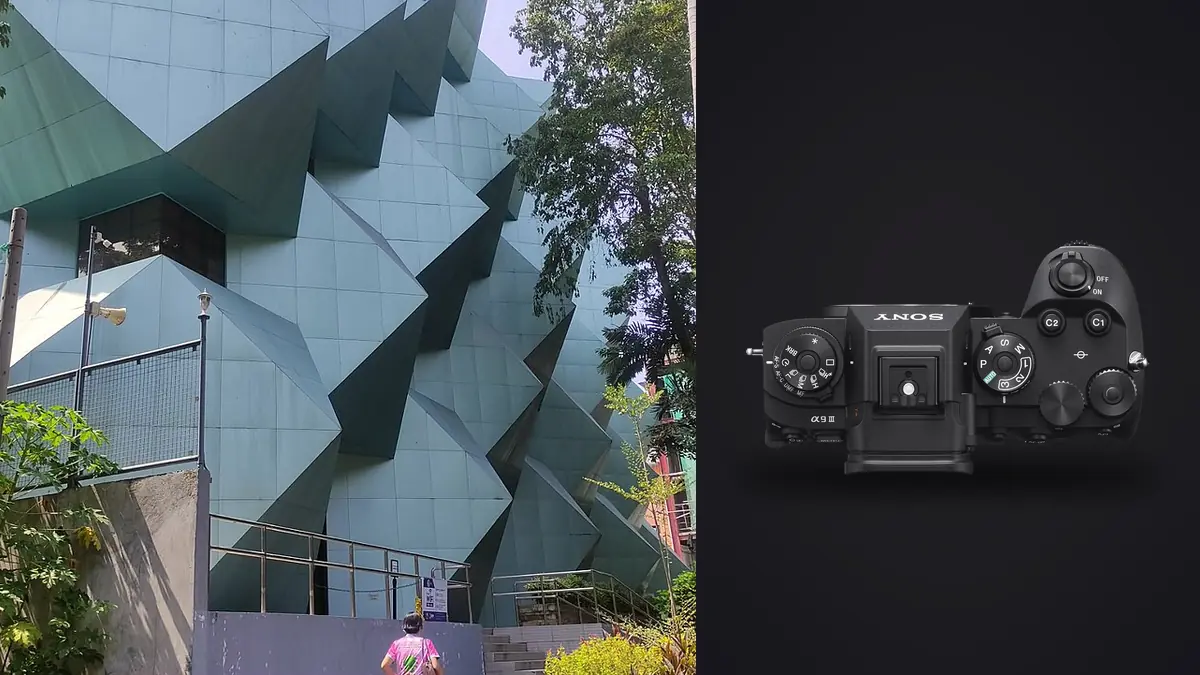
I got asked twice in the same month whether the Sony A9 III was "worth it" for shooting finished interiors and architectural work, both times by photographers who'd bought one used from a sports shooter chasing the next body and then wondered what they'd actually gotten. It's a fair question. Nothing about the A9 III's marketing points at real estate, hospitality, or architecture. It's built and sold as a football-and-motorsport camera. But the sensor underneath it does something no other full-frame body on the market does, and for a narrow slice of interior work that one thing matters more than the spec sheet suggests.
The one feature that actually matters here
The A9 III has a global shutter. Every other full-frame mirrorless camera on the market, including Sony's own a7R V and a1 II, reads the sensor line by line, top to bottom, which is why they need an electronic-first-curtain or mechanical shutter to avoid distortion with fast motion or flicker. A global shutter reads the entire sensor at once. The practical upshot for sports shooters is zero rolling shutter skew on a swinging bat or a spinning wheel. The practical upshot for someone lighting a living room is flash sync at any shutter speed, up to the camera's mechanical ceiling of 1/80000s, with full power output every time.
That is not a small thing if you shoot interiors with strobes. Every other camera forces a choice: sync at the native flash speed (usually 1/200s to 1/250s) and let a bright window blow out, or switch into high-speed sync and lose a stop or two of power chasing a shutter speed fast enough to kill the ambient light pouring through the glass. On the A9 III you just set the shutter to whatever kills the window (1/2000s, 1/4000s, whatever the light outside calls for) and the strobe still fires at full output, synced cleanly, every frame. I've balanced a bright south-facing kitchen against interior fill using nothing but shutter speed and two speedlights at full power, no HSS penalty, no gradient masking in post to fix a blown pane of glass. That workflow alone is the reason this body shows up on architecture jobs at all.
Where the advantage actually shows up
It's narrowest with strobes and speedlights aimed at controlling a bright exterior. It matters less if you shoot ambient-only with a tripod and long exposures, which is still how a lot of architectural photography gets made. If your typical interior brief is "natural light, bracket it, blend it in post," the global shutter buys you almost nothing over any other modern Sony body. If your brief involves gelled strobes tucked behind furniture to balance color temperature room to room, it buys you a genuinely different way of working.
A9 III against the camera most interior shooters would actually reach for
The comparison that matters isn't A9 III versus a rolling-shutter DSLR from a decade ago. It's A9 III versus the a7R V, since that's the body most working architecture and interior photographers on the Sony platform already own or are choosing between.
| Factor | Sony A9 III | Sony a7R V |
|---|---|---|
| Resolution | 24.6MP | 61MP |
| Native ISO floor | ISO 250 | ISO 100 |
| Dynamic range (practical, base ISO) | Noticeably tighter, roughly 1.5-2 stops behind the a7R V in shadow recovery | Class-leading for the mount, generous highlight and shadow latitude |
| Flash sync | Any shutter speed, full power, no HSS penalty | 1/200s native, HSS above that with reduced output |
| Rolling shutter under flicker or fast pans | None (global shutter) | Present, manageable with anti-flicker shooting |
| Buffer for bracket sequences | Deep, essentially a non-issue at typical bracket speeds | Adequate, can lag on long 9-frame brackets in compressed RAW |
| Body weight | ~703g (body only) | ~723g (body only) |
| Where it wins for this genre | Strobe-lit interiors, mixed ambient/flash, walk-and-shoot commercial work | Large-format prints, single-exposure dynamic range, resale/marketing crops |
Put plainly: the a7R V is the better default for architecture and interiors as a genre. Twice the pixel count matters when a client wants a two-meter print in a lobby, and the extra stop or two of dynamic range at base ISO means fewer bracket frames needed to hold a window and a dim corner in the same set. The A9 III earns its keep specifically when strobes are doing real work against daylight, which in my experience is maybe a third of interior jobs and almost none of pure architectural exterior work.
The resolution question, honestly
24.6 megapixels is not a small file by any historical standard, but it's a step down from what interior and architecture clients have started to expect out of a full-frame Sony body, mostly because the a7R series set that expectation. If you're delivering to a print catalog, a large-format lobby display, or an architect who wants to crop hard into a detail shot for a portfolio spread, the a7R V's files give you more room to work with after the fact. On the A9 III, I've found myself shooting a touch tighter and being more deliberate about framing up front, because there's less pixel real estate to crop into later. That's not a disaster, it's just a different discipline, closer to how people shot film medium format when every frame had a fixed cost.
Dynamic range is the part that actually changes the workflow. The A9 III's sensor is optimized for readout speed, not for squeezing every stop of latitude out of a single exposure, which is the opposite of what the a7R V and a1 II are tuned for. In practice that means I bracket more aggressively on the A9 III than I would on a higher dynamic range body: five or seven frames instead of three, especially in a room with a bright window and a dark wood floor. The global shutter's deep buffer makes that painless to shoot (there's no meaningful lag firing off a seven-frame bracket), but it does mean more files land on the card per setup, and more files land on the card per job.
Lenses that actually make sense on this body for rooms
Nobody's shooting interiors with a 400mm f/2.8, so the sports-lens ecosystem that usually gets paired with this camera is irrelevant here. What matters is a wide, low-distortion rectilinear lens, because architecture punishes barrel distortion and converging verticals more than almost any other genre.
What's worked for me
The Sony FE 16-35mm f/2.8 GM II is the obvious workhorse: sharp corner to corner, minimal distortion after a one-click profile correction, and fast enough to shoot ambient ceiling detail without pushing ISO into the range where the A9 III's noise floor starts to show. For tighter rooms, the FE 14mm f/1.8 GM earns its place, though at 14mm you're fighting perspective distortion on any vertical near the frame edge, and no amount of software correction fully undoes a person or a lamp stretched toward the corner. If a client specifically wants perfectly parallel verticals in a single frame rather than a stitched or corrected composite, a manual-focus shift lens (Laowa's 15mm f/4.5 Zero-D Shift is the closest thing to affordable on E-mount) is still worth carrying, global shutter or not. The A9 III doesn't change what glass you need for architecture, it only changes what you can do with a strobe once the lens is on.
Mixed lighting is still the hard part
Global shutter solves sync speed. It does not solve color. Interiors routinely mix daylight through a window (roughly 5500K, shifting warmer or cooler by time of day), tungsten or warm LED fixtures (2700K-3000K), and whatever accent lighting the designer specified, which on a lot of newer builds is unlabeled LED strip lighting with a color rendering index that varies wildly by manufacturer. None of that gets fixed by faster sensor readout. What the global shutter does help with is flicker: because the whole frame exposes simultaneously rather than scanning top to bottom, you avoid the banding that can show up under some LED or fluorescent sources at high shutter speeds on a rolling-shutter camera. At the shutter speeds most interior work actually uses (1/60s to 1/250s ambient, faster only when killing daylight with strobe) that banding risk was already low on most modern Sony bodies, so don't expect this to be the reason you buy the camera. It's a real but minor bonus stacked on top of the sync-speed advantage, not a separate reason on its own.
Color correction still happens where it always has: gel the strobes to match the dominant ambient temperature, shoot a gray card or ColorChecker under the trickiest mixed-light room in the set, and set white balance per lighting condition rather than trying to find one setting that works for the whole house. That part of the job hasn't moved.
What actually piles up: the file count
Because the A9 III rewards heavier bracketing (to make up the dynamic range gap) and because its buffer makes rapid-fire bracket sequences effortless, the file count from a single interior job climbs fast. A modest eight-room house shoot with five-frame brackets per angle, two or three angles per room, plus detail shots, easily clears six or seven hundred RAW files before you've touched a single edit. Multiply that by a week of back-to-back listings or a hospitality client wanting every guest room documented, and culling becomes the bottleneck long before editing does.
This is where I actually run the files through imagic before opening anything in Lightroom or Capture One. Bracket sets are effectively burst sequences from a sorting standpoint (same framing, same subject, exposures a fraction of a second apart), and imagic's duplicate and burst clustering groups them automatically instead of leaving me to eyeball which of five near-identical frames from the same tripod position is actually the sharpest at the wood grain or the window mullions. Because it runs its focus and sharpness scoring locally on the machine, nothing from a client's unreleased property goes anywhere near a cloud upload, which matters more on commercial interior work than most other genres given how often NDAs are involved before a listing goes public. Once the pick is chosen, I've also set up an apply_my_style preset trained on how I typically grade daylight-balanced interiors, which gets a consistent starting point across a few hundred files before I go in and hand-correct the handful of rooms with genuinely difficult mixed lighting. More on how that scoring actually works is in how AI photo culling works, and the broader case for cutting sorting time out of a shoot day is in 10 tips for a faster photo workflow.
None of that is specific to the A9 III. It would matter just as much shooting an a7R V. But the A9 III's bracket-happy workflow makes the culling step heavier than it would be on a body better suited to single-exposure dynamic range, so it's worth planning for before the first shoot day rather than discovering it at 11pm staring at a folder of 640 RAW files.
So is it worth buying for this work specifically
If you already own an A9 III because you also shoot sports, weddings with fast action, or events, and you're wondering whether it's a credible second body for interiors, yes, particularly for any job involving strobes against bright windows. It genuinely changes that part of the workflow for the better. If you're starting from zero and architecture or interiors is the only thing you shoot, I'd put the a7R V ahead of it for the resolution and dynamic range, and only reach for something like the A9 III if lighting-heavy commercial interiors (hospitality, retail, real estate with aggressive strobe work) make up a real share of the calendar rather than the occasional job.
Frequently Asked Questions
Does the global shutter actually reduce noise in dim interior corners?
No, and it's worth being clear on that because the two get conflated. Global shutter is about how the sensor reads out, not how it converts light to signal. The A9 III's noise performance at higher ISO is decent but not standout, and it's tuned more for clean readout at speed than for maximum low-light latitude the way a1 II or a7R V sensors are tuned. Dim room corners still benefit more from a fill light or a longer ambient exposure than from anything the global shutter contributes.
Can I still use high-speed sync flash on the A9 III, or is it only full-power sync?
You don't need HSS at all on this body for interior strobe work, that's the point. Because the entire sensor reads simultaneously, there's no rolling shutter artifact to avoid, so the flash can sync at literally any shutter speed the camera offers, up to 1/80000s, at full published power. HSS mode still exists in the menu for compatibility, but for interiors you'll generally leave it off and just set shutter speed like you would with a leaf-shutter medium format body.
Is 24.6MP actually a problem for real estate or interior marketing use?
For web listings, MLS uploads, and most social or brochure use, no, it's plenty. It becomes a real limitation only at large-format print sizes or when a client wants aggressive crops from a wide establishing shot, which is common in architecture portfolio work but less common in day-to-day real estate delivery. If large prints are a regular part of the client list, the resolution gap versus the a7R V is worth weighing seriously before buying.
What's the biggest workflow change moving from a rolling-shutter body to the A9 III for interiors?
Heavier bracketing to compensate for the tighter dynamic range, and a genuinely different approach to balancing window light with strobes since sync speed stops being a constraint. The first one means more files per setup and a real need for fast culling once you're back at the desk. The second one is the upside that makes the trade worth considering in the first place.