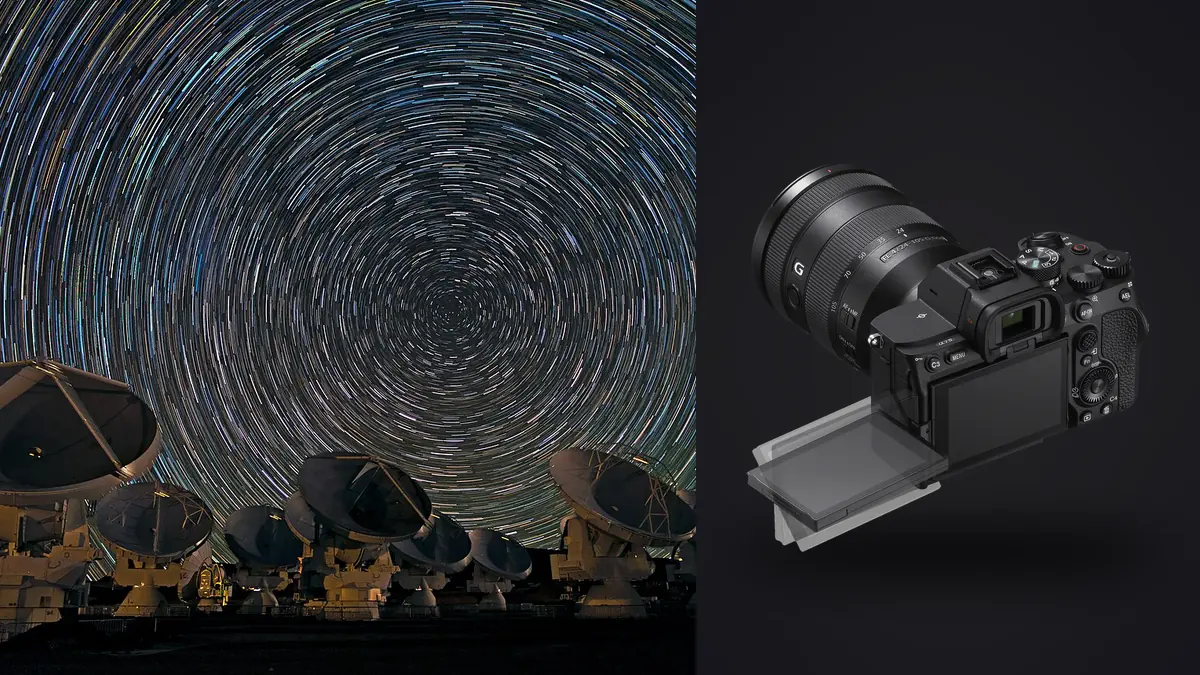
The Sony A7 IV is a 33-megapixel full-frame hybrid camera that can produce detailed night-sky RAW files while also serving general portrait, event, landscape, and video work. That breadth is its strongest astrophotography buying argument. It is not a dedicated cooled astronomy camera, an astro-modified body, a star tracker, or an in-camera deep-sky stacking system. Buyers should judge whether one flexible body fits the whole photographic workload, not whether a familiar model name guarantees the cleanest possible sky file.
Astrophotography performance is a system property. Lens speed and corner rendering, focus stability, tracking accuracy, sky darkness, temperature, exposure length, calibration frames, stacking software, and processing skill all affect the result. A body upgrade cannot compensate for a lens with poor star shapes or a tripod that moves. The A7 IV is a sensible fit when its resolution, controls, E-mount lens access, and general-purpose features align with the rest of the plan.
Identify the kind of astrophotography first
Milky Way landscapes, tracked wide-field mosaics, constellations, meteor showers, lunar work, and deep-sky imaging place different demands on a camera. A Milky Way landscape values portable lenses, good high-ISO RAW files, weather-conscious controls, and a tilting or articulating screen. Tracked nebula work values long-session power, remote control, calibration, stable sensor position, and spectral response. Meteor coverage values interval reliability, battery duration, and broad sky coverage.
Write down the primary target type, common focal length, tracking plan, final print or screen size, and whether daylight photography shares the body. If most work is daytime and occasional night landscapes, a hybrid camera is efficient. If the body will remain permanently attached to a telescope and the desired emission wavelengths are restricted by a standard filter, a dedicated or professionally modified solution may be a better fit.
| Use case | A7 IV fit | Main limitation to assess |
|---|---|---|
| Milky Way landscape | Strong hybrid fit | Lens corners and field focus |
| Tracked wide field | Capable with external tracker | Polar alignment and power |
| Meteor sequence | Useful interval-based capture | Battery, condensation, and storage |
| Narrowband deep sky | Possible but not specialized | Standard spectral response and external stack |
| Permanent telescope rig | May be unnecessarily broad | Cooling and astronomy integration |
Decide whether 33 megapixels helps the output
The sensor provides enough resolution for detailed landscapes, moderate crops, and substantial prints when focus and tracking are accurate. More pixels also make lens faults, tracking error, atmospheric blur, and small focus shifts easy to see. Resolution should be matched to output and technique, not treated as a free increase in celestial detail.
At the same final size, a carefully processed high-resolution file can be downsampled, which may make noise less visible. That does not mean pixel count alone determines low-light quality. Exposure, sensor behavior, temperature, stacking count, and processing all matter. Avoid comparing bodies through unstandardized web samples with unknown lenses and noise reduction.
File size affects the night. A long interval sequence, panorama, or stack can consume considerable card and storage capacity. Budget for originals, calibration frames, previews, intermediate stack files, and final renders. Dual card slots can support redundancy or overflow, but the selected role should be tested with the intended RAW format and interval behavior.
Put the lens ahead of the body upgrade
For untracked night landscapes, a lens needs a useful balance of focal length, aperture, corner star shape, focus repeatability, flare control, and weight. A very fast maximum aperture is attractive, but stars near the edges may stretch or develop wings when the lens is used wide open. Stopping down can improve corners while demanding more exposure time or ISO.
E-mount offers native and adapted lens options across wide, normal, and telephoto ranges. Compatibility does not guarantee astrophotography quality. Review full-resolution star fields made with the exact lens, inspect corners at the intended aperture, and verify whether focus shifts as temperature changes. A decentered copy can make one corner poor even when the model is generally respected.
Manual-focus handling matters in darkness. A focus ring with repeatable response, clear magnified view, and minimal accidental movement is valuable. Tape or a lens heater band should never obstruct controls or strain the mount. Recheck focus after a major temperature change, filter change, or bump.
Understand what the camera does not include
The A7 IV does not replace an equatorial tracker. Without tracking, exposure length is limited by focal length, pixel scale, viewing size, and tolerance for star movement. A simple rule based only on focal length is a starting estimate, not a guarantee. Make a test, inspect central and edge stars, and shorten the exposure if trails are visible.
It also does not produce a finished multi-frame star stack in the way dedicated desktop stacking software does. Interval capture supplies source frames. Alignment, rejection, calibration, and statistical combination happen later in a compatible application. Panorama stitching and advanced layer blending are also separate jobs.
A standard camera's internal filter response is designed for general color, not maximum sensitivity to every astronomical emission. Professional modification can change daylight color, autofocus assumptions, warranty status, dust risk, and resale. Buy or modify only after confirming that the target type benefits and that suitable correction filters and workflows exist.
Evaluate field controls in darkness
The articulating screen can help with low tripod angles, but any screen produces light that affects night vision and nearby photographers. Reduce brightness, use a red-light discipline where appropriate, and shield the display. Configure a custom night profile with RAW capture, manual exposure, manual focus support, delayed release or remote control, fixed white balance, and disabled distractions.
Turn off long-exposure noise reduction when a sequence cannot tolerate a matching dark-frame delay after every exposure, then capture separate calibration frames if the stacking workflow uses them. The correct choice depends on the project. For a single isolated long exposure, in-camera noise reduction may be acceptable; for an uninterrupted meteor sequence, the dead time can miss events.
In-body stabilization should normally be disabled on a stable tripod when Sony's guidance and the support setup call for it, especially with tracked work. Test the exact lens and mount. Stabilization cannot correct star movement from Earth's rotation and may complicate a locked support if left to search for motion.
Plan power, weather, and condensation
Cold conditions reduce practical battery endurance, while long exposures, screen use, and interval capture keep the camera active. Carry charged batteries in a protected location or use a supported external power arrangement that does not strain the port or leave the weather sealing compromised. Test whether the camera continues the interval correctly during the chosen power method.
Dew can end a session before storage does. A lens heater and controller may be needed in humid conditions, but they add batteries, cables, and possible vibration. Route cables with slack, secure them below the camera, and prevent them from catching as a tracker rotates. Check the front element with a dim, shielded light between sequences.
Weather resistance is not permission to leave ports open in rain or condensation. Use a cover that allows heat and cable routing, and avoid moving a cold camera directly into warm humid air without a sealed acclimation plan. Condensation can form inside as well as on the front element.
Assess tracker and interval compatibility
A tracker changes the exposure limit by rotating the camera with the sky, but it adds polar alignment, payload, balance, periodic error, and foreground strategy. Confirm that the combined body, lens, ball head, heater, and cables fit within the tracker's practical capacity. A nominal payload figure does not guarantee accurate tracking with a long, unbalanced lens.
For tracked sky and sharp foreground, capture them as separate exposures only when the composition and ethics of the project allow a composite, then disclose or label the result where context requires it. The camera does not align those layers. A single-frame approach remains available when a composite is inappropriate.
Test the intervalometer or internal interval function with the exact exposure length. Include write time, long-exposure settings, and a safe interval gap. Confirm that the planned number of files fits the card and that the sequence does not stop because a bracket, timer, or power-saving option conflicts.
Compare total system fit before buying
List the body, primary astro lens, tripod, tracker, head, power, heater, interval control, filters, storage, stacking software, and transport. Mark which components already exist and which problem each new item solves. A less expensive body with a better lens and stable tracker can outperform a premium body attached to weak support for the intended result.
Handle the A7 IV in darkness before deciding if possible. Check menu access with gloves, screen articulation at low angles, manual-focus magnification, button placement, port clearance, and how the camera balances on the intended head. Ergonomic friction repeated across a long cold session matters more than a specification that never enters the workflow.
Compare RAW support in the selected editor and stacking application. Use ordinary test files to verify color, lens metadata, calibration-frame handling, and export. Do not buy around a processing chain that cannot open or combine the files as required.
Build a local ingest and stack handoff
After the session, copy the ARW files into folders that separate lights, darks, flats, bias frames if used, tracked sky, foreground, and test exposures. Preserve capture order and source names. Verify the data and create an independent second copy before clearing media.
imagic can locally score sharpness, exposure, and composition and group duplicates or bursts, which can help identify accidentally moved frames or repeated test exposures. It does not align or combine a star stack, merge HDR, stitch panoramas, or provide layers. Send the approved source sequence to dedicated stacking software and retain the calibration structure.
Apply culling carefully. A dark calibration frame is supposed to look dark, and a light frame with dim sky may still be valid for stacking. Automated aesthetic or exposure scores are not astronomy calibration decisions. Keep every rejection reversible and judge stars at useful magnification for tracking, focus, clouds, aircraft, satellites, and vibration.
See the desktop workflow for local file review and Camera Hardware for more buying and setup guidance. Final stacking and specialized astronomical processing remain in the separate tools chosen for that purpose.
Buying checklist
- Define the primary target: landscape, meteor, tracked wide field, or deep sky.
- Confirm the final output and whether 33MP crop detail is useful.
- Inspect candidate lenses for corner stars at the intended aperture.
- Verify manual-focus control and temperature stability.
- Budget complete storage for sources, calibration, stacks, and exports.
- Test interval, power, tracker payload, cable routing, and dew control.
- Confirm ARW support in both RAW and stacking software.
- Choose a dedicated or modified camera if the target demands specialized response.
Frequently asked questions
Is the Sony A7 IV a good first astrophotography camera?
It can be a strong choice for someone who also needs a general-purpose full-frame body. Lens, tripod, sky access, and processing plans should be budgeted with it.
Does the A7 IV stack stars in camera?
It can capture source sequences, but a finished aligned star stack requires separate compatible software. Calibration and rejection also happen in that workflow.
Is a star tracker required?
No for short untracked exposures and many night landscapes. It becomes useful when longer sky exposure is needed, but it adds alignment, payload, and foreground decisions.
Should the A7 IV be astro-modified?
Only when specific targets benefit enough to justify changed daylight color, filters, service risk, and workflow. A standard body is more flexible for mixed daytime and night use.