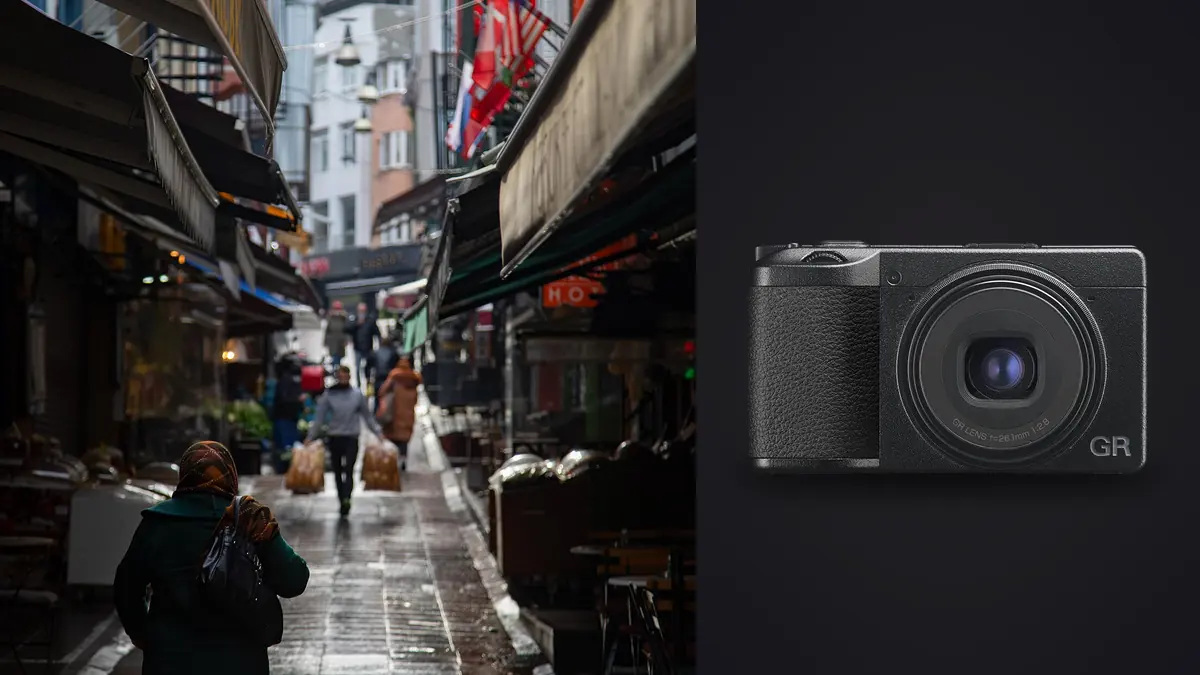
When Ricoh released the GR IIIx in September 2021, the headline change wasn't a new sensor or a faster processor. It was a single number: the lens went from 18.3mm (28mm full-frame equivalent) to 26.3mm (40mm equivalent). For most camera buyers that's a footnote on a spec sheet. For street and documentary shooters who'd spent a decade arguing about focal length choice, it was the whole reason to buy the thing. I've carried both the standard GR III and the IIIx through the same city blocks on different afternoons, and the difference in how I frame a moment is bigger than a nine-millimeter change in focal length has any right to produce.
Why 40mm Changes the Way You Actually Work a Scene
28mm invites you in close. It's forgiving of distance, it swallows environment along with subject, and it rewards the shooter who's comfortable being three feet from a stranger. 40mm asks for a half-step back, or a slightly longer wait for the subject to walk into the right spot in the frame. That sounds like a small adjustment until you spend a week doing it. What changes is the ratio of subject to context. At 28mm a person on a market street is one element among many. At 40mm they start to separate from the background just enough that the photo reads as being about them, not about the street they happen to be standing on.
This matters specifically for documentary work, where you're often trying to hold a face or a gesture as the anchor of the frame while a chaotic environment happens around it. The GR IIIx doesn't erase that chaos, it just gives you a slightly longer lever to control how much of it enters the frame without physically closing the distance to your subject. There's also a practical side benefit: close-up faces at 28mm pick up a bit of that wide-angle stretch near the edges. At 40mm, faces read more naturally, which matters if a chunk of your documentary work involves environmental portraits rather than pure candid captures.
The trade-off is real. 40mm is a worse focal length for tight interiors, cramped market stalls, or anything where you can't back up. If your documentary subject is mostly interiors, alleyways, and vehicles, the standard GR III's 28mm will serve you better. I'd never tell someone to buy the IIIx sight unseen. Borrow one for a weekend if you can, because the focal length preference here is genuinely personal rather than objectively correct.
Snap Focus Is the Feature That Actually Earns Its Keep
Autofocus on the GR IIIx is fine. It's not the fastest system on the market and it can hunt in low light or low contrast scenes, which is exactly the kind of scene documentary work happens in. What makes the camera usable for fast, unrepeatable moments isn't autofocus at all, it's snap focus: a mode where the lens jumps to a preset distance the instant you press the shutter, with zero focus search.
My working setup is snap focus at 2 meters, aperture around f/5.6 to f/8 depending on light, ISO on auto with a ceiling around 6400. That combination gets me a depth of field wide enough to forgive a slightly wrong distance estimate, and the shutter fires the moment I press it, full stop. There's no shutter lag to think about, no AF confirmation beep, nothing between your intention and the exposure. For a documentary shooter working a scene that won't repeat itself, that's worth more than a stop of extra sharpness from a contrast-detect AF hunt that fires half a second too late.
The snap distance is adjustable in the menu (1m, 1.5m, 2m, 2.5m, 5m, or infinity, plus a customizable value), and I'd encourage anyone new to this to spend an actual afternoon walking a specific distance and shooting at that snap setting until it becomes intuitive. Two meters is roughly one long stride plus a normal stride from your subject. Once that's in your body rather than your head, you stop thinking about focus at all, which is the entire point.
Carrying It Without Looking Like You're Working
The GR IIIx disappears into a jacket pocket in a way no APS-C camera with an interchangeable lens ever will. That's not a minor convenience, it's the reason documentary photographers who work in sensitive or informal settings gravitate toward it. Nobody clocks a compact black camera the way they clock a body with a lens hood and a strap. You get a different, more relaxed version of a scene when your presence doesn't register as "photographer" to the people in it.
The trade-off is grip and eye-level shooting. Out of the box the body is slim enough that it can feel slippery in cold weather or with gloves, and there's no built-in viewfinder, you compose on the rear LCD or buy the separate optical external viewfinder that slots into the hot shoe. I use the LCD for almost everything and only reach for the external finder in bright midday sun when the screen washes out. If you're used to eye-level shooting from a rangefinder background, budget for that accessory rather than assuming you'll adapt to screen composing, because some people never do.
What the Sensor Actually Buys You Over a Phone
The GR IIIx uses the same 24.2-megapixel APS-C sensor as the GR III, which is a genuinely large sensor for a camera this size, comparable to what you'd find in a mid-range mirrorless body rather than anything phone-sized. In practice that means usable files up to around ISO 3200 without much fuss, and ISO 6400 is workable if you're not planning to print large or crop hard. For documentary work shot in bars, night markets, or dim interior spaces, that headroom is the difference between a keeper and a frame you delete on the spot.
Two features that don't show up on a casual spec comparison but matter constantly in the field: the built-in 2-stop neutral density filter, which lets you shoot at f/2.8 in bright daylight without blowing highlights (useful when you want a subject to separate from a busy background with shallow depth of field even at noon), and the in-body 3-axis shake reduction, which buys you an extra stop or two of usable shutter speed handheld in dim interiors. Neither of those is unique to Ricoh, but having both in a pocketable body without extra glass or a tripod is unusual.
How It Actually Compares to the Obvious Alternatives
People shopping for a serious compact street camera usually end up cross-referencing the GR IIIx against the standard GR III and against Fujifilm's X100 line. Here's how they actually stack up on the things that matter for this genre specifically, not a generic spec dump.
| Camera | Equivalent focal length | Sensor | Body weight (with battery) | Built-in ND | Viewfinder | Approx. new price |
|---|---|---|---|---|---|---|
| Ricoh GR IIIx | 40mm | APS-C, 24.2MP | ~262g | Yes, 2-stop | None built-in (optional external optical) | ~$1,099 |
| Ricoh GR III | 28mm | APS-C, 24.2MP | ~257g | Yes, 2-stop | None built-in (optional external optical) | ~$999 |
| Fujifilm X100VI | 35mm | APS-C, 40.2MP | ~521g | Yes, up to 4-stop | Hybrid optical/electronic, built in | ~$1,599 |
The X100VI is a genuinely excellent camera and its hybrid finder is nicer to shoot with than composing on any rear screen. But it's roughly double the weight and doesn't fit a jacket pocket the way the GR line does, and for documentary work where you're on your feet for eight or ten hours, that weight difference is felt by hour six. The GR IIIx trades finder quality and resolution for something a photojournalist friend of mine put well: "it's the camera I forget I'm carrying, which means it's the camera that's actually in my hand when something happens."
Battery Life and the Unglamorous Logistics of a Full Day
The DB-110 battery is rated by CIPA standards around 200 shots, which sounds alarming until you realize CIPA testing cycles the LCD constantly in a way most street shooters don't. In real use, with the screen mostly off between shots and review kept brief, I get closer to 350 to 450 frames per charge, still not a lot by DSLR standards. I carry two spares on any documentary day longer than a few hours, charge them all the night before, and treat the in-camera USB-C charging as an emergency top-up rather than a primary method, since it's slow.
The single UHS-I SD card slot is another spot where the GR IIIx shows its compact-camera priorities. It's not fast, and there's no backup slot, so if card failure would be catastrophic for a specific assignment, offload frequently rather than trusting a single card for a multi-day shoot. Weather sealing is also limited. Ricoh doesn't rate the standard GR IIIx for weather resistance the way some mirrorless bodies are, so a rainy documentary assignment means a plastic bag or a dedicated rain cover, not confidence in the body alone.
Turning a Week of Street Takes Into an Actual Edit
Here's the part nobody mentions in gear reviews: a camera this easy to carry gets used constantly, and that means the file count balloons fast. A single afternoon of walking and shooting at a market or a protest can easily produce six or seven hundred frames once you count every burst fired at a fleeting moment. Most of those are near-duplicates, three or four frames apart by a fraction of a second, with only one actually sharp on the subject's eyes or hitting the right gesture.
That's the exact problem I built my culling habit around when I started running everything through imagic before I touch Lightroom. It scores sharpness and clusters bursts and near-duplicate frames locally on my laptop, so instead of scrubbing through forty near-identical shots of someone crossing a street, I get the cluster narrowed down to the two or three actually worth a second look. For documentary work specifically, the fact that it runs entirely offline matters beyond convenience. A lot of what I shoot involves people who didn't sign a release and wouldn't want their faces sitting on someone else's cloud server before I've even decided which frame to keep, so local-only processing isn't a nice-to-have, it's a condition for taking the camera into certain situations at all.
Once the cull is done, consistency across a big batch is the next problem, especially if a documentary series needs to read as one coherent body of work rather than three hundred individually-tweaked images. I trained imagic's apply_my_style feature on a set of edits I'd already graded by hand for a black-and-white documentary project, and it's saved me from the tedium of re-applying the same tonal decisions frame by frame across a shoot that size. It's not magic, it's pattern-matching against your own prior choices, but for a genre where the whole point is a consistent visual voice across dozens of frames, that's exactly the tedious part worth automating. If you're new to culling workflows generally, how AI photo culling works is a reasonable place to start before you commit to a specific tool.
None of this replaces editorial judgment. A software tool can tell you which frame is sharpest in a burst, it can't tell you which frame has the right expression or the right gesture, that's still entirely a human call. What it does is get you to the decision faster, which matters when a week of shooting has left you with thousands of frames and a deadline.
Frequently Asked Questions
Is 40mm too tight for candid street photography?
It's tighter than the classic 28mm or 35mm street focal lengths, but "too tight" depends entirely on your working distance habits. If you're comfortable standing back a step or two and letting a scene compose itself rather than diving in close, 40mm works well. If your style depends on getting physically close to strangers, the standard GR III's 28mm will feel more natural. Try both before assuming either is correct for you.
How reliable is snap focus for fast-moving subjects, like someone running or cycling?
Snap focus fires instantly at a fixed distance, so reliability comes down to how well you've judged the distance, not the camera's speed. For a subject moving toward or across your fixed distance point, a smaller aperture like f/8 gives enough depth of field to forgive a meter or so of misjudgment. For genuinely fast, unpredictable subjects at varying distances, continuous autofocus will actually track better than snap focus will, even with its slower response.
Do I need the external optical viewfinder for documentary work?
Not as a starting purchase. Most GR IIIx shooters compose on the rear screen and adapt within a few weeks. The external finder earns its cost in two specific situations: bright midday sun where the LCD washes out, and assignments where you want to look like you're not actively photographing someone, since holding a camera to your eye reads very differently to a subject than holding it at chest height staring at a screen.
Is the built-in ND filter actually useful, or is it a gimmick?
It's genuinely useful for this specific lens. Because the aperture only goes to f/2.8, shooting wide open in bright daylight without an ND would force shutter speeds beyond the camera's electronic shutter ceiling in some conditions. The 2-stop ND lets you keep shallow depth of field for subject separation at midday, which matters more for documentary portraiture than it does for typical street snapshots where everything in focus is often the goal anyway.