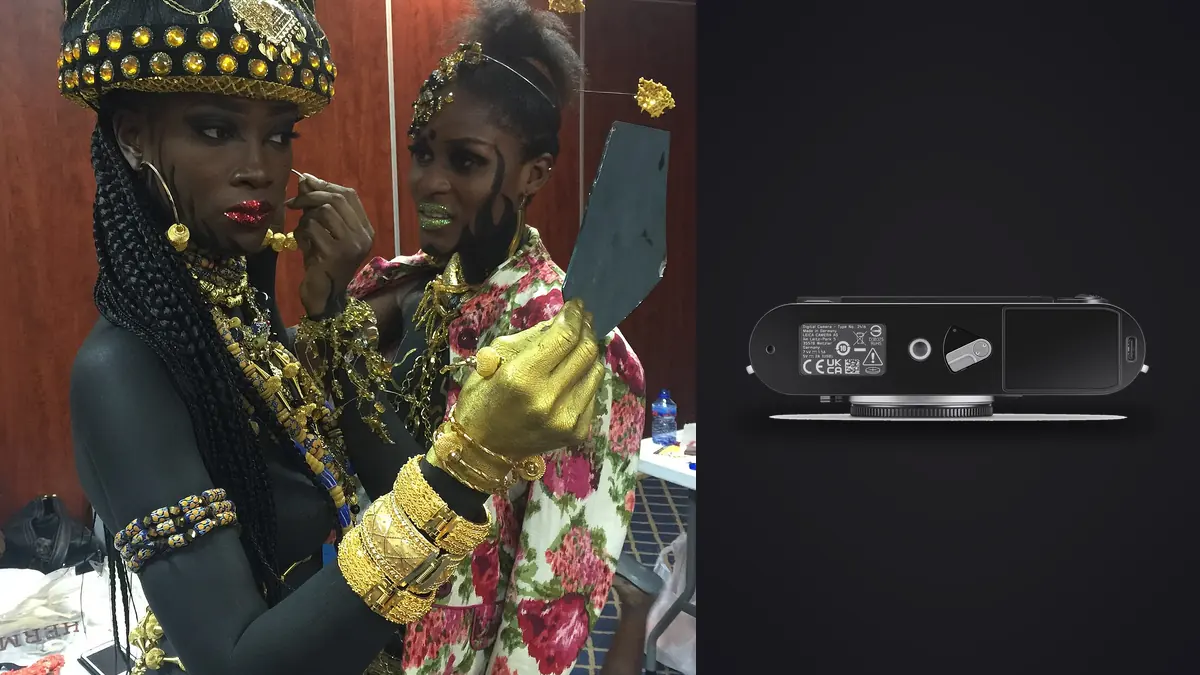
A brand's creative director asked me last season if I could shoot their pre-fall lookbook on a Leica M11. Not "do you own one." Not "can you get one." They wanted the M11 specifically, because their previous photographer had shot a capsule collection on one and the skin tones and fabric texture in those files became the reference point for how they wanted the whole catalog to look going forward. That request is more common than it used to be. Leica has become a genuine style choice for certain fashion clients, not just a collector's object, and the M11 is the body most of them mean when they say it.
The problem is that a lookbook is a production job with a schedule, a shot list, and a client standing behind the monitor, and the M11 was not built with that job in mind. It was built for photographers who want to slow down and look through a rangefinder patch. Whether those two things are compatible depends a lot on what kind of lookbook you're shooting and how you set the day up around the camera's limits rather than pretending they don't exist.
Why manual focus isn't the dealbreaker people assume
Lookbook work is not sports photography and it is not a runway show. Most of the frames a client actually licenses come from a model holding a pose for two to four seconds while you fire off a handful of shots, adjust, and fire again. That rhythm is much friendlier to a rangefinder than people expect. You focus once on the eye through the patch, hold the pose, and you're not fighting a moving subject the way you would be at a live event or on a runway.
Where it gets genuinely hard is a stylist calling "walk it" for a movement sequence, or a model who shifts weight and breathes between frames at f/1.4 on a 50mm. At that aperture the plane of focus across a face is thin enough that a half-inch of sway between the cheekbone and the eyelash line will show up on a 60-megapixel file when you pixel-peep it later. I've learned to stop down to f/2 or f/2.8 for anything with real movement and save the wide-open glass for genuinely static beauty shots. That's a compromise a fashion client doesn't need to know about, but it's the honest reason the M11 works on set: you're managing the camera's weakness by controlling the choreography, not by out-focusing it.
The 60-megapixel file is a blessing and a scheduling problem
The M11's sensor shoots at 60, 36, or 18 megapixels depending on which DNG size you pick before the shoot, and that switch matters more on a lookbook day than the spec sheet suggests. Full 60MP files run somewhere around 80 to 100MB apiece, and a lookbook with 30 looks and a reasonable number of frames per look can put you well past a thousand exposures by lunch. That adds up to real storage and real transfer time, especially if you're handing a card to a retoucher at the end of the day rather than shipping files overnight.
A good habit is to shoot the actual selects at full 60MP and drop to 36MP for anything that's clearly a secondary angle or a behind-the-scenes bonus frame. It sounds like a small thing but it noticeably cuts down the pile you have to sort through later, and it matters because the M11 doesn't give you dual card slots. There's internal storage plus a single SD card, and internal storage is not a backup strategy for important work, it's a buffer. On anything you cannot reshoot, tether to a laptop over USB-C and back up as you shoot, which is a workflow habit the M11 basically forces on you if you're being responsible with irreplaceable files.
Flash sync will change how you light the shoot
This is the part that surprises photographers coming from Sony or Canon bodies. The M11's mechanical shutter syncs with strobes at roughly 1/180s, and if you push past that with a standard flash you'll get a banded frame instead of a clean exposure. There's no high-speed sync workaround built into the system the way there is on most modern mirrorless bodies with electronic first-curtain tricks. If your lookbook is an outdoor shoot in bright daylight and the plan was fill flash at 1/1000s to control the sky, you either need to bring ND to bring your shutter speed down into sync range, or you switch your lighting plan to continuous LED panels, which don't care what shutter speed you're on.
I now default to continuous light for anything outdoors with this camera and save strobes for the studio days where I control the ambient completely. It's not a limitation you can shoot around with technique the way you can with focus. It's a hard sync ceiling, and building the lighting plan around it before the shoot day saves you from finding out on location with a model, a stylist, and a client all waiting.
| Camera | Resolution | Autofocus | Approx. RAW size | Mechanical flash sync | Where it earns its place on a lookbook |
|---|---|---|---|---|---|
| Leica M11 | 60MP (switchable to 36 / 18MP) | None, rangefinder manual | ~80-100MB DNG | ~1/180s | Controlled studio poses, fabric texture, brand wants the rangefinder rendering |
| Fujifilm GFX100S II | 102MP medium format | Hybrid contrast/phase AF | ~120MB+ compressed RAW | ~1/125s | Ultra-high-res e-commerce crops, slower-paced beauty sets |
| Sony a7R V | 61MP | Fast hybrid AF with eye tracking | ~60-70MB compressed RAW | ~1/250s | High-volume days, lots of looks, small crew moving fast |
| Leica SL2-S | 24MP | Contrast AF, noticeably slower than Sony/Fuji | ~30MB DNG | ~1/250s | Second body for movement sequences and behind-the-scenes coverage |
What the table doesn't show
Numbers on a spec sheet don't capture how differently these cameras feel to operate for eight hours straight while a stylist re-pins a hem between every third frame. The M11 rewards a slower, more deliberate cadence. If your client's shot list has forty looks and you need volume more than you need a specific file character, the Sony or the Fuji will get you through the day with less friction. If the brand is paying specifically for the Leica look on a tighter, more curated set, the M11 is worth the slower pace.
Glass that actually earns its place in the bag
Three lenses cover almost everything needed on a lookbook day. A 35mm APO-Summicron handles full-length environmental looks where you want the model and enough of the location or set in frame to give the brand context shots, not just isolated product. A 50mm Summilux at f/1.4 is the three-quarter-body lens, the one that gives separation from a plain backdrop without needing a huge studio for distance. A 90mm APO-Summicron-M does the detail work: buttons, stitching, jewelry, close beauty crops, shot from far enough back that you're not standing in the model's face between wardrobe changes.
The M11's frameline pairs (28/90, 35/135, 50/75) mean you're always seeing a bit more than what actually lands on the sensor, which takes getting used to if you're coming from an optical or electronic viewfinder that shows exactly the frame. For lookbook work where the client sometimes wants a tighter crop pulled from the same file later, that extra visible margin around the frameline is genuinely useful. You can compose knowing there's clean space to crop into without guessing.
Color and texture, without pretending it's magic
The base ISO of 64 gives noticeably clean shadow detail on garments with dark tones, which retouchers notice immediately when they're pulling detail out of a black wool coat or navy suiting. There's no anti-aliasing filter on the sensor, so fine woven textures, denim, knit patterns, hold up sharp at full resolution in a way that matters when a client zooms into a fabric swatch on their monitor. Skin tones out of the M11 read slightly warm and settle in fast with minimal color correction, which is the part clients actually mean when they ask for "the Leica look." It's a real, describable difference, not just brand mystique, but it's also not going to save a shoot with bad lighting. It's a head start on the color grade, not a substitute for getting the light right on set.
Getting through the files without losing the day
A forty-look lookbook shot at even a modest ten frames per pose generates a genuinely large take, and a huge share of it is near-duplicate frames where the model blinked, shifted a hand, or the fabric caught the light slightly differently. Sorting that manually after a twelve-hour shoot day is the part of this job nobody enjoys. Run everything through imagic before it goes anywhere near a retoucher: the local sharpness and focus scoring flags the frames where rangefinder focus actually landed on the eye versus the ones that only look sharp on the back screen, and the duplicate and burst clustering groups those ten near-identical frames per pose down to the two or three worth a client's attention. If you want the mechanics behind that kind of scoring, this breakdown of how AI photo culling works covers it in more depth than I need to here.
The other reason it matters for this specific job: fashion clients are often shooting a collection weeks before it's cleared for release, under an NDA that explicitly rules out anything touching an outside server. Because imagic processes everything locally on the machine and never uploads images anywhere, that isn't a workaround I have to explain to a nervous PR team, it's just how the software works. Once I've built a look I'm happy with on a shoot's hero frames, the apply_my_style feature lets me carry that same edit character across the rest of the set's selects instead of re-grading every look from scratch, which is the difference between a same-day contact sheet and a same-week one. There's a general rundown of the rest of that pipeline in these workflow tips if the culling step is the part slowing you down most.
Battery life and the physical grind of a full day
The M11's battery is bigger than the one in the M10 generation and it shows, but it's still modest next to a mirrorless body rated for 600-700 shots. Carry three spares and top up over USB-C during wardrobe changes, which is realistic because those changes happen constantly on a lookbook set anyway. The body itself is light, around 530 grams without a lens, which matters more than people think when you're holding a camera at chest height for the same pose forty times in a row, waiting for a stylist to fix a collar. It's a genuinely comfortable camera to operate all day in a way that a bigger SL2 body with an L-mount lens isn't.
Frequently Asked Questions
Can one photographer realistically run a full lookbook day on the M11 alone?
Yes, but plan for a slower pace than an autofocus body would give you, and budget extra time for movement or walking sequences where you'd normally lean on eye-tracking. Static, posed looks are where the M11 keeps up fine. If the shot list includes a lot of motion, bring a second AF body as backup rather than trying to force the rangefinder through it.
Do I need to shoot every frame at the full 60 megapixels?
No, and I'd argue you shouldn't. Drop to 36MP for secondary angles, test frames, and behind-the-scenes coverage, and reserve the full 60MP DNG for the shots you already know are strong client selects. It cuts your storage and culling load without costing you resolution on the frames that actually matter.
What's the single biggest practical drawback for paid commercial work?
The lack of dual card slots. There's internal storage and one SD card, and internal storage isn't a real backup on a job where you can't reshoot a collection sample that's already been sent back to the showroom. Tether and back up as you go rather than trusting a single card for an entire lookbook day.
Is the mechanical flash sync limit a problem for indoor studio work too?
Less so, because in a controlled studio you're usually managing ambient light anyway and can work comfortably within the roughly 1/180s sync ceiling. It becomes a real constraint outdoors in bright sun when you want a fast shutter speed to control the sky while still firing flash for fill, which is where I switch to continuous light instead of fighting the sync speed.