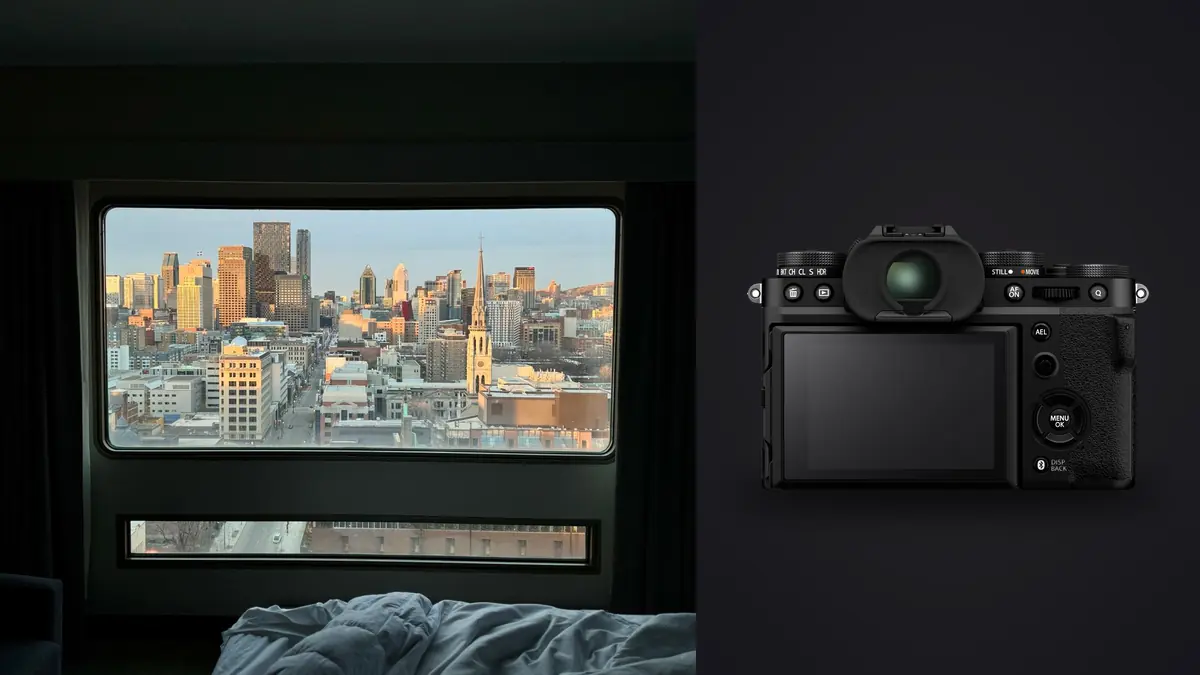
Picture a boudoir session where your usual body is in for a sensor clean and the date is fixed, so you grab the X-T5 and the 56mm out of the bag you keep for personal work. Two hours into a hotel suite session you realize you haven't reached for a bigger camera once. That's not a marketing line, it's just how it tends to go, and it's a good reason to keep reaching for it for this specific kind of work.
The body itself changes how the room feels
Boudoir and intimate portraiture happen in small spaces, usually a bedroom, a hotel suite, or a rented studio flat with a bed and not much else. The camera you're holding is part of the atmosphere whether you like it or not. A big DSLR with a battery grip and a 70-200mm hanging off the front reads as clinical, even a little intimidating, in a room where the client is already nervous about being photographed in lingerie or less. The X-T5 doesn't do that. It's a compact, dial-driven body, around 557 grams without a lens, and next to a 56mm f/1.2 or a 35mm f/1.4 it looks more like something a documentary photographer would carry than studio gear.
That matters practically, not just emotionally. Because the ISO, shutter speed, and exposure compensation live on physical dials, I'm not staring into a menu between poses. I can glance down, make a half-stop adjustment, and get my eyes back on the subject in under two seconds. In a genre where rapport carries the session more than technical polish does, that's worth more than most spec sheet features.
One honest limitation: the X-T5 kept a three-way tilting rear screen rather than the fully articulating one on the X-T4 and X-H2 line. It tilts up and down cleanly in landscape orientation, but boudoir work is shot vertically far more often than not, and the screen doesn't rotate with the camera. I've made peace with shooting low-angle vertical frames from eye level rather than the hip, but if you lean on a vari-angle screen for low shots from the foot of the bed, budget time to adjust your habits.
What 40 megapixels actually buys you here, in both directions
The X-T5's 40.2MP X-Trans sensor is a genuine step up in resolving power over the older 26MP generation, and in boudoir work that cuts two ways. On the upside, fine detail in lace, sheer fabric, and skin texture holds up to serious cropping. A loose three-quarter shot can be reframed into a tight vertical crop for a private album and still leave more than enough resolution for an 11x14 print. If a client wants a signature piece printed large, that headroom is real.
On the downside, 40 megapixels is unforgiving. Every stray hair, every bit of texture you'd rather smooth, shows up at 100% in a way it simply didn't on a 24MP file. Retouching takes longer per image, not because the tools changed but because there's more information to look at and decide on. And the files themselves are heavier: compressed raw files from the X-T5 run 45-55MB apiece for me, so a two-hour session that produces 300-400 frames eats 15-20GB before I've even started culling. If you're used to a smaller sensor, plan for the extra storage and the extra time at the screen.
The resolution also punishes sloppy focus more than a lower-megapixel body would. At f/1.2 with the X-T5's pixel density, the plane of focus at typical boudoir working distances (arm's length to about two meters) is thin enough that missing the near eye by a centimeter is visible on export, not just at 100% crop. I lean on eye-detect autofocus with a single point rather than a wide zone, because the wide zone tends to lock onto whatever has the most contrast in frame, which in boudoir work is often jewelry, a strap, or a fold of fabric rather than the eye.
Lenses that actually earn a place in the bag
I don't carry a zoom for this genre. Everything is primes, chosen for how they render skin and how close I can get without the working distance becoming awkward in a small room. Here's what I actually reach for and why, not a generic spec dump.
| Lens | Widest Aperture | Minimum Focus | Full-Frame Equivalent | Where it earns its keep |
|---|---|---|---|---|
| XF 35mm f/1.4 R | f/1.4 | 28cm | ~53mm | Environmental frames that include the room, walking-around lens when the space itself is part of the story |
| XF 33mm f/1.4 R LM WR | f/1.4 | 30cm | ~50mm | Sharper wide open than the older 35mm, my default when I only want to carry one lens all session |
| XF 56mm f/1.2 R WR | f/1.2 | 50cm | ~84mm | Classic tight beauty crops and detail shots, heaviest subject separation in the bag |
| XF 90mm f/2 R LM WR | f/2 | 60cm | ~137mm | Flattering compression from across a small room, useful when the client needs more physical space than a 56mm gives |
If I had to keep one, it's the 33mm. It focuses close enough for detail work, wide enough for a full-length pose in a cramped hotel room, and it's sharp at f/1.4 rather than needing to stop down half a stop to clean up. The 56mm stays in the bag for when I want that heavier, almost medium-format-feeling background blur on a close portrait, but I don't shoot a whole session on it because the working distance at f/1.2 gets uncomfortably close for both of us.
Reading light in a bedroom that wasn't built for photography
Boudoir sessions often happen in spaces you don't control: a bedroom at home, a rented Airbnb, occasionally a proper studio with a bed set built for the purpose. Window light is my first choice almost every time. A sheer curtain over a north-facing or east-facing window gives soft, wraparound light that's genuinely flattering on skin without needing modification. I position the subject at roughly 45 degrees to the window rather than facing it directly, which keeps one side of the body in gentle shadow and avoids the flat, shadowless look you get shooting straight into diffused light.
When the window light isn't enough (basement suite, overcast afternoon session that started too late, a room that only has one small window), I bring a single continuous LED panel rather than a flash. This is a deliberate choice for the genre, not just a gear preference. A flash pop in an intimate setting is jarring, it interrupts the mood between the subject and me, and it doesn't let either of us see how the shadow is actually falling before the shutter clicks. A continuous panel bounced off a white ceiling or wall gives soft, adjustable light that stays on the whole time, so I can nudge the subject half a step and watch the shadow move rather than guessing and checking the back of the camera.
On ISO: the X-T5's base is 125, and I'll push it to 3200, occasionally 6400, in dim rooms rather than drag the shutter speed down too far. The noise at those settings reads fine, actually fine in a way I didn't expect coming from earlier X-Trans sensors. It has a texture to it that suits low-key, moody boudoir work rather than looking like a technical compromise. I don't fight it with heavy noise reduction in post, since a bit of grain in a dim bedroom scene reads as intentional rather than as a mistake.
Settings I actually dial in, session after session
Aperture priority for almost everything, floating between f/1.8 and f/2.8 depending on how much of the pose I need in focus. I'll stop down to f/4 for two-subject shots or anything where I need the whole body sharp against a shallow background. Shutter speed I keep no slower than 1/125 handheld, even with the X-T5's in-body stabilization rated up to seven stops, because IBIS corrects for camera shake, not for the subject shifting weight or breathing mid-pose. If someone is actively moving into position, I'll bump to 1/250 rather than trust the stabilization to freeze them.
White balance is one place I don't trust auto. Mixed window light and a warm lamp in the same room sends auto white balance hunting between frames, and skin tone consistency matters more in this genre than in almost any other kind of portrait work, since clients will scroll through a gallery comparing shot to shot. I set a custom Kelvin value once I've assessed the room and leave it alone for the session.
I shoot electronic shutter indoors for the silence, which matters in a genre where the mechanical clack of a shutter can feel intrusive at close range. The one thing to watch is banding under LED panels that flicker at certain frequencies. If I see banding at faster shutter speeds under an LED source, I'll drop back to mechanical or electronic first-curtain rather than fight it in post.
Color that doesn't need to be reinvented every session
Fujifilm's film simulations are a genuine starting point, not a gimmick, for this kind of work. Pro Neg Std renders skin with a softer contrast curve that I find flattering straight out of camera, and Nostalgic Neg gives a warmer, slightly faded look that suits low-key bedroom scenes when you want something moodier than a clean, bright edit. I shoot raw and preview the simulation in-camera to judge the scene, but the final grade always comes from the raw file rather than the baked-in jpeg, since I want the flexibility to adjust exposure and white balance without the simulation's contrast curve fighting me.
Once I've built a grade I'm happy with on the first handful of images from a shoot, getting the rest of a 300-frame set to match it consistently is where I lean on imagic's apply_my_style feature. It's trained on my own past edits rather than a generic preset, so it carries forward the specific way I handle warmth in skin tones and how much I pull back highlights on a shoulder or collarbone, without me re-building sliders from scratch on image two hundred. For a genre where consistency across a gallery matters a lot, that saves real editing hours per shoot.
The unglamorous part: getting through the files afterward
A two-hour boudoir session on the X-T5 routinely produces 300 to 500 raw files, because people change poses in small increments and I'd rather have three near-identical frames to choose from than miss the one where the expression actually lands. At 45-55MB per file, that's a genuinely heavy folder to sort through by eye, and it's also sensitive material that most clients would not want sitting in a cloud service while it gets processed.
This is where I've come to rely on imagic for the culling pass. It runs entirely on my own machine, no upload to a server anywhere, which matters a lot in this genre specifically since these are images people trust a photographer to keep private. It groups the near-duplicate poses from a burst into clusters instead of leaving me to scroll through them one at a time, and it scores sharpness and focus locally so the frames where the eye AF landed a half-inch off at f/1.2 get flagged before I've spent time zooming into each one manually. On a 40MP body where focus misses are more visible than they'd be on a lower-resolution sensor, that first sharpness pass has saved me from delivering a soft-focus frame more than once. If you want more detail on how that scoring actually works under the hood, we've written about it separately at how AI photo culling works, and there's a broader workflow rundown at 10 tips for a faster photo workflow that covers the culling-to-delivery pipeline more generally.
What used to be a two-hour slog through a memory card is now closer to thirty minutes of confirming the software's picks and making the judgment calls it can't make for me, which is really where my time should go anyway.
Frequently Asked Questions
Is 40 megapixels overkill for boudoir work, or does it actually help?
It helps for print sales and reframing, since you can crop hard into a frame and still deliver a large print without upsampling. It doesn't help your workflow speed. Files are heavier, retouching takes longer because there's more skin detail to address, and focus errors that would be invisible on a 24MP body show up clearly here. I'd call it a net positive for the genre, but go in knowing it adds time on the back end.
Does the X-T5's electronic shutter actually matter for client comfort?
In my experience, yes, more than most gear choices do. A silent shutter means the only sound in the room is my voice giving direction, not a mechanical clack every few seconds. For clients who are already a little nervous, that quiet does noticeable work in keeping the mood relaxed. Just watch for banding under flickering LED panels at fast shutter speeds and switch to mechanical if you see it.
Which Fujifilm film simulation actually flatters skin tones for this kind of shoot?
Pro Neg Std is my default for a clean, true-to-life rendering with softened contrast. Nostalgic Neg works well for warmer, moodier bedroom scenes where a client wants something with more visual weight. I treat both as a starting reference while shooting rather than a final look, since the actual grade happens from the raw file afterward.
How many images should I expect from a typical session, and is that manageable?
Between 300 and 500 raw files for a two-hour booking is normal once you account for pose variations and small bursts. It's manageable with the right sorting tool but genuinely tedious without one. Grouping near-duplicate bursts and flagging soft-focus frames before you start manual review is the difference between a thirty-minute cull and a two-hour one.