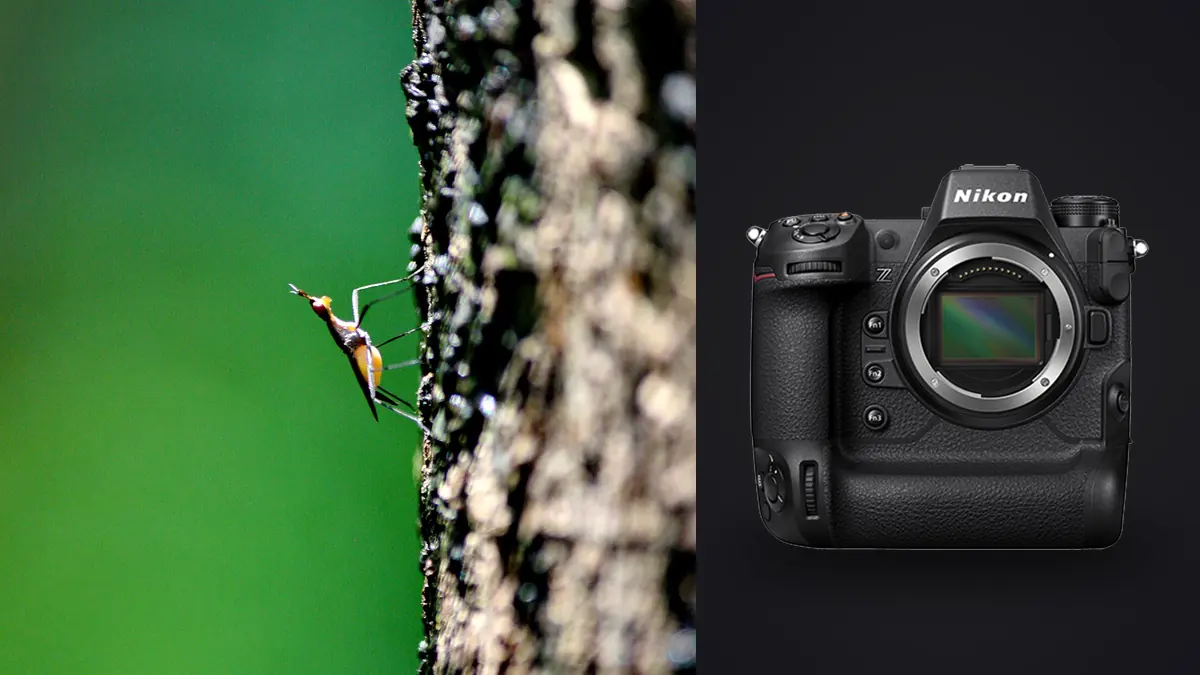
I spent most of last June crouched in wet grass at a reservoir near my house, pointing a Nikon Z9 at dragonflies and jumping spiders instead of the football matches it usually covers on Saturdays. Nobody designs a 45.7-megapixel stacked-sensor flagship specifically for insects. It is heavy, it is built for people shooting sports and birds in flight, and the menu system has nothing labeled "macro mode." And yet it turned out to be one of the more capable bodies I have used for bugs, for reasons that have almost nothing to do with resolution or the marketing copy around it.
The shutter matters more than the pixel count
The single biggest reason the Z9 earns its keep on insects is that it has no mechanical shutter at all. Every exposure is read off the sensor electronically. For a photographer used to older DSLRs, this sounds like a spec-sheet footnote, but out in the field with a jumping spider six centimeters from the front element, it changes how the session actually goes. There is no shutter slap, no mirror movement, none of the little vibration pulse that a mechanical shutter sends through the lens barrel at 1:1 magnification, where even a slight jolt can shift the plane of focus off the eyes entirely.
It also means the camera is silent. That matters more for insects than most people expect. Bees and hoverflies do not seem to care about shutter noise, but jumping spiders and some beetles will freeze or bolt at a mechanical clack from twelve inches away. Shooting in full electronic mode, I could fire a fifteen-frame burst on a resting dragonfly and it would not so much as twitch.
The tradeoff is rolling shutter. The sensor reads line by line rather than all at once, so anything moving fast through the frame, a wing mid-beat, a leg twitching as the insect pushes off, can show up slightly skewed or warped. On a stationary damselfly it is a non-issue. On a bee lifting off from a flower head, I have seen wing tips smear in a way that a mechanical shutter would not produce. It is worth knowing about before you assume every soft or odd-shaped frame is a focus miss.
Getting autofocus to behave on something this small
The Z9's subject detection is genuinely strong on birds, dogs, cars, people. On insects it is inconsistent, and I want to be upfront about that rather than oversell it. There is no dedicated "insect" detection category the way some newer bodies now offer. Point it at a large moth or a fat bumblebee and the animal-detection algorithm will sometimes lock onto it, often finding an eye with a green box the way it would on a bird. Point it at a jumping spider or a small ant and it usually just gives up and reverts to standard area AF, hunting across whatever contrast it can find.
What actually works, most of the session, is single-point AF with a small box, manual pre-focus, and a slow rock forward and back on my own feet or knees to walk the focus plane onto the eyes rather than relying on the lens to hunt. At high magnification the depth of field is a few millimeters at best, and autofocus motors hunting back and forth burn more time than they save. I keep AF-S rather than AF-C running for anything static, and I lean on focus peaking in the viewfinder more than I expected to when I started this project.
Where the Z9 genuinely earns points is the buffer. Pre-release capture, the feature that starts saving frames from up to a second before you fully press the shutter, has rescued more dragonfly takeoff shots for me than any AF setting has. Insects do not telegraph the decisive moment. A dragonfly launching off a reed happens in about 40 milliseconds of visible wind-up. Setting C30 with pre-capture running means I am not trying to react to the launch, I am reviewing frames that already happened by the time my brain registered movement.
Matching camera settings to how the subject actually behaves
Different insects call for different combinations of crop mode, AF mode, and burst settings. This is roughly what I settled on after a season of trial and error, and it is specific to the way each subject moves, not a generic settings chart.
| Subject | Typical behavior | AF approach that worked | Crop / frame rate | Rough keeper rate per burst |
|---|---|---|---|---|
| Jumping spiders (Salticidae) | Mostly stationary, sudden short hops | Manual pre-focus, body rock for fine adjustment | FX, single frames or short 5-frame bursts | 60-70% |
| Dragonflies, perched | Long still periods, explosive takeoff | AF-S lock, pre-release capture armed | FX, C30 with pre-capture | 75% on the perched shot, under 20% on the takeoff sequence |
| Bees and hoverflies on flowers | Near-constant small movement, brief pauses | AF-C, wide-ish area, high shutter speed | DX crop for extra reach, 15-20fps | 30-40% |
| Ants and small beetles (with extension tubes) | Slow but continuous walking | Manual focus only, focus peaking | FX, single frames | 40-50%, mostly limited by depth of field |
The DX crop deserves a specific callout. Switching to the 1.5x crop with a 105mm macro lens does not add magnification in the optical sense, you are just using the center of the sensor, but it functionally extends your working distance for the same framing. On skittish subjects like hoverflies that spook if you get too close, cropping in-camera let me back off another few inches and still fill the frame. You lose resolution (down to roughly 19 megapixels) and I would not use it for anything I planned to print large, but for web galleries and stock-style insect shots it is a reasonable trade.
In-camera focus stacking, with a big caveat
The Z9's focus shift shooting menu lets you set a starting point, step width, number of shots, and interval, then it racks focus through the stack automatically. It genuinely works well, but only on subjects that are not moving under their own power. I have had good results stacking dew-covered spiderwebs, a dead cicada found on a windowsill, and a beetle that had gone still in cold morning air. On anything alive and active, forget it. Even a "resting" dragonfly sways slightly with its own breathing and the wind, and a 20 to 40 frame stack at a narrow step width takes long enough that the subject drifts out of alignment before the sequence finishes.
For live subjects, my approach is different: shoot a single frame at f/11 to f/16 for more usable depth of field, accept that some of the frame outside the eyes will be soft, and lean on diffused flash to let the aperture close down without the shutter speed collapsing into unusable territory. Full stacking I save for controlled setups, and even then I keep the step width tighter than the camera's default suggestion because macro depth of field falls off faster than the automatic calculation seems to assume.
What a full day of this actually produces
Here is the part nobody mentions in gear reviews. A productive afternoon shooting insects with pre-release capture and 20-30fps bursts generates an absurd number of files. I came back from one four-hour session with just over 3,100 RAW frames, most of them either near-duplicates of the same still spider or motion-blurred failed attempts at a bee in flight. Culling that by eye, frame by frame in a normal RAW browser, would eat an entire evening.
This is the point where I stopped trying to do the whole workflow manually and started running the take through imagic before touching Lightroom. Its burst and duplicate clustering groups those 40-frame dragonfly launch sequences together automatically, and the local sharpness scoring flags which frame in each cluster actually has the eyes in focus rather than the wings or the perch behind it. For macro work specifically, where the difference between a keeper and a reject can be a millimeter of focus shift between two visually similar frames, having that scoring run against actual sharpness rather than a rough thumbnail preview matters. If you want the mechanics of how that kind of scoring works under the hood, there is a longer breakdown in how AI photo culling works.
The other practical benefit, working in the field with a laptop and no reliable connection, is that the whole process runs locally. Nothing gets uploaded anywhere to be scored, which matters when you are sitting in a gravel car park by a nature reserve on a phone hotspot trying to clear a card before heading back out for the evening light. Once I have the keepers isolated, I run my usual macro edit as an apply_my_style preset built from a set of insect shots I graded by hand earlier in the season, so color and contrast stay consistent across a session instead of drifting frame to frame the way it does when you eyeball forty separate edits in a row.
The parts that trip people up who haven't tried this yet
A few things caught me off guard the first few weeks that are worth flagging directly.
Battery life drops faster than expected when you're running pre-release capture continuously, since the sensor is effectively always reading even before you press the shutter. I started carrying three batteries for a session I would have covered with one on a normal outing, and I now top off in the car between locations rather than waiting for a low-battery warning.
Flash sync with a fully electronic shutter is not as simple as it sounds on paper. Above the base sync speed, banding or partial-frame exposure can show up with strobed flash because of how the sensor reads out line by line, so I stay at or under 1/200s with fill flash rather than pushing shutter speed to freeze wing motion, and use flash duration to do the freezing instead.
And weight is a real factor by the third hour. The Z9 with a 105mm macro and a flash bracket is not a light rig to hold in a low crouch over a flower bed. A monopod or a beanbag rest for stationary subjects saves your arms for the moments that actually need handheld precision.
Frequently Asked Questions
Is the Nikon Z9 overkill for macro insect photography compared to a smaller mirrorless body?
For pure magnification and portability, yes, a lighter body with the same macro lens will get you similar image quality with less arm fatigue. The Z9 earns its place specifically because of the shutterless design, the deep buffer, and pre-release capture, which matter most for fast, unpredictable subjects like insects taking off rather than for static close-up work.
Does the Z9's animal eye detection actually work on insects?
Inconsistently. It picks up larger, high-contrast subjects like moths and bumblebees reasonably often, but small or thin-bodied insects like jumping spiders and ants rarely trigger it reliably. Single-point manual AF with focus peaking is a safer default for anything smaller than a bee.
What's the best crop mode setting for insect macro on the Z9?
Full FX for anything you might print or where you want maximum resolution, and DX crop when you need extra working distance from a skittish subject without changing lenses. The resolution drop to roughly 19 megapixels in DX is a reasonable trade for web and social use.
How do you manage the huge number of burst files this setup produces?
Cull ruthlessly before editing rather than after. Grouping burst sequences and scoring sharpness with software built for that (imagic is what I use, entirely offline) before opening anything in Lightroom cuts the file count down to something manageable, which also speeds up the rest of the workflow described in tips for a faster photo workflow.