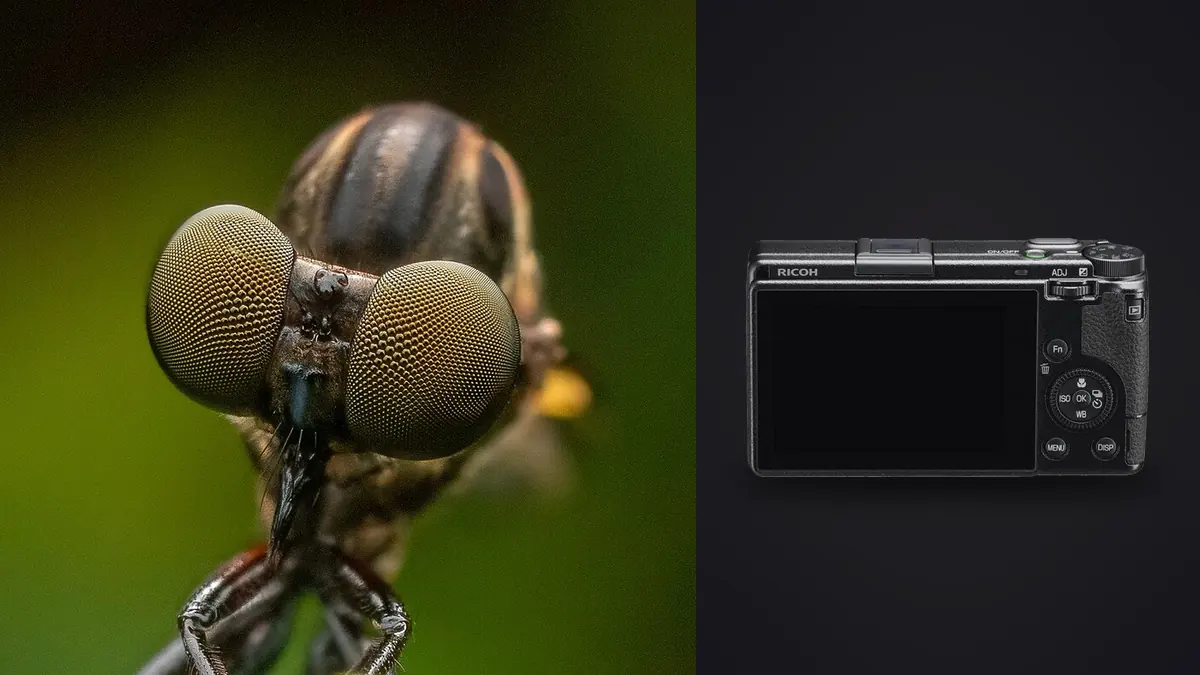
The Ricoh GR IIIx was designed for street work: a 40mm-equivalent lens, a body that disappears into a jacket pocket, and a shutter quiet enough to use in a library. Nobody at Ricoh pitched it as a macro camera. And yet a lot of GR owners end up pointing it at spiders on window screens, bees on lavender, and beetles crossing a garden path, because it's the camera they already have in their hand. The question worth answering honestly is whether that instinct produces usable insect photography, or just a folder of soft, half-cropped disappointments.
The short version: the GR IIIx can get you real, printable macro-adjacent shots of insects that hold still, and it will frustrate you with almost everything that flies. The long version depends on understanding exactly what "Macro" means on this camera, because it is not the same claim a dedicated macro lens makes.
Where the GR IIIx actually sits in a macro kit
Strip away the marketing and the GR IIIx is a fixed 26.1mm f/2.8 lens (40mm full-frame equivalent) in front of a 24.2-megapixel APS-C sensor, with three-axis in-body shake reduction and a leaf shutter that tops out around 1/4000s. There's no interchangeable lens mount, no filter thread without buying the optional GA-2 adapter ring, and no hot shoe for flash. None of that is a criticism of the camera as a street tool; it's context for why "macro" here means something narrower than it would on a system camera.
On an interchangeable-lens body, macro photography usually implies a dedicated lens capable of 1:1 reproduction, meaning a subject the size of your sensor's long edge fills the frame edge to edge. The GR IIIx never gets there. Its Macro mode is a focus-range extension, not a magnification system, and treating it like a substitute for a 100mm macro lens is where most people's disappointment starts.
What "Macro" mode really gets you
Switch the GR IIIx into Macro mode and the lens can rack focus down to roughly 12cm, measured from the front element rather than the sensor plane. Because the lens barrel itself takes up several of those centimeters, the actual working distance between the glass and a moth's wing is closer to 8 or 9cm. That's tight enough that your own shadow becomes a lighting problem, but not tight enough to produce anything close to 1:1 magnification. In practice you're looking at something in the neighborhood of 1:4, enough to fill the frame with a large dragonfly's head or a whole ladybug, not enough to fill it with a single compound eye.
That distinction matters for insect work specifically, because the interesting detail in insect photography, the facets of an eye, the texture of pollen on a bee's leg, the segmented antennae, lives at magnifications the GR IIIx's optics simply don't reach. What the camera is good for is environmental macro: an insect shown at a believable, still-recognizable scale within a bit of habitat, rather than a frame-filling portrait of a single body part.
The working-distance problem, and which insects tolerate it
Working distance, not magnification, is what actually determines whether you get the shot with a compact camera. At 8 or 9cm, most flying insects treat you as a threat and leave before you finish focusing. Dragonflies, wasps, houseflies, and most bees in motion are effectively off the table unless you're extremely patient or extremely lucky.
Where the GR IIIx earns its keep is with subjects that either can't move fast or have a good reason not to:
- Cold insects early in the morning, before the sun has warmed their flight muscles: moths on a porch light, dew-covered beetles, torpid bumblebees on a cool dawn.
- Caterpillars and other larvae, which have no flight response at all.
- Insects mid-feed on a flower head that isn't going anywhere, particularly on overcast days when they're less skittish.
- Anything already dead or recently found, which sounds grim but is a legitimate way many insect photographers build a portfolio without the chase.
A leaf shutter this quiet is genuinely useful here. There's no mirror slap and barely any mechanical sound, so a subject that's already tolerating your presence at 9cm usually isn't going to bolt from the shutter itself. Movement of the camera toward the subject spooks insects far more reliably than the sound of it firing.
Getting more reach without carrying more gear
Two in-camera and one accessory option extend what's realistically achievable, and it's worth being clear about what each one actually buys you rather than what it sounds like it should.
The in-camera digital crop modes (35mm, 50mm, and 71mm equivalent) trim the frame around the center of the sensor. At the 71mm setting you're throwing away roughly two-thirds of the pixel count to get a tighter apparent frame, dropping from 24 megapixels to something closer to 8. It doesn't change magnification at the lens, it just crops what you already captured, so image quality suffers proportionally. Still, for web use or a modest print, that tradeoff is often worth it, especially paired with the actual macro focus range rather than as a replacement for it.
The GA-2 adapter and hood, an accessory Ricoh sells separately since the GR IIIx has no native filter thread, opens the door to clip-on close-up diopters. A +4 diopter roughly halves the working distance and meaningfully increases magnification, pushing you from around 1:4 toward something closer to 1:2. The tradeoff is that your working distance shrinks to around 5cm, which rules out almost every insect except the ones that were already going to sit still for you.
| Setup | Approx. magnification | Working distance | Extra weight | Rough cost |
|---|---|---|---|---|
| GR IIIx, built-in Macro mode | ~1:4 | 8-9cm from lens front | 0g | included |
| GR IIIx + GA-2 adapter + clip-on +4 diopter | ~1:2 | ~5cm | ~40g | €40-70 |
| GR IIIx Macro mode + in-camera 71mm crop | ~1:2.5 effective (cropped, ~8MP) | 8-9cm | 0g | free |
| APS-C mirrorless + dedicated 100mm macro lens | 1:1 | 15-30cm | ~700g | €600-900 |
Read that table as a decision tool, not a ranking. If the trip is a weekend hike where a dedicated macro rig would never leave the bag, the GR IIIx plus a cheap diopter beats a macro lens you didn't bring. If the goal is serious insect portraiture for its own sake, none of the GR IIIx options substitute for the fourth row.
Light and depth of field at these distances
Close focus punishes depth of field regardless of sensor size, and the GR IIIx is no exception. At f/2.8 and 8cm from the subject, the zone of acceptable sharpness on an insect's face can be a couple of millimeters deep, sometimes less. Stopping down to f/8 or f/11 helps, but the lens's maximum aperture only goes to f/16, and diffraction starts softening detail well before you get there on an APS-C sensor at this magnification.
Flash would normally solve the resulting shutter-speed and ISO problem, but the GR IIIx's built-in flash sits close to the lens axis and at macro distances the lens barrel itself blocks a meaningful part of the beam, producing an ugly crescent-shaped shadow across the bottom of the frame. There's no hot shoe for an external flash or a proper macro ring light either. That leaves natural light as the practical option: shoot early or late for softer angled light, use a small reflector or even a white index card to bounce fill into the shadow side, and accept that many usable frames will come from cloudy days rather than harsh midday sun.
A field routine that actually produces keepers
Autofocus tends to hunt at macro distances on any camera, and the GR IIIx is not immune. The technique that works more reliably than waiting on autofocus is manual focus racking: set focus roughly where you expect the subject to be, then move the camera itself slightly forward and back through that plane while firing in continuous burst. It feels wasteful in the moment, and it is, in the sense that you'll come home with far more frames than you need. But it reliably nets a handful of genuinely sharp shots out of subjects that would otherwise be missed entirely by single-shot autofocus.
The cost of that approach is volume. A single promising subject, a hoverfly working a thistle head for example, can easily produce eighty or a hundred nearly identical frames by the time you've racked through focus a few times. Sorting that by eye on a laptop screen, squinting for which one actually nailed the compound eye, is where most people's enthusiasm for macro insect work quietly dies. This is one place where AI photo culling earns its keep rather than being a nice-to-have: imagic scores each frame in a burst for sharpness locally on your machine and clusters the near-duplicates together, so instead of clicking through a hundred variations of the same hoverfly you're looking at the four or five that are actually in focus where it counts.
Editing what you bring home
Insect macro shots tend to need a fairly consistent treatment: a bit more clarity in the fine hair and texture, contrast pulled up slightly, backgrounds pushed toward a soft wash so the subject reads clearly against foliage. Once you've settled on a look that works for this kind of close-focus, low-magnification shot, redoing that same set of adjustments across every session gets old fast. imagic's apply_my_style feature builds a preset from edits you've already made rather than a generic filter, so a macro session that comes home at 1am doesn't also require an hour of manually re-applying the same curve and clarity tweaks to sixty photos. Everything runs on the machine itself, with no upload step, which matters less for privacy on a beetle photo than it does for keeping a laptop battery alive on a multi-day trip without a reliable connection.
If burst shooting and racked focus are part of your normal insect routine, it's also worth tightening the rest of the workflow around that reality rather than treating each session as a one-off; a few habits around import, review, and export save real time over a season, and a faster photo workflow compounds more than any single piece of gear does.
Where a dedicated macro setup still wins outright
None of the workarounds above change the fundamental limit: the GR IIIx tops out well short of 1:1, its working distance is short enough to spook most flying insects, and there's no flash system built for the job. A used APS-C body with a 90mm or 100mm macro lens will out-resolve, out-magnify, and out-work-distance the GR IIIx at every turn for serious insect portraiture, and it does so specifically because that's what the lens was designed to do.
What the GR IIIx wins on is presence. It's the camera in your pocket on the ordinary Tuesday walk when a praying mantis is sitting on a porch rail and a 900-gram macro rig is at home in a drawer. For casual, opportunistic insect photography, where the alternative is no photo at all, its short-working-distance macro mode plus a cheap clip-on diopter covers a surprising amount of ground. Treat it as a capable secondary tool for still and slow subjects rather than a replacement for a real macro lens, and it stops being a disappointment and starts being exactly what it is: a very good compact camera that happens to focus close.
Frequently Asked Questions
Does the Ricoh GR IIIx have true 1:1 macro magnification?
No. Its Macro mode extends the minimum focus distance to roughly 12cm from the front of the lens, but the resulting magnification is closer to 1:4, well short of the 1:1 reproduction ratio a dedicated macro lens delivers. It's better understood as a close-focus mode than a true macro system.
What's the actual working distance for insect shots in Macro mode?
Because the lens barrel itself extends toward the subject, the practical gap between the front glass and an insect is closer to 8 or 9cm rather than the full 12cm measured to the front element. That's tight enough to spook most flying insects but workable for cold, feeding, or larval subjects that hold still.
Can I use flash for close-up insect shots with the GR IIIx?
The built-in flash is close enough to the lens axis that at macro distances the lens barrel casts a visible shadow across part of the frame, and there's no hot shoe for an external unit. Natural light with a small reflector or bounce card is the more reliable option at these distances.
Is the standard GR III better than the GR IIIx for macro insect work?
The base GR III's 28mm-equivalent lens focuses closer in absolute terms (around 6cm in Macro mode) and delivers a slightly higher magnification than the IIIx's 40mm lens, which can be an advantage for very small subjects. The tradeoff is an even shorter working distance, which makes skittish insects harder to approach without spooking them first.