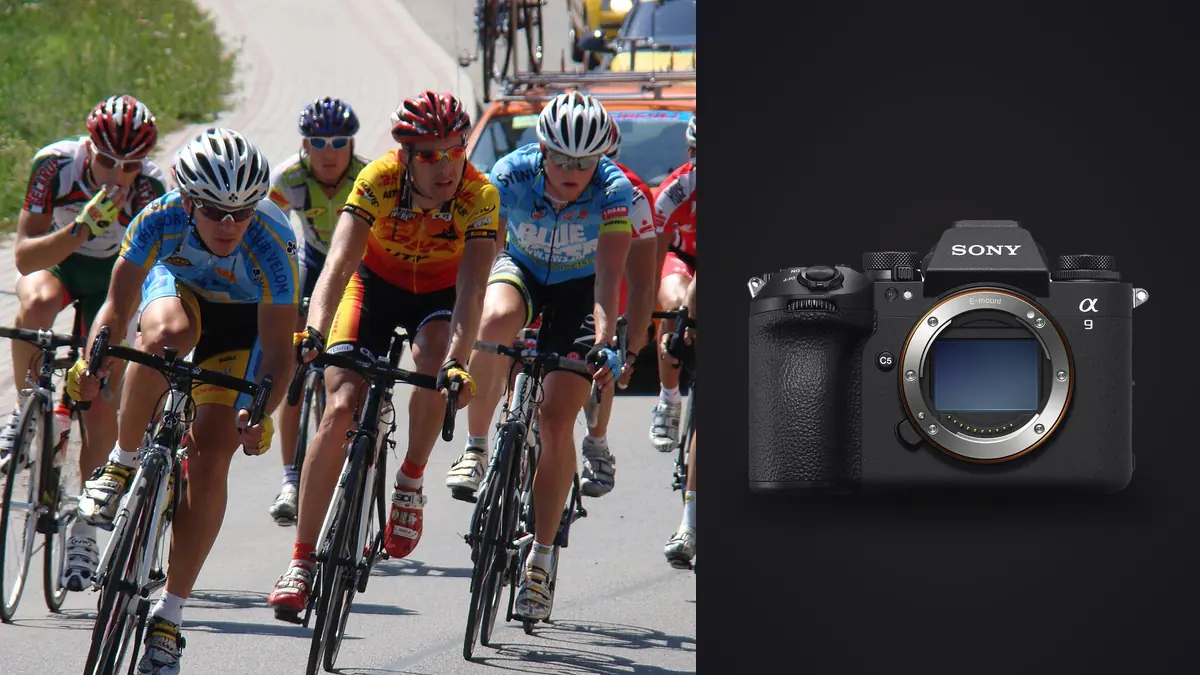
I spent a chunk of last spring's outdoor season working track meets with a Sony A9 III strapped to a monopod at the finish line, and it changed how I think about what a sports camera is actually for. Most reviews of this body talk about it in terms of team sports, football sidelines, motorsport. Track and field is a different animal. You've got sprinters covering 100 meters in under ten seconds, false starts that eat your first frame if you're not ready, field events happening simultaneously in the infield, and lighting that swings from full sun to stadium floodlight shadow depending on where your credential lets you stand. The A9 III's headline feature, a global shutter sensor, turns out to matter more here than in almost any other genre I shoot.
The sensor architecture is the whole story
Every camera before this one, Sony or otherwise, reads its sensor a row at a time. That's rolling shutter, and it's fine for most subjects. But a sprinter's leg swinging through the frame at speed, or a baton changing hands mid-stride, can produce a skewed, jello-ish distortion when the rolling readout doesn't keep pace with the motion. I've seen it on high-frame-rate electronic shutter bursts from other bodies: straight lane lines that bow, hurdles that lean. It's subtle enough that you might not catch it on the back of the camera, then you get home, zoom to 100%, and there it is.
The A9 III reads every pixel at once. There's no mechanical shutter in the camera at all, not even as an option, because the global shutter design makes one unnecessary. The practical result for track work is that a 400m runner at full extension looks the way they actually looked, not the way a scanning sensor interpreted them a few milliseconds later.
The second effect, and this one caught me off guard, is flash sync. Because the whole sensor exposes simultaneously, you can sync flash at any shutter speed up to 1/80,000 sec. For a night meet or an indoor championship where I'm supplementing with strobes on the infield rail, that means I'm not locked to a 1/250 sync speed fighting ambient stadium lighting. I shot a long jump pit under mixed LED floodlight and pop-up flash at 1/8000 and got clean freeze-frames of chalk dust hanging in the air with none of the usual sync-speed compromise. That alone would be worth the upgrade for anyone shooting evening meets regularly.
Frame rate you can actually use, not just brag about
120 frames per second with full autofocus and autoexposure tracking sounds like a spec sheet number until you point it at a 100m final. A race like that is roughly nine to eleven seconds of usable action, meaning a single continuous burst from gun to tape can produce over a thousand raw frames. That's not hyperbole, I've pulled memory cards after a 4x100 relay final with north of 3,000 images on them from maybe ninety seconds of actual shooting across the whole event.
The feature I actually rely on more than the raw frame rate is Pre-Capture. It buffers up to a full second of frames before you fully depress the shutter, so as long as you've got your finger on a half-press when the gun goes, you're not going to miss the reaction off the blocks even if your own reflexes lag the starter's pistol by a beat. For sprint starts specifically, this closes a gap that's cost me frames on every camera I've owned before this one.
I don't shoot the full 120fps for most of a race. I usually sit around 20 to 30fps for the bulk of a sprint or a relay leg, and only push to the top frame rate for the start and the finish, where the difference between frame N and frame N+1 actually matters. At 120fps for an entire 400m, you'd be looking at close to 5,000 frames from one runner alone, which is more raw material than any workflow needs.
Field events ask for something different
Pole vault and high jump are less about frame rate and more about anticipation. The action peaks for maybe a quarter second at the bar, and everything before and after is approach. I found myself using a lower continuous rate, closer to 10fps, and trusting the AF tracking to hold the vaulter through the plant and rotation rather than trying to spray-and-pray through the whole approach run. Long jump and triple jump reward a burst right through the board and into the pit, since the takeoff angle is what most editors and coaches actually want to see, not the mid-air peak everyone assumes is the money shot.
Autofocus on a crowded track versus an empty sideline
The subject recognition on this body covers humans specifically well, and it's noticeably better at holding a bib number or a torso through a pack of runners than the AI tracking on the A9 II was. Where it gets tested is a mid-distance race with a tight pack coming off the final bend. Eight athletes shoulder to shoulder, all in motion, and the camera has to decide who you meant. I lean on the joystick to place my AF point on the athlete I actually want rather than trusting wide-area tracking to guess correctly in a pack, and once it locks, it holds through arm swings and other runners crossing in front surprisingly well.
Relay handoffs are the hardest thing I shoot with this camera, full stop. Two athletes, a baton, and a legal exchange zone all converging in about half a second, often with a third runner from another lane drifting into frame. The AF handles the transfer of focus from outgoing to incoming runner better than I expected, but I still miss more of these than I'd like. No autofocus system fully solves a problem that's this fast and this cluttered.
| Camera | Shutter readout | Max fps with full AF/AE | Max flash sync | Rolling shutter distortion at top speed |
|---|---|---|---|---|
| Sony A9 III | Global (no mechanical shutter) | 120 fps | 1/80,000 sec | None |
| Sony A1 II | Stacked, rolling | 30 fps electronic | 1/400 mechanical, limited HSS electronic | Minor on fast pans |
| Nikon Z9 | Stacked, rolling | 20 fps raw, higher in JPEG-only modes | 1/200 with HSS | Minor to moderate |
| Canon EOS R3 | Stacked, rolling | 30 fps electronic | 1/180 mechanical | Minor on fast pans |
None of the rolling shutter numbers above are dealbreakers, plenty of great track work has come out of all three of those bodies. But the A9 III is the only one where distortion and sync speed just stop being a variable you have to think about.
Lenses that actually make sense for a track credential
24.6 megapixels is on the modest side for 2026, and if you're used to cropping hard on a 45 or 50 megapixel body, you'll need to rethink that habit here. I found the 300mm f/2.8 GM more useful than the 400mm for track specifically, since a lot of infield positions put you closer to the action than a football sideline does, and 400mm at full frame from a tight vantage point crops athletes right out of the shot. For distance events on the far side of the track, or for compressing a pack coming down the home straight, the 70-200mm GM II paired with a 1.4x or 2x teleconverter earns its keep, and the global shutter's lack of rolling shutter penalty means you're not paying a distortion tax for shooting wide open with a teleconverter attached. If your credential puts you at a fixed spot for the whole meet, the 200-600mm G is the practical choice for field events happening on the far side of the infield, at the cost of some sharpness compared to the primes.
What happens after the gun, when you're staring at ten thousand frames
This is the part nobody warns you about before you buy a 120fps body. A single meet, shot across sprints, relays, and a couple of field events, can leave you with 8,000 to 15,000 raw files by the end of the day. Culling that by eye, frame by frame, is not a realistic Tuesday night after a Saturday meet. I run everything through imagic before I open a single frame in an editor, letting its local sharpness and focus scoring flag the genuinely sharp frames out of a 120fps burst and its burst clustering group near-duplicate sequences so I'm reviewing one representative group instead of forty nearly identical frames of the same stride. It runs entirely on my laptop with no upload step, which matters at meets where the venue wifi is unusable and I don't want race-day images sitting on someone else's server anyway. Once I've got a shortlist, I lean on imagic's apply_my_style preset, trained on how I've edited my own track work in the past, to get a fast first pass on color and contrast across the selects before I go in and hand-finish the ones that are actually going to a coach, an athlete, or a publication. It's not a replacement for real editing judgment on the images that matter, but it means the four hundred frames that don't need individual attention aren't eating my evening. If you're new to thinking about culling as a distinct step from editing, how AI photo culling works is a reasonable place to start, and there's a broader set of habits worth adopting in 10 tips for a faster photo workflow if burst volume from any high-frame-rate body is new territory for you.
Where it falls short
Battery life is the honest weak point. The NP-FZ100 is rated for roughly 520 shots CIPA on this body, and CIPA numbers were never designed around a shooter who occasionally lets the shutter run at 120fps for two full seconds at a time. I carry three batteries to a full day meet and have come close to needing a fourth during a heavy relay schedule. Buffer depth is generous, comfortably over a thousand compressed raw frames before you'd need to pause and let it clear, but at sustained 120fps you can still hit that ceiling during an unusually long event like a 4x400 with slow exchanges. And 24.6 megapixels, while plenty for web use, prints, and moderate cropping, is not the file size to reach for if you're regularly cropping a distant field event down to a tight portrait for a magazine cover.
Frequently Asked Questions
Do I actually need 120fps for track, or is 20-30fps enough for most of a meet?
For the majority of a race, 20 to 30fps is genuinely enough, and it keeps your file count sane. The top frame rate earns its keep specifically at the gun and at the tape, where a fraction of a second is the difference between a clean start reaction and an athlete mid-blink. I treat 120fps as a tool for those two windows, not a default setting for the whole race.
Is the global shutter's flash sync advantage worth it if I only shoot day meets in natural light?
Less so. If you never touch flash and you're not fighting stadium LED flicker, the bigger day-to-day win is the elimination of rolling shutter skew on fast lateral motion, which shows up even in daylight on sprinters and hurdlers. The flash sync benefit is real but mostly matters for indoor and evening meets.
Will the autofocus reliably pick the right runner in a tight pack coming off the final bend?
It's better than the previous generation at holding a locked subject through a crowd, but I don't trust wide-area auto-select to guess correctly in a tight pack. I place the AF point manually on the athlete I want before the pack tightens, then let tracking hold from there rather than asking the camera to choose for me.
How do I stop 120fps bursts from turning every meet into an unmanageable backlog?
Treat culling as a separate pass from editing, done the same day if you can. Running bursts through something like imagic's local sharpness scoring and burst clustering before you ever open a raw editor cuts a 10,000 frame day down to a workable shortlist in far less time than reviewing every frame by eye, and because it runs locally there's no upload wait standing between the meet and your first look at the selects.